
Hello, friends! Do you know, I have the best readers? You people are awesome. To prove it, here’s a two-part conversation I had with Nick Marshall, a reader who reached out a few months ago with some really cool thoughts. I just know you’ll love it.
In Icons, Not Instruments, I mention what I call the fallacy of the group: treating statistical generalizations about populations as if they tell you something meaningful about the particular human standing in front of you. I’d like to spend some time today unpacking that and showing how our tendency to universalize is a common and persistent barrier to encountering others in reality and developing true and authentic relationships with them. It’s not even a new phenomenon, as you’ll see.
Have you guys read any Kant at all? Not deeply, just the introductory stuff about the categorical imperative? To shoehorn a world into a grain of sand, one of the really cool things Kant does with his categorical imperative is that to show that it works, he first states it, but then he turns it inside out and upside down and holds it up to a mirror to show that it works from a bunch of different perspectives. These different angles are what he called the “three formulations” of the categorical imperative:
1. Act only according to that maxim whereby you can at the same time will that it should become a universal law.
2. Act in such a way that you treat humanity, whether in your own person or in the person of any other, never merely as a means to an end, but always at the same time as an end.
3. Thus the third practical principle follows [from the first two] as the ultimate condition of their harmony with practical reason: the idea of the will of every rational being as a universally legislating will.
Immanuel Kant, Groundwork of the Metaphysics of Morals
The trick is to see that Kant is actually saying the same thing three times, in three different ways. It would be super easy here to get stuck on Kant and just yap about the categorical imperative (because one of the fun things to do with it is figure out more formulations), but I’d rather do something much smaller and particular. I hope you don’t mind.
You see, my “fallacy of the group” is one formulation of a different basic premise. It’s extrapolated from the core, foundational idea that each human being is particular. We could structure it this way:
1. Each human being is a particular, unrepeatable icon of God: we love them by encountering them in their particularity. Our love for humanity grows from the particular to the general, not the other way around.
2. Inverting that process by elevating some general principle of humanity over the particularity of each human being violates that particularity. We do it because, as a pattern-matching activity, it feels useful to our human brains. Our brains love to find patterns, even when they aren’t useful.
3. Thus, we have a double error to watch out for, an error which is a massive barrier to encounter, relationship, love and friendship:
A. The fallacy of the group-- treating statistical generalizations about populations as if they tell you something meaningful about the particular human standing in front of you.
B. The universalization of personal experience-- treating our personal, subjective experiences as if they have a universal resonance with other human beings.
Now, I could continue writing this essay as a great big abstract examination of these ideas, and it would probably be cool enough. But I’ve got something more fun in mind: a story from a particular human being. You see, Nicholas Marshall has a unique perspective on this double error…
Nick: I am excited about the storytelling part, (after all, that’s why writing exists, right?) but I want to take a second here to appreciate what you’ve brought to the conversation. First, the grounding in Kant is fascinating; my only exposure to him is the brief summary I got in an undergrad intro-to-philosophy class. It was a great class, but it didn’t prepare me at all to discuss that giant figure. Wearing my ignorance on my sleeve, I’ll add this; it’s unclear to me how the categorical imperative #2, which seems to me to be self-evidently essential and beautiful, is a third version of the other two. I love #2, but I’m squinting suspiciously at #1 and #3 in the way a mathematician treats a plausible-sounding but potentially catastrophic axiom.
Laura: I wish I could send you back in time to Dr. Ferreira’s ethics class! I can’t reproduce what he did, but he chalk-and-blackboard walked us through the relationships. In the meantime, I still like the Stanford Encyclopedia of Philosophy: especially section nine on the unity of the formulations. But enough of Kant! No more Kant! It’s too easy to get stuck on just one of his sentences. Moving on!
Nick: I wish I could remember the names of my undergrad philosophy professors. They were both excellent, and whatever sins they may have committed, they didn’t deserve to have to put up with my mouthy 18-year-old self. Anyway. Your own point #2 genuinely startled me! You’ve hit upon a bit of philosophical misprision that 100% lies behind my motivation to write on this topic, but that I didn’t spell out at all until we started this discussion.
There’s this phenomenon I’ve noticed in the world of online Orthodox discourse that (to use the technical term) bugs me. For an example, I’m personally acquainted with an Orthodox philosopher who specializes in arguing for philosophical realism over nominalism, and makes the case that realism is unavoidably affirmed in the ecumenical Church councils. Very well; his argument is reasonable, and I’ve found his engagement with ancient philosophy from a Christian perspective to be super fun as well as educational for me. I’m a fan of his online content. Unfortunately, I can’t help concluding that in some cases he and others who invoke the nominalism / realism dichotomy (whether or not they know they’re doing that) commit a basic logical fallacy.
I hadn’t heard of these terms before encountering this philosopher’s work, so I’ll recap it myself. Please correct any inaccuracies if you see them, I’m not a philosopher myself. Realism asserts that when we identify “genera” in the world -- types of things -- those identifications point to true, extant structures of reality; think Plato’s Forms. That is, a cat is a different type of thing from a beetle. Contrariwise, nominalism argues that those terms are only terms, and that we apply them to make sense of the matter-in-motion of which the universe is composed. Okay. I understand how a traditional Christian of any flavor might find the latter idea unpalatable.
Laura: Well, perhaps metaphysical nominalism is unpalatable that way. But I have an idea about where you’re going with this...
Nick: Haha. Yeah, I’m not sneaking up on it very much, especially in the context of your intro where you talked about the fallacy of the group. The formal fallacy I noticed comes in when somebody points to any assertion that a certain thing is merely a social construct / arbitrary label / ‘just your opinion, man,’ and says “Ah ha, that’s just nominalism!” (Or “postmodernism,” which was the boogeyman in my childhood that preachers invoked when they decided something was bad.) The philosopher I mentioned, for instance, claims that to say “gender is a social construct” is nominalism, as is “LGBTQ.” He doesn’t address the fairly-well-defined distinction between sex and gender, nor does he specify what about that acronym is nominalist.
The abstract form of this fallacy goes like this: “Some S are P. Therefore, all P are S.” Or, more specifically, “Principle X is proven, and it states that some S are P. So, if you are saying that any P is non-S, you must be wrong.” I think the right name of the fallacy is an illicit conversion, but I should ask a logician.
Laura: Ooooh. Now you’re giving me traumatic flashbacks to my syllogism days. Venn diagram for the interested!
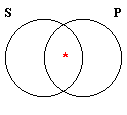
Figure 1: Some things in the set of “Things which have the quality of being S, P, or both” are in the overlappy area in the middle. But not all of them.
Nick: I love syllogisms. They’re more mathy than a lot of actual math classes. Just to be clear, the categories I’m discussing here are something like this:
S = “things we noticed in the world that are useful, important, or lovely”
P = “absolute, metaphysical truths that are objectively real”
We still haven’t gotten to the story part, but I figured it would be good to illustrate the error I’m seeing here. What I’m going to do is pick several areas with clear, absolute rules in which I am a little knowledgeable, and call attention to some concepts in those areas which are clearly...just names.
For instance, the Sicilian Defense in chess, or a hydrogen atom in chemistry. The idea is that these terms refer to recurring, useful patterns which emerge as a consequence of the absolute rules of the system (those rules, of course, being properly real and not nominal) but they do not exist in the ultimate sense. Nowhere in the laws of physics is the object hydrogen atom defined.
Laura: Hold up. A hydrogen atom is a single proton with a single electron. It is, technically, scientifically defined...?
Nick: Okay, that was a little bit bait, haha. Yes! The idea is that “with” is doing a lot of work in the definition you used. A hydrogen atom is a pattern formed under the real laws of physics of this universe, which contains protons and electrons. (And of course protons are patterns of three quarks, but I don’t want to exaggerate my knowledge there. I’m literally a guy who makes crystals and rubber for a living).
But a proton and electron recombining into an atom (which process, the physicists tell us, initiated the existence of the first light in the universe, before which there was only the chaos of unbound plasma -- I couldn’t make this stuff up if I tried!) is just as much a pattern as the moves 1.e4 d5 are in a game of chess. Maybe more so.
It is tempting to suspect that it’s patterns all the way down, and what you ultimately arrive at is the pre-eternal Son of God playing with the matter He created, like G.K. Chesterton would have said. “Do it again!” And is this nominalism or realism? I’m honestly not sure. It feels Platonic to me, but you would know better than I. Regardless, it just isn’t that hard to point out a category of things that are very “thingy,” but don’t have an absolute existence.
Laura: I think you’ve independently arrived at something Sir Karl Popper did a great job of showing: how one can be a metaphysical realist and still hold to a form of nominalism for methodology-- which actually becomes really important in the philosophy of science and any sort of clear thinking that requires we define our terms. Popper called the kind of ideas you are talking about-- those that arise from thinking, but have a reality of their own-- “world 3 objects.”
In any case, being able to hold to realism while accessing the useful aspects of nominalism has been really helpful for me. It’s allowed me to articulate for myself the difference between models and reality, and also parse in my own thinking how science-thinking and humanities-thinking often set themselves at loggerheads with each other unintentionally, through ill-defined terms. This kind of mixed-up method leads to just the sort of fallacy you’re getting to, especially with regards to how culture and theology relate to each other...
Nick: Yes. I haven’t read Popper in the original, but I love him solely for the strength of the classical Popperian “let’s see if we can disprove this hypothesis” approach. That mental discipline is so potent that most working scientists don’t try to practice it because it’s too hard. In truth, that practice comprises the asceticism of the scientific world.
Laura: “Asceticism of the scientific world.” I love this. I’m stealing it, with attribution of course. But we’re up in the clouds. How does this connect to the fairyland of internet Orthodoxy?
Nick: Ha! We super are. That’s the trouble with talking to people who know interesting things.
The connection here to our topic is pretty obvious; just because (say) Orthodox Christians believe that some concepts are real (God, humanity, etc.) doesn’t mean that if we say “Boys wearing pants and girls wearing skirts is just a societal gender construct” we are affirming some sort of anti-Christian philosophical relativism -- I guess you would say metaphysical nominalism?
Laura: Right. It’s a kind of mental positioning that can’t see outside of itself, and justifies its self-reference with an appeal to theology. Metaphysical nominalism would be the position that a reality independent of a mind’s experience of it doesn’t really exist. Here’s the hair we are splitting: We’re saying that as Christians, it’s possible to believe in a reality outside of one’s head (realism), but that at the same time, we can use and work with constructs that absolutely do not have independent reality for themselves. So, nominalism without being metaphysical about it; nominalism as a tool.
Without this distinction, you find that in defense of realism, people assign a whole lot of concrete absolutism to concepts that are much more malleable in our experiential reality. In other words, in defense of realism, people tend to collapse models into reality, and then get stuck when the models don’t have the power to account for outliers.
Nick: That’s exactly it, and there are a lot of determined, smart Christian folk out there who are driving their metaphysical / theological cart and horse backwards with good intentions.
I think this fallacy appears in public religious discourse far more than people realize, and you named it when we first started talking about this topic (unlooked-for by me) in your point 3(a) -- or, rather, you identified the converse set which demonstrates the failure of the fallacy. “Some words are just useful terms for a pattern.” I suppose that a writer with a biology degree and a publication titled Patterns for Life is bound to have a certain practical appreciation for the limited usefulness of identified patterns.
Laura: I write a lot for myself, just to think things through, and one of the concepts I keep coming back to is that distinction between model (or pattern) and reality. We make mental models to serve a particular purpose, and we get ourselves in trouble when we use a model intended for one thing in order to think about something else. This is how we mix up categories, as when we make scientific claims about theology or vice versa, or when we start to treat our own personal experience/phenomenology as if it has the same status as universal truth, simply because we ourselves are trying to situate ourselves there out of perceived fidelity to Truth, Beauty and Goodness.
Which is where we get to the fun part! Let’s look at a quote:
“There are two novels that can change a bookish fourteen-year old’s life: The Lord of the Rings and Atlas Shrugged. One is a childish fantasy that often engenders a lifelong obsession with its unbelievable heroes, leading to an emotionally stunted, socially crippled adulthood, unable to deal with the real world. The other, of course, involves orcs.”
John Rogers
Nick, when you shared this quote with me, I laughed out loud. Like many people, I encountered Ayn Rand as a teenager, and boy, did she make a lot of sense to my teenage brain. In particular, I found her celebration of excellence to be a breath of fresh air. But as anyone who tries to live out her principles eventually realizes, I discovered that it doesn’t lead to a joyful existence. Tell me about your background with her.
Nick: “A joyful existence.” That’s heartbreakingly true, Laura. Rand holds up certain beautiful things produced by civilizations she admires and says “Look at this. It’s beautiful, and the world is tearing it down and putting garbage in its place.” And she’s right about that, and an idealistic teenager in love with beauty and truth ends up willing to run through a wall for her.
Okay, it’s really time for the story part now.
I was raised a strict Objectivist until I was twelve.
Haha! I couldn’t resist the cliffhanger. If you, like me, are hooked, be sure to check back in a few days for Part Two!
Nicholas Marshall is a professor of chemistry, writer, tree enthusiast, and Brazilian jiu-jitsu instructor. He and his family live in South Carolina, USA. He can be reached at nicholas.mclane.marshall@gmail.com.
Comments
Nothing yet. Say the first thing.
Sign in to join the conversation.