
Justin Lind and I are starting a private community for parents who want to raise the ceiling for their families. We see it as a fourth-space, where you can find mentorship, connection, ideas, and more, all focused on raising our own ambition and connection. We’ll be sharing more in the coming weeks, but if you’ve been searching for a high trust group focused on family, reach out to one or both of us.
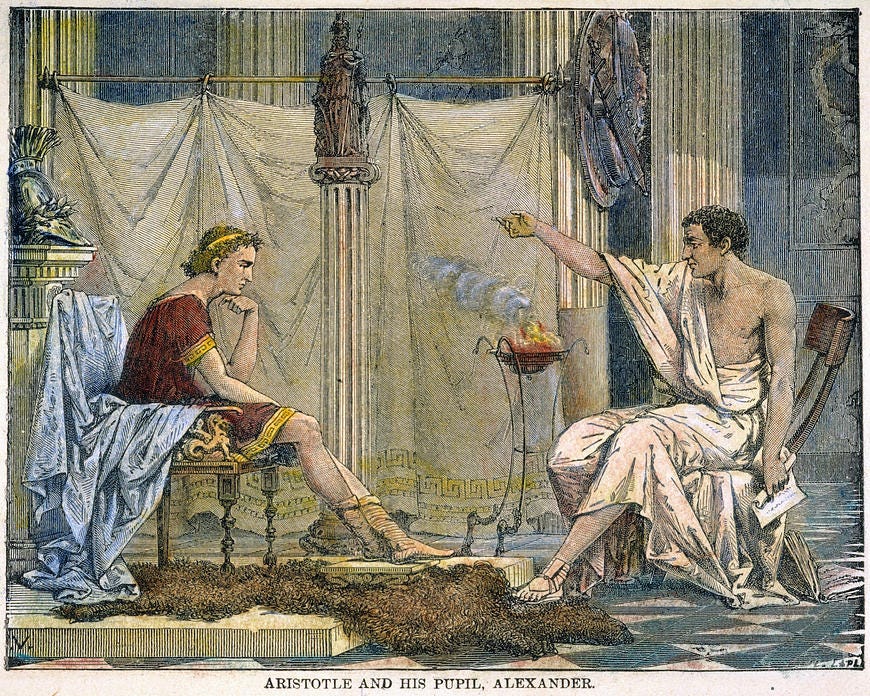
You probably know the story of Alexander and Aristotle. Plutarch tells us that “looking upon the instruction and tuition of his youth to be of greater difficulty and importance than to be while trusted to the ordinary masters in music and poetry, and the common school subjects,” Alexander’s father “sent for Aristotle, the most learned and most celebrated philosopher of his time.”
Aristotle didn’t just endeavor to teach his young charge the lessons of the day, but to see Alexander become someone the ancient world had only dreamed of. He set out to make a philosopher-king.
To do so, Aristotle created numerous works instructing Alexander in becoming a great king. Aristotle gave him the annotated copy of Homer’s Iliad that Livy, Plutarch, and others say rested under his pillow — sitting snugly next to his dagger. Alexander would later bring wild beasts back for Aristotle’s studies, contributing to the first understanding of natural history.
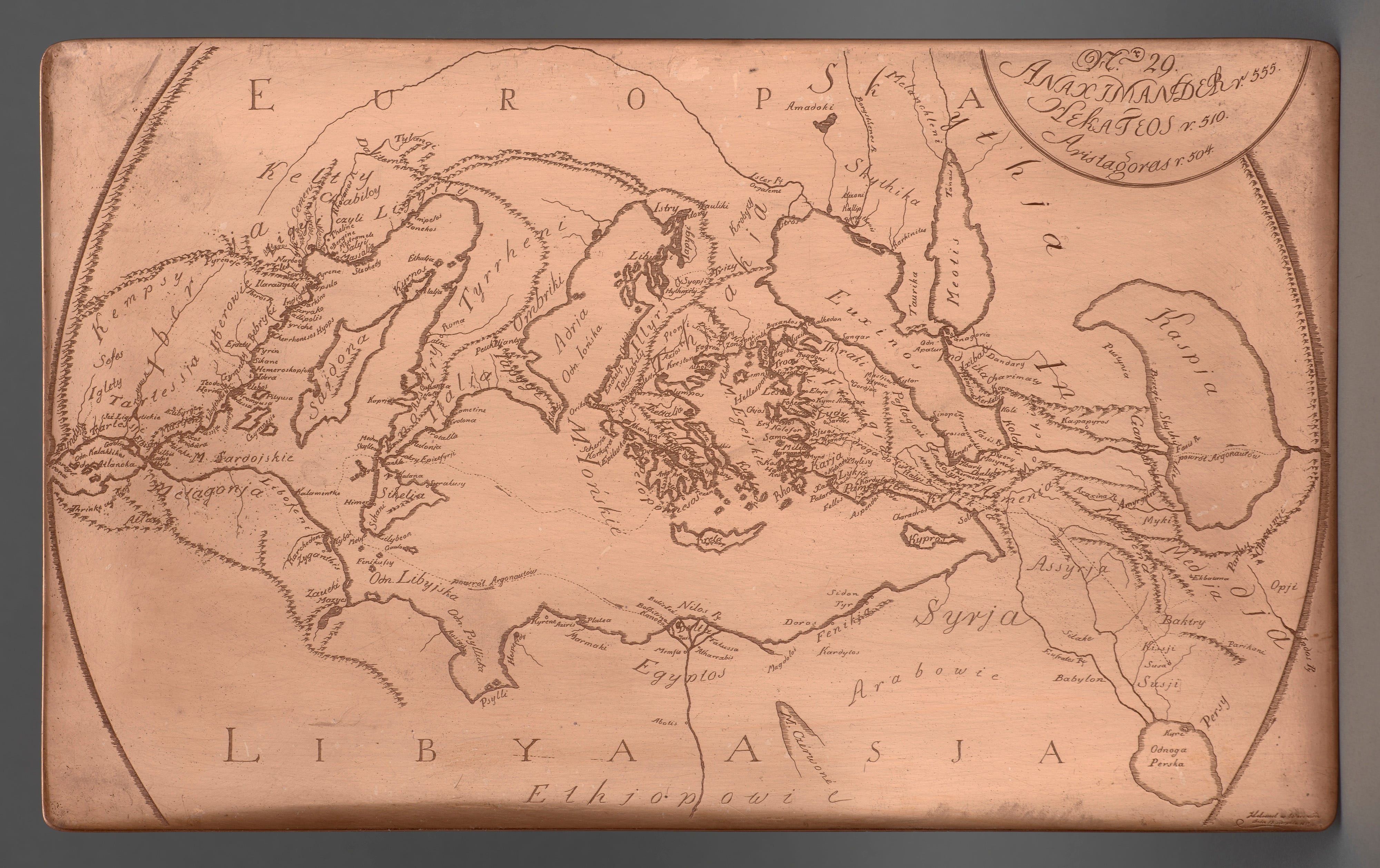
We know what Alexander would go on to do. He created an empire which was an inspiration to the later Roman empire, and in doing so he created new ways of merging his subjects into one population, using monetary policy to unite his empire, and stimulating trade. He started at least 24 new cities (Plutarch tells of 70), all known as Alexandria. The greatest gave us the Library of Alexandria, which can trace a thread all the way to modern scholarship. He was both warrior and statesman, conqueror and philosopher. We don’t remember him because of his conquests only, but because his identity and ambition changed the ancient world.
It’s all too easy to dismiss Alexander as a bloodthirsty tyrant with no talent at anything but creating war, especially when we compare him to today’s standards of morality. But in his time, Alexander’s was a model of moral empire. He may not have lived up to the philosopher-king ideal as we wish he had, but Aristotle shaped in him a balance between morals and ambition. Aristotle taught him to imagine himself as someone whose life could matter in the long arc of history.
*
As a young Navy officer, I had this incredible commanding officer, JJ ( I never would have called him JJ at the time, both out of respect and because the man was kind of intimidating). He was tall, kind of lanky, and his running stride looked a lot like a gazelle galloping. He reminded me of an old World War II Admiral, and I half expected him to show up with a wooden pipe hanging crookedly from the corner of his mouth.
I used to run with him every morning, before work, as the marine layer hugged the California coast. We’d run on these old potholed roads, the kind where you couldn’t tell the jogging lane from the centerline. He was faster than me. Every day, I’d fall behind right at the start, and be hurrying to catch up while I tried to hide that I was out of breath.
About a year into our runs, he casually dropped on me that he’d decided I should apply to Navy Test Pilot School.
I was honored he thought that much of me, but this seemed crazy. Test pilots, guys like John Glenn and Neal Armstrong, were one thing.
I was pretty sure I wasn’t that thing.
“Look, I think you’d be great at it. Just give it some thought.”
“I’ll think about it, Sir.” I said. And for the rest of the day I really did think about it. I called my wife to ask her. I looked up the requirements online. I ignored work because I couldn’t help but think about it. And then as I was getting ready to leave, he called me back into his office. After all that research, I was still intimidated.
“Turner, Did you think about Test Pilot School any more yet?”
“Yes sir. I’ve been thinking about it all day.”
“Good,” he said, “the application is due in a month. Let’s get started now.”
A month was next to no time. I protested that I wasn’t ready. I reminded him that I would be the youngest pilot applying, that I was still a year away from even needing to look for my next assignment. All the other applicants were a year more experienced than me.
He listened to me, and then kindly told me to stop whining. That settled it.
For the next month he helped me build my application. He found the right recommenders and convinced them I was worth recommending. He scheduled me for important flights, and pushed me to get key certification. And when his boss didn’t recommend me, he went direct to the application committee.
Two months later I got my acceptance letter. I would be a test pilot.
His support led to years performing high risk flight test, which gave me the opportunity to run a rapid development program hunting Submarines. That experience was the key to getting hired at Rigetti, which led to a series of opportunities I never could have foreseen.
I owe the shape of my own ambition to JJ’s mentorship.
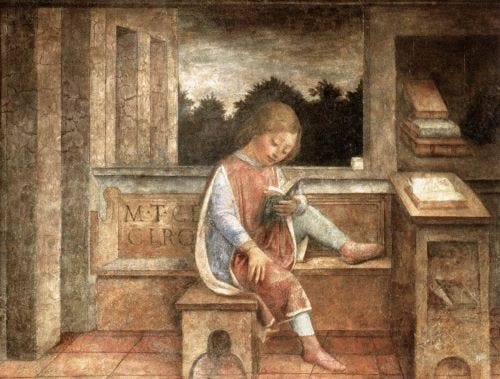
I talk a lot about education. Teaching my kids has become my identity, and I have the kind of identity that loves to go to extremes. But when I talk about education, it’s a window into my theory of the world.
It seems to me that we often confuse education and school. I too am guilty of it. But when I talk about education, I don’t mean school. School, by design, raises the floor. But education can be more than school.
Education raises the ceiling.
Raising the floor has become the default assumption in our educational system. When we talk about education as an equalizer among students and as the measure of a country’s prosperity, we’re choosing an educational system that raises the floor for students. Hell, just look at the names: Every Student Succeeds Act, which replaced No Child Left Behind. The big conversation is all about raising the floor.
No one talks about raising anyone to greatness.
Raising the floor is a view of the world where the safety net is the whole goal. It’s a public good; it’s not the full work of human development.
That’s not to say it isn’t without precedent. Our education system stems from the foundation that Plato, Xenophon, and Isocrates laid for us. They imagined structures designed to educate governments that would be enlightened enough to never kill each other again. In our times, we’ve extended this goal to the education of every citizen and in practice, this system has come to be about raising the floor. It’s why Horace Mann spoke about education as preserving democracy, not creating exceptional citizens.
The safety net (even if it was never as equal as we might like to imagine) was about stability, not self-actualization.
It also has its benefits. In modern times, we’ve raised millions out of poverty through our educational system. I don’t think anyone argues we should undo that.
But when I talk about education, I mean something else.
In Claiming an Education, Adrienne Rich advised the women of Douglass College that “you cannot afford to think of being here to receive an education; you will do much better to think of yourselves as being here to claim one. One of the dictionary definitions of the verb “to claim” is: to take as the rightful owner; to assert in the face of possible contradiction.” It seems to me she’s arguing for demanding an education that raises their individual ceiling.
William Cronon goes further: “Liberal education aspires to nurture the growth of human talent in the service of human freedom. Liberally educated people have been liberated by their education to explore and fulfill the promise of their own highest talents.” Read that again: education which liberates to fulfill the promise of their own highest talents.
Raising the ceiling is a view of the world where the foundation is the starting point. It’s a belief that we can accelerate our children’s path to self-actualization, by helping them develop depth, taste, confidence, and identity. Raising the ceiling is education designed not just to produce citizens, but produce great humans.
In this view, greatness matters.
Raising the ceiling also has its historical precedents. Plato’s Republic lays out an educational program designed to cultivate an elite class of philosopher-kings (as Aristotle attempted to create in Alexander). W.E.B. Du Bois proposed his “Talented Tenth” designed to create community leaders. The Humanism movement of Renaissance education was a deliberate turn towards raising the ceiling.
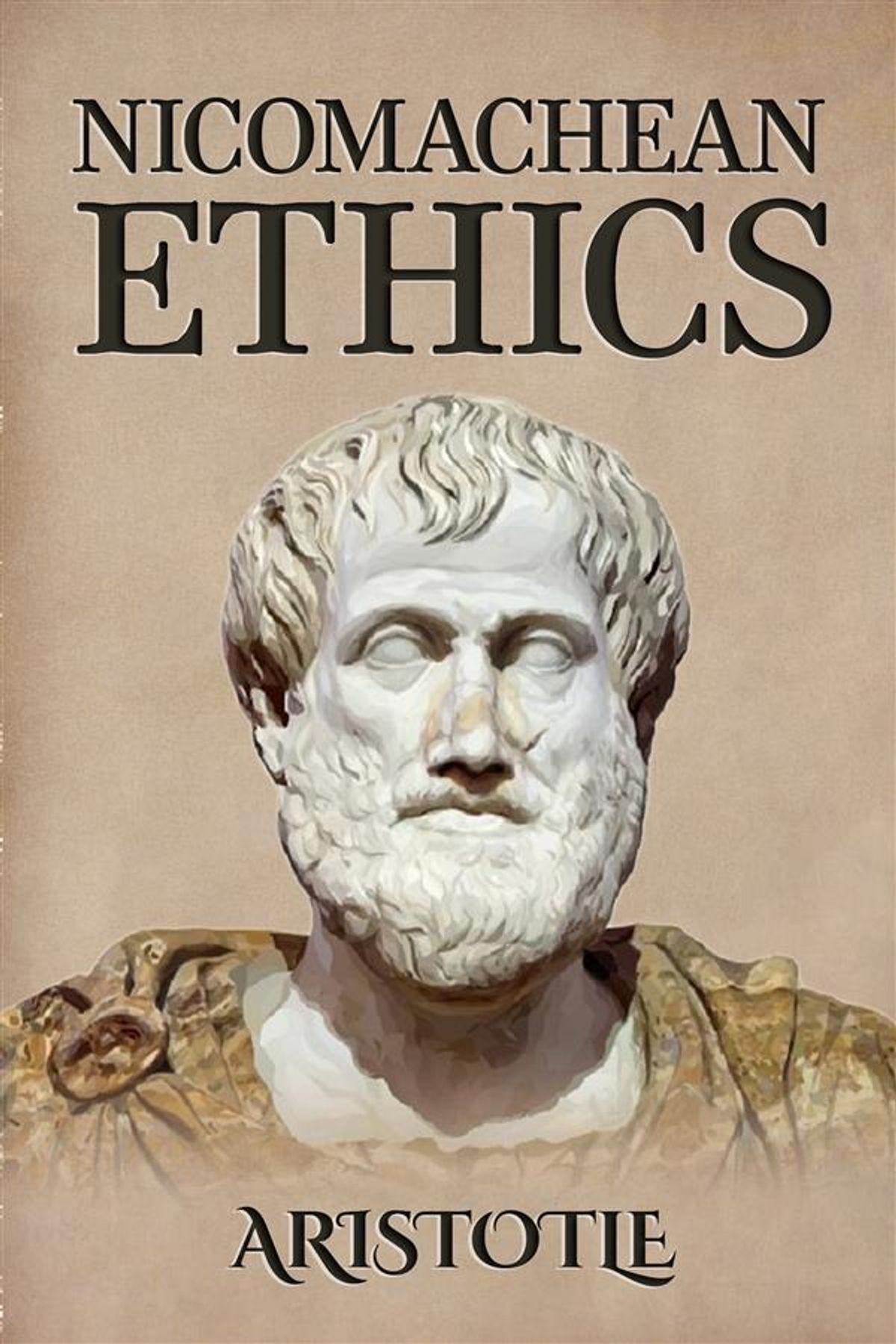
Aristotle said “Flourishing then, is found to be something perfect and self sufficient, being the end to which our actions are directed.” If we believe him (and I’m pretty inclined to), then we can’t help but choose to raise the ceiling.
Two different visions of the world.
We need to raise the floor for millions. We need future generations who are more competent, more responsible, more prepared to weather the dangers than our generation is. Schools are the most effective way we know to accomplish that.
The work that calls to me — what makes me excited every morning — is to raise the ceiling for the children right here, in my home. I am inspired to shape a higher vision for my kids.
And I’m inspired to bring together others who feel that same pull — to raise the ceiling, together.
No posts
Comments
Nothing yet. Say the first thing.
Sign in to join the conversation.