
Last week, I tried to explain to my seven and ten year old the idea of virtue. Now, I’m well aware how much of a fool’s errand that sounds like; even typing it makes me feel ridiculous. Anyone who has worked with kids knows that such an abstract idea isn’t in their world yet. I scrunched up my face trying to find the right metaphor. My palms sweated as I flipped through our book. It was horrible. How did I end up here?
To be fair, I didn’t start here.
My kids and I are reading a history of Western Civilization. Twice a week, we sit around the table over a cup of coffee and two cups of milk, reading a section of The Golden Thread: A History of the Western Tradition1. I want them to understand their history, their culture, before they understand how our current culture works.
Ambitious? Yes. Crazy for elementary school? Maybe.
Still, it’s worth trying.
Every day, I read the paragraphs aloud. The idea was that I would read, then we would discuss. As we’ve gotten into our rhythm, I’ve tried every technique I know of to make it work. I explain words — a lot of words. We look at maps, pictures, and pottery. I make them narrate back to me, I ask pointed questions, and I often reread entire sections. At its best, we have a fun discussion. At its worst, well, it’s two blank stares while I learned something new.
This week’s subject: Greek philosophy in the wake of the Peloponnesian War.
In the wake of horrible war after horrible war, Greek philosophers desperately tried to imagine a better government. “The most important consequence of the Peloponnesian War for later Western history was the discrediting of both democracy and oligarchy in the eyes of Greece’s most thoughtful men. Something had gone terribly wrong with city-state government, and every reflective person knew it.” My daughter’s eyes perked up. My son wanted to hear more about the wars (he likes the history of war — all boy that one). My hopes started to lift. We read about Plato’s two tier education, about Isocrates’ refined conception of paideia, and about Aristotle’s belief that the city states lacked enough men of virtue to provide the basis for a durable aristocracy. Maybe this would be a good discussion day.
“You both are in the middle of educations designed around their ideas. What do you think about them?” I asked my children.
“It’s okay, I guess.” my son offered. He was itching to talk about a battle.
“I don’t know,” said my daughter.
“What don’t you know?” I tried to probe with more gentleness than I felt. We’d already read this section three times.
“Everyone talks about this virtue thing. I don’t know what that is,” she told me.
Which is how I found myself trying to explain the idea of virtue to two extremely restless children. After an hour of concentration. When it was a gorgeous day outside.
It also was how I realized how little I truly understood about virtue. I sat there, hemming and hawing, trying to explain to them that virtue was about following a way of life that was good, that it had to do with being the best version of yourself, and so on and so on. With every additional sentence, I felt just a little less confident, until I admitted I didn’t really know as well as I’d hoped. Which is when my daughter threw me a life raft.
“I think I get it, Dad. You did good today.”
Mortimer Adler said “The person who says he knows what he thinks but cannot express it usually does not know what he thinks.” Guilty.
*
As I’m creating this education for my children, I realize how poorly educated I am. It’s not so much the facts I didn’t learn (there are lots). Nor is it the books I haven’t read (again, there are many). Those are just more of the vision of education that focuses on grades as learning. I needed a different vision.
After World War I, Werner Jeager shared a different vision for education. He grappled with the question of what is virtue and how do we teach it? She didn’t know it, but my daughter had tapped into a long line of thinking. His answer, classical paideia, inspires how I want to educate myself. It’s not about learning, but understanding. Everything I do needs to serve that education.
I want to create that education for myself. And I’m realizing I’m not alone — so many of us are realizing we need to educate ourselves to educate our children.
I need to educate myself if I am going to offer them what I had never gotten. So I started reading Plutarch’s Lives in the evening and imagining ways to teach virtue and leadership through the Lives during the day. I studied the history of subjects which I only skimmed the surface of (if at all) as a kid. It has been an improvement, that’s for sure. But it wasn’t good enough.
Yes, reading and researching is valuable. Putting in the work is important. But what I really need is a new method of learning.
In An old new vision for the humanities, or how to recreate a sense of wonder and awe, I shared a vision for teaching inspired by John Senior, Dennis Quinn, and Frank Nelick.
Quinn wrote of the IHP that it integrated the humanities as a whole. I want to do the same. Rather than classes on English literature, European history, or music appreciation, the humanities I want to teach is a single experience. He also wrote that real education started with the whole and only then examined the parts.
So let’s start with the whole. And by starting with the whole, I want to start with a series of questions. Questions which are important to students. Questions like:
What is a friend? How do I be a good one?
How should I choose to live?
What is just and fair?
That’s a vision that follows from the Great Books Tradition. Adler and Hutchins believed understanding required conversation between texts across centuries. While I agreed with them in theory, in practice I was merely absorbing what one author at one point in time had to say.
My daughter so pointedly reminded me that I wasn’t following my own vision.
Color me humbled. And also, challenge accepted.
A few years ago I became interested in personal knowledge management. I’d taken Building A Second Brain and tried Notion, Roam Research, even a homebuilt Zettelkasten. They all promised I’d never forget anything. But I failed with all of them for the same reason: I was organizing information without creating understanding.
I had two problems I had to solve. What should I read, and how do I read deeply? I needed to answer both of them before any tool could help.
In How to Read a Book, Adler advised reading synoptically. That is, reading across books to understand an idea from multiple angles. I had read Adler years ago, but the practice hadn’t really taken root. It was time to revisit.
I realized that reading synoptically wasn’t just about choosing the books, but it was about capturing those insights across book. In past efforts, I had created lots of quotes, with maybe a few thoughts. But I hadn’t actively engaged across books. To do that, I designed a scheme for myself. If I could design what I wanted to capture from the outset, I would be more likely to engage with books as Adler suggested.
For the types of questions I am curious about, a book’s genre is irrelevant. Virtue has been explored in philosophy, history, fiction, epic poetry, and theatre, just to name a few. Jeager knew that history, poetry, and philosophy all served paideia. I agree.
What was more important than genre was what question the book was trying to ask and explore. My library would be organized by the question each book was asking. Once I knew the questions the book was exploring, quotes and lessons naturally fell out. But the important unit was actually the question.
I was interested in following a line of inquiry more than I was reading a specific author. I wanted to be able to ask “What is virtue?” and develop a guide through the madness. This was education as research.
Following the line of inquiry was my entry point into education. But it’s not the end. True understanding isn’t a static experience of knowing something. It recognizes that ideas change, grow, evolve. So I wanted to be able to trace those ideas throughout the dialogues that shaped them. I wanted to be able to trace the lineage of any idea.
Once I realized what to read (or at least how to choose), I realized there was one important point that I was missing. I could create my scheme, choose the books, read and capture notes, and still not develop true understanding. Understanding stems from active synthesis. So I had to build active synethesis.
Once I had my systems, I was ready to build a tool for my project. I might have been able to return to Notion or Roam and build it in there. After all, those tools are general purpose enough that you can build anything. But I was also curious what I could do differently. I was looking for my own surprise and delight. So I decided to build it.
Which is how I found myself spending hours in front of my computer screen. And a few days later, I had a personal research library.
Version one allowed me to store books in the schema I created. Each book allows me to record the questions it explores, what lessons I’ve learned, and any quotes that relate to those questions.
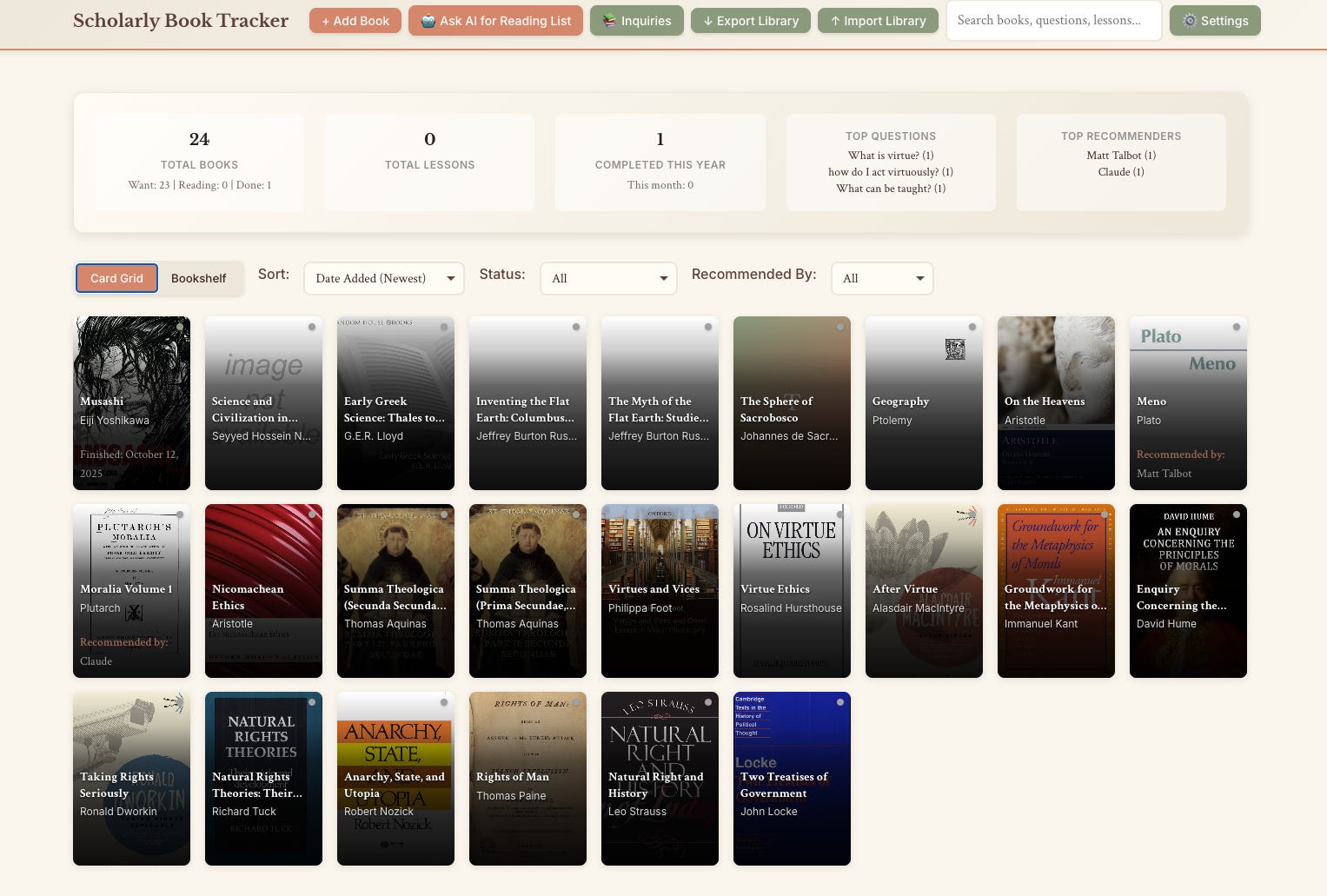
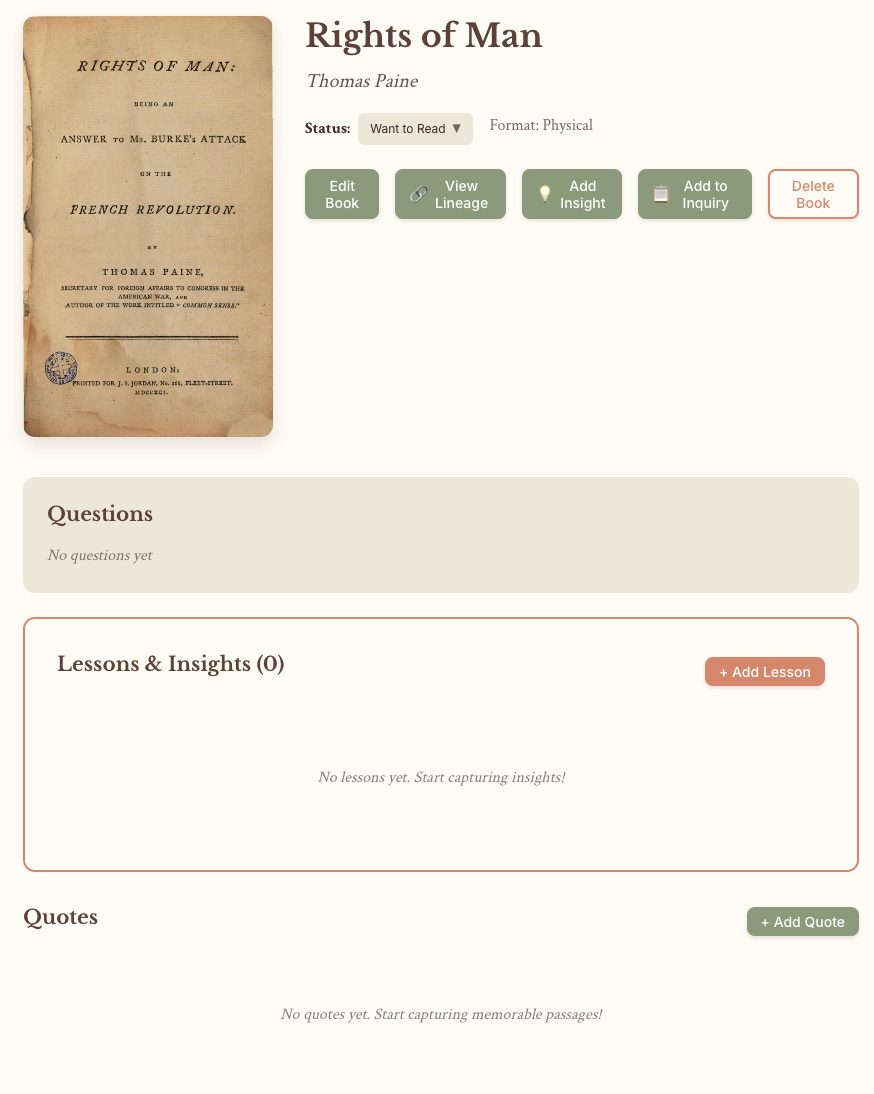
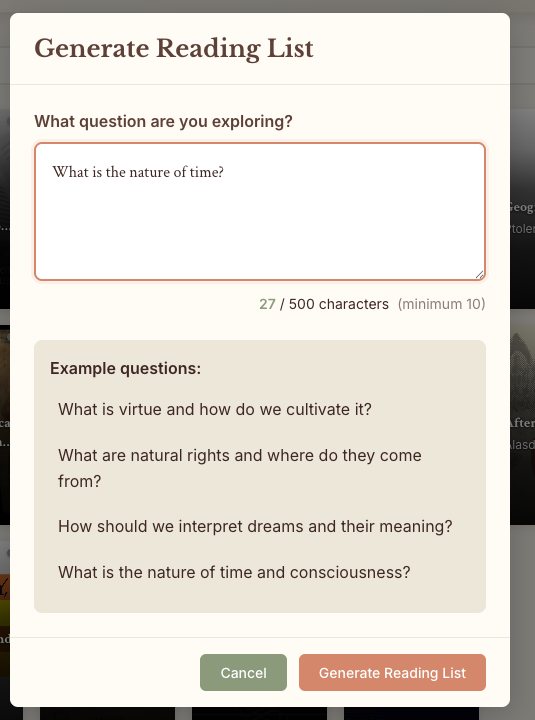
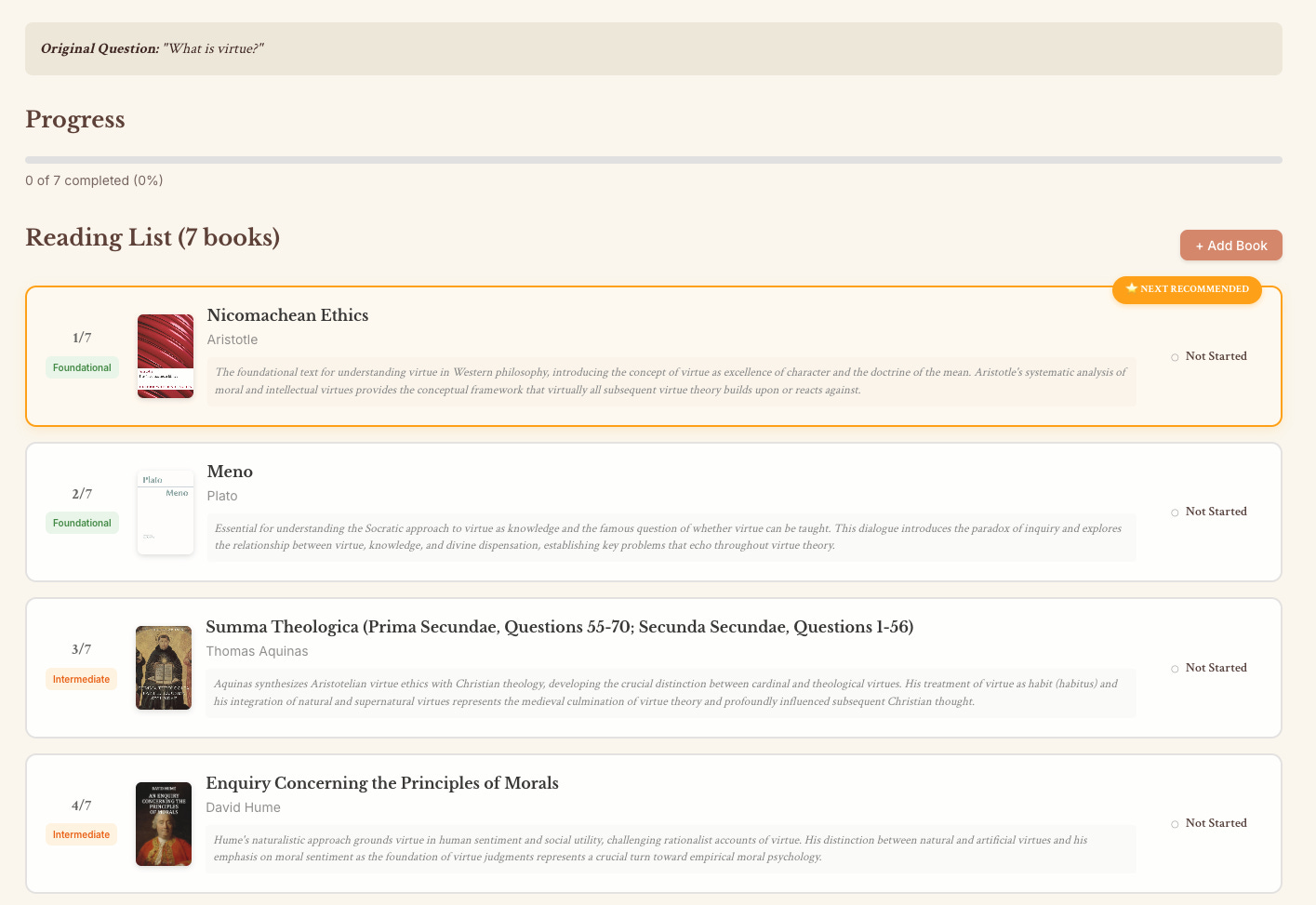
Version two was where the real magic came. I hooked my new digital library into the Claude API with a button that allows me to ask a question and get a study guide. For example, I asked “What is virtue?” and Claude returned a reading list, with justification for why each book was included and what order to read them in. All of that is stored in an inquiry, which I can refer back to and track my progress against. I can add books to that inquiry later, or remove books that don’t feel right.
Within that inquiry, I can create insights between books. As an example, let’s say I’m working through my inquiry into virtue. I find myself noticing that Kant and Hume are talking about virtue, but in completely different ways. As I read back and forth, I write that “Kant believes that reason is the basis for all morality, where Hume believes that reason is subservient to passion.” In my research tool, I can create that insight and assign it to Hume’s Enquiry Concerning the Principles of Morals and Kant’s Groundwork for the Metaphysics of Morals2. When I click on either book, I see the connection to the other, and I also see it within the inquiry itself.
It’s my way of actively synthesizing the book.
Lastly, I had Claude Code build me a tool to identify the lineage of an author’s ideas. Say for instance that I am curious about who influenced Hume’s dismissal of induction. As a decidedly amateur learner, identifying where that idea comes from and where it leads feels like a gargantuan task. Never mind then following that line of reasoning.
Now I simply click the “lineage” button on a book. The API returns a list of books. Some which influenced Hume, some of contemporary thinkers exploring the same ideas, and some who later carried on Hume’s line of reasoning.
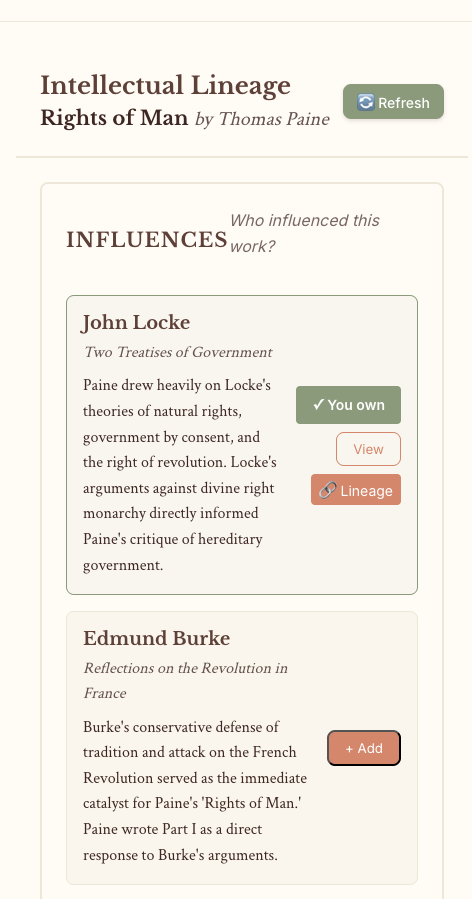
Now I’m not just building my own research projects, but I’m mapping the web of ideas.
I created all of this in a weekend with Claude Code. From Friday morning until Sunday night, I went from a cool idea in my head to a product on my local server. It’s maybe the first time I’ve had the feeling of “this is magic” that friends talk about from their youth.
I’ve only really started playing with it. I’m not even sure where I’ll go with it from here. Claude code suggested ideas for improvements — visual knowledge graphs or a chat interface to discuss my learnings — but I’m not sure how much more I need yet. Maybe it’ll stay this way for a while. If others are curious, maybe I’ll share it. If you are, let me know in the comments and I’ll figure out how to deploy it.
*
Building this tool scratched a personal itch. I want it to help me answer the next question my kids ask, and the one after that, or any of the 1000 naively intelligent questions they riddle me with every week. In my wildest dreams it helps me, and maybe other parents like me, choose a personal education that is more than facts and dates. Maybe it even helps turn the tide of educational decline which I experienced in my own schooling. Wouldn’t that be the dream?
But I am the first to recognize that a tool doesn’t make an education.
Werner Jaeger, who spent three volumes studying Greek paideia, would probably laugh at my digital library. He knew, and I know, that we don’t pursue our ideal life by reading and cultivating notes. Intellectual understanding can only go so far. I may come to understand how Aristotle and Aquinas, how the stoics and the founding fathers of America thought about virtue. But real virtue isn’t taught; it’s practiced.
In ancient Greece, virtue was practiced in the gymnasium, debated in the symposium, and modeled in the poleis. It was an active practice, in community with adults genuinely wrestling with these questions together. That community practice is really what gave us Plato’s Republic, Aristotle’s Nicomachean Ethics, and Plutarch’s Moralia.
I’ve searched for just such a community, found pieces of it here and there, but never quite found the whole. Which is when I decided to create it. Because I’m convinced Jeager was right: Virtue isn’t a solo project after all.
Justin Lind and I are creating a private community for parents who want to raise the ceiling for their families. Within the community, we’re envisioning high trust mentorship and relationship, rich conversations, and an ethos of building together for our families. We’ll be sending out our first invites in a few weeks. If you’re interested in helping shape where the community goes as a founding member, reach out to one or both of us.
https://goldenthreadacademic.com/the-golden-thread/
I admit I haven’t yet read either of these books, much less created the insight that appears here. I needed an example and a quick Google Search presented something similar. I hope through this project to rectify that so that I have my own insights. Which is kind of why I built this.
No posts
Comments
Nothing yet. Say the first thing.
Sign in to join the conversation.