
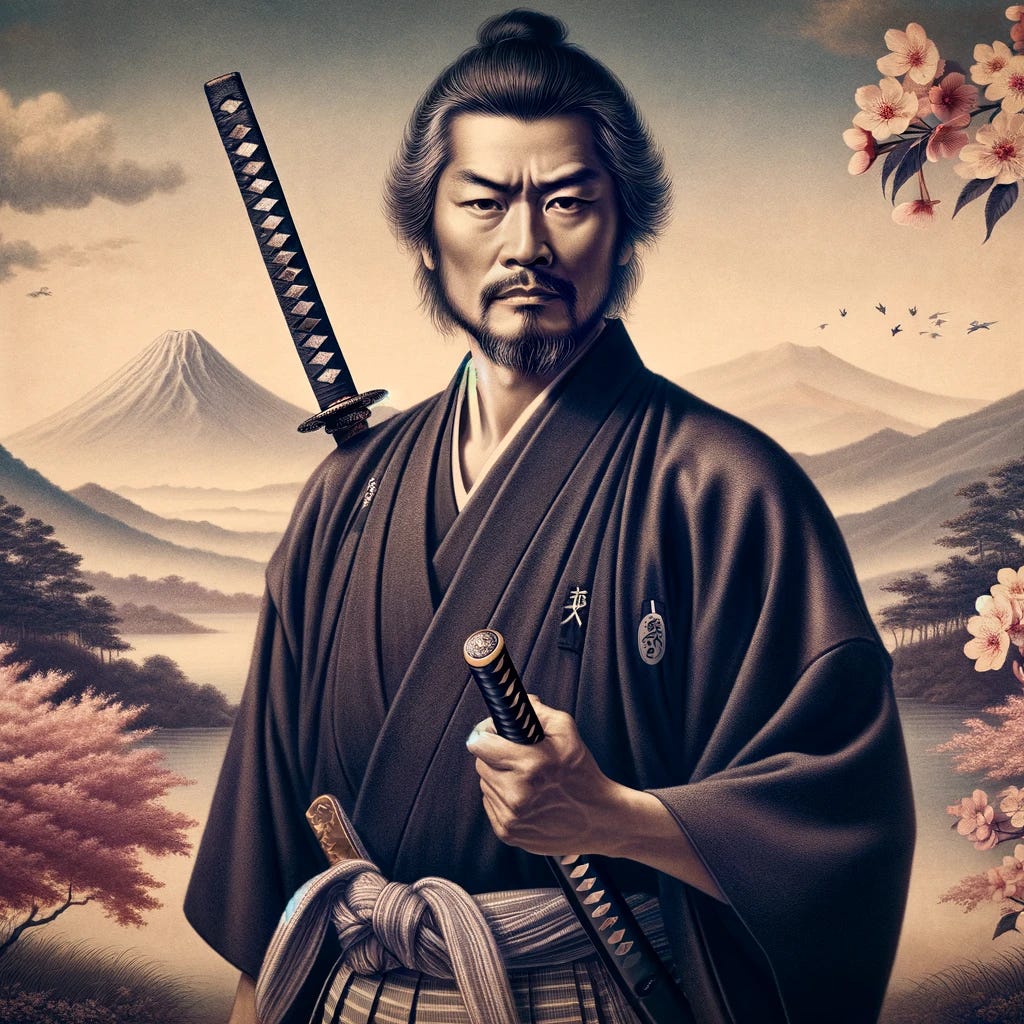
April 13, 1612. Japan. Under a deep azure skyline, a lone samurai sits stoically in a modest sculler boat. His black hair thrashes in the wind. It’s the only sign of the violence to come. The samurai stares absorbed at broken oar in his lap. With every stroke the young boatsman makes, the waters soak the samurai more, but he simply smiles as he whittles the oar and ties his kimono. To the outside world watching he is the pinnacle of serenity.
But on this day, our samurai, Miyamoto Musashi, approaches the fight of his life; in a few minutes, he will battle the most difficult rival in all of Japan, Ganryū, to the death.
There are some books which sit with you long after the last period on the last page. The Sound and the Fury was one such book for me. Zen and the Art of Motorcycle Maintenance was another. These books usually find us at a particular important juncture in our lives, offering us lessons we may barely know we’re seeking. At 42, well into parenthood and with conviction in my worldview, I didn’t think I was at such a juncture.
Eiji Yoshikawa’s Musashi found me anyway.
*
As Musashi approached the shore and the sight of his most difficult battle, it was anyone’s fight. Both had mastered heihō, the Way of the Sword. Musashi had stopped following heihō and begun seeking Ku no Michi, or the Way of the Void. Ganryū had continued along the path of heihō. It was a battle of single minded mastery against transcendence. It was anyone’s fight.
I don’t expect to face my own Ganryū in a battle with the ultimate consequence any time soon. My military days are long gone, and these days the toughest opponent I face is a particularly strong willed seven year old with piercing chestnut eyes. But were I to imagine I couldn’t learn a lesson from Musashi, I would miss what life really is.
We all face battles. The addict tries to beat addiction. The workaholic hides from feelings of insignificance. I remember being the athlete wondering why I didn’t feel pleasure in victory even while I was scared to death of defeat. The real battles aren’t external, but in our own psyche. In those battles with our own psyche, we find the true lesson of Musashi.
We live in an age where the loss of meaning is the defining question of our generation. This is our battle.
It’s been mine for the last several years. Questions of who I am outside of the uniform gave way to questions of what my purpose is when I’m no longer working outside of my home. Doubts about whether I was doing the right thing in homeschooling my kids; the right thing for myself as much as for them. Staring into the abyss of my future when homeschooling is all over and I have to figure out what I want to be then.
The hardest question for me over the last several years has been one of love.
Did I actually have to earn the love of others or was I worthy of it simply by being? What did I owe others who did love me? Could I learn to simply accept it?
For years I’d steeled myself for that fight. I spent years on a spiritual search to understand my life. Before that I hardened myself against the temptations of the world — of ego and indiscipline and the desire for recognition over substance. I felt like I’m prepared for a fight. Yet I’m still fighting.
But what stuck with me from Musashi wasn’t my own personal battles; I’ve known those for years. What stuck with me was that Musashi could be a blueprint for how to equip my children to prepare for that fight. Or to never have to face it.
Like I said, some books reach through their context into your personal circumstance.
When the future is as uncertain as it is today, when I can’t begin to tell you what skills or knowledge my children may need to build their own lives going forward, when fear and hate seem to be at their zenith, I still hold faith that education can arm them for the future. Yoshikawa didn’t write about education. but the question found me anyway.
And I have come to believe that we need a kyōiku-dō (The Way of the Teacher). Education needs a way.
In Eastern thought, there are distinct disciplines or Ways that train one for the ultimate truth. Just as heihō (The Way of the Sword) and Ku no Michi (The Way of the Void) prescribe a way of learning, they all descend from the Dō. Without the Dō, Ways would be simply performative. With it, they are transcendent.
As all life goes, education should go too.
We need an ideal for when the path seems unpassable. We need an ideal for when we’re racked with doubt, for when the easy way of doing what everyone else does is tempting at our egos, much less our souls. We need an ideal, not to guide our actions but to hone our intentions. The way points beyond standardized tests and college admissions. It needs to point to life.
The Way offers us not an easy road, but an honest one.
Without it, we’re lost. With it, we stand equipped.
*
How do we describe an ideal? Should an ideal be universal or should it be personal?
I can only offer you what I think of as my ideal.
These are my goals, the things I wish to impart upon my children as I educate them.
Musashi exemplifies raw discipline. He studies swordsmanship obsessively, hiding in the hills for years to steal himself against the distractions of the world. His is the ancient life in hard mode.
By contrast, his childhood friend, Matahachi, chooses the path of pleasure. Matahachi is the alter-ego, what would have been without the Way of the Sword. He falls in with the wrong people, he lacks the discipline to take responsibility for his actions. He shames his mother and himself. As I read along, I was ashamed of Matahachi and proud of Musashi.
Yoshikawa doesn’t let us off so easily.
Both Musashi and Matahachi fail.
The way isn’t followed through discipline. Nor is it followed through indiscipline. It’s followed through integration.
I try teaching my children to go beyond accumulating knowledge. But to go beyond, they must first own that knowledge. I expect discipline, because learning requires discipline and hard work, but I never let my children rest on it. I teach math; I teach science; I teach reading. They memorize poetry and work practice problems. They hear from me the lesson of 3,000 years of history
However, there’s a difference between knowing an idea and living it. Musashi constantly learns that the Way is followed in relationships. And every time he relearns it, he rejects love.
So I ask them to bring their knowledge into the world.
That’s learning as a spiritual discipline, in the same way the priest chants a rosary, or the monk prostrates himself before God.
My daughter just finished a section of her math book focused on addition strategies. The next step was to give her a math circle problem, to let her play with math and try the strategies on a problem which wasn’t designed to teach. Then we worked on math at the store.
I’m not sure that’s enough. I want to see her bring the idea of addition into her everyday life. I want her to know that addition as a tool is also the union of colors in a beautiful painting. It’s combining her ideas with her brother’s to create something new. It’s a way of knowing that she can always add to the world, and hoping she’ll be proud of it.
That’s integration for a 7 year old.
My hope is those lessons will give her the courage to see the world as it really is — the world she helped create.
When she can see the world, she can prepare for the battles to come.
We’ve created a world where we praise children for anything. When words are violence and withholding praise is an act of aggression, how is the next generation supposed to face the loss of meaning? When they’ve never faced a real challenge, what are they going to do when reality smacks them in the face?
Yoshikawa doesn’t tell us that Musashi is a hero because he defeats many opponents. He is a hero because he refuses to give up on the Way. There are times when it’s too much and he doubts himself. He wants nothing more than to quit and live an easy life.
But instead of running, Muashi opens to that discomfort. He doesn’t hide from it, even when the person he turns to for guidance, a Zen priest named Gudō, rejects him outright. He sits with that too. If he didn’t, he never would have found the Dō.
So what should our ideal be?
I believe the Way of education has to honor the heart and the mind. Not privilege one over the other. They can’t ignore their intellect — it’s a powerful tool. But they also have to develop their emotions. And the strength to feel them in all their messy pain.
So would I be heartless in our education, knowing that it’s for their own good?
I don’t think so. We have to find the balance between challenge and ease. We have to honor that oftentimes our children’ s motivation is built on previous success. We should make school easy enough where they keep coming back, but present enough challenges that they develop the muscle to sit with hard feelings.
But the true secret isn’t the curriculum. It’s the relationship.
The way I teach them to face hard feelings is by facing hard feelings with them. I show them what it looks like, talk to them about how to do it, scaffold the hell out of it. But the really hard part of it all is that I have to deal with my own shit in the process.
Because joy isn’t the absence of discomfort. It’s the embrace of it.
My ideal grounds itself in discomfort to prepare my kids for the joy in their everyday life.
In our age of optimization, it seems that if only we could eliminate our weaknesses and embody our strengths we could have it all. 10 tips to combat laziness. How to become so focused it feels illegal. All of those are actual newsletter titles from the last few months. It’s no coincidence that everyone is looking for the shortcut to success. It’s ingrained in us from our earliest schooling that we need to do well, to be better than everyone else.
It’s not just in school. Read ancient texts too. Plutarch’s Lives admires Romulus and Thesius because of their ambition, their daring. Both reject lives of insignificance to make cities that outlast them. You and I want to leave a legacy of our time on earth (or maybe that’s just me). And we are told to reject the sin in us if we want to be allowed into heaven.
Is that actually the ideal?
When Musashi is at his absolute lowest point, he’s literally begging for guidance. He’s begging for a lesson in how to be better. Gudō offers “not one thing.” Disgusted, he takes a stick and draws a circle around Musashi. Musashi is irate, calling Gudō a “swine of a priest.”
But then he sees.
A circle is “a perfectly round line, no beginning, no end, no deviation. If expanded indefinitely, it becomes the universe. If contracted, it becomes as small as the infinitesimal dot in which his soul resides. One entity — himself and the universe.”
The circle completely encloses him. It’s a boundary between him and what is not him. And it’s a lesson: that The Dō is in him.
What if our ideal took as a foundation that our children are already enough? We don’t need to form them into the adults we think they should become. They don’t need to be optimized if they’re going to be successful, or worthy.
I want to teach my children to never doubt they are enough. I may not be able to teach them that, to have it ingrained into their way of living simply by telling them it’s so.
But I can point to it.
It’s not until two pages from the end of the book that we find Musashi understanding the Dō. He’s spent 900 pages rejecting love for discipline, hardening himself at the expense of himself. But then Yoshikawa brings Otsū back for one final love scene. All she’s ever wanted was to be with him. And Yoshikawa breaks out hearts.
They don’t get to sail off happily into the sunset. They express their love, then Musashi leaves her for battle.
It’s heartbreaking. It feels unfair. But it’s a reminder that our actions have consequences and sometimes we are just too late.
I think that’s an important realization, one I want to bring to my kids. Everywhere else they’re shielded form that lesson. Not just in participation trophies, but in low expectations. In the way we infantalize and cater to children, we tell them that their choices don’t matter.
But really, every choice they make leads to an outcome. They won’t always be able to change course.
Rather than fear that, I need them to accept that reality and keep moving forward. Do their best and accept the consequences.
*
Musashi didn’t just affect me for the lessons it taught. It stuck with me for the way it taught them.
The Way of Education is more than ideals. It is also action; it’s the craft of the book.
Yoshikawa almost torments his reader with how often Musashi repeats the same cycle. As I was reading it, I found myself alternating between frustration and exasperation. How could this keep happening again? Why does this take 900 pages? It turns out, that may have been the point.
Learning in this way isn’t just about being exposed to information and seeing the future. My kids don’t get to learn something once and be done with it. They must experience their own reaction to it. They need to feel frustrated and stuck.
The teaching isn’t the lesson, it merely facilitates it. Their experience is the lesson. They’ll learn to battle their own demons by battling their demons.
Along the way, Musashi isn’t alone. At key moments on his journey, a mentor appears. Tikuan ties him to a tree and locks him in captivity for 3 years with nothing but books. He asks hard questions and sets high expectations for Musashi, while he lets Musashi do the work. It seems cruel, but it’s a gift. This is what real mentorship looks like.
Gudō appears when Musashi most needs him. But he doesn’t offer the help Musashi wants. He offers the lesson he needs. He spits on him and walks away. Calls him hopeless. Incites anger. He isn’t nice, he’s caring. If our kids need to see through their anger, what are we really doing by teaching them to hide it?
The Way of Education should be an act of mentorship. If my kids grow into their whole selves is up to them.
I’m merely here to help, to guide, and to love.
Lastly, the final lesson of Musashi isn’t on the pages. Yoshikawa himself is that lesson. He wrote Musashi from 1935-1939, as Japan was building up a martial culture that would lead to World War 2. He supported a culture which would commit some of the worst atrocities of that war. He was a self-avowed fascist whose work supported the regime.
Not exactly someone to exemplify.
But we can still learn from him. We can examine how a man can follow a politic of hate and write a book about peace. We can learn how someone can write one book, and our act of reading it can bring out another book. We can learn that the greatest lessons are ones we own — the good and the ugly of it.
The Way of Education is an ideal for teaching. It’s also an ideal for living. Following the way offers my children a path to a good life. But more than that, it offers me a guide to finding my own value in this effort.
This is the gift of Musashi.
Over the last several years I’ve spent my time deciphering how to create an exceptional education for my children. The learning has been intense, but the outcomes speak for themselves. I’m starting to explore how I can help others create this type of education as well.
If you’ve considered trying something like this, whether full time or as an enrichment idea, I’d like to talk. If you’ve designed learning experiences or learning communities outside of school, I’d like to talk as well. If either of those describe you, please comment here or DM me.
Thank you in advance.
No posts
Comments
Nothing yet. Say the first thing.
Sign in to join the conversation.