
In the last month: a hand-built robot wearing Nike Air Maxes, an AI-generated squirrel that hit the top 1% of all TV ads, a recliner full of practical-effects gear that became one of the year’s most charming brand films, a Bigfoot in a hair towel selling streaming bundles in Belgium, a Decathlon robot escaping its lab to do the splits between two cliffs, and George Clooney getting elbowed out of an ad to make room for Dua Lipa.
Oh, and if you forgot, last month Apple launched a mascot too.
Six stories. One pattern. Let’s go.
Pip & Nut is a UK nut butter brand. Their mascot is, predictably, a red squirrel. Nothing clever about the design. It’s a squirrel. It eats nuts.
The campaign animates the squirrel via AI (with creative studio Scary Robots), pairs it with a music choice that does half the emotional work, and scores 5.9 on System1 — top 1% of all TV ads ever measured.
For contrast, McDonald’s recent AI-heavy Christmas adverts were called “creepy” and “uncanny,” and the ad was finally pulled. Same technology. Wildly different result.
The difference isn’t the AI. It’s that Pip & Nut had a character first and used AI to bring it to life. McDonald’s used AI to manufacture a feeling. One is an owned asset getting a new tool. The other is a tool pretending to be an asset.
Marcel says: “Simple character + great music + actually owning the thing = top 1%. Three ingredients, no MBA required.”
Quechua launched the MH900 hiking shoes with a small white robot called QUECH-01. The setup: QUECH-01 is a product tester at Decathlon’s Mountain Store testing facility who decides the lab tests aren’t enough. So it escapes into the wild to push the shoes harder.
It walks through brambles to test the mesh. Wades through a stream to test the waterproofing. Sprints from a brown bear and does a full Van Damme split between two cliffs to test the grip. Then the human engineers show up, mildly annoyed, and explain that they’re supposed to be the ones testing. Tagline: “Designed to take you further. Tested to go beyond.”
Here’s what makes this work: every outdoor brand on earth says “we test our gear.” Quechua is the only one with a character who does it.
That’s the move. They took the most boring, most over-claimed, most ignored line in outdoor marketing (”we care about quality”) and gave it a backstory. A character. A motivation. Now “we test our gear” is a story instead of a sentence.
And QUECH-01 can come back forever. New shoes? New tests. New tent? Test in a hurricane. The narrative engine is built. They just have to keep feeding it.
Marcel says: “Most brands say ‘we care about quality.’ Quechua built a robot who breaks out of a lab to prove it. Same message. Different universe.”
If you haven’t watched the making-of for Indeed’s Ingrid character, stop reading this and go watch it. I’ll wait.
Here’s what’s happening: a creature suit, a practical-effects rig sitting in an actual recliner on a studio set, motion capture, and then a digital character layered on top. Old-school puppetry meets new-school post.
Why does this matter? Because the AI mascot conversation keeps getting framed as a binary: real production vs. generated. Ingrid proves the answer is hybrid — use whatever gives you the most soul per scene. Foam puppet, Veo prompt, or both.
The brands that win the next two years won’t be the ones who go “all AI” or “all traditional.” They’ll be the ones who understand that the character is the constant and the tools are interchangeable.
Marcel says: “A robot wearing tracksuit pants in a recliner. This is the most honest behind-the-scenes photo in advertising right now.”
Pablo Rochat made a character for Nike’s Air Max 90 page that is literally hand-assembled. You can see the strings, the tape, the seams. Deliberately rough, charmingly DIY, wearing the shoes.
This is Nike. They could have generated a perfect 3D character in fifteen minutes with current tools. They chose to build something that looks made.
That choice is the point. In a feed where every product shot looks the same, a character with visible thumbprints stops the scroll. The robot doesn’t need to be technically impressive. It needs to feel like someone cared..
It also signals where brand mascots are heading: not more polish, more texture. The Pip & Nut squirrel works because it feels handmade in the script. The Nike robot works because it feels handmade in the materials. Different routes, same destination.
Belgian telecom Telenet just introduced BingeFoot, and a few sidekicks (including Merbusinessman 🤣). Yes, the name does what you think it does.
For most of the last twenty years, telecom branding has been a race to the same place. Blue. Geometric shapes. Hopeful music. Maybe a couple looking at a phone. Telenet just opted out.
I’ll be watching how this one is applied. The launch is the easy part. The next twelve months of consistent, weird, distinctive use are where most mascots quietly die.
A recent Nespresso-style ad starts with George Clooney, the face of the brand for nearly twenty years. Then Dua Lipa walks in. Clooney has to step aside to make room. It’s played for laughs, but the subtext is brutal: the celebrity you spent two decades building is now sharing the frame with someone half his age, and at some point soon, he’s leaving the frame entirely.
That’s celebrity-led brand building at its endpoint. You spent millions making someone synonymous with your product. Then they age out, get cancelled, or lose relevance, and you pay millions more to bolt the next person on. And again. And again.
Every dollar you spent making Clooney famous for the brand now has to be partly redone for Lipa. The asset doesn’t compound. It depreciates the moment the contract ends.
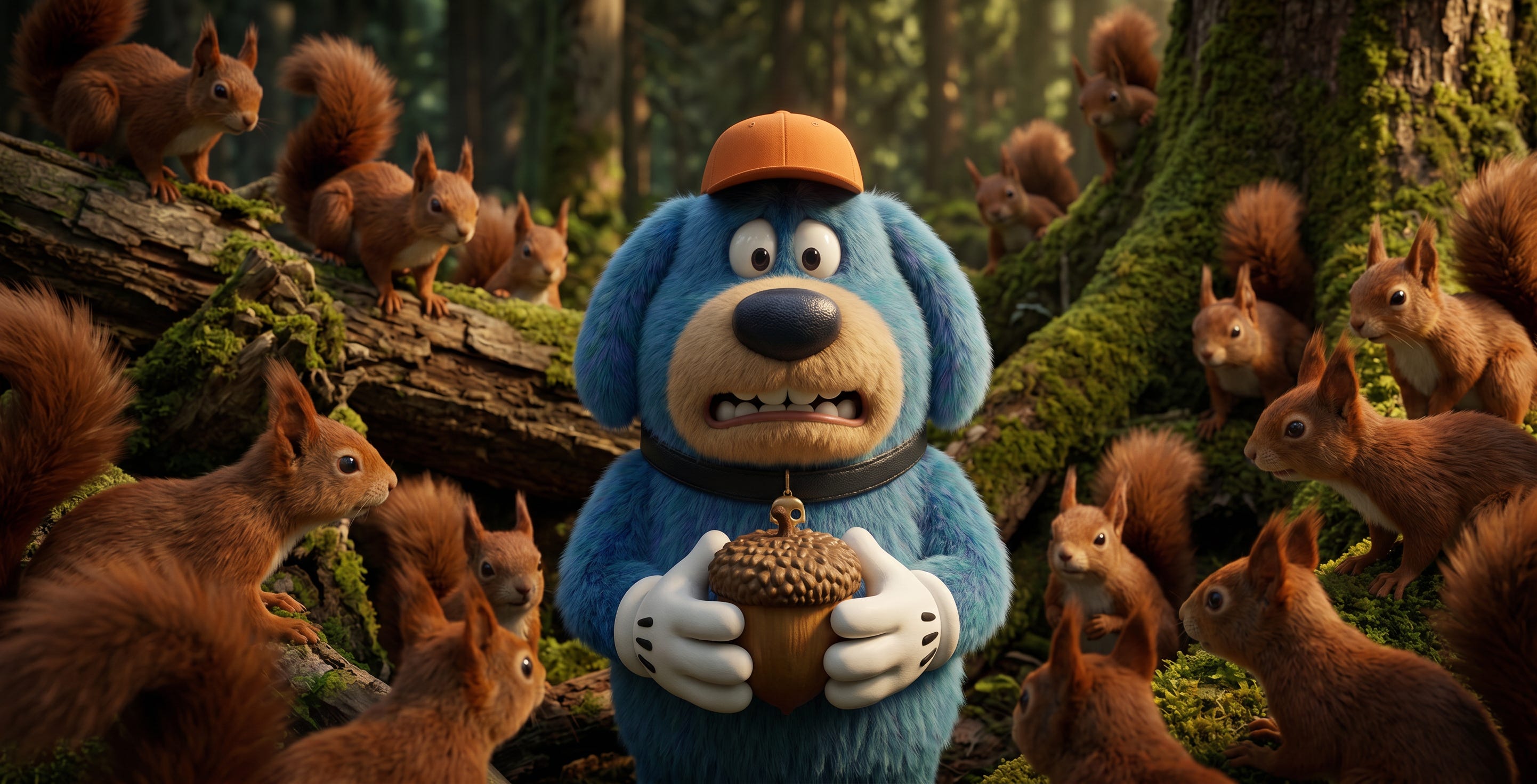
A character doesn’t have that problem. The Pip & Nut squirrel will still work in 2030. The Decathlon robot doesn’t have a publicist. Pablo Rochat’s Nike character can come back for the Air Max 270, the 95, and the Vapormax. Marcel will still be wearing his stupid orange pants and his MMGA cap when half of LinkedIn has rotated through three different “brand ambassadors.”
That’s the moat. Not aesthetics. Not nostalgia. Asset economics.
Six stories, one pattern: the tool isn’t the strategy, the character is.
If you’ve been waiting for the “right moment” to give your brand a face, the moment was about eighteen months ago. The second-best moment is now, while your competitors are still debating whether ChatGPT is going to replace their copywriter.
Marcel says: “Six brands, one moat. I’d write a thesis, but I’m a dog.”
Wonder how your brand universe could look like? Book a 20-minute call here.
Subscribe to Marcel’s Lab for weekly mascot case studies and workflows.
Comments
Nothing yet. Say the first thing.
Sign in to join the conversation.