
In the first part of this three-part series, we explored the Society goals. Now we descend one level further, toward the living systems upon which society—and every music classroom within it—depends.
In the previous installment, we followed the Sustainable Development Goals (SDGs) through the social life of a music classroom. We considered hunger and poverty, health and education, energy and housing, gender equity, community life, and the institutions that support them. These relationships are readily visible because music educators work with people. They build communities, negotiate differences, distribute opportunities, and create cultures of participation every day.
The social layer rests within a living world that makes collective life possible. Follow food in a school cafeteria backward and it leads to farms, soil, rainfall, labor, transportation, energy, and climate. Follow the water bottle beside a student’s chair and it leads to rivers and reservoirs. Beyond them are treatment plants, infrastructure, policy, and geography. Follow an instrument far enough and it may lead to forests, mines, animals, factories, shipping routes, electrical grids, and generations of accumulated craft knowledge.
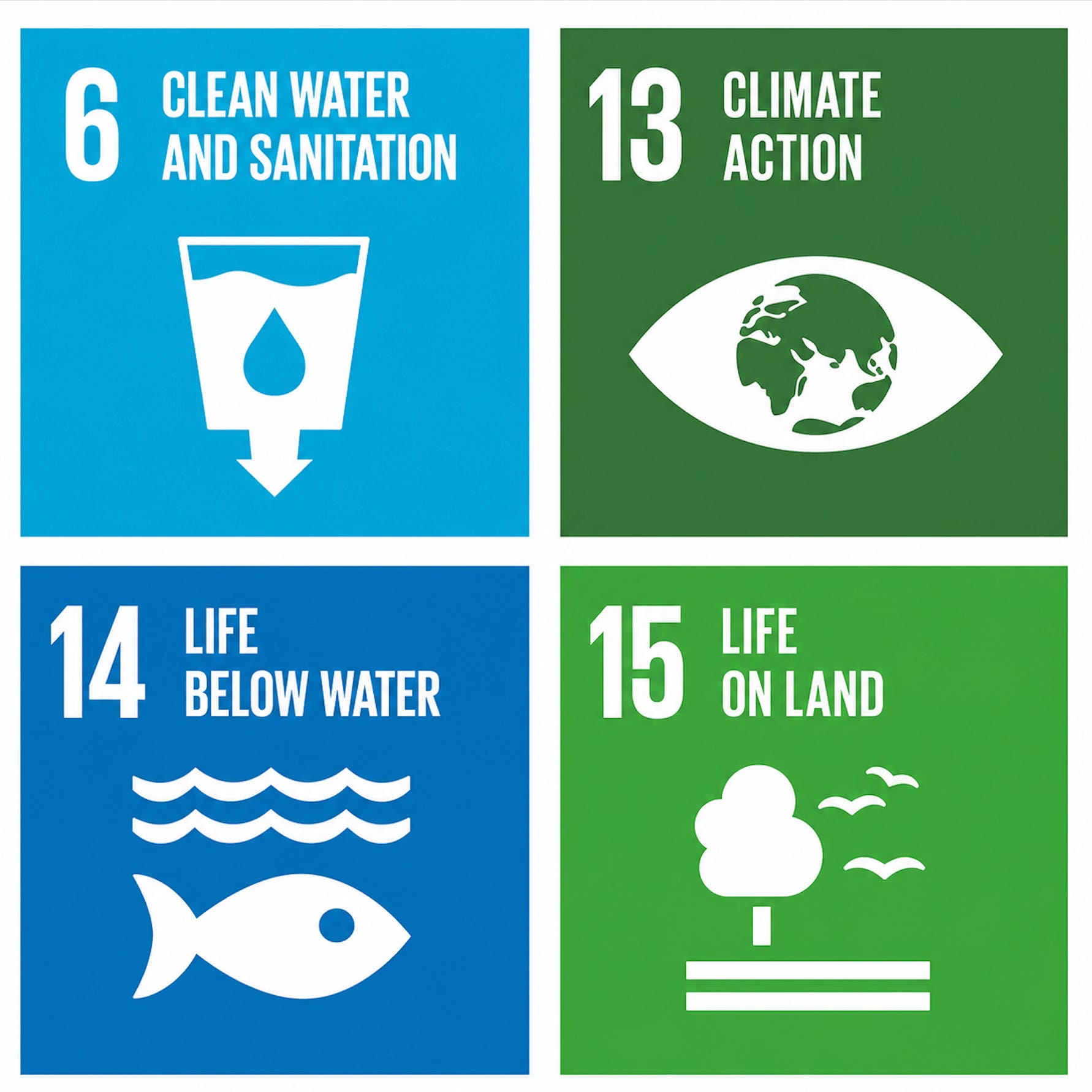
Every social system eventually descends into the biosphere, the thin layer of Earth where life is possible. This foundation includes four SDGs: SDG 6, Clean Water and Sanitation; SDG 13, Climate Action; SDG 14, Life Below Water; and SDG 15, Life on Land (United Nations, 2015).
The United Nations presents the SDGs as an integrated agenda. The “wedding cake” model (Rockström et al., 2009) rearranges them into a structure that makes their interdependence especially visible. The economic goals rest upon the goals concerned with society, and both depend upon the biosphere as their living foundation (Stockholm Resilience Centre, 2016).
This structure changes the question we ask of music education. Environmental sustainability often enters through climate-themed repertoire, recycling projects, or special concert programs. These can support worthwhile learning, although the relationship begins earlier than any particular lesson. Biological conditions, material resources, climate systems, and public infrastructure already make music learning possible.
The guiding question, then, is: What living systems already make music learning and teaching possible?
SDG 6 concerns access to safe water and sanitation. It also addresses the sustainable management of water resources and the protection of freshwater ecosystems (United Nations, 2015). These concerns are central to sustainability because communities cannot maintain public health, food systems, education, or economic life without dependable water.
Sustainability efforts connected with SDG 6 therefore involve more than conserving water at the household level. They also require healthy watersheds, functioning infrastructure, equitable access, responsible governance, and long-term planning. The goal asks societies to protect the systems that provide water while ensuring that people can use those systems safely and fairly.
Water enters musical life most immediately through the body. Singers and wind players depend on hydration, as do dancers, conductors, and teachers. This need becomes especially visible during long rehearsals, marching seasons, and outdoor performances. A reminder to bring water belongs to ordinary rehearsal practice, while the ability to follow that reminder depends on reliable access to clean water and the systems that provide it.
Living in a desert region has made these relationships concrete for me because water and heat shape many ordinary decisions surrounding schools and musical activity. That experience offers one local point of entry into a global question that every community encounters differently.
A music teacher might begin with hydration and examine its effects on concentration, endurance, vocal production, and physical safety. A class could investigate where its school water comes from and what happens before it reaches the drinking fountain. Students might listen closely to rain, rivers, drainage systems, or drought-altered landscapes and use those sounds as material for composition. They could also trace the water involved in producing a reed, a sheet of paper, or another object used in the music room.
Through these approaches, students begin to understand water as one of the conditions supporting musical participation. They also learn that sustainability involves maintaining the ecological and human systems upon which everyday activities depend.
Water reveals how environmental systems shape bodies, infrastructure, schedules, and safety. Those relationships become even more visible when we turn toward climate.
SDG 13 calls for action on climate change through mitigation, adaptation, education, and stronger capacity to respond to climate-related hazards (United Nations, 2015). Climate action is central to sustainability because climate conditions influence food production, water availability, public health, migration, ecosystems, infrastructure, and economic stability.
Mitigation seeks to reduce the causes of climate change, particularly greenhouse gas emissions. Adaptation focuses on preparing for effects that are already occurring or are likely to occur. Sustainability efforts require both because communities must limit future harm while also responding to present conditions.
Climate change already enters schools through practical decisions about heat, smoke, energy use, travel, and outdoor activity. In music programs, these conditions can affect whether students rehearse outside, whether performances can proceed safely, and how much cooling a facility requires. Heat and humidity can also affect instruments, rehearsal spaces, and storage conditions.
A storage room can therefore become a place where environmental conditions are observed over time. A rehearsal calendar may also document adaptation as outdoor practices shift, performances move, or schedules change in response to unsafe conditions.
Music educators can help students investigate these relationships through songwriting or soundscape study. They might use recording projects to document changes in a local environment, translate climate data into sound, or collaborate with science and social studies classes. Students might also imagine possible futures through composition and design, asking how musical life could change as communities adapt.
Musical activity can help communities preserve memory and communicate experience. It can also support collective reflection when familiar places or ways of life begin to change. These cultural and educational responses contribute to sustainability by helping people understand shared conditions, imagine alternatives, and participate in decisions about the future.
Climate connects every region to larger planetary processes. Following those connections outward eventually leads to oceans, whose influence may be less visible from an inland classroom but remains essential to the stability of life on Earth.
SDG 14 concerns the conservation and sustainable use of oceans, seas, and marine resources (United Nations, 2015). Oceans support biodiversity, regulate climate, absorb heat and carbon dioxide, produce much of the oxygen in the atmosphere, and sustain the livelihoods of communities around the world.
Sustainability efforts associated with this goal include reducing pollution, protecting marine habitats, limiting destructive extraction, and supporting responsible use of ocean resources. The goal recognizes that ocean health affects life far beyond coastlines because marine systems help regulate the entire planet.
For many inland music classrooms, SDG 14 may feel more distant than the other Biosphere goals. That distance deserves to remain visible because systems thinking requires proportion. Communities do not encounter every ecological issue with the same immediacy, even though they remain connected through planetary and economic systems.
Several meaningful relationships remain available to music educators. Instruments, electronics, replacement parts, and other classroom materials often travel through international shipping networks that depend on oceans. That connection allows students to consider how musical objects move through global systems before reaching a school.
Marine environments also offer powerful possibilities for acoustic inquiry. Many aquatic animals rely on sound to communicate, navigate, locate food, avoid predators, and interpret their surroundings. Human-generated noise can interfere with these essential activities and alter the character of marine habitats (National Oceanic and Atmospheric Administration, 2024).
Students might listen to recordings of marine environments and compare biological sounds with those produced by ships or sonar. They could investigate ocean noise as a question of habitat and communication. Music classes might also explore the musical histories of coastal and island communities, paying attention to how marine environments shape culture and livelihood.
These pathways allow SDG 14 to enter with an appropriate degree of weight. They also demonstrate an important sustainability principle: a system can affect us profoundly even when its presence is difficult to see from where we stand.
Where the ocean may enter an inland classroom indirectly, the living systems represented by SDG 15 are often visible in the instruments and materials already in students’ hands.
SDG 15 concerns the protection and restoration of terrestrial ecosystems. Its focus includes forests, soils, biodiversity, and landscapes affected by degradation (United Nations, 2015). Healthy land systems support food production, store carbon, regulate water, provide habitats, and supply many of the materials upon which human communities depend.
Sustainability efforts connected with SDG 15 seek to protect biodiversity while restoring damaged ecosystems and using natural resources responsibly. The goal asks people to consider how present choices affect the capacity of land to support life in the future.
The relationship with music becomes visible through materials. Wooden instruments begin in forests, while reeds begin as plants. Bow hair comes from animals. Cork, cane, leather, metals, resins, paper, and electronic components pass through ecological and industrial systems before entering musical life.
An instrument can therefore be understood as an artistic object and a tool, as well as a material supply chain. Its construction carries histories of cultivation, extraction, manufacturing, transportation, maintenance, and accumulated knowledge. Some of its materials may have taken years or decades to grow and prepare.
Students might trace one material found in an instrument and follow it back toward its source. They could investigate how a reed is grown, how instrument wood is selected, or where metals in electronic equipment originate. This inquiry can lead toward questions of durability, sourcing, manufacturing, and waste.
Repair offers another practical entry point. Maintaining an instrument extends its usable life and preserves the labor and materials already gathered inside it. Students can therefore understand repair as a musical skill, an economic decision, and a sustainability practice.
SDG 15 also creates opportunities to learn from land. Outdoor listening can help students attend to seasonal changes and the distinctive sounds of a place. Place-based composition can explore relationships among landscape, history, community, and cultural practice.
Together, these approaches invite students to ask what forms of life, labor, and time are gathered inside the materials that make music possible. They also show that sustainability involves protecting the living systems from which human culture continually draws.
One of the first Education for Sustainable Development activities I encountered asked learners to photograph a meal and identify its ingredients. They then investigated where those ingredients came from and connected the meal with the SDGs.
Although the activity began with breakfast, its deeper lesson concerned perception. A piece of toast could become soil and water. It could also reveal seed, labor, transportation, packaging, energy, trade, health, and culture. The food remained the same, while the learner’s capacity to recognize the systems gathered inside it expanded.
I later adapted that activity with university students. After tracing food through several SDGs, I asked them to list the “ingredients” that made up their instruments. At the time, I was still working to understand how sustainability connected with music technology and music education. I felt uncertain about whether the lesson would hold together. Some students saw the connections quickly, while others remained unconvinced.
That uncertainty matters because sustainability education remains an emerging area of practice for many music educators. In the United States, the relationship between sustainability and music learning can still sound misplaced or unnecessary. Many teachers have received little preparation, time, language, or institutional support for understanding it.
The need to develop that understanding is becoming more urgent as the SDGs approach their 2030 target date. The United Nations’ 2026 assessment reports meaningful progress across the agenda, although global gains remain uneven and insufficient. Many targets continue to advance too slowly or move backward (United Nations Department of Economic and Social Affairs, 2026).
Education shapes what people notice and what they value. It influences what they regard as normal and what kinds of futures they can imagine. Music education, understood broadly as the places and relationships through which people learn, make, share, and pass music forward, participates in that influence.
Recognizing the environmental relationships already present in musical life can give educators the confidence to develop them intentionally. The form those connections take will depend on the context. One teacher may examine instrument materials, while another may compose from a local water history. A program might study a changing soundscape, reconsider outdoor rehearsal practices, repair neglected equipment, or invite students to imagine the musical cultures of a more sustainable future.
The SDGs provide a shared language through which local experiences can connect with larger systems. They help educators ask more expansive questions while preserving the professional knowledge and judgment that responsible teaching requires.
Viewed together, the Biosphere goals ask us to look beneath the visible life of a music classroom. Hydration rests upon water access. Rehearsal calendars reflect climate. Global musical commerce crosses oceans. Instruments carry land, life, labor, material, and time.
The task is to see music education more fully and decide which relationships deserve attention, care, and action within a particular place. As you look around the places where music is learned and made in your own life, consider this question: What living systems make that music possible, and what might become possible if you and your students began noticing them together?
If any of this resonated — or if you think I am getting something wrong — I would genuinely like to hear from you in the comments. And if there is a topic you would like me to dig into — something that has been sitting with you, something you cannot quite find good writing on — please reach out. That kind of signal genuinely shapes what I write next.
If you are finding value here, subscribing — even at the free level — helps this work reach more people. So does liking, commenting, and reposting. In a crowded information environment, those small actions matter more than most people realize. I notice every one of them, and I am sincerely grateful for each.
Thank you for reading. It means more than I can easily say.
I am an independent scholar with a PhD in education, writing about sustainability, Education for Sustainable Development, and the future of learning. I am available for research collaboration, consulting, and teaching opportunities — linkedin.com/in/kylecbartlett
National Oceanic and Atmospheric Administration. (2024, June 16). What is ocean noise? National Ocean Service. https://oceanservice.noaa.gov/facts/ocean-noise.html
Stockholm Resilience Centre. (2016, June 14). The SDGs wedding cake. https://www.stockholmresilience.org/research/research-news/2016-06-14-the-sdgs-wedding-cake.html
United Nations. (n.d.). Communications materials. Retrieved June 4, 2026, from https://www.un.org/sustainabledevelopment/news/communications-material/
United Nations. (2015). Transforming our world: The 2030 Agenda for Sustainable Development. https://sdgs.un.org/2030agenda
United Nations Department of Economic and Social Affairs. (2026). The Sustainable Development Goals Report 2026. https://unstats.un.org/sdgs/report/2026/
No posts
Comments
Nothing yet. Say the first thing.
Sign in to join the conversation.