
The auditorium falls silent, and a seventh grader lifts her flute to her lips for the eight measures she’s been rehearsing since September. She has the fingerings. She has the breath control her lessons taught her. What she doesn’t have, this particular Tuesday, is breakfast — her mom’s shift ran long, the bus came early, and the granola bar in her backpack is for lunch, not now. She plays anyway. The tone is thin where it should be full. Nobody in the audience will know why. Nobody has ever put “did the kids eat” on a rehearsal checklist, because nobody thinks of hunger as a music problem.
It is one. The body a musician plays through has requirements before it has technique, and breath, in particular, does not negotiate with an empty stomach.
I’ve been circling this problem since the last piece in this series, the one about who gets to be a music kid. That piece was about fees and trip costs — the gates with price tags on them. But underneath it, the whole time, sat a gate with no price tag at all: a body that hasn’t eaten. I said then that I’d been talking around hunger. This is where I stop talking around it.
This series has, until now, walked the seventeen UN Sustainable Development Goals — the blueprint, adopted by nearly every country in 2015, for what a livable, dignified world requires by 2030 — one at a time, a piece per goal, in order. Starting here, that changes, and it’s worth saying why before the argument gets underway.
The Stockholm Resilience Centre’s “wedding cake” model sorts the seventeen goals into tiers: a biosphere layer at the base, a society layer above it, an economy layer above that, with partnership running through all three (Rockström & Sukhdev, 2016). Starting with this piece, I’m going to take the goals in those tiers, in clusters, rather than one at a time.
I want to be honest about why, because both reasons are real. It’s more efficient — seventeen separate essays would mean making the same interconnection argument seventeen times. And it’s more honest to what this whole series has been claiming. Nothing in a child’s life arrives labeled “Goal 2” or “Goal 4.” Hunger, learning, health, and safety happen to one kid, in one body, at one time. The tiers are a way to hold a seventeen-part problem in a human-sized hand — a map folded small enough to fit in a pocket, useful precisely because it leaves things out. The trick, and it’s a trick worth naming out loud, is to keep using the map without mistaking it for the ground it’s standing on.
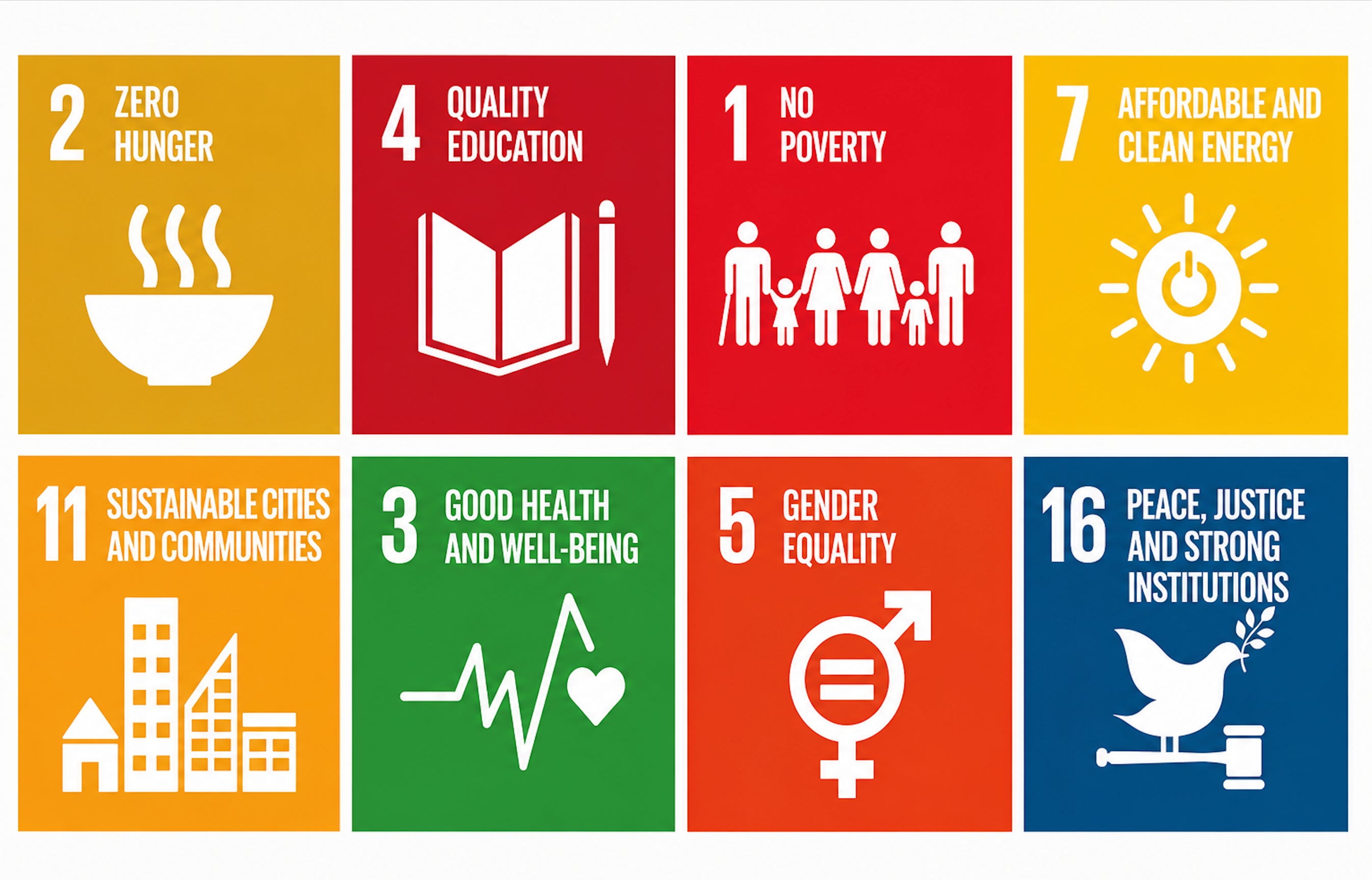
Start with the flute player and follow the thread outward, instead of stopping at “she didn’t eat breakfast.” Eight official goals live on this thread — the full society tier of the wedding cake, not a convenient subset of it. Each one has a number, a global target most readers have never had explained to them plainly, and a reason it already belongs to you, whether anyone told you that or not. Walk all eight.
Hunger — SDG 2, Zero Hunger. Globally, this is the UN target for ending hunger and malnutrition and making sure every person has reliable access to enough food — not a distant crisis but a number the world is still a long way from closing. In a rehearsal room, it looks like a body that hasn’t eaten, being asked to do something breath doesn’t grant on an empty stomach. It’s also, quietly, the reason a lot of directors keep a drawer of granola bars nobody talks about. Nobody called that food security work. It already was — which is the point. This goal was always the kid in the third row, not a policy document sitting in Geneva, and you were already answering her.
Education — SDG 4, Quality Education. Globally, this goal is about making sure every person gets an education that actually prepares them to participate fully in the world — not just a seat filled, but learning that sticks and opportunity that follows it. A body that hasn’t eaten struggles to attend, sit still, retain, and learn — not from laziness, but from the same basic physiology that thinned that flute tone (Alaimo, Olson & Frongillo, 2001). I wrote a full installment on this goal already: education as the mechanism the other sixteen goals move through, a music classroom already operating at that leverage point without being told to. Every lesson plan you’ve ever written already had a foot in this goal, which is exactly why it matters to you: you don’t need a mandate to already be doing the work this target describes.
Poverty — SDG 1, No Poverty. Globally, this is the goal of ending poverty in all its forms, everywhere — not only the extreme poverty of distant headlines, but the ordinary, local kind that quietly decides who can afford what a program requires. A mind that struggles to learn accumulates fewer credentials and fewer of the doors that let a family climb out of the income bracket it started in — the argument the last piece in this series made at length: fees and trip costs functioning as gates, the difference between being poor and staying poor. Every fee you’ve ever quietly waived, every instrument you’ve handed out without asking too many questions, was already this work, done before it had a name. It matters to you because you’re one of the only adults positioned to notice the gate is even there.
Energy — SDG 7, Affordable and Clean Energy. Globally, this goal is about making sure everyone has access to reliable, affordable power — not a given, even in a wealthy country, once a household is choosing between the electric bill and everything else. A family that fell behind on poverty’s ledger falls behind here next: a house where the power gets shut off isn’t just dark, it’s a house where a phone can’t charge, where an amp can’t run, where practicing after dinner stops being an option because there’s no light to read the page by. It matters to you because “didn’t practice” and “the power was out” can look identical from the front of a rehearsal room, and only one of them is actually a discipline problem.
Housing and community — SDG 11, Sustainable Cities and Communities. Globally, this goal is about making sure the places people live are safe, stable, and actually reachable — housing, transportation, public space that works for the people using it, not just the people who planned it. A family under financial pressure moves more, and moving mid-year breaks the kind of continuity an ensemble runs on — the seat a kid worked all year to earn, gone, because a lease ended. Getting to an early rehearsal depends on a bus that comes, a walk that’s safe, a ride someone had time to give. It matters to you because the student who “can never seem to get here on time” may not be describing a discipline problem either — they may be describing a transit map.
Health — SDG 3, Good Health and Well-Being. Globally, this goal covers everything from reducing preventable deaths to expanding access to care to supporting mental health at every age — health treated as something everyone is owed, not something that depends on circumstance. This is where the loop starts to compound instead of just continuing: fewer doors, a colder or hotter house, a longer or less certain commute, all held long enough, turn into worse health outright — a checkup pushed back, a prescription refilled late, a small problem that becomes an emergency because nobody caught it in time. A room that runs on routine and steady presence is already, without meaning to be, one of the more reliable health-adjacent spaces in a kid’s week — a place that notices when something’s off before a form does. It matters to you because you may be the first adult who notices, well before anyone with a clipboard does.
Gender — SDG 5, Gender Equality. Globally, this goal is about ending discrimination and violence against women and girls, and making sure opportunity and leadership don’t keep getting handed out along the same old lines. In the loop, it’s where the weight stops distributing itself evenly: who eats last in a house that’s short on food, whose schooling gets deprioritized first, whose health gets treated as the thing that can wait. Not because any one parent is choosing unfairly — because scarcity runs downhill, and it has been running down the same paths for a long time. Who gets first chair, who gets asked to solo, who gets interrupted mid-rehearsal: a program that starts watching those patterns on purpose is already doing this goal’s actual work, no separate curriculum required. It matters to you because a seating chart is a small, honest mirror of a much larger pattern — and you have more control over yours than the UN has over the larger one.
Peace and strong institutions — SDG 16, Peace, Justice and Strong Institutions. Globally, this goal is about building societies with functioning, trustworthy institutions — places where justice is reachable and safety isn’t a privilege. Every goal above holds, or it frays, depending on whether there’s a functioning institution standing behind it: a school that notices a kid has stopped eating breakfast, a clinic that’s actually open and actually affordable, a neighborhood policy hasn’t quietly abandoned. Where those institutions are strong, the loop has somewhere to be caught. Where they’re not, hunger doesn’t stay contained to a stomach — it moves, unimpeded, through every room in the house. Which means the ordinary, unglamorous reliability of a well-run music program — same room, same time, same person, every week — is already institution-building, not a neutral backdrop but the thing this goal is actually asking for. It matters to you because you may already be running one of the few reliably functioning institutions some of your students have.
That’s eight official names — hunger, education, poverty, energy, housing and community, health, gender equality, peace and strong institutions — worn by one loop, moving through one kid. It’s also a loop that widens as you follow it: it starts inside one student’s body, moves out through a family and a household’s utilities, out further into a neighborhood’s transit and housing, and lands in a community, even though the child never leaves the room.
Two of these eight, this series has already spent a full piece on: education, and poverty. I’m not re-making either case here — both are linked below if you want the fuller argument, fees and trip costs for one, the four-term hierarchy of sustainability education for the other. But watching them resurface, as two turns on the same loop rather than two unrelated essays, is its own kind of evidence. This is one loop, described from eight different rooms in the same house, rather than seventeen separate problems that happen to share a syllabus.
Here is where it would be easy, and wrong, to reach for the nearest benefit concert — music raising awareness of hunger, a food drive at intermission. None of that is bad, exactly. But it isn’t the actual argument, and reaching for it too quickly would let this piece slide into the trap this whole series keeps having to climb back out of: treating music as a tool for something else, instead of something that already belongs, on its own terms, to the work.
So here’s the argument, made as plainly as I can make it: singing and eating aren’t just two nice things a culture does. They’re among the very few things nearly every culture does together, in the same room, on purpose — and they share more than a room. They share a body. Both require breath. Both require sustained physical effort from something as unglamorous as a diaphragm. A body that can’t sustain a long exhale can’t sustain a long phrase, whether that phrase is spoken, sung, or played. Hunger and music share more than a metaphor: the same muscle, doing two different jobs, and failing at both for the same reason.
Which means hunger’s exact mechanism — the body’s basic capacity to sustain breath and effort — is the medium the entire subject runs on, in a way it never quite is for a math class or a history lecture, where hunger only ever visits from outside. A fed body doesn’t become musical just because it ate. But an unfed body can’t become musical no matter how hard it tries, and that’s a different, more specific claim than “kids play better when they’re not hungry.” Every subject is easier when a kid isn’t hungry. Only a few subjects are, in the most literal sense, made of breathing.
So the music room is where a fed body gets to do something a hungry one can’t: turn survival into something offered, on purpose, to other people in the room, rather than where hunger itself gets solved. That’s what’s on the other side of hunger’s door once it opens, more than it’s music helping hunger — the reason the meal was worth serving in the first place.
None of this is useful yet. A loop is not a lesson plan, and recognition, left where it is, just becomes one more thing to feel briefly bad about before the day starts. So here’s the floor: seven things worth looking at differently, arranged from the smallest lever to the largest, not by which goal they belong to.
Know the program by name. Learn the name of your building’s breakfast or food program, specifically, and don’t assume the front office has already connected the kids who need it. You don’t run cafeteria logistics. But you can be one more adult in the building who knows the actual program by name and says its name out loud to a kid who needs to hear it.
Read fatigue as information. The student who’s suddenly withdrawn, who suddenly can’t hold a rehearsal’s attention — treat that as data before you treat it as a discipline problem. And know, ahead of time, who you actually call: a counselor’s name, a nurse’s office, not a vague sense that someone handles this.
Don’t assume “didn’t practice” means “didn’t care.” When an at-home assignment doesn’t happen, ask before you assume disengagement. A working outlet, a charged phone, a quiet lit room after dinner — none of it is guaranteed everywhere, and the kid who didn’t practice may be describing a household, not an attitude.
Ask, instead of only auditing. Rather than quietly reviewing your own program for who gets pushed to the front — section leaders, solos, first chairs — ask your students what they’ve noticed. They usually know before you do, and asking is itself a small return of the thing this whole series keeps arguing for: some real say in the room they’re in.
Notice the transportation math. For an early rehearsal, a before-school sectional, an after-school trip — consider whether attendance depends on a ride, a bus that actually comes, or a walk that’s safe to make. A schedule can quietly select for who’s able to show up, long before anyone calls it unfair.
Treat a fee like a rule, not just a cost. Pick one recurring cost in your program — an instrument rental, a trip fee, a uniform — and ask not just whether it’s expensive, but whether it’s a rule you actually have any power to change. Sometimes the honest answer is no. Sometimes it’s a waiver you’ve never actually been asked to offer.
Notice what your classroom already is. The routines, the safety, the same-time-every-day consistency you already run aren’t scaffolding around the real content. For a lot of kids, your room is one of the only functioning institutions in their week, whether you built it on purpose or not. Naming that, even just to yourself, changes what the room is for.
Only one of these is new work. The rest are things you’re already doing, just newly worth noticing.
None of this needed a benefit concert, only a name for something that was already happening, eight ways, in one loop, through one kid.
This piece closes out the society tier — all eight goals now have a home somewhere in this series, two of them, energy and community, walked for the first time right here. Next, the arc moves to the biosphere: water, climate, life on land and in the sea, the layer the whole cake is actually sitting on. But an ending shouldn’t spend its last breath previewing the next one. So here’s the question I’d actually like to leave you with, the one underneath all eight goals and both meals in this piece’s title:
What does the music make possible, between people who have just eaten together?
It’s a real question, worth asking on the way out of the cafeteria and into the room where the concert happens.
If any of this resonated — or if you think I am getting something wrong — I would genuinely like to hear from you in the comments. And if there is a topic you would like me to dig into — something that has been sitting with you, something you cannot quite find good writing on — please reach out. That kind of signal genuinely shapes what I write next.
If you are finding value here, subscribing — even at the free level — helps this work reach more people. So does liking, commenting, and reposting. In a crowded information environment, those small actions matter more than most people realize. I notice every one of them, and I am sincerely grateful for each.
Thank you for reading. It means more than I can easily say.
I am an independent scholar with a PhD in education, writing about sustainability, Education for Sustainable Development, and the future of learning. I am available for research collaboration, consulting, and teaching opportunities — linkedin.com/in/kylecbartlett
Share Teaching for a Complex World
Alaimo, K., Olson, C. M., & Frongillo, E. A. (2001). Food insufficiency and American school-aged children’s cognitive, academic, and psychosocial development. Pediatrics, 108(1), 44–53.
Rockström, J., Steffen, W., Noone, K., Persson, Å., Chapin, F. S., Lambin, E., Lenton, T. M., Scheffer, M., Folke, C., Schellnhuber, H. J., Nykvist, B., de Wit, C. A., Hughes, T., van der Leeuw, S., Rodhe, H., Sörlin, S., Snyder, P. K., Costanza, R., Svedin, U., … Foley, J. (2009). Planetary Boundaries: Exploring the Safe Operating Space for Humanity. Ecology and Society, 14(2). https://doi.org/10/gd53h4
United Nations. (n.d.). Communications materials. Retrieved June 4, 2026, from https://www.un.org/sustainabledevelopment/news/communications-material/
No posts
Comments
Nothing yet. Say the first thing.
Sign in to join the conversation.