
In the first two parts of this series, we moved through the social and ecological foundations of musical life. Now, in this final installment, we turn to the economic systems built within them—the arrangements that determine how time, labor, tools, opportunity, and resources are distributed.
Pause a song one second before it begins.
Nothing has reached your ears yet. Still, an enormous amount has already happened.
Someone needed time to learn, experiment, practice, or remember. They needed a voice, instrument, device, or some other way of turning intention into sound. Perhaps they needed a room, electricity, software, headphones, internet access, transportation, childcare, or a teacher. Someone built the instrument, wrote the code, repaired the cable, engineered the recording, organized the event, preserved the tradition, or showed another person how the music goes.
Rules have already shaped what happens next. Who owns the recording? Who receives credit? Who is paid? Who absorbs the cost when the equipment breaks? Which music is promoted, archived, taught, or treated as valuable? Who has enough time and security to participate at all?
Before music becomes audible, an economy has already begun deciding what is possible.
We tend to notice that economy only when something fails: a program loses funding, a student cannot afford an instrument, a venue closes, a musician cannot make rent, a device becomes obsolete, or a community loses the conditions needed to carry a practice forward. The crisis makes the system visible, but the system was present all along.
This series has used the Sustainable Development Goals “wedding cake” model developed by the Stockholm Resilience Center (2016).
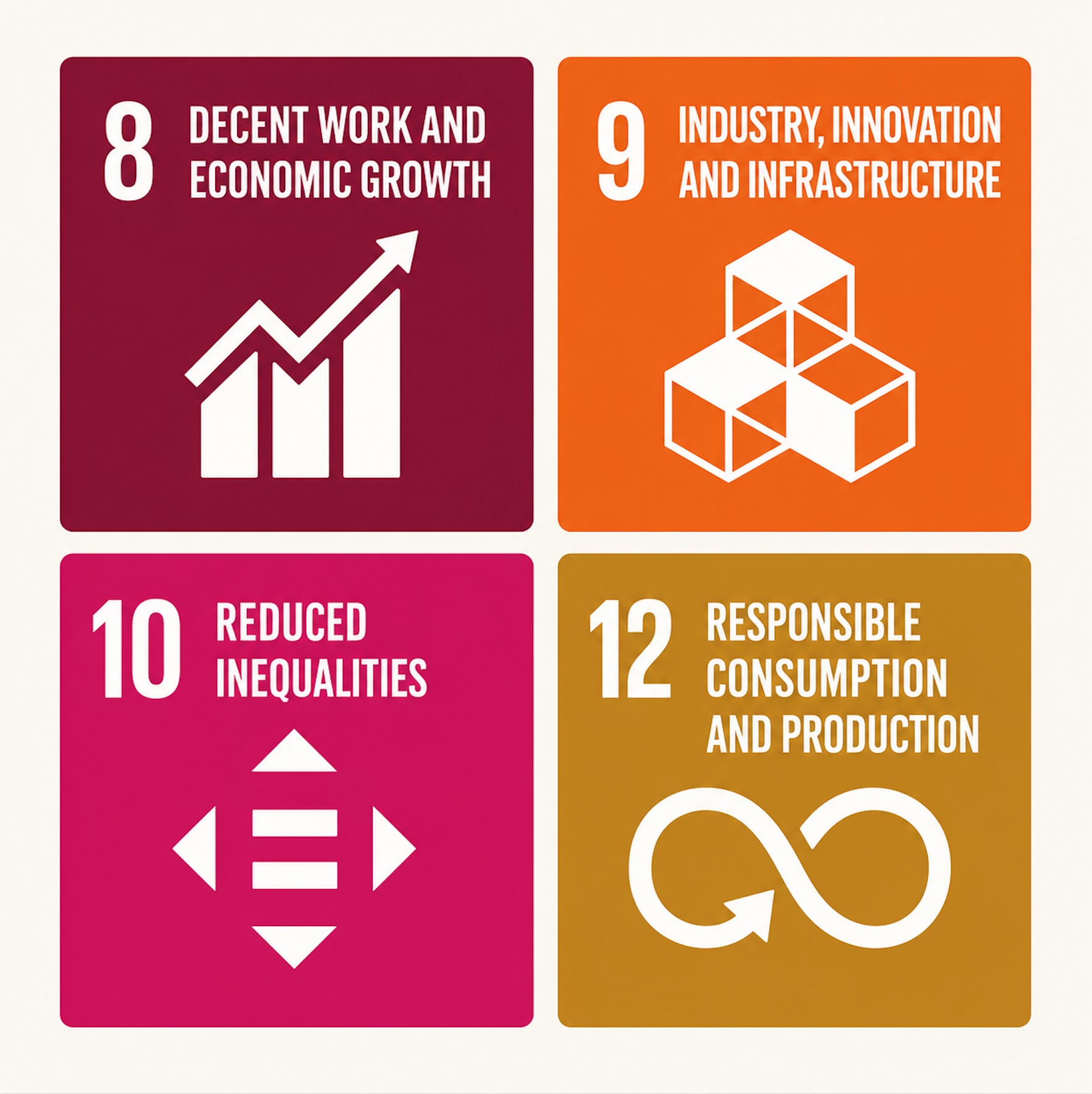
The model places economies within societies, and societies within the biosphere. Environmental, social, and economic development are therefore nested within the same living system rather than treated as separate projects competing for attention. Its economic tier contains SDGs 8, 9, 10, and 12: decent work and economic growth; industry, innovation, and infrastructure; reduced inequalities; and responsible consumption and production (Rockström & Sukhdev, 2016; United Nations, 2015).
In the first part of this series, I examined the living foundation beneath musical life: water, climate, energy, materials, biodiversity, and the ecological conditions that allow people and cultures to continue. In the second, I moved into the social tier: health, food, education, equality, peace, community, and the institutions that shape whether people can participate.
The economic tier asks how those conditions are organized, valued, and distributed.
Who has time? Who has tools? Who performs the labor? Who receives compensation, recognition, ownership, and opportunity? Who carries the risk? What resources are consumed? Which forms of musical life can continue—and which become possible only for people who can afford the entrance fee?
These questions already live inside music classrooms. They appear when a student is asked to record something at home, when instruments are assigned, when travel is required, when unpaid family labor keeps a program functioning, or when some forms of musicianship receive institutional investment while others remain less visible.
Some traditions enter funding and scheduling conversations with established legitimacy. A request to support an orchestral string program, for example, may be understood as a routine part of school music because large-ensemble models grounded primarily in Western classical traditions have long occupied a dominant position in U.S. music education (Heuser, 2011; Johnson, 2004). Mariachi educators, by contrast, have described needing to establish and defend their programs’ legitimacy while navigating institutional barriers and established school-music norms (Tucker et al., 2026).
Those unequal starting positions can shape which programs receive curricular time, academic credit, staffing, facilities, and sustained financial support. The difference is not simply which instruments schools purchase—violins belong to both orchestral and mariachi traditions—but which forms of musical knowledge institutions are already organized to recognize and sustain.
I first encountered a smaller version of this distinction at the first school where I taught, where more than fifty languages were spoken in students’ homes. The first time I played “Happy Birthday” for the class, I automatically began with the version I had grown up hearing. Several students stopped me.
“Wait, Mr. Bartlett—that isn’t the version we sing at home.”
It was a formative lesson for me as both a teacher and a person. Even something I had assumed was culturally universal existed in multiple forms, carried through different languages, families, and traditions. What felt standard to me was only one version—one that happened to arrive in the classroom already recognized.
That moment points toward a larger institutional question: Which forms of musical knowledge enter school already treated as standard, and which become visible only when students interrupt the curriculum to name what it has overlooked?
Those judgments can shape economic investment. Schools are more readily able to fund, schedule, staff, and award credit to musical practices that fit structures they already recognize. Other practices may remain dependent upon individual teachers, volunteer labor, extracurricular time, or students’ willingness to introduce knowledge the institution has not yet learned to recognize (Heuser, 2011; Johnson, 2004; Tucker et al., 2026).
In my regional survey of 102 K–12 music educators, the economic dimension was the least frequently recognized of the four dimensions of sustainability I presented, selected by 41.2% of respondents (Bartlett, 2025). That result makes sense to me. Teachers encounter budgets, access, labor, technology, purchasing, and inequality constantly, but they are rarely given a framework that reveals these as parts of the same system.
The central question, then, reaches beyond how much money music generates:
What has to be economically possible for someone to have a musical life—and who receives those conditions?
SDG 8 brings together employment, decent work, labor rights, creativity, entrepreneurship, productivity, and resource efficiency (United Nations, 2015). Its language matters because musical work is surrounded by a persistent contradiction: music is woven throughout social life, yet much of the labor that produces it remains unseen or precarious.
The performer is visible. The composing, arranging, teaching, rehearsing, transporting, repairing, promoting, scheduling, administering, recording, editing, and emotional labor surrounding the performance may be much harder to see.
A UNESCO report on employment in cultural and creative industries found that 40% of workers in the sector earn less than their national minimum wage, while informality, precarity, and gender disparities remain deeply entrenched (UNESCO, 2026). Loving the work does not make insecure conditions decent. Exposure does not substitute for compensation. Entrepreneurship can open real possibilities, but it cannot repair labor systems that transfer nearly all risk to individual creators.
For music educators, the immediate invitation is not to turn every student into a professional musician or small-business owner. It is to make musical labor perceptible.
Who tuned the piano? Who wrote the arrangement? Who loaded the equipment? Who made the software? Who taught the technique? Who booked the room, secured the permissions, ran the sound, or cleaned the space afterward? Which contributions receive applause, and which disappear into the background?
Students can learn to hear more than the finished product. They can learn that music becomes possible through networks of skill, knowledge, care, and work. That recognition can support more honest conversations about careers, but it also matters for students who never pursue music professionally. It teaches them to notice how value is created—and how easily some contributors are omitted from the story.
Imagine a young person producing a track on a borrowed laptop.
The technology may look like an equalizer. A single device can contain instruments, recording equipment, editing tools, an archive of musical references, and a route to an audience. Yet the apparent simplicity conceals an infrastructure.
The student may also need reliable electricity, broadband, storage space, compatible software, functioning headphones, a quiet place, time that is not already claimed by work or caregiving, and enough technical knowledge to solve problems when something stops working. They may need accessible interfaces, a school network that does not block the platform, and an adult who recognizes beat-making as legitimate musical learning rather than time spent “playing on a computer.”
SDG 9 concerns sustainable and resilient infrastructure, innovation, technological capacity, and affordable, equitable access. Its targets include infrastructure that supports human well-being and wider access to information and communications technology (United Nations, 2015). In musical life, infrastructure includes much more than concert halls and rehearsal rooms. It includes broadband, libraries, studios, community centers, public spaces, repair systems, archives, transportation, devices, software, and the social networks through which knowledge travels.
This is where economist Amartya Sen’s capability approach offers a useful distinction. Rather than evaluating well-being through income or resources alone, the capability approach asks what people are genuinely able to do and become with the opportunities available to them (Sen, 1999).
A student can technically possess a device without having a genuine opportunity to create. An instrument may be available during school while remaining inaccessible for home practice. A free app may still require a newer phone, data, privacy, technical fluency, or an account that the student cannot create.
Equal resources do not automatically produce equal capabilities because people encounter those resources through different bodies, schedules, responsibilities, histories, and environments (Sen, 1999).
That changes the teacher’s question. Beyond asking whether a resource was made available, we might also ask:
What does this opportunity quietly require before a student can actually use it?
SDG 10 focuses on reducing inequalities by expanding inclusion, equal opportunity, representation, and more equitable outcomes (United Nations, 2015). In music, inequality is frequently discussed through the price of participation: instruments, lessons, uniforms, travel, fees, software, tickets, or devices.
Those costs matter. They are also only part of what is distributed.
Music programs distribute time with the teacher. They distribute desirable instruments, advanced courses, solos, leadership, feedback, public visibility, access to technology, and invitations into professional networks. They distribute messages about which musical knowledge counts, who appears talented, what professionalism looks like, and which forms of participation deserve institutional space.
Outside schools, platforms and industries distribute attention, discoverability, ownership, revenue, and risk. Communities may create musical forms and knowledge that others later package, teach, record, or profit from. A person can be heard widely while retaining little control over the conditions of that visibility.
None of this means that every unequal result originates in one classroom decision. Teachers work within schedules, budgets, traditions, policies, facilities, and inherited program structures that they did not create. Awareness does, however, make local patterns easier to examine.
What is being distributed here besides money? Who consistently receives more of it? What does participation assume about transportation, prior training, family schedules, disability, technology, language, or unpaid time? Where could one gate be lowered without pretending that a local adjustment solves the larger system?
These are questions for working underneath the hood of one’s own context. The answers will differ across schools and communities. They also become more accurate when students and families are treated as sources of knowledge rather than merely recipients of a teacher’s solution.
Every instrument, microphone, laptop, speaker, cable, stage light, uniform, piece of merchandise, and touring vehicle enters musical life through material systems. Even apparently immaterial forms of music depend upon bodies, energy, devices, storage, networks, and places.
SDG 12 addresses sustainable consumption and production, including the management of natural resources, waste prevention, reuse, sustainable procurement, and public awareness of the consequences of consumption (United Nations, 2015). It brings the economic tier back down into the biosphere.
A music program constantly acquires, maintains, shares, stores, repairs, and eventually disposes of things. The most useful educational question may therefore reach beyond whether an item belongs in a recycling bin.
How long was it designed to last? Can it be repaired locally? What knowledge disappears when replacement becomes easier than maintenance? Which materials and forms of labor produced it? Who bears the environmental cost after it leaves the classroom?
Consider the difference between replacing a damaged instrument and sustaining a repair ecology. Repair requires skilled people, tools, parts, institutional memory, time, and a financial model that allows the work to continue. It can preserve materials, extend access, support local livelihoods, and teach a different relationship to objects: one shaped by durability and stewardship.
This does not mean every purchase is irresponsible or that teachers should audit global supply chains before ordering a cable. Musical life participates in material systems, and those systems can be made available for inquiry.
Students might follow one object backward: an instrument, controller, pair of headphones, vinyl record, or phone. What had to happen before it arrived? What will happen after it is discarded? Who and what remain outside the frame when we see only the finished object?
Economic language can make music educators uneasy because it often seems to ask music to prove itself through jobs, revenue, tourism, test scores, or some other external return. Those outcomes can matter. They do not contain the whole value of musical life.
A lullaby passed through a family may have little market price. A community song may sustain memory without creating a measurable financial return. Friends making music in a living room, a congregation singing together, a teenager building a private world through headphones, or an elder teaching a child how a song belongs within a ceremony may never appear in an economic-impact report.
Yet these practices still require conditions. People need time, safety, health, space, continuity, and some measure of control over their cultural lives. A society’s economy influences whether those conditions are widely available or increasingly reserved for people with money, flexibility, infrastructure, and institutional recognition.
This is why the capability question matters. A healthy musical economy should be judged partly by whether people possess real opportunities to create, learn, listen, participate, work, inherit, transform, and share music in forms they have reason to value (Sen, 1999).
Music has economic value. It also carries artistic, social, personal, civic, and cultural forms of value that exceed price. Economic sustainability should create conditions under which those values can continue without requiring every musical practice to become profitable before it deserves support.
Return to the song paused before its first sound.
The biosphere is there in the materials, energy, water, climate, bodies, and living systems upon which the music depends. Society is there in education, health, nourishment, safety, culture, equality, community, and the institutions that allow people to gather and participate. The economy is there in the distribution of time, labor, tools, infrastructure, ownership, recognition, opportunity, and material resources.
The wedding cake is a single living arrangement viewed at different scales.
For a music educator, this does not create an obligation to add four more goals to an already crowded curriculum. It offers a more accurate picture of what is already happening.
An instrument assignment can carry questions about access and capability. A recording project can reveal infrastructure and ownership. A performance can make invisible labor visible. A purchasing decision can open questions about durability and repair. A piece of music can become a map of the human and material systems that allowed it to exist.
Perhaps the most portable place to begin is with three questions:
Before the first sound, what had to be available?
Who contributed labor, knowledge, materials, attention, or care—and who received compensation, recognition, ownership, or opportunity?
What assumption about time, cost, equipment, technology, or participation could be reconsidered in this particular context?
A sustainable musical economy would not be measured only by how much revenue music generates. We would also see it in whether people possess genuine opportunities to enter and shape musical life—and whether those opportunities can continue without hiding intolerable costs in another worker’s precarity, another community’s exclusion, or another generation’s depleted world.
What would it take for more people not only to hear music, but to enter, shape, sustain, and call a musical life their own?
If any of this resonated—or if you think I am getting something wrong—I would genuinely like to hear from you in the comments. And if there is a topic you would like me to dig into—something that has been sitting with you, something you cannot quite find good writing on—please reach out. That kind of signal genuinely shapes what I write next.
If you are finding value here, subscribing—even at the free level—helps this work reach more people. So does liking, commenting, and reposting. In a crowded information environment, those small actions matter more than most people realize. I notice every one of them, and I am sincerely grateful for each.
Thank you for reading. It means more than I can easily say.
I am an independent scholar with a PhD in education, writing about sustainability, Education for Sustainable Development, and the future of learning. I am available for research collaboration, consulting, and teaching opportunities—linkedin.com/in/kylecbartlett.
Share Teaching for a Complex World
Bartlett, K. C. (2025). Education for Sustainable Development in K–12 Music Education: A Survey Study of Teacher Perspectives and Practices in the Southwestern United States [ProQuest Dissertations & Theses]. https://www.proquest.com/docview/3281118753?pq-origsite=primo&accountid=4485
Heuser, F. (2011). Ensemble-based instrumental music instruction: Dead-end tradition or opportunity for socially enlightened teaching. Music Education Research, 13(3), 293–305. https://doi.org/10.1080/14613808.2011.603043
Johnson Jr., B. L. (2004). A Sound Education for All: Multicultural Issues in Music Education. Educational Policy, 18(1), 116–141. https://doi.org/10.1177/0895904803260028
Rockström, J., Steffen, W., Noone, K., Persson, Å., Chapin, F. S., Lambin, E., Lenton, T. M., Scheffer, M., Folke, C., Schellnhuber, H. J., Nykvist, B., de Wit, C. A., Hughes, T., van der Leeuw, S., Rodhe, H., Sörlin, S., Snyder, P. K., Costanza, R., Svedin, U., … Foley, J. (2009). Planetary Boundaries: Exploring the Safe Operating Space for Humanity. Ecology and Society, 14(2). https://doi.org/10/gd53h4
Sen, A. (2001). Development as freedom. Oxford University Press. https://raggeduniversity.co.uk/wp-content/uploads/2025/01/1_x_senDevelopmentasFreedom-_compressed.pdf
Stockholm Resilience Center. (2016, June 14). The SDGs wedding cake [Text]. https://www.stockholmresilience.org/research/research-news/2016-06-14-the-sdgs-wedding-cake.html
Tucker, O. G., Nicholson, G., & Knight, T. C. (2026). “Hey, Our Program Is Legitimate”: A Phenomenology of Mariachi Educators’ Experiences in Public Schools. Journal of Research in Music Education, 00224294251414651. https://doi.org/10.1177/00224294251414651
UNDESA. (2015). Transforming our world: The 2030 Agenda for Sustainable Development | Department of Economic and Social Affairs. https://sdgs.un.org/2030agenda
UNESCO. (2026). Skills and employment in the culture and creative industries: Strategic frameworks and promising initiatives. UNESCO. https://doi.org/10.54675/WAFG1116
United Nations. (n.d.). Communications materials. Retrieved June 4, 2026, from https://www.un.org/sustainabledevelopment/news/communications-material/
No posts
Comments
Nothing yet. Say the first thing.
Sign in to join the conversation.