
Last week, I gave a talk at the Wellcome Trust on evidence and uncertainty for their 90th anniversary celebrations. One of the things I talked about was how populations and scientists respond to shifting situations and emerging challenges. In particular, I’ve thought a lot in my research and writing about the default responses that can crop up when faced with a new threat.
From COVID to climate change, I’ve noticed that there can be a tendency for people to drift into either complacency (“it will all be fine”) or fatalism (“we’re all screwed anyway”). But why does this happen?
Carissa Véliz’s recent book Prophecy got me thinking more about how this issue fits with the wider science of causality. Prophecy makes the point that many ‘predictions’ that are framed as inevitable (e.g. “AI will take all the jobs”) are really attempts by people with vested interests to shape the future.
It occurred to me that the inverse of this behaviour explains the problem with default responses to emerging challenges. Complacency (“it will all be fine”) or fatalism are both attempts to use prediction to avoid shaping the future:
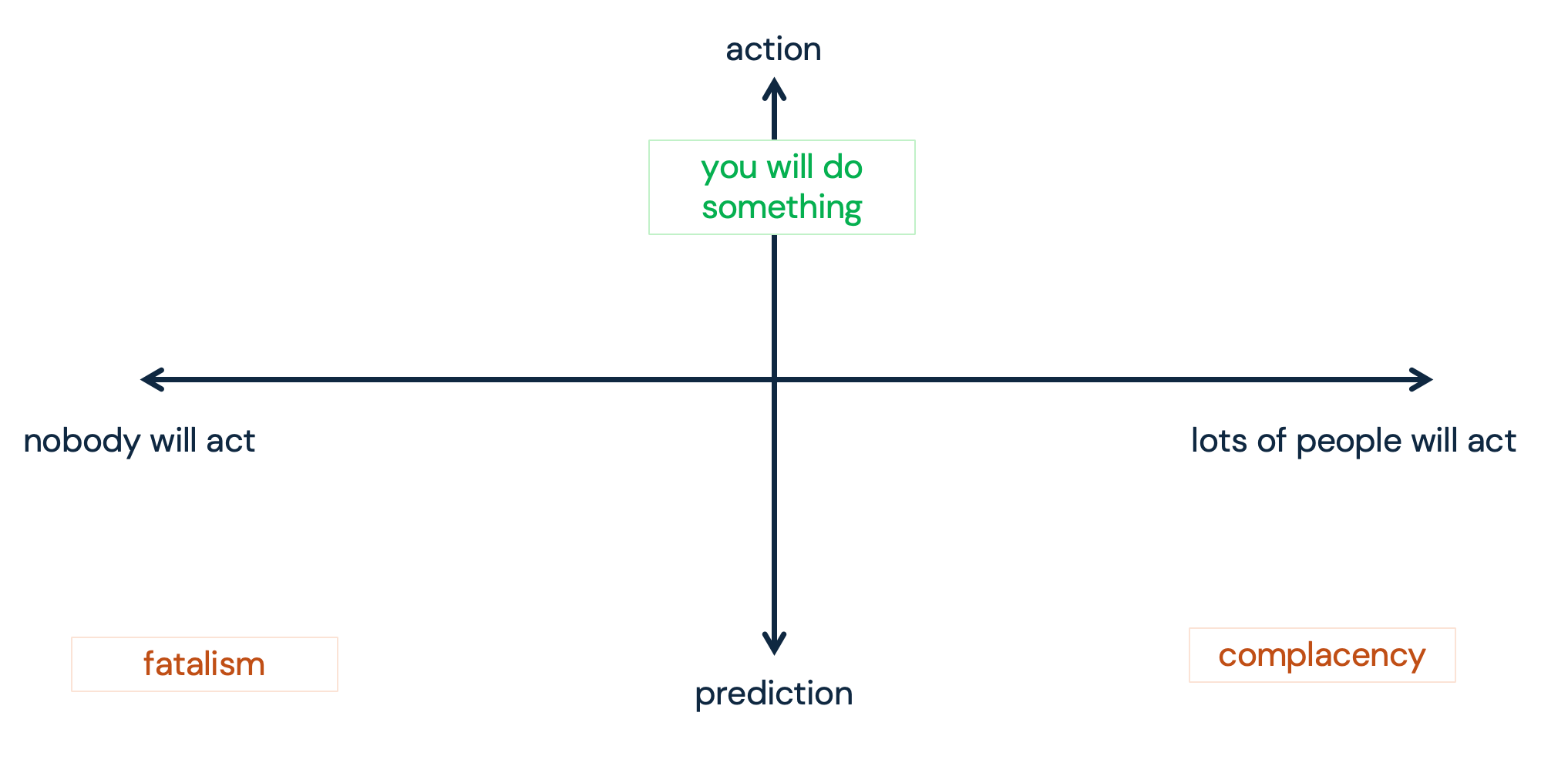
Producing an accurate prediction is hard, but making a prediction is arguably far too easy. In life – and in scientific research – focusing on prediction is generally much less work than considering cause-and-effect and our role in it.
While writing Proof, I spoke with Julia Rohrer, who made a good point that there is often a disconnect between what people are actually interested in, and what commonly gets studied in fields like psychology. As she put it: ‘Psychologists always talk about prediction, but they never have a use case.’
Nobody wants a prediction that their relationship is about to go downhill; they want to know why, and what to do about it. That’s a much harder question, both to research in theory and tackle in practice.
So the next time you’re tempted to default to complacency or fatalism, take a moment to consider whether your prediction is actually just an attempt to avoid taking action.
Thanks for reading Understanding the unseen! This post is public so feel free to share it.
No posts
Comments
Nothing yet. Say the first thing.
Sign in to join the conversation.