
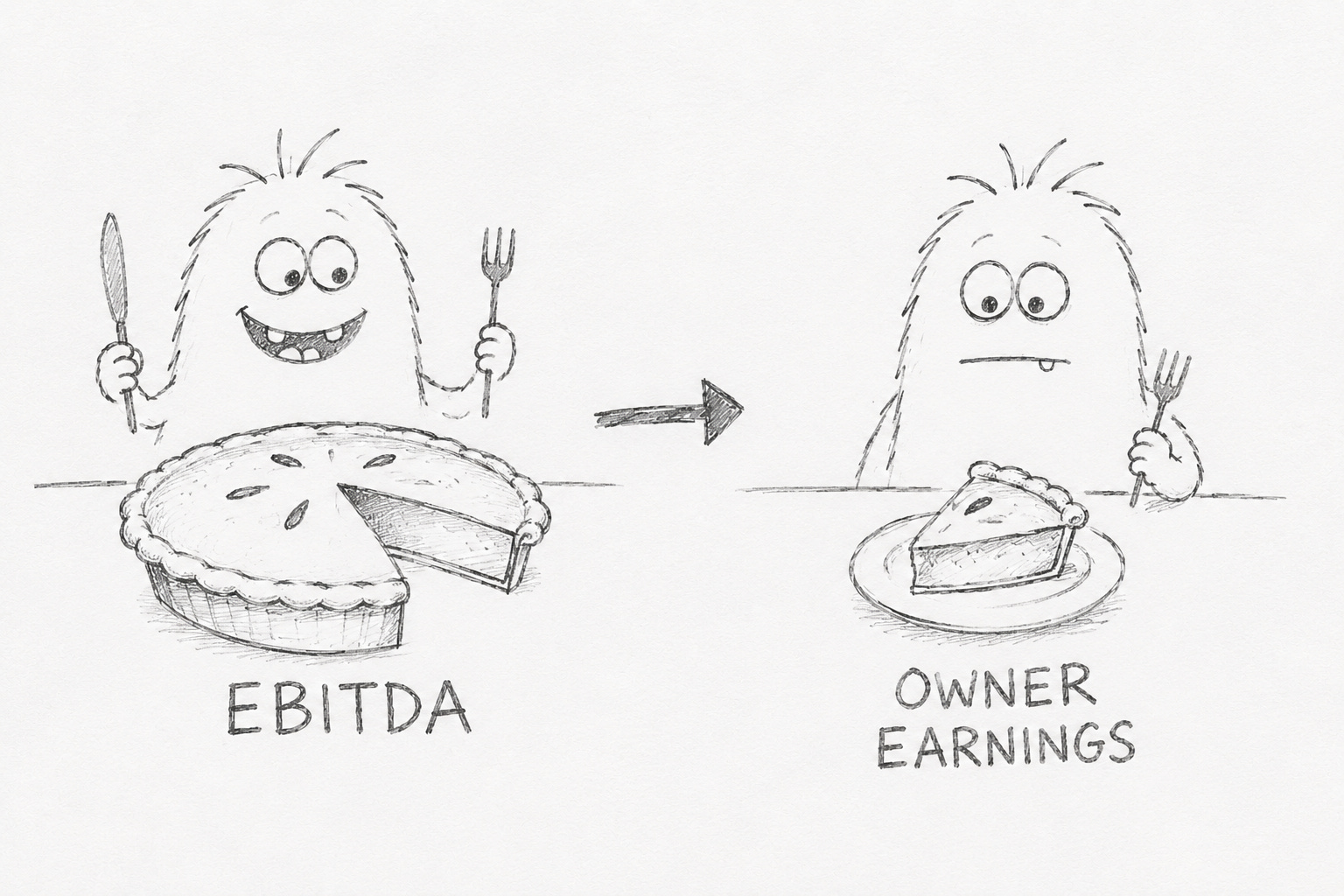
Earnings Before Interest Taxes Depreciation and Amortization (EBITDA).
These are the earnings of a company before taking into consideration the depreciation of its equipment, interest from its debt, and amortization of its intangible assets.
Or as Charlie Munger calls it:
“bullshit earnings”
Here is a video where him and Buffett speak about it (It is worth watching from beginning to end):
We have all heard this before but I still meet many smart practitioners who ignore an important truth about EBITDA and how it should be used in evaluating performance.
I know a lot of people who abide by this rule, and as a result focus on Net Income After taxes (NIAT) as the single source of truth for performance. This is a prudent way to look at company, but it is not the most realistic way to look at a company.
Charlie and Warren, after stating how EBITDA has been abused, missed stating the importance of carefully using depreciation depending on the type of company you are looking at.
Warren is famous for saying “we like businesses that don’t need a lot of money to make a lot of money.” He said this in last year’s shareholder meeting when making reference to Coca Cola and how they are shifting away from bottling.
Having asset light businesses that spit out cash is the holy grail, but in reality Berkshire owns many attractive assets in heavy industry such as BNSF (railroads), Berkshire Energy (utilities and energy), Precision Castparts (aerospace manufacturing), Clayton Homes (manufactured housing), Net Jets (to the extent they own planes for maintenance), and others. Even See’s Candies has its own manufacturing for its chocolates.
So the question is: with businesses that have heavy assets, how does one assess true performance when depreciation can cloud the true nature of a business?
Let’s give an example of a power plant:
Assume an investor builds a power plant for $1 billion. And let’s say the plant is depreciated over 20 years, which gives an annual depreciation expense of $50 million per year.
The plant generates the following annual operating results:
Revenue: $220 million
Operating costs: $120 million
EBITDA: $100 million
Depreciation: $50 million
EBIT: $50 million
Interest expense: $20 million
Pre-tax income: $30 million
Under GAAP accounting, the business appears to earn only $30 million before tax on a $1 billion investment.
That’s a pre-tax income margin of 3%.
When you look at this you have to ask yourself “Does this represent the true economics of the business?”
Suppose that during the year, the plant only required:
$15 million of actual maintenance capex for servicing, repairs, and sustaining operations.
In that case, the true recurring cash generation of the business is much closer to:
EBITDA: $100 million
Less maintenance capex: ($15 million)
Less interest expense: ($20 million)
Approximate recurring pre-tax owner earnings: $65 million
Maintenance capex is the real amount you spend to maintain your equipment to fully maintain its long-term competitive position. This number can be very different (and often times is different) from depreciation.
This produces a very different economic picture from the GAAP result of $30 million.
I run a bakery business and we have a manufacturing facility (commissary) that is the engine for our store operations, and when we started, I was scratching my head on how best to portray the true economics of our business. It is very different to compare ours to another chain of stores with no commissary. So I dug a little bit deeper and found a 1986 shareholder letter from uncle Warren, and in it it says:
If we think through these questions, we can gain some insights about what may be called "owner earnings." These represent (a) reported earnings plus (b) depreciation, depletion, amortization, and certain other non-cash charges such as Company N's items (1) and (4) less ( c) the average annual amount of capitalized expenditures for plant and equipment, etc. that the business requires to fully maintain its long-term competitive position and its unit volume. (If the business requires additional working capital to maintain its competitive position and unit volume, the increment also should be included in ( c) . However, businesses following the LIFO inventory method usually do not require additional working capital if unit volume does not change.)”
Cash Flow”, true, may serve as a shorthand of some utility in descriptions of certain real estate businesses or other enterprises that make huge initial outlays and only tiny outlays thereafter. A company whose only holding is a bridge or an extremely long-lived gas field would be an example. But “cash flow” is meaningless in such businesses as manufacturing, retailing, extractive companies, and utilities because, for them, ( c) is always significant. To be sure, businesses of this kind may in a given year be able to defer capital spending. But over a five- or ten-year period, they must make the investment - or the business decays.
Why, then, are “cash flow” numbers so popular today? In answer, we confess our cynicism: we believe these numbers are frequently used by marketers of businesses and securities in attempts to justify the unjustifiable (and thereby to sell what should be the unsalable). When (a) - that is, GAAP earnings - looks by itself inadequate to service debt of a junk bond or justify a foolish stock price, how convenient it becomes for salesmen to focus on (a) + (b). But you shouldn’t add (b) without subtracting ( c) : though dentists correctly claim that if you ignore your teeth they’ll go away, the same is not true for ( c) . The company or investor believing that the debt-servicing ability or the equity valuation of an enterprise can be measured by totaling (a) and (b) while ignoring ( c) is headed for certain trouble.
To sum up: in the case of both Scott Fetzer and our other businesses, we feel that (b) on an historical-cost basis - i.e., with both amortization of intangibles and other purchase-price adjustments excluded - is quite close in amount to ( c) . (The two items are not identical, of course. For example, at See’s we annually make capitalized expenditures that exceed depreciation by $500,000 to $1 million, simply to hold our ground competitively.) Our conviction about this point is the reason we show our amortization and other purchase-price adjustment items separately in the table on page 8 and is also our reason for viewing the earnings of the individual businesses as reported there as much more closely approximating owner earnings than the GAAP figures.
Questioning GAAP figures may seem impious to some. After all, what are we paying the accountants for if it is not to deliver us the “truth” about our business. But the accountants’ job is to record, not to evaluate. The evaluation job falls to investors and managers.
Accounting numbers, of course, are the language of business and as such are of enormous help to anyone evaluating the worth of a business and tracking its progress. Charlie and I would be lost without these numbers: they invariably are the starting point for us in evaluating our own businesses and those of others. Managers and owners need to remember, however, that accounting is but an aid to business thinking, never a substitute for it.
This is not something that is explained when Warren and Charlie were on stage. On stage, they stopped short of criticizing EBITDA without going a step further on how they actually evaluate businesses. In the 1986 letter, he is saying the best way to evaluate earnings for businesses that have depreciation is:
Owner Earnings =
A (Net Income)
+ B (Depreciation + Amortization and non cash charges)
- C (the amount of capitalized expenditures for plant and equipment, etc. that the business requires to full maintain its long term competitive position and its unit volume)
It is also wrong to assume that if EBITDA is flawed, then NIAT is automatically the only correct way to evaluate business performance. It also surprises me that Owner Earnings (despite its importance) is less frequently used by finance professionals.
In heavy industries, the skill of management is on how they maintain assets and this is reflected when calculating Owner Earnings. Buying cheaper and less reliable assets will probably result in faster depreciation vs investing in high quality ones. This has to be scrutinized.
Another thing: if you are a startup that is building out some fixed assets, your early years should show minimal maintenance capex, and will likely show heavier maintenance towards the later years, as Warren alludes to about Sees in the commentary above. This is because new companies have brand new equipment with warranties. In this case EBITDA will match (or closely match) Owner Earnings. This should be considered when looking into an early stage brick and mortar business.
I would go a step further in evaluating businesses, and this has helped me when looking at companies like Crocs (whose previous GAAP earnings were low due to impairment charges. Not operational in nature) and Hershey’s (manufacturer of chocolates), two public company stocks I have held since last year.
Owner earnings is about understanding what the owners (i.e. the shareholders) get at the end of the year, and understanding what is recurring vs non-recurring is something that Buffett does not state in this shareholder letter, but I assure you he considers when he adjusts earnings further.
Owner Earnings =
A (Net Income)
+ B (Depreciation + Amortization and non cash charges)
- C (the amount of capitalized expenditures for plant and equipment, etc. that the business requires to full maintain its long term competitive position and its unit volume)
+/- D (non-recurring expenses and gains)
These steps are critical on how businesses should be evaluated that often go overlooked in most finance text books, and should be useful for all managers and leaders.
Questioning GAAP (or PFRS for Philippines standards) may seem illogical to many. After all, what are we paying accountants for if not to deliver the “truth” about a business? But as Buffett says, accounting is a tool for recording, not a tool for true performance.
This does not mean GAAP should be ignored. It is the foundation for understanding business. But the real task is to be objective when evaluating and to seek truth underneath the accounting presentation.
So the next time someone says NIAT is the only correct way to value a business, remember that real businesses are more complex than a single accounting number.
ABOUT THE AUTHOR
Keenan Ugarte is Managing Partner at DayOne Capital Ventures, an independent private holding company that invests in and builds high-growth, early-stage businesses that serve the Philippine mass market.
No posts
Comments
Nothing yet. Say the first thing.
Sign in to join the conversation.