
While I was in LA, I decided to check out the Getty Museum. The place was really about his art and collections and less about the history of the man himself, but something got me curious about him and how he built his businesses. In 1957 J. Paul Getty was considered the richest man in the world, mainly from oil. I did hear stories about his frugality and odd tendencies, and there is a movie about him (which I haven’t seen). As I was checking out of the museum, they had a copy of one of his books:
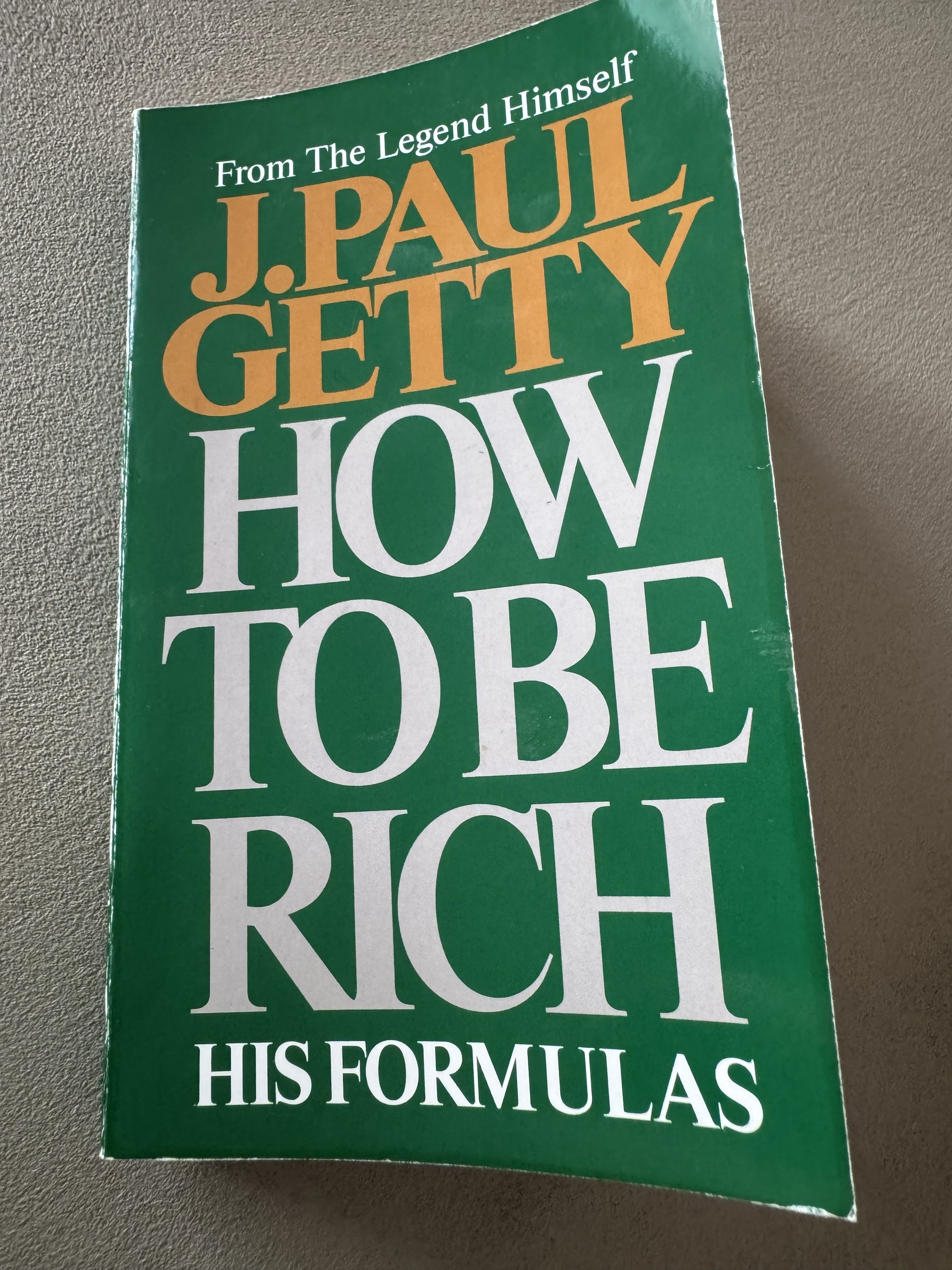
The title sounded obnoxious but intriguing. If there was one man who could give this advice, it would be him. I also learned that it was featured in the Founders Podcast, which tells me there is something worthy about this book. So I picked it up.
This book started as a series of “business advice” articles that Hugh Hefner invited Getty to write for Playboy magazine. As Getty explored the topic in more depth he started to go deeper into the subject, and the articles grew into what became this book: How to be Rich.
I read the book front to back on a single flight from LA to Manila, and I have to say it was full of valuable lessons. There is so much more about this book than a simple “How to”. It is a philosophical mindset that results in wealth accumulation. He even has a section about how he invests in the stock market and it is shockingly similar to the way modern value investors invest, and keep in mind this was written in 1965. This guy not only knew business, but he was a master at capital allocation.
Here are some of the biggest lessons from the book:
Getty keeps repeating that true wealth comes from owning assets:
Businesses
Real estate
Oil fields (in his case)
Investments that produce income
The big lesson is that trading time for money has limits and nobody can breach those limits. There is a reason why you are hired, so the insitution hiring you can leverage your talents for their own benefit.
Building or owning things that generate value while you’re not working creates leverage. This is the type of leverage needed in order to accumulate wealth, but it sacrifices short term liquidity (cash). Ironically, he kept emphasizing how he felt poor in cash and that most of his wealth were tied to his businesses.
In the book he has a strong quote:
“There were no secrets, no mystical formulas behind these successes. I operated in much the same manner as did almost all wildcatters — with one important exception. In those days, the science of petroleum geology had not yet gained very wide acceptance in the oil fields. Many oilmen sneered openly at the idea that some “damned bookworm” could help them find oil. At best, the vast majority of oilmen were skeptical about geology as a practical science and put little stock in geologists reports. I was among the few who believed in geology. I studied the subject avidly at every opportunity, and applied what I learned to my operations.”
This reminds me of the mentality of Munger and Buffett. The whole idea of “Turning a page” is what they say gives them an edge at Berkshire, but most people don’t do that.
The lesson: turn a page and learn your subject areas more than the average. Read books and study intensely.
One of Getty’s most famous traits was frugality.
His point wasn’t “never spend money.” He just made it a point to preserve the right amount of capital to accumulate real wealth, and to do that you need to limit the unnecessary stuff.
Small habits of spending compound to something larger over time.
Wealthy people stay wealthy because they control spending.
Many people focus on earning more while ignoring leaks in their finances.
The lesson is to spend for things that clearly add value to your life, and nothing more.
Here is a nice line:
I’ll wager that most firms could slash their entertainment budgets by 50% or more without losing a single sale. I can take a drink or two myself, but I’ve observed that one generally does far more business in 15 minutes over a cup of coffee than he can possibly do in three hours over a six-martini lunch” “There is no rule that requires all salesmen and executives in a company to fly “deluxe” wherever they go, when they can get where they’re going just as fast, almost as comfortably (and at a much lower cost) on tourist flights.
There are many other areas that the smart young businessman will find that he can effect economies. There is always room for improvement and for savings, in business or for the home office.
I’m not advocating senseless penny pinching. I am saying however that there is no excuse for waste or unnecessary expenditures if one is faced with heavy competition.
In any all-out business battle to capture markets, it is necessary to reduce all costs wherever possible — an axiom some firms and individuals tend to forget during peak boom periods.
This leads to the next one.
He keeps mentioning what his father taught him about how to use money. Money was not meant to be abused but to be used to benefit society, and as a result yourself. He mentions in the book that he didn’t really know what that meant until a few years of business. But the whole idea is reflected in this quote:
An individual had to work to justify his existence, and that a rich person had to keep his money working to justify its existence. My father tried to impress upon me that a businessmen’s money is capital to be invested and reinvested.
“You’ve got to use your own money to create, operate, and build businesses,” he argued. “Your wealth represents potential jobs for countless others — and it can produce wealth and a better life for a great many people as well as for yourself.”
Across the book he gives examples of contrarian plays, and some of his greatest investments were made when the crowd was against him, but he went after it based on his own independent judgment.
Here is a good one:
“In business, it is never easy to go against the beliefs and attitudes held by the majority. The businessmen who moves counter to the tide of prevailing opinion must expect to be obstructed, derided and damned. So it is with me when, in the depths of the US economic slump of the 1930s, I resolved to make large scale stock purchases and build a self contained oil business. My friends and acquaintances — to say nothing of my competitors — felt my buying spree would prove a fatal mistake. Then, when I announced my intention to buy into one of the seven major oil companies operating in California, even those who had been my supporters in the past were inclined to believe I had taken leave of my senses.”
This reminds me of a famous line by Buffett when he says:
“You’re neither right nor wrong because other people agree with you. You’re right because your facts are right and your reasoning is right—that’s the only thing that makes you right. And if your facts and reasoning are right, you don’t have to worry about anybody else.”
So the lessons here is stay independently minded and focus on the facts and pursue opportunities that are factually correct, while ignoring the noise. This is something that is not easy to do as human nature drives us to do things to “fit in”. Fitting in is beta. going against convention is alpha.
Getty describes many deals that took years to work out. It wasn’t about his brilliance or one single idea. It was about creating something, facing the struggle of creating, and always making it better and better despite the struggles. Wealth is accumulated through constant force of creating and facing the pains of that creation, which he highlights throughout the book.
This goes against the common believe today that wealth is about one genius idea or building that single app.
His view is that it takes time to build something, so the ones who are most persistent and almost stubborn will get what they deserve.
He believed:
Most people quit too early.
Success belongs to the person who stays in the game longest.
Endurance is a competitive advantage.
He didn’t care for reckless gambling, but he did believe that to accumulate wealth you needed to have a mindset of risk taking. But he labelled these as calculated risks. Knowing the downside and the upside, and living with the result of both.
Most people today only focus on the upside. This goes in business and in investing. But knowing the downside is critical to all pursuits.
This reminds me of the saying of Mohnish Pabrai: “Heads I win, tails I don’t lose much.” This is also emphasized by Seth Klarman in Margin of Safety where he talks about positioning yourself far enough from intrinsic value so it becomes all upside regardless of the outcome.
Buffett had a famous saying:
“If you’re going to drive a 10,000-pound truck across a bridge, you don’t build a bridge that can only hold 10,000 pounds. You build one that can hold 15,000 or 20,000 pounds.”
Throughout the book, Getty emphasizes this and he goes through examples.
Lesson:
Gather information.
Understand the downside.
Make a decision when the odds are favorable.
Many people either avoid risk entirely or take uninformed risks. Getty preferred informed risk-taking.
Getty stresses that relationships are built over time and it is important to maintain important relationships. Your reputation is everything and it takes time to develop it. Nurture them and maintain them. Trust becomes a form of capital.
People bring opportunities, people share information, and people become lifelong partners for growth. That was his mindset.
He believed that building something with purpose and passion was more important than the desire to accumulate wealth. Wealth is a byproduct of it.
He believed in the maxim from Sir Francis Bacon “No man’s fortune can be an end worthy of his being.” He said that in his life it was never money as an end state that drove him, it was the challenge of business and seeking purpose in those achievements and to build something lasting for society.
The important things were:
Freedom to choose work
Freedom to refuse bad deals that might eat up time.
Freedom from financial anxiety
Getty saw wealth has having control over one’s life in all aspects including purpose and passion.
There is a chapter in the book where he talks about how wealth is more than money, as one has to have deeper meaning around time, health and family. He failed when it came to family and he admits it in the book, but he does not know how to pursue greatness without sacrificing family as it was a struggle for him.
He had 5 different wives and after his last wife, he never remarried.
But he did emphasize that there is more to money, almost like telling the reader not to make the same mistake and to look at wealth differently. He links this to your own values and to look deeply into what you value most in life.
Getty became one of the richest people on Earth, but he had personal troubles:
Multiple marriages
Family conflicts
Loneliness
He goes on to talk about his cousin Hal, who he was envious about. Not because he was rich in cash and possessions, but because of how he lived his life with freedom and in control of his time.
Towards the end of the book he dedicated chapter on how to deal with the stock market, and his methods are shockingly similar to some of the top value investors today.
“Sound stocks, purchased for investment when their prices are low and held for the long pull , are very likely to produce high profits through increases in value”
He also goes on to say that any surplus capital (from business) should go into stocks for the long run.
He emphasizes the nature of Wall Street and how the crowd is predominantly short term in nature and highly emotional. His focus is on high quality companies serving the oil industry, an industry he knows well. He even goes on to the fact that he is weak in understanding other industries but he knows the oil industry well, and invests accordingly. This is similar to Warren Buffett’s margin of safety. For this to be written in 1965, he was ahead of the curve when it came to insights on margin of safety, circle of competence , compounding, and the art of long term investing.
That’s it. There are other areas he explores around building good habits and the decay of American culture (he thought the values of the puritans destroyed culture and the appreciation for art, which is a tragedy for America). He also breaks down the reasons for it and how it will get worse over time, and how it is important for advanced societies to have a deep appreciation for art, or the decay of culture can spillover and have a lasting negative effect on society. There are a whole bunch of interesting tid bits about this throughout the book.
Thanks and happy reading.
ABOUT THE AUTHOR
Keenan Ugarte is Managing Partner at DayOne Capital Ventures, an independent private holding company that invests in and builds high-growth, early-stage businesses that serve the Philippine mass market.
No posts
Comments
Nothing yet. Say the first thing.
Sign in to join the conversation.