

A few weeks ago, I had a chance to judge at my alma mater’s fourth annual Innovation Showcase, where they highlighted top students who pitched their startup ideas. Out of the top 50, 6 were selected to showcase their ideas.
Before the event started, they asked each of the judges to stand and give advice to the graduating class. It had to be short and sweet.
So I decided to say this:
“Luck happens all the time, but it’s your responsibility to capture that luck. The more you learn and be curious, the more luck gets captured.”
It was a weird feeling because I felt like I didn’t belong there, especially alongside others in the panel (who had much better credentials than me). Nor am I at that age where I can pass on the type of grandfatherly wisdom to the next generation, but I knew I could give some advice from a mid-life perspective.
I left the room not knowing whether the message really got through. A few weeks later, I spent time with my younger brother, who is almost 20 years younger than me and had just graduated. Watching him step into “real life” mode made me think more about what I said during the previous showcase at my alma mater.
As a student or recent graduate, you are probably asking:
“ok so if I learn and be curious I am able to capture luck. How do I be curious if I don’t know what I want to do yet?”
This is the area I didn’t dive into when I gave the earlier statement.
Of my 18 years watching investment bankers, entrepreneurs, asset managers, venture capitalists, angel investors, CEOs, and others, I’ve realized the best ones share certain traits:
They read a lot
They have energy
They are passionate and obsessed in their own fields
They surround themselves with people in their interested fields.
They form an environment that blurs the line between work and leisure. One that aligns with their passions.
They are not afraid to ask for advice from people better than them.
They are earnest
They are lifelong learners
They are trustworthy
Then the student might ask:
“ok… that’s fair, but that still does not answer the question of how one becomes passionate if they don’t know what to do yet. I’m still figuring out what to pursue. So I first need to figure what to pursue before I can start getting passionate.”
Fair point.
There is no fixed answer to this. I believe passion comes from a combination of knowledge and personal experience. You are not born loving something. You grow to love it through the experiences you have and the understanding you gain. That combination is different for everyone.
That said, I do believe that having enough diverse real world experience in various fields increases your chances for finding your passion, and increasing your worldview optionality, allowing you to capture luck when it happens.
Worldview optionality. I made this term up as something to describe the process of allowing one to have more options as they graduate, and after checking Google if this term exists, it turns out it does.
Here is the definition:
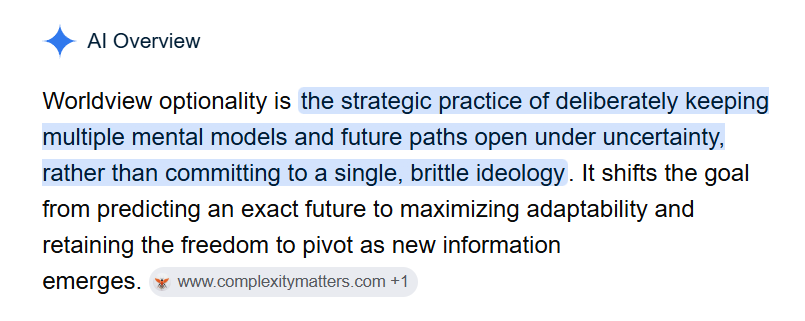
I guess this sums it up.
I would add that it is about having as many options as you can as you enter the workforce.
But how do you get these options?
I will explain this by giving two examples of polar opposites: John and Dan.
John
John gets into a good school.
He comes from a privileged background and grows up comfortable.
Opportunities are always around him if he wants them, but he rarely takes them. If he needs an internship, his dad or Uncle Bob can arrange one. He shows up just enough to put it on his resume. Clocks out at 5pm, and hits the bars with his buddies.
At first, he studies Engineering but switches majors because it feels difficult. Summers are spent partying and burning through money with old friends.
As graduation approaches, John starts applying for jobs as a chore. When people ask what he wants to do, his answer is simple: “I want a high-paying job at a big bank.” He decides on this path because it is what society says is a good path. He follows societal standards.
He sends out resumes.
Mostly silence.
Eventually, he ends up working for Uncle Bob anyway, at a bank.
Years pass. He tells people he likes the job, but deep down he feels disconnected from it. Work is just something to tolerate. The money gives him comfort, but not direction.
He cruises through life without a real sense of purpose. He works 9-5 during the week, and parties with friends on weekends and hits the beach.
Monday blues are painful, but they are part of life. Waking up to boxed-in offices and work that is just work.
And then there is Dan…
Dan
Dan starts working summer jobs in high school.
One high school summer he starts a bubble tea business with a buddy, selling out of his garage. It makes good money to save enough to invest in the stock market, which he too is passionate about.
Another summer he does a marketing internship for a confectionary company in Thailand.
He then gets into a non-target university. But the school is decent enough.
Then in Freshman year college he gets a banking internship in New York. He got this by walking into the senior bankers office with a book he read about, and was interested to learn more about how they operated. That curiosity led to the internship.
Still unsure what he wants to do, he now knows what its like to be a banker and marketing executive. He has one year left and decides to do an internship at a biotech startup in Silicon Valley.
Then finally in his senior year at Chick-fil-A in Louisiana. Post summer, he gets a job at the University mailroom to save money and invest whatever he has.
He studies Accounting, but becomes fascinated with food engineering and nutrition from his experiences. Instead of choosing one path he double majors. His schedule is brutal. Long nights in labs. Weekends in the library while working the mailroom for extra cash, while everyone else is out partying.
But he doesn’t feel miserable.
He’s energized and obsessed.
For fun, he writes ideas about making chicken tenders healthier, cheaper, and better tasting through this new process that he learned about in his last internship.
What starts as curiosity turns into pure passion.
Before graduating, Dan attends talks outside his university, joins niche communities and surrounds himself with people building things in food science and entrepreneurship.
By senior year, he’s no longer asking:
“What job should I get?”
He’s asking:
“When can I get back to building something?”
One day, someone from his network reaches out. A startup founder working on healthier fried chicken products wants him on the team.
Dan joins right away.
He barely thinks about salary. He forgets to even ask when the paycheck arrives because he’s consumed by the mission itself.
Soon, the founder realizes Dan can contribute beyond R&D. With his accounting background, he begins helping with finance, strategy, and operations too.
Dan finds work that feels meaningful, and there is no division between work and play. It is interconnected. He gets bored on weekends so he shows up in the office on a Saturday and can’t wait for Mondays.
What’s the lesson here?
When you are in university, and in most cases a recent grad, you have limited experience, so your worldview is limited by those experiences. This limits what your interest pool can be.
Sure you can take classes, but the way schools are designed is to take freedom away from you with grades as the gun to your head, forcing you to do work you don’t want to do. I’m not saying this is wrong. It is a necessary evil. But that won’t bridge the interest and passion gap.
Work experience will.
We live in a society where schools define you, and where you went matters more than what you actually do. This is the convention across most advanced societies. As if it is a single point in time where four years is the right amount time and knowledge to progress in life, and that’s it.
If you want to read more about this conventional viewpoint, I suggest the writing of Dan Koe:

DAN KOE@thedankoe
https://t.co/oBvzZZKGUm
6:00 PM · Apr 26, 2026 · 526K Views
175 Replies · 688 Reposts · 5.02K Likes
Not to say that there are no great people who go to good schools. There are amazing peope who come out of them, but one can get blinded when that is the sole criteria of quality.
It is flawed to think that there are no great people who went to non-target schools. Some people get inspired later in life. Some do at a younger age and in high school. But the sooner you get inspired and find that passion, the more successful you become. And to do that, you need experience. Something I believe more schools should incorporate in their curriculum.
As I gave advice to the entrepreneurship class, I forgot to mention how important it is to break out of the mold to explore and drive curiosity to find their own luck. It’s something that isn’t so easy to explain.
I graduated in 2008 at the height of the subprime crisis, coming from a non-target school entering the most competitive workforce in the world (America). Looking back, how naïve was I to think I could even come close to landing a job at one of the top firms. Especially when some of the smartest financial practitioners were getting laid off in record numbers. This was the reality despite having top grades and being part of the Finance honors program. I remember counting about 54 rejection emails. I was surprised that I reached the final interview with some companies. There was one instance where someone made a referral to a senior managing director. He grabbed my resume and looked at it and flat out said “you won’t get far with this background. You won’t get anywhere.” I still remember this message and it stung and still stings today. It also makes me wonder why he even invited me to his office in the first place. I settled for a junior analyst role at a trading division of a commercial bank. Not the role you brag about in cocktail parties.
Knowing what I know now, would I have changed my course of action as I graduated? Probably. Do I regret doing what I did? No I don’t. I consider all those rejections a big learning curve and it makes me who I am today. A special learning experience that no school will ever teach.
Why did I want to work for investment banking? There was something intriguing about the field . The intellectual aspect plus the pay that made it attractive. I kept seeking and eventually got into the field with a boutique firm in the Philippines (through luck). A far cry from the high towers in Wallstreet. That said, that experience alone would change the course of my career and gave me skills I wouldn’t trade for anything. It shaped me in a big way.
One thing I did notice in that journey was the amount of respect senior bankers placed on credentials. Paper credentials were everything. You were part of the Ivy League (or the equivalents), or you are nothing. Where you went to school mattered much more than anything else, and this left me in constant underdog mode coming from a non-target school. This happened for a good 13 years of my working career, until I quit in 2020 to start building my own company.
Here is a side lesson: sometimes in life, you will work in places that you were not meant to be in, but they will teach you lessons that will be useful later in life. You are forced to learn skills that you don’t know will be useful until later in your career.
It was only when I started building and investing my own money where I learned the difference of being an agent and an owner. I realized that once you start becoming an owner, credentials didn’t matter. In fact the whole idea of a perfect resume didn’t matter either. Outcomes did.
I was in my early 30s, realizing that I was too late to get into an MBA program. And seeing others my age graduating from top schools made it feel like I was left behind. So I did the most unusual thing. I spent most of my savings investing and building companies. This is probably the opposite of what any parent will tell you to do.
In my mind, my downside was that I would lose all my money, but still learn the necessary skills working with different investors and entrepreneurs. And the upside would be: I recoup my losses and some, and still learn enough along the way. As Mohnish Pabrai says “Heads I win, tails I don’t lose much.” Knowledge was a currency in my view.
Six years later and I have no regrets . Of course, this couldn’t have happened without my financial backers and people who placed their trust in me. I owe them. But the journey is not over. Not even close. And there are still big risks ahead.
As an investor, I’ve encountered workers who graduated from the best schools who failed and encountered those with poor credentials who shined. It reframed my worldview from an investors perspective on the debate around credentials.
I started to see things differently.
In my bread retail business, people have asked how we know locations so well. There is no method. It is through domain experience of searching and witnesses failures and successes over many stores that allow us to see patterns. One of my partners had this skill when we started the business. Without him, we would not be where we are. He got it from his years working the streets and within the mass market. Today, you could ask him if a potential location is good and he can let you know within a reasonable range what the average daily sales will be, and it usually hits the target. You don’t see those patterns in class rooms. It’s that skill from experience that differentiates people.
This relates to obsession. Paul Graham talks about it in his article How to Do Great Work when he says “What are you excessively curious about — curious to a degree that would bore most other people? That’s what you’re looking for.” He goes on to say “Boldly chase outlier ideas, even if other people aren't interested in them — in fact, especially if they aren't. If you're excited about some possibility that everyone else ignores, and you have enough expertise to say precisely what they're all overlooking, that's as good a bet as you'll find.”
This happens when you start touching what he calls the frontier of knowledge. Areas other people overlook or find boring because it may either be too technical or unimportant or both. When this happens, society labels you as a nerd. It gives you passion that no other person will find interesting. This happens when your worldview optionality expands as you gain experience.
Sometimes I find myself talking about the stuff I am obsessed about too much, but that’s fine. People around me will find it odd when I spend time in fast food restaurants staring at menus and assessing hospitality methods, or nerding out about value investing. Life is too short to let others judge you. But that’s what brings me to certain environments where like minded people can discuss ideas, and boy what a difference it makes. Your conversations become less shallow when you build the right circle.
Going back to the example of Dan.
Dan would not have found his passion without:
experimenting with small businesses early in life,
exposing himself to different industries,
learning finance and consumer behavior,
and surrounding himself with people building things.
Each experience compounded into a deeper understanding of what interested him.
John on the other hand, has not found his passion. But it’s nobody’s fault but his. He never created the environment that brought out that deep sense of curiosity and passion. It could have been his upbringing or his laziness, but whatever it is, he skipped an important part of what it means to find luck.
I am sharing this because I learned this late in life (in my 30s). Only when I quit my corporate career did I learn this, because quitting my job (I don’t recommend this early on) allowed me to experiment with ideas without limits. Many of them stupid. But I made some good investments too. All of which contributed to insights that allowed me to start my own businesses. Looking back, I would not trade this for anything, but at the same time I wish for students to learn from it so they can discover passion and purpose early in their careers.
Abraham Maslow once wrote, “What a man can be, he must be.” Universities should work toward helping students discover that potential through real-world experience, curiosity, experimentation, and failure. Not just standardized achievement.
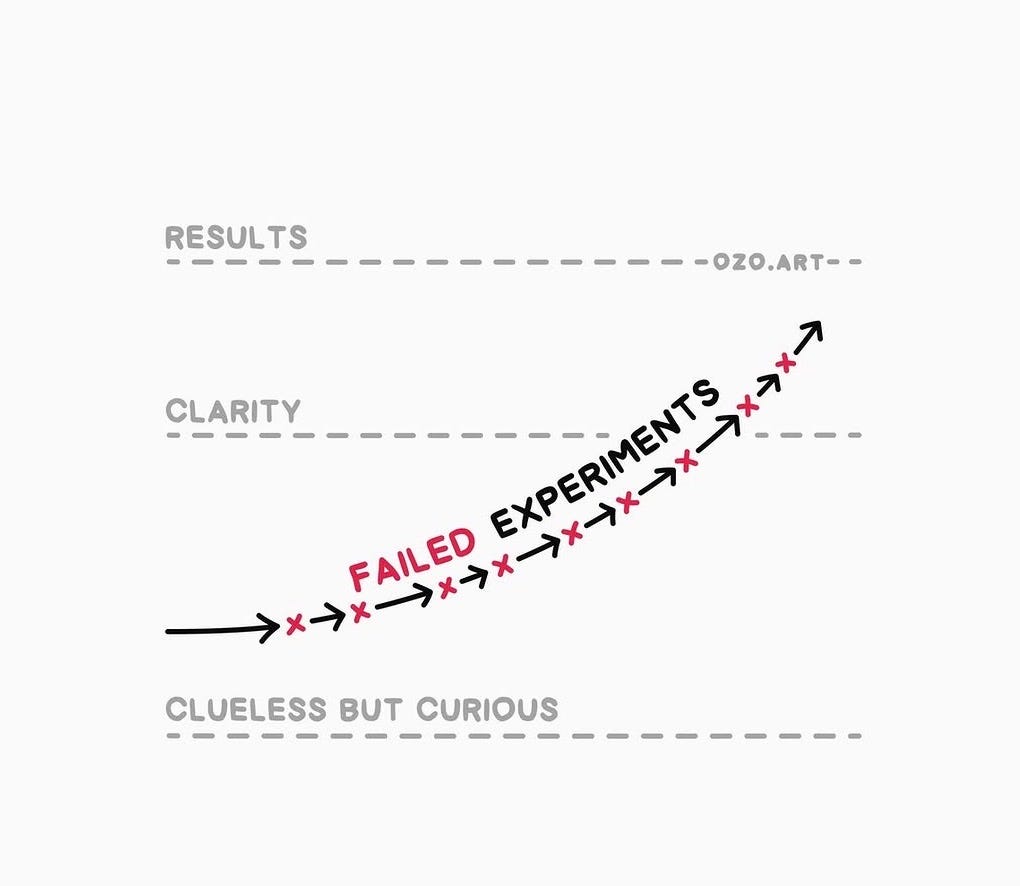
So going back to the general advice of capturing your own luck at the beginning of this essay. Dan was lucky to find the company that was making engineered chicken tenders. He fit right in. You can call him lucky. But he created luck over years of effort by being curious. It’s not enough to stop and say “I don’t know what to do. I’m lost. I don’t know what I like “ and sit on a couch. It’s enough to say the same words but with the effort of going out there and being in different working environments that allow you to capture moments that give you unique insights and opportunities that lead to passion.
Another topic is energy. When you get obsessed with something, it will use your energy. The only way to build energy as you age is to stay fit. Staying fit allows you to manage the mental load of learning and building, and the stress that comes with it. I didn’t say that being passionate and obsessed makes the job easy. Pain is part of the journey. You will fail. Staying fit lessens the friction.
Limit your drinking . The more you drink, the more your energy gets diverted away from what matters. Dopamine is the main reason you feel refreshed and alert most mornings. Hangovers drain your motivation and pull you toward the couch instead of your goals. The less you drink, the more energized you are, the earlier you wake up, and the more you get done. Luck lurks around the corner. As the saying goes, the early bird catches the worm.
Now what happens if you haven’t found that passion by the time you graduated, and you have been slacking all along? Just remember, college is only 4 years. What happens there doesn’t matter in the grand scheme of things. I am 41, and I can tell you that the amount you can learn in your next 10 years after graduating can add more value to your life than you can imagine if you make the right decisions. It’s never too late.
So I hope with this message it is clear what I mean by capturing luck through obsession.
Go out there and create your own luck by expanding your worldview optionality.
Be curious and keep learning.
As Warren Buffet says “Turn a page, because most people won’t. If you do, you are ahead. Never stop turning a page.”
ABOUT THE AUTHOR
Keenan Ugarte is Managing Partner at DayOne Capital Ventures, an independent private holding company that invests in and builds high-growth, early-stage businesses that serve the Philippine mass market.
Appendix: Examples of Domain Experts
Jiro Ono of Sukiyabashi Jiro.
He specialized in one very specialized and specific skill. He mastered the art of preparing sushi, and he did well at it. He didn’t care about how much money he made, but he cared deeply about making the best sushi in the world. He obsessed over it. No formal education, just pure practice that made him a genius in his craft.
He began submitting his stories in his teens to different publishers, receiving countless rejections, as told in his autobiography On Writing. He did it so much that he didn’t care and the rejections became part of life. But he did it every week. One rejection after another. But he loved writing. He then wrote Carrie while working in a local high school as a janitor and living in a trailer with his wife. He was dead broke. Then one day, he gets a call from a publisher who offered him $400k for the rights to reproduce the story. The rest is history. There is a whole story of why he picked this story but the insight was from his experience being a janitor and cleaning bathrooms.
Todd Graves pitched his college thesis of starting a chicken tender chain. His professors thought it was too niche and would never succeed. He got the lowest grade in class. Graves ignored them. To fund the business, he worked grueling jobs as a boilermaker in oil refineries and as a commercial salmon fisherman in Alaska before opening the first Raising Cane’s near Louisiana State University in 1996. The restaurant became a hit. He called it Raising Cane’s Chicken Fingers. Today, Raising Cane’s has more than 1,000 locations across the US, generates billions in annual sales, and turned Graves into a billionaire.
Sam Walton became obsessed with one thing: understanding how retail worked at the ground level. He spent years visiting stores across America, studying customer behavior, pricing, shelf placement, logistics, and inventory systems. Walton believed that small operational advantages compounded over time. He constantly took notes, experimented, and learned directly from the field instead of relying on theory alone. What made Walmart powerful was not just scale, but Walton’s unusual obsession with efficiency and understanding ordinary consumers better than anyone else. In fact Wall Street did not trust him in the early days. He built one of the most successful retail operations in history. Today they call him the Henry Ford and Thomas Edison of retail. He did graduate from college, but nothing exceptional (University of Missouri).
Steve Jobs
Steve Jobs became obsessed with the intersection of technology, design, and human experience. He was not the best engineer nor the best programmer, but he had an unusual ability to connect ideas across multiple fields (he was obsessed with design and storytelling). After dropping out of Reed College, he continued sitting in on classes that interested him, including calligraphy, which later influenced the typography and design philosophy of the Macintosh. Jobs had an obsession with product detail that bordered on irrational. That’s what led to Apple.
Rose Blumkin, better known as “Mrs. B,” was a Jewish immigrant who arrived in America with almost nothing and didn’t speak English. She couldn’t write. She started Nebraska Furniture Mart with an obsession for selling furniture cheaper than anyone else. She had no formal education and learned business entirely through experience, negotiation, and understanding customers at the ground level. She worked until she died at age 104 and would walk around the showroom floors herself and personally studying pricing and inventory. Warren Buffett admired her because she understood retail fundamentals better than many highly educated executives. He used to say “She would have run circles around CEOs of the top Fortune 500 companies.” Top students at the best business schools used to visit Buffett, and he would have Mrs. B give advice. A lady with no formal education giving advice to MBA students from the top schools.
In last years Berkshire Hathaway shareholder meeting, someone in the crowd asked him how he found the Japanese investments (Itochu, Marubeni, Mitsubishi, Mitsui, and Sumitomo). People were curious how we had the thesis of investing in Japan. Buffett goes “I was just looking through an old Japanese handbook that I had translated. In it were all the corporations registered in Japan, and I spent everyday looking through it. Until I found these trading houses that were cheap with attractive fundamentals. So I invested.” And then he goes “In life you need to keep turning a page. Most people won’t do that, but if you do, you will go far.” I don’t think the average person in this world spends their weekends looking through old Japanese handbooks with company data. Buffett did this for fun but out of pure interest and curiosity. This is what makes him special. He created his own luck by finding these companies in this handbook that was completely ignored by the market. He is now making billions from it.
Koch Industries is one of the most successful private companies in the world. Charles Koch inherited a company back in the 60s worth about $20m. Today, it generates over $150 billion in sales. He mentions the secret is based on his principles related to hiring and seeking the right people. His philosophy is around finding passion amongst the people who work for him. They seek passion and culture first over credentials. Their CIO has no college degree. You can learn more about it in this video (starting at the 42nd minute onwards):
Note the following quote: “Everyone has capabilities. If you don’t develop it and apply it in a way that creates value for others, you may be successful monetarily in some way, but you will be deeply unhappy your whole life because you won’t be fulfilling your nature.”
No posts
Comments
Nothing yet. Say the first thing.
Sign in to join the conversation.