
Marek Health is a US telehealth health-optimisation company co-founded by Derek of More Plates More Dates. It coordinates blood testing, health coaching and access to partnered medical providers and pharmacies. It’s not an independent testing lab or pharmaceutical manufacturer.
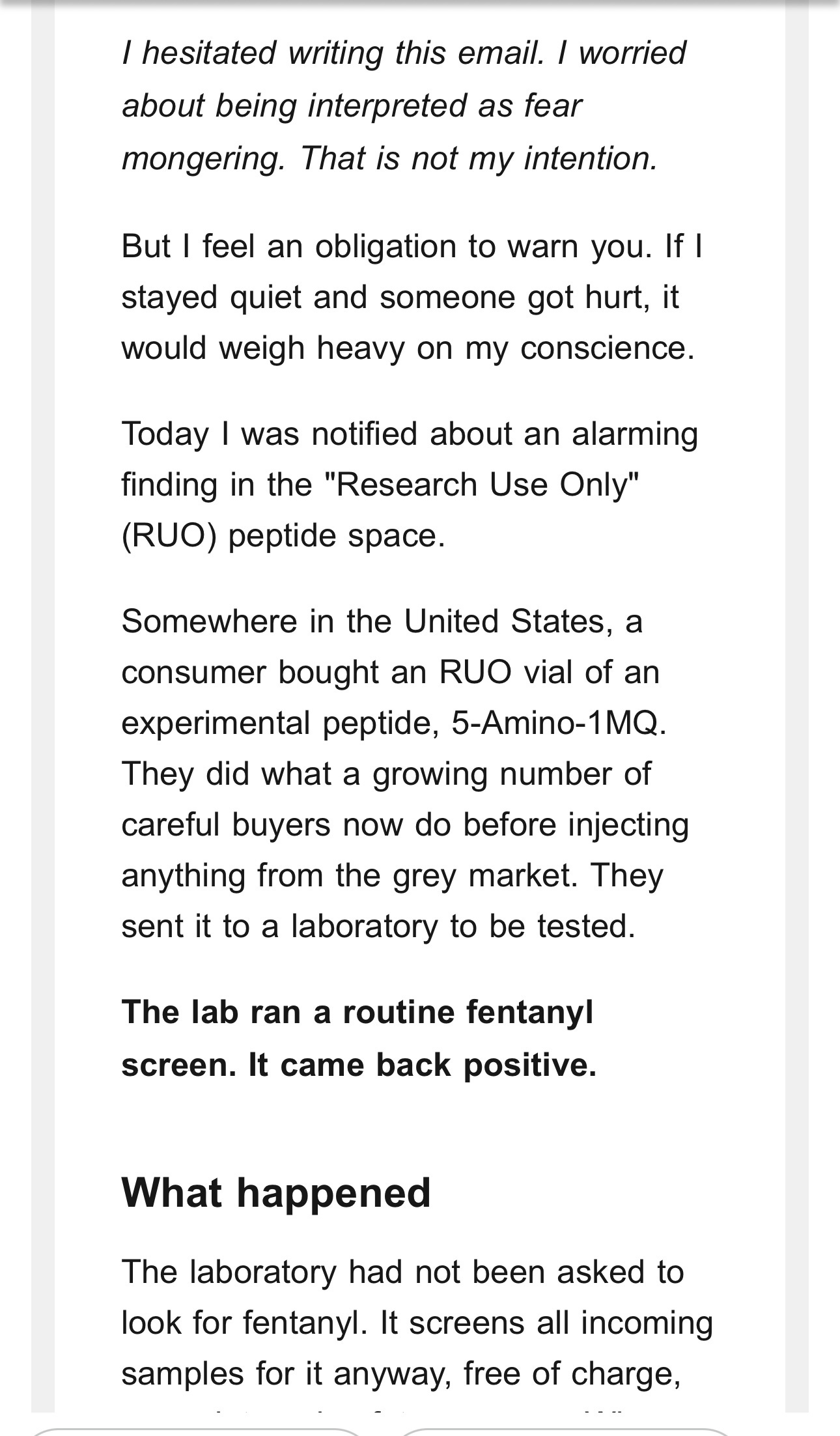
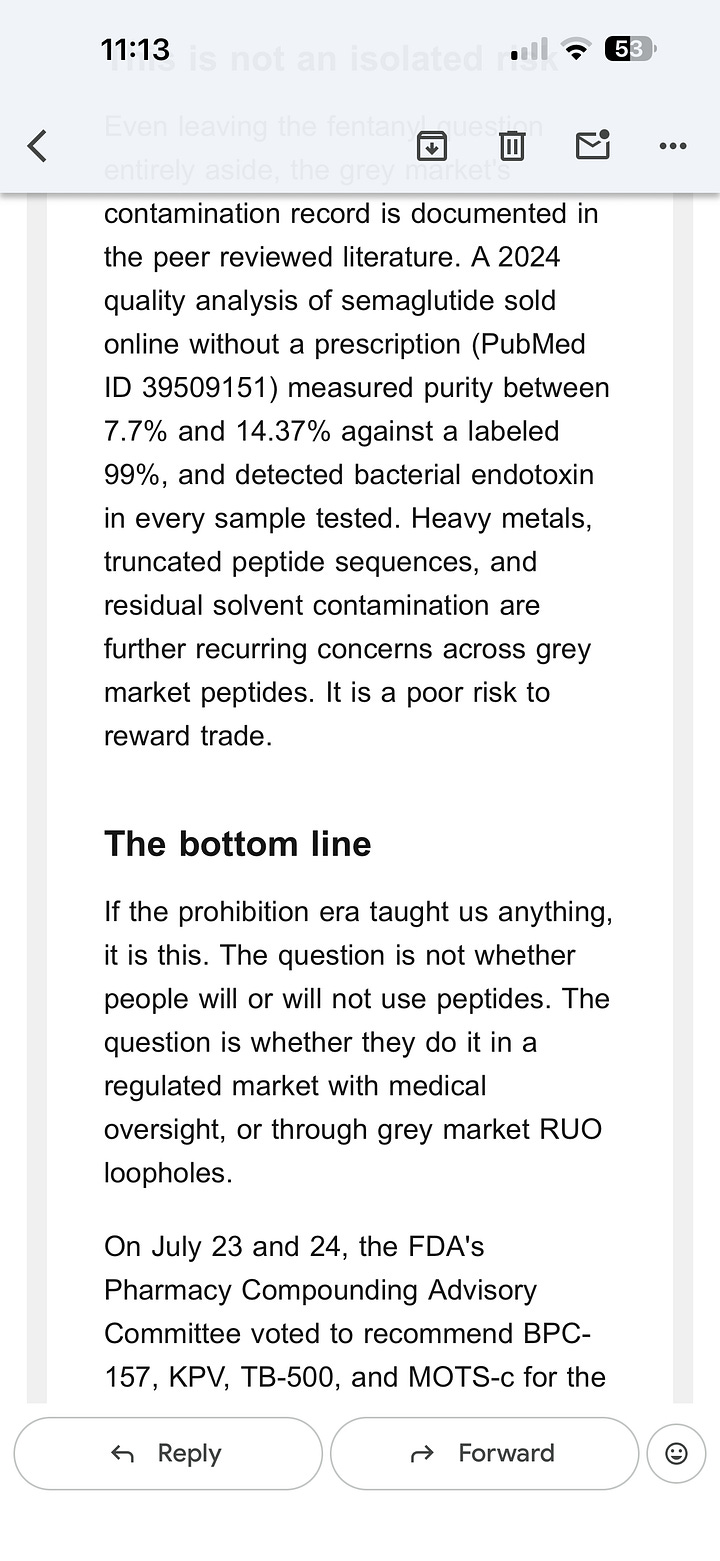
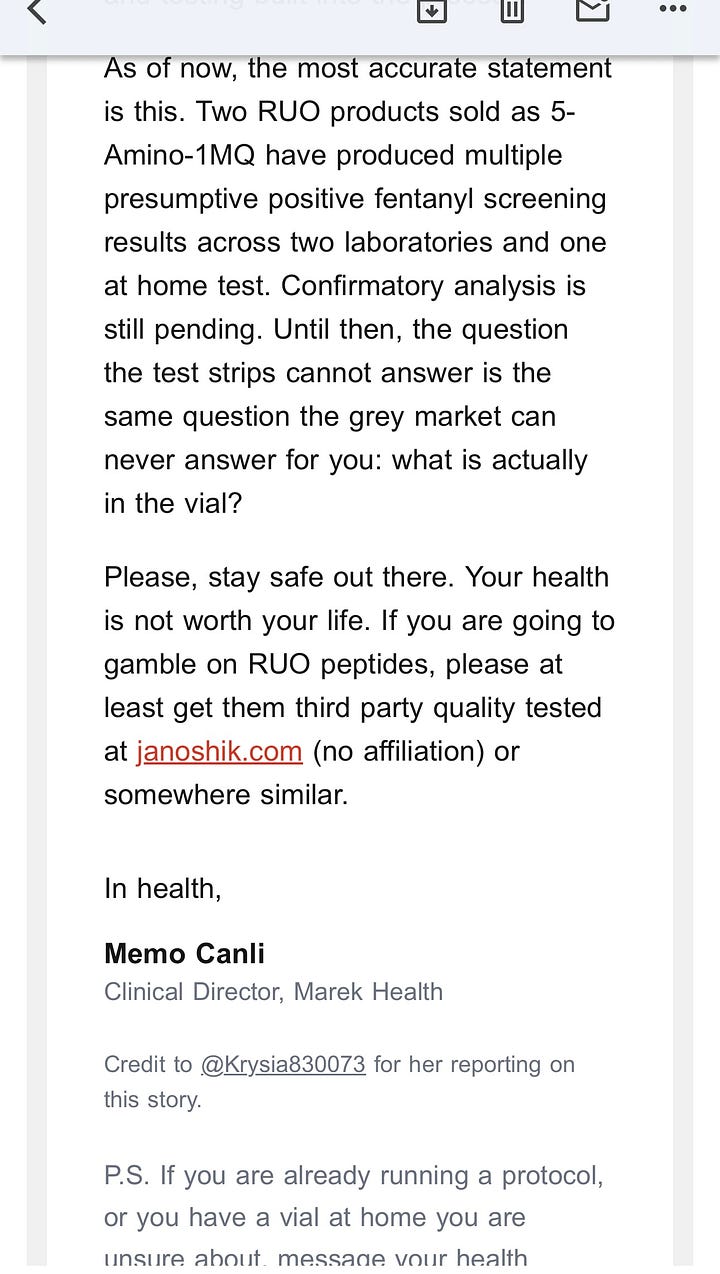
The company recently used my article on the 5-Amino-1MQ fentanyl scare in an email signed by Memo Canli, identified as Marek Health’s Clinical Director.
The email credited my reporting, but then turned it into a sales funnel.
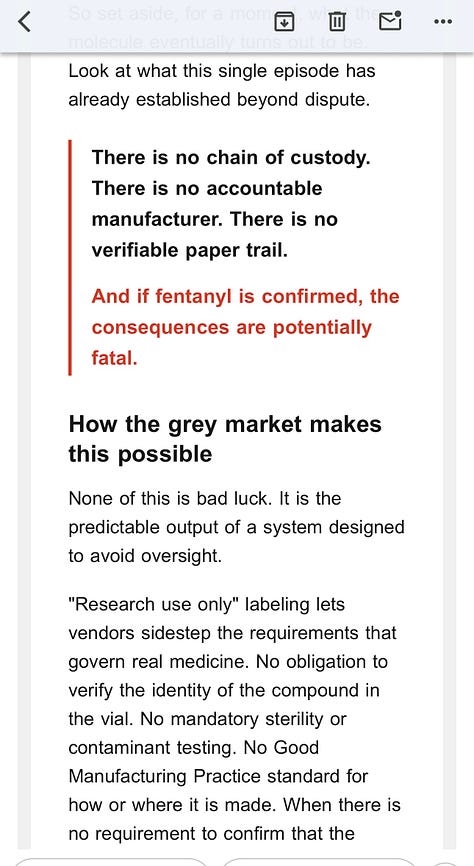
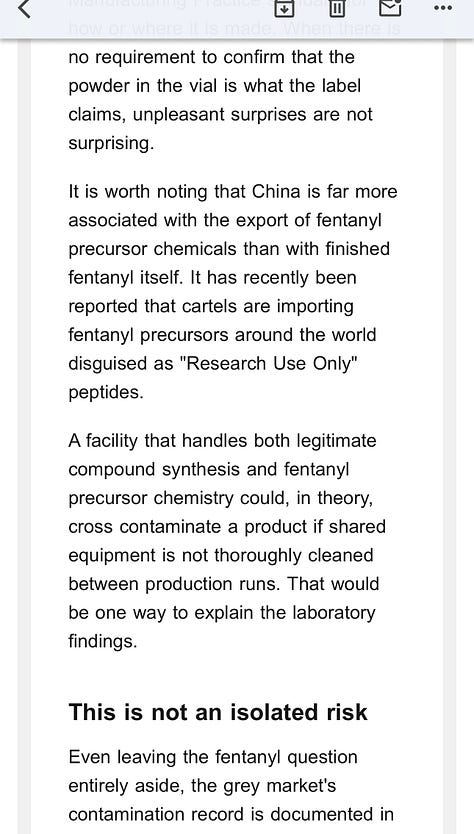
It opened with an “obligation to warn,” described the potentially fatal consequences if fentanyl were confirmed and speculated that cross-contamination could have occurred inside a Chinese facility handling fentanyl precursor chemicals. There was never any analytical evidence supporting that theory.
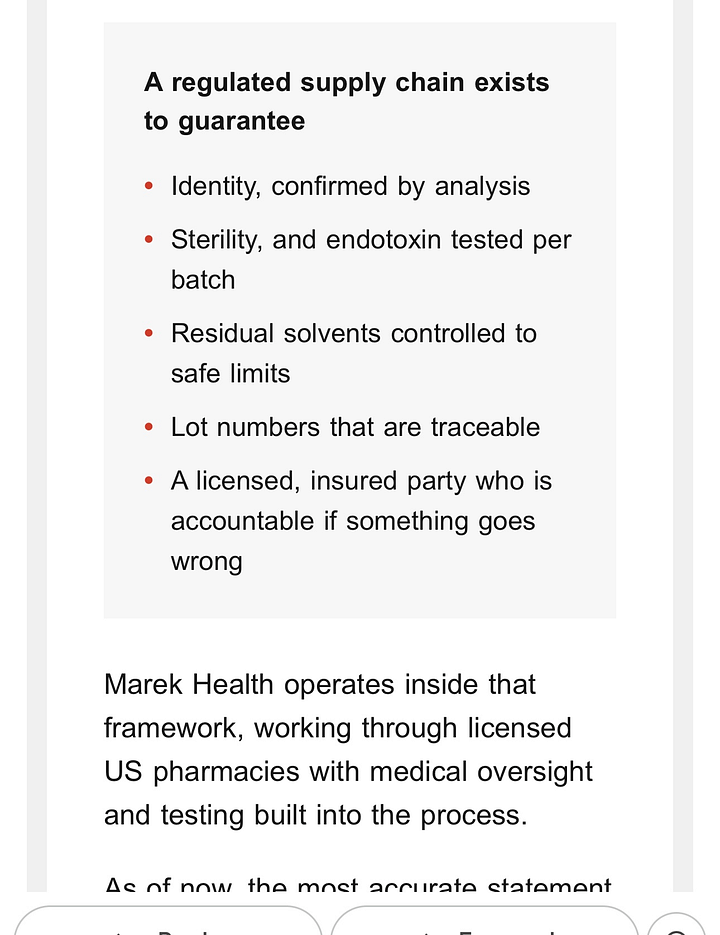
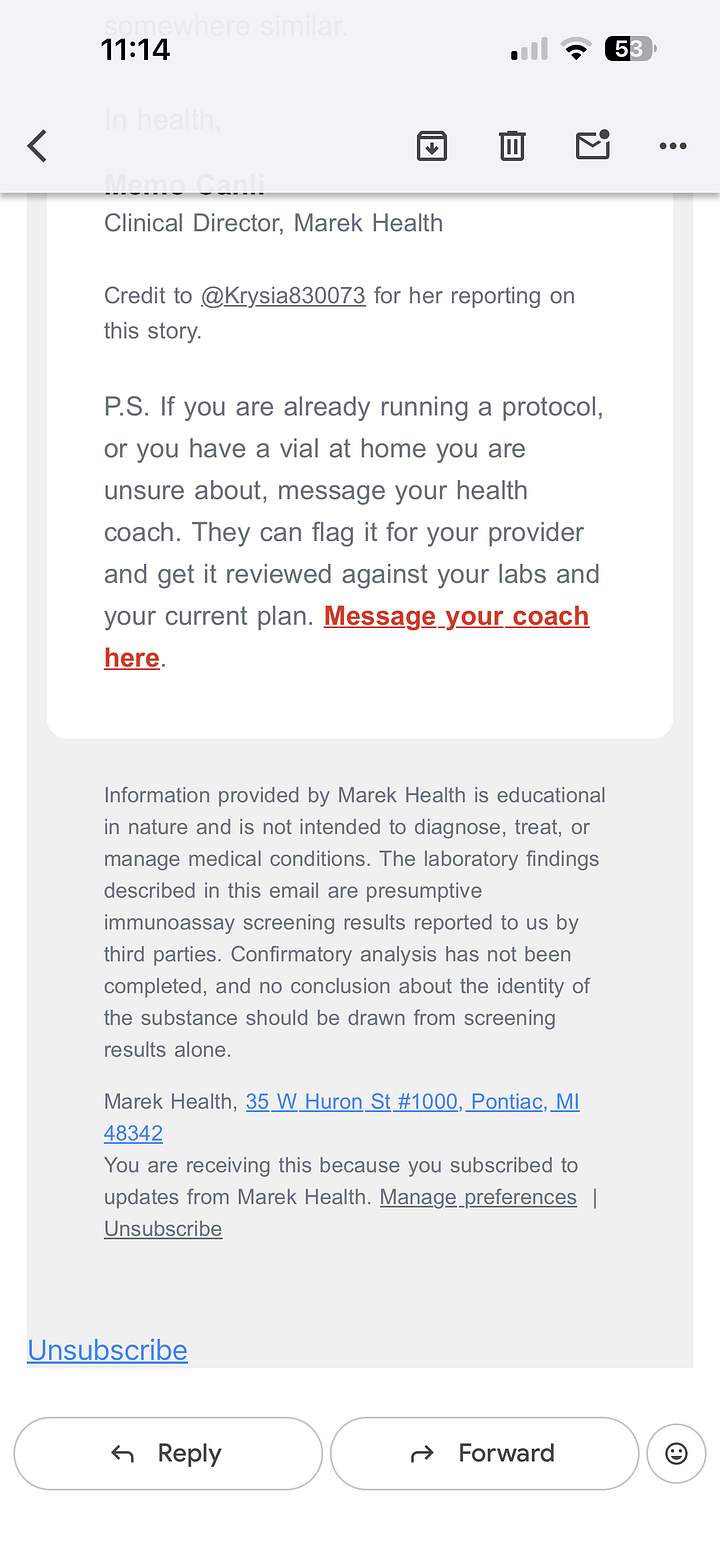
The email then contrasted the grey market with Marek Health’s “regulated supply chain,” promoted its work with licensed US pharmacies and ended with a direct “Message your coach here” button.
This wasn’t simply an educational reference to my investigation. My reporting was used to create fear around the grey market before directing readers towards Marek Health’s paid services.
There were also basic problems with the article. It called 5-Amino-1MQ an “experimental peptide,” although 5-Amino-1MQ is a small molecule. It made absolute claims about there being no chain of custody, accountable manufacturer or paper trail, before moving into an equally absolute claim that a regulated supply chain “guarantees” identity, sterility and traceability.
Most importantly, its own disclaimer admitted that the laboratory findings were only presumptive immunoassay screening results and that confirmatory analysis hadn’t been completed.
In other words, Marek knew the story was unfinished.
The Confirmatory Results Are No Longer Pending
Since that email was published, the evidence has changed substantially.
Vanguard reproduced presumptive positive strip reactions using multiple 5-Amino-1MQ samples, including an authenticated reference standard. When the products were diluted according to the strip manufacturer’s instructions, the results were negative.
Vanguard also issued an official COA for a Beebo-supplied sample believed to be connected to the original batch. Targeted LC-MS/MS found no detectable fentanyl at a stated detection limit of 10 ppb.
The original sample sent by Janoshik was then analysed by a national drug laboratory. None of the 15 fentanyl-related compounds included in its targeted panel were detected.
No targeted panel can exclude every hypothetical fentanyl analogue ever created, but there’s currently no analytical evidence that an untested analogue was present. Reproducing the same reaction across unrelated 5-Amino-1MQ products and an authenticated standard makes interference from the compound, its concentration or the sample matrix the far stronger explanation.
The presumptive strip reactions are now best understood as false-positive screening results, not evidence of fentanyl contamination.
The Story Did Not End With the Warning
I reported the initial strip reactions because a potential fentanyl finding had to be taken seriously. I reported the negative confirmatory results for exactly the same reason.
This isn’t a defence of the grey market. It’s correction of a specific allegation that the evidence didn’t support. Wider concerns about grey-market products can’t be used to keep a fentanyl scare alive after the confirmatory testing found none.
Responsible reporting follows the evidence, even when the conclusion becomes less dramatic.
Credit Is Not a Substitute for a Correction
The problem isn’t that Marek Health reported the original warning. At that stage, confirmatory testing really was pending.
The problem is that Marek used the most alarming stage of my investigation to market its own services, but hasn’t given the same audience the results that followed.
Its subscribers were warned about a potentially fatal contaminant, shown speculation about Chinese fentanyl chemistry and then directed towards a Marek Health coach. They should now be told that the original sample tested negative across the national laboratory’s 15-compound panel and that Vanguard’s instrumental testing also found no fentanyl. So we still haven't found a positive fentanyl test in any grey market products.
If Marek Health is willing to use my reporting when it helps sell its version of safety, it also has a responsibility to report the outcome when the evidence changes.
If Memo Canli is reading this, I trust he’ll do the right thing and issue a correction to the same subscribers, by making clear that confirmatory testing found no fentanyl and the original screening reactions were false positives.
No posts
Comments
Nothing yet. Say the first thing.
Sign in to join the conversation.