
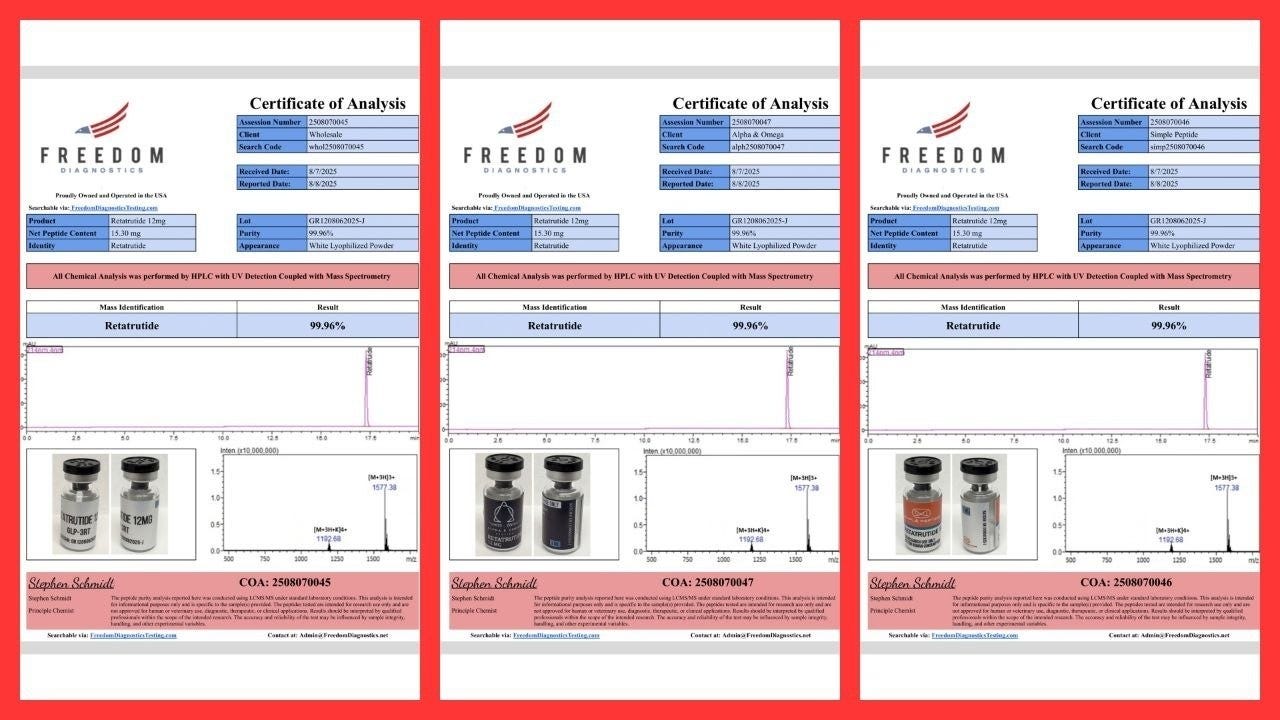
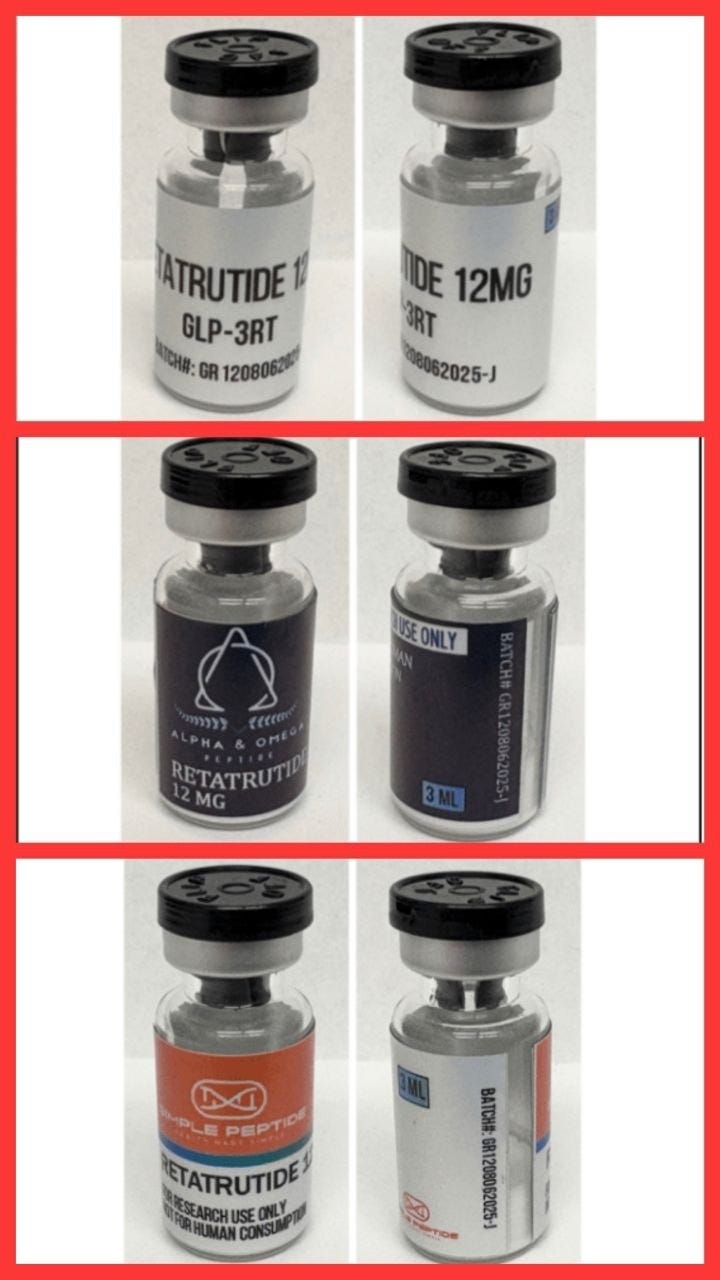
The discussion began with three Freedom COAs showing what appears to be the same physical vial photographed with three different labels. The analytical result may be genuine, but the photographs create the impression that three separately branded products arrived at the laboratory and were independently tested.
This opened a wider conversation between Janoshik, Vanguard, Kovera and ResearchVerify about additional COAs: reports issued under another company name without another sample being submitted or another analysis being performed.
Dustin from Vanguard acknowledged that some traceability may remain if the laboratory sample ID and lot number stay the same. However, he argued that best practice, and the spirit of ISO 17025 requirements around unambiguous sample identification, is to document the item exactly as it arrived.
Physically applying different labels or staging new photographs creates images that don’t accurately represent the received item. Someone looking at the reports could reasonably believe that several distinct branded products had been independently tested when only one vial was submitted.
Dustin also recognised why clients request them. White-labelling is common in non-GMP markets such as supplements, kratom and cannabis, and clients don’t want to pay for another complete analysis if several sellers genuinely bought the same product or batch.
The practice may now extend beyond occasional white-labelling between established businesses. Turnkey providers reportedly offer the product, a company-matched version of the COA, a duplicated branded website and even the logistics. So an additional report is no longer simply an administrative copy, it’s become part of a ready-made package allowing a new storefront to appear with its own testing history from the moment it launches.
That may help explain the sudden appearance of large groups of near-identical peptide companies. However, the existence of these services doesn’t prove that every duplicated website or matching COA came from the same provider.
The problem is that “same vendor and same batch” is still information supplied by the client. The lab hasn’t independently established that every business named on the resulting COAs holds matching stock.
Kovera raised the same traceability concern. AJ said many grey-market products don’t contain enough unique identifiers to justify connecting one tested vial to every product subsequently sold under that batch claim. He also said people had wanted to submit one vial and request “10 subs.”
Kovera removed the general option because it became a headache, although AJ said it might still be considered for longstanding clients with a good testing history. He also supported either stopping the practice collectively or limiting requests to the time of the original submission.
Janoshik already imposes that timing restriction. He said all additional versions must be ordered beforehand. Janoshik changes only the report header and client name:
The laboratory ID does not change
The lot or batch number does not change
The product photograph cannot be replaced
The original photograph may be removed
A separate charge applies to every additional report
Vanguard currently follows essentially the same policy. It permits a different company name and watermark but doesn’t change the product image, laboratory ID or lot number. Dustin was also considering refusing retrospective requests, even where the client claimed traceability.
The prices vary. Vanguard currently charges $25 and intends to increase it. Peter quoted 35 in the discussion, while Janoshik’s order page lists an additional report with a separate client name at €35. Kovera said it charges $150 for one-off retail clients, compared with approximately $550–$800 for a new full testing panel.
Both Janoshik and Vanguard discussed increasing the price to encourage clients towards original reports. The difference between the cost of another header and a completely new analysis also explains why the service is attractive.
Dustin suggested that any report using alternative labels should carry a prominent disclaimer:
“Photographs show client-requested alternate brand labels for illustrative purposes only and do not represent the sample as received. All results apply exclusively to Laboratory Sample ID [XXXX] / Lot [YYYY]. Multiple branded COAs reference this same tested sample. Brand equivalence and commercial labelling are the client’s responsibility.”
ResearchVerify then explained how the current system looks from outside. When the same analytical result appears under several brand names, they can often work out that they came from one test because the numbers line up. However, that connection is being inferred by comparing reports rather than read directly from the certificates.
He proposed two simple additions:
A shared sample or lot identifier tying every version together
A plain statement confirming that all versions refer to the same tested sample
Another suggestion is shown below;
Original COA: 1234567A
First alternative: 1234567B
Second alternative: 1234567C
This would allow aggregators to group them as one test instead of accidentally presenting each branded version as separate evidence.
ResearchVerify also raised an important fairness issue for the laboratories. Labs that openly connect and document additional reports may appear to issue more duplicates than laboratories that don’t disclose the relationship. In reality, they may simply be the ones being transparent about it.
Nobody needs to know why one sample is being presented under several brands. That commercial arrangement is between the laboratory and its client. What buyers and aggregators do need to know is whether they’re looking at several tests or several versions of the same test.
An additional COA isn’t necessarily fake, and the underlying analysis doesn’t become invalid. But it’s not another independent piece of evidence either.
One vial may produce several headers. It should never be allowed to look like several independently tested products.
No posts
Comments
Nothing yet. Say the first thing.
Sign in to join the conversation.