
Most reviews come out after a book releases, but in the publishing business, a handful of pre-publication reviews carry a lot of weight with bookstores and libraries deciding which books are worth ordering.
This morning, Kirkus published its review of Live Laugh Love. Not only is it a beautiful one, but Kirkus awarded the book a coveted starred review. 🌟 That means it’s one of their favorite titles, and the little star will grab the attention of bookbuyers. (I can personally attest to that—as department chair, I was in charge of deciding which history books to order for our library, and those starred reviews always get an extra close look and most ended up in the purchase pile.)
Here’s the Kirkus review, and that last sentence is everything:
Investigating the roots of Christian women’s culture.
Women have frequently been barred from participating fully in theological and ecclesiastical life, notes religious studies scholar Du Mez. They have not been excluded from American consumer culture, though, which has led to their being “less invested in maintaining theological boundaries.” This consumer culture comes in many forms, from dolls to books, cosmetics, and self-help fads. One form is alluded to in Du Mez’s title: In the early 1900s, an Iowa woman, Bessie Anderson Stanley, won a magazine contest on the theme of success: “The person who achieved success, Stanley wrote, was one who ‘has lived well, laughed often, and loved much.’” All these decades later, Du Mez writes, the online retailer Wayfair has more than 56,000 “Live Laugh Love” items for sale. From Erika Kirk’s sequined pantsuits to tradwife TV shows and home-goods emporia like Utah’s Ballerina Farm, from Aimee Semple McPherson to Phyllis Schlafly and Michelle Bachman, women have Christianized politics, commerce, and culture. One notable player, little known these days, was Henrietta Mears, a Zelig-like character whose disciples over the years included the founders of Young Life and the fundamentalist church that private citizen Ronald Reagan attended. Mears convinced Billy Graham to evangelize and crusaded against homosexuality, feminism, and anything short of worship of the free market. Somewhat amusingly, many of these entrepreneurs plagiarized from one another when marketing an endless series of manuals for Christian wives, most of which demanded submission and providing husbands with gratification on demand: “A wife who failed to satisfy a husband’s sexual needs committed the ‘sin of selfishness,’ and the price would be husbands who were ‘carnal, nasty, and insulting.’” With twists such as Amish fiction, the scrapbooking craze, and entrenched Christian nationalism, all this remains very much with us today.
A smart, endlessly interesting exercise in connecting cultural dots to learn how we got here.
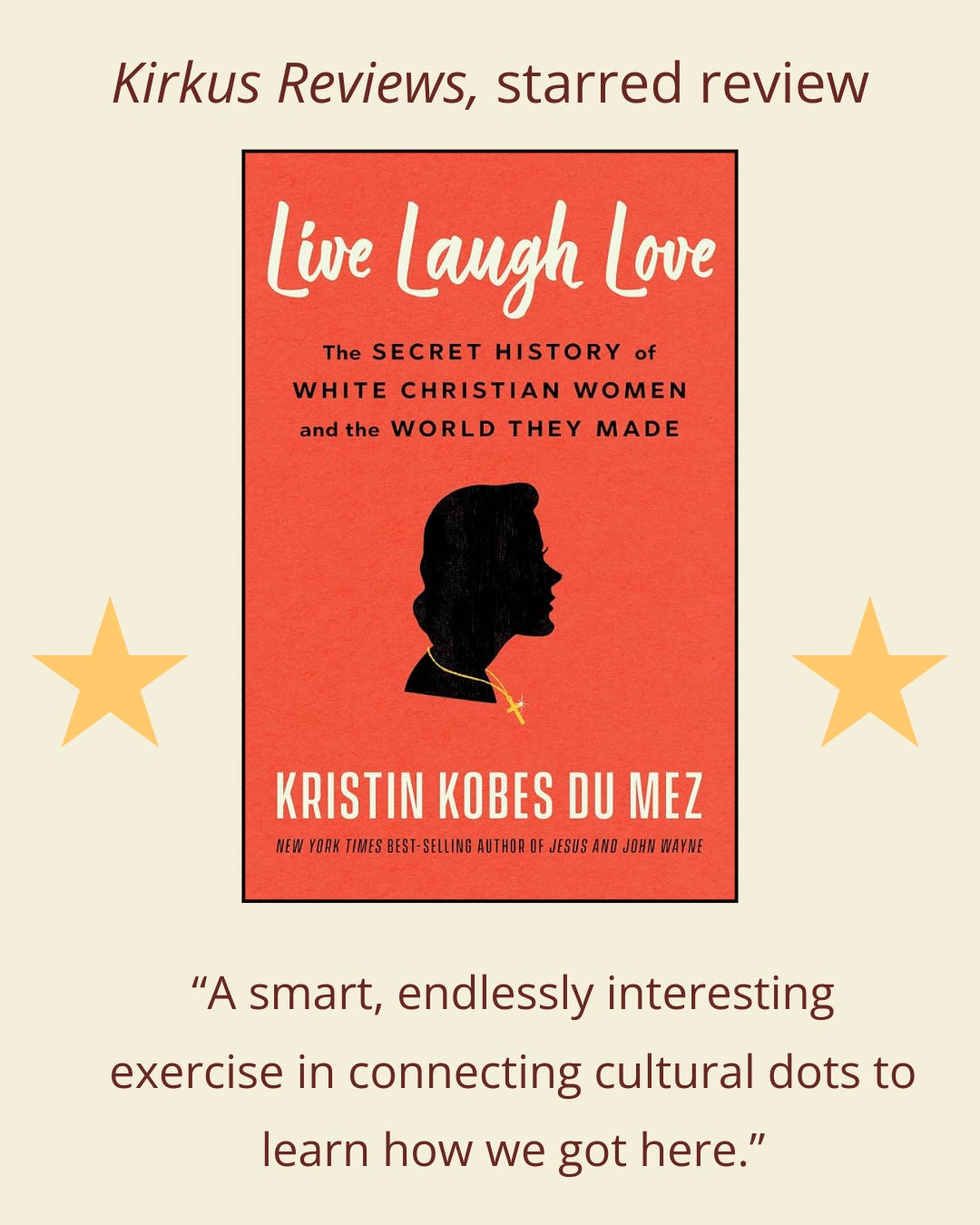
Any author would be thrilled with this synopsis, but for a book coming in at 352 pages, “endlessly interesting” carries some real weight. That sentence alone deserves to be cross-stitched and framed, Hobby Lobby-style.
It’s always fun to see which elements reviewers draw out. They’re alotted very little space, and I’ve packed a lot into those 352 pages. It was a challenge for me to distill the book down to a couple paragraphs for the jacket copy, and I’ve lived with the book for 5+ years, so I’m always impressed when reviewers so skillfully identify key themes and illustrations.
Here’s another excellent synopsis, from Publisher’s Weekly:
The book begins in the 19th century with Hannah Whitehall Smith, who published a popular guide to happiness that asserted “Christians must embrace a positive attitude” no matter their circumstances. Smith’s argument dovetailed with the emergent New Thought movement in which “positive thinking... produced positive results” and which went on to influence other movements like Christian Science and the Prosperity Gospel. Via Smith and other Christian women writers focused on “positivity,” an idealized form of Christian womanhood—rooted in domesticity, consumerism, and subservience—was woven into the heady mix of spirituality and capitalism that defined New Thought–inflected Christianity. Kobes Du Mez surveys an impressive range of such writers, who strictly policed their fellow women’s femininity (one recommended embodying “angelic innocence” by wearing “anything fluffy”). She also examines white Christian women’s roles as participants in the multilevel marketing industry; as consumers of “sentimentality” via romance novels and Precious Moments figurines; and as both perpetrators and victims of a culture of silence that has allowed sexual abuse to run rampant. Most strikingly, she details the mental anguish white Christian women experience when they feel unable to meet idealized feminine standards. It’s an astute dissection of a repressive strain of American womanhood.
Publisher’s Weekly also featured Live Laugh Love in an author Q&A with Sarah Pulliam Bailey. Here’s an excerpt, but read the full interview here.
Talk about the darker side. What did you see?
In the cases of abuse, patriarchal systems don’t just require submission to male authority. They essentially define unhappiness as sin. Women cannot advocate for themselves and often cannot identify relationships as abusive. Not all women in these spaces are in abusive relationships, but when they are, there are problems. That’s when it can become so difficult.
This “trad wife” ideal has been produced and promoted by conservative religious and political groups with a clear agenda. Marketed to women as “empowering,” this definition of femininity and limiting of women’s roles is essential to the broader goal of reinstituting a hierarchical social and political order.
Can you share about the systems of abuse you found, such as the ones you found in multi-level marketing, where sellers make money from sales made by sales teams they recruit?
In MLMs, you’re not allowed to be negative. You had to cut people out from your life if they were negative. You don’t question those above you. It reminded me of evangelical systems where people give deference to those who have assigned themselves authority. That led me to look into the role of positivity and how it reinforced free-market capitalism and made it difficult to see structural inequality.
Why did you focus on white Christian women?
Christian consumer culture was designed to cater to white middle-class Christians. Every Christian radio artist and label knew you had to appeal to a white, 30-something, Christian woman. The book tries to describe that consumer culture and the institutions that created and fed that culture.
How does consumer culture help shape religious identity?
For many women, cultural products have had a deeper influence on their value system than the more formal religious institutions. It shapes not just their theology, but also their core values, the ones which shape their political values and cultural identity.
As a writer, you make millions of tiny decisions. Every sentence, every word, is there because other sentences and words were considered and dismissed or deleted. There are so many things I could have included instead of the things I did. (Because I’m always long-winded, I ended up cutting tens of thousands of words from the manuscript.) There were virtually countless organizational possibilities. Where does this story begin? When? How many chapters will it be? Which parts belong in which chapters? Like Jesus and John Wayne, Live Laugh Love is complicated in that it moves chronologically and thematically, but Live Laugh Love is considerably more complex because it’s not just about evangelicalism—it’s also about Mormonism and positive thinking, and it starts in the nineteenth century and ends when I had to stop writing, this January.
One of my favorite comments about the book was from early reader Holly Berkley Fletcher, author of The Missionary Kids: Unmasking the Myths of White Evangelicalism. If you’re not already following Holly on Substack, you should be. Holly is hilarious and generous, and she shared her initial reactions to on Live Laugh Love a couple weeks ago:
I will have more to say about it later, but for now—I have long thought to myself, “I think there might be some kind of evangelical conspiracy to focus women on frivolous things to keep them docile, but that’s too crazy and paranoid. Stop being ridiculous, Holly, maybe evangelical women just really like decorating.”
Well, as it turns out, I think there actually is some kind of evangelical conspiracy to focus women on frivolous things to keep them docile. Among other weirdness. Basically, Kristin goes way back in American history and demonstrates how women have unwittingly (and sometimes purposefully) become the chief propagandists of toxic-positivity-properity-gospel slop that neuters the actual Gospel of its radical power.
But this is too simplistic a reading of the book. Like I said, more on it later. For now, I just want to sing the praises, again, of Kristin as a person. Kristin is a bonafide, best-selling fancy person. [Like I said, Holly is generous and hilarious.] And unlike a lot of fancy people authors out there, who shall remain nameless, she hasn’t phoned it in for her follow-up book. She has put in the archive-diving, grunt-work research of a dissertation writer struggling to make an initial impression. This thing is meaty.
And as a historian, I love that she’s once again presenting real scholarship in a way that’s engaging, accessible, and relevant for a general audience. That’s how you change the world, kids, and Kristin is out there doing exactly that.
I definitely did not phone this one in.
If I had, I would have finished it when I was contracted to! And it would have been shorter. And a tiny bit cheaper. (Paper isn’t cheap, my editor told me when he noted that I had 25k words in the footnotes.) Instead, I took the time—three extra years—to follow where my evidence was leading. The result is a book that is not exactly the one I set out to write, but one that is considerably more illuminating, more disturbing, and, I think, more important.
As a writer, it always seems nothing short of miraculous when readers—reviewers and ordinary readers alike—find in a book exactly what you put into it, exactly the things you hoped they would see. And sometimes they see them with even more clarity than you did as you were writing.
Live Laugh Love is not a simple and straightforward book. If you come to the book looking for simplistic stories with clear-cut heroes and villians, you might be frustrated. But if you stick it out, you’ll find something far richer and more revealing. It’s extremely gratifying to see that early readers and reviewers are doing exactly that.
(Also, from now on, feel free to remind my husband and children that despite what they may think, I am in fact smart and endlessly interesting.)
🌟🌟🌟🌟🌟🌟🌟🌟🌟🌟🌟🌟🌟🌟🌟🌟🌟🌟🌟🌟🌟🌟🌟🌟🌟🌟🌟
Comments
Nothing yet. Say the first thing.
Sign in to join the conversation.