
Over the past year, there has been significant turnover at Christianity Today.
Last summer, Tim Dalrymple stepped down as CEO and president of CT to become president of the John Templeton Foundation. A few months later, Russell Moore stepped down from his role as editor-in-chief and handed the reins over to Marvin Olasky, longtime editor of World Magazine. (Olasky resigned from World in 2021 over objections to the publisher’s decision to feature a new online opinion section focusing on conservative politics and culture, which Olasky feared would overshadow the magazine’s legitimate reporting.) In the months after Moore and Dalrymple stepped away from their leadership roles, key members of the team also left, including reporters Kate Shellnutt (editorial director of news) and Daniel Silliman. As longtime staff exited, new ones came on board.
All of this was in the back of my mind when my attention was drawn to two articles published last week at Christianity Today that stirred conversation. The first, a response to NPR’s interview with Doug Wilson that I wrote about here, was by deputy editor and editor of books and ideas, Bonnie Kristian. Kristian has been a columnist at CT since 2020, was hired under Russell Moore in 2022, and held a senior editorial role for the past three years; in 2025 she assumed the role of deputy editor [An earlier version erroneously dated Kristian’s arrival to 2025. I apologize for this error and misrepresentation of Kristian’s role. You can read a more comprehensive mea culpa here.]
“Very little in the NPR story is new,” Kristian assessed. “Wilson has been hitting all these notes to a string of wide-eyed interviewers for some time now.”
Fair enough. Wilson didn’t unveil any new positions on NPR, though it would have been odd if he had. I certainly wouldn’t describe Leila Fadel as “wide-eyed,” however. She appeared, rather, to be doing her job: informing her audience about someone NPR assessed as influential or representative of the Christian Right, particularly with respect to their apparent growing power inside the Trump administration.
For Kristian, “one point deserves scrutiny” (I’d argue several points of the interview do), and it was the idea of household voting, “in which the head of each household would be the sole voter.”
Kristian cites data to show that since “single, female heads of households, and unmarried women lean ever more Democratic,” disenfranchising married women would benefit Democrats over Republicans.
Wilson knows this, Kristian writes:
…he notes that women in his family “vote, and they vote more wisely than millions of men do,” and that he has “no interest in cutting the conservative vote in half at the very same time that the left is pushing to expand the franchise to every illegal alien in southern California.” He’s said repeatedly that his visions of theocracy are all long-term, something he hopes will be realized 250 years hence, around 2276, long after we are all dead, and it seems his household voting is on that timeline too.
For the near-term, then—and not just the next election cycle but all of my lifetime and yours and probably our children’s and grandchildren’s and great-grandchildren’s lifetimes too—Doug Wilson’s household voting plan is not a real thing. It’s a hypothetical, a provocation, bait, and clickbait.
By Wilson’s own account, he doesn’t want household voting right now, and if he got it, it would disempower him, his favored major party, and all his political allies for many elections to come. Credulous reporters, take note.
Kristian is right to point out that Wilson often tries to deflect from his controversial views by suggesting they are things he hopes to see 250 years from now.
But why should we believe him?
Politics is the art of the possible, he says. If he sees an opening to achieve his agenda sooner, of course he’ll take it. Besides, as I wrote here last week, Wilson thinks it’s wholly appropriate to lie in order to advance a “godly” agenda. Necessary, in fact.
Scrutinizing only one thing in that interview misses the bigger picture. This isn’t just about gender, or just about whether women should vote. That quesetion is just one piece of Wilson’s broader vision for a “Christian republic.” In a Christian republic, non-Christians do not hold office and do not vote. Which is to say, you don’t have to worry about that Democratic advantage when it comes to single women and female-headed households. Aren’t all Democrats godless? In Wilson’s ideal Christian republic, liberal boss babes won’t be voting at all. Nor will Muslims like Fadel, female or not.
One need not be wide-eyed to observe that those who like Wilson’s plan to install this form of Christian rule—call it theocracy or call it Christian nationalism—share his hierarchical understanding of God’s order, one that is fundamentally incompatible with our current Constitution. (As much as Wilson gushed about loving the Constitution, note that he also mentioned that he’d want to change a few things.)
Kristian acknowldges the role CT played in platforming Wilson in 2008. I describe that process in Jesus and John Wayne, where I show how powerful evangelical leaders like John Piper smoothed the way for Wilson to move from fringe to mainstream—or whatever he is now. Now, Doug Wilson and Al Mohler are doing podcasts together. Wilson has set up a church in DC and has the ear of the Secretary of War, among other administration insiders. But in the midst of all of this, CT seems to be assuring us that there’s nothing to see here. It’s a curious take.
[Full disclosure: I should note that Kristian is currently promoting her forthcoming book, which according to the publisher “engages with the work of influential critics of evangelicalism―including Kristin Kobes DuMez, Beth Allison Barr, and Tim Alberta―as well as interviews with theologians, pastors, and thought leaders, to deftly dismantle bad-faith critiques while acknowledging where reform is necessary and desirable. In Defense of Evangelicalism demystifies and humanizes evangelicals, demonstrating irrefutably that evangelicals are not the menace they’ve been made out to be. In fact, Kristian maintains, the evangelical movement is a force for good that every American should want to preserve.” Kristian has also requested Live Laugh Love for review.]
The other article to appear in the pages of Christianity Today last week carried the provocative title “Love Thy Trillionaires.” The piece was written by Luke Simon, an MDiv student at Covenant Theological Seminary and writer for The Gospel Coalition. Simon started writing for CT in the summer of 2025 and is now a frequent contributor.
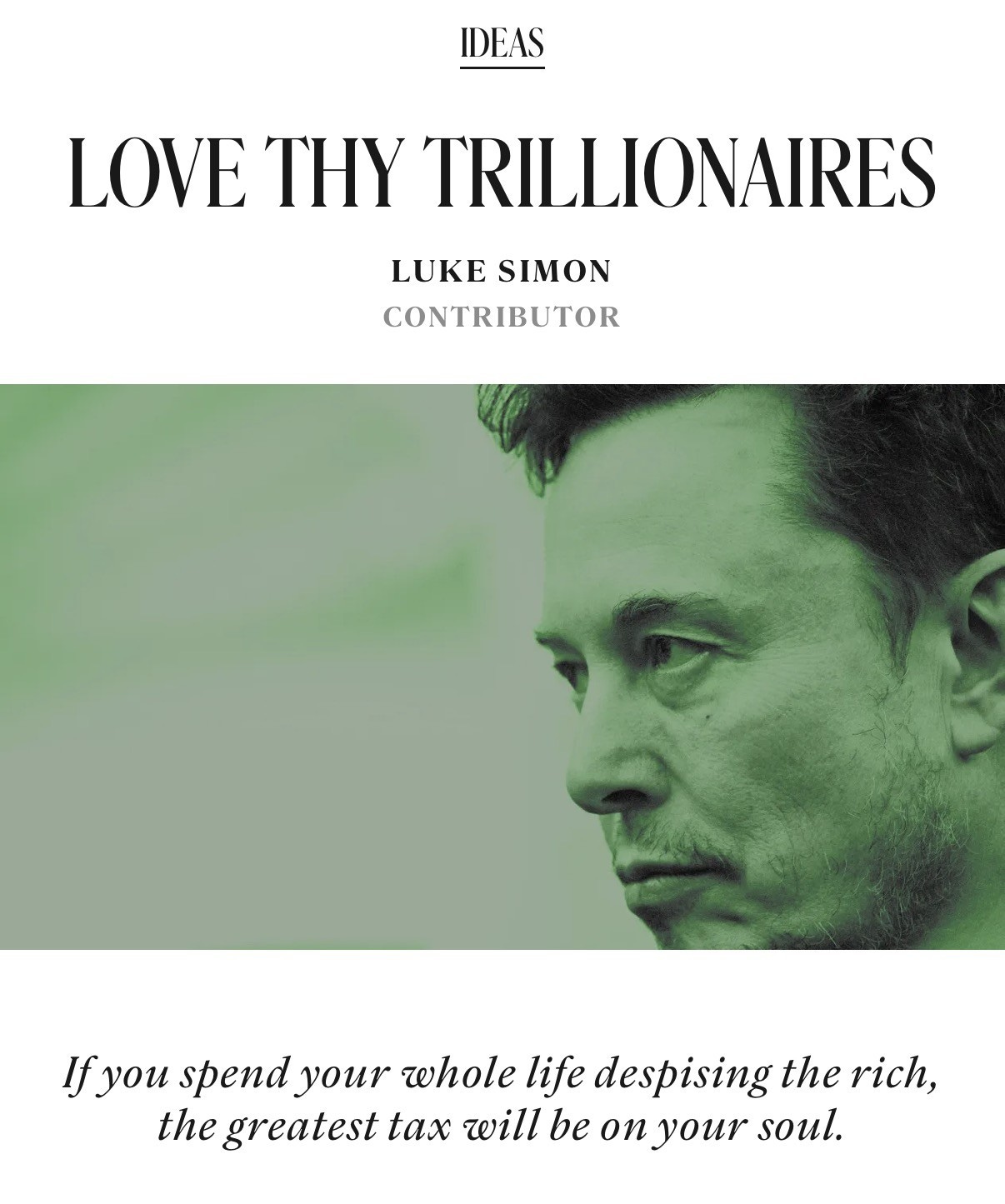
Is it wrong to be a trillionaire? Simon asks, in light of Elon Musk crossing into trillionaire territory a few weeks ago. Democratic Socialists might think so, but not so fast. The “logical endpoint” of Sanders’ and Ocasio-Cortez’s call for “a moral and political fight against billionaires,” according to Simon, is Luigi Mangione’s assassination of United Healthcare CEO. For Simon, all this seems to boil down to “resentment of the wealthy.” This is a problem that plagues left and right, he argues, and is inevitably linked to antisemitism. To be sure,
Scripture is not gentle with the wealthy. Jesus warned that riches can crowd out faith. James condemned landlords who exploited their workers. The prophets raged against people who trampled the poor.
That said,
We know what greed does to those who have too much. We are slower to reckon with what coveting does to those who have less. That’s what makes the tenth commandment so remarkable.
Christians are not immune to wanting what others have. In fact, we’re often uniquely susceptible because we have sophisticated vocabulary for disguising our desire. The Christian on the left wraps resentment in the language of justice and solidarity. The Christian on the right wraps it in the language of protecting Western civilization from shadowy elites. Both can quote Scripture to justify their anger. Both can be entirely blinded by envy.
My generation has inherited real economic burdens. Housing costs are staggering. Student debt has delayed families and homeownership. Many young adults feel as though the opportunities their parents enjoyed have quietly closed. Christians should never minimize those realities. We should care deeply about justice, generosity, and the poor. But hardship can quickly become fertile soil for envy, and envy is a weed that Scripture takes seriously regardless of how justified it feels.
Jesus was not subtle about what to do with your enemies. Love them. My generation has decided that trillionaires are the enemy. But the ultimate question is not whether Elon Musk deserves a wealth tax. It’s whether we’ll see him as a human being made in the image of God and worthy of love.
While making some valid points, the article is filled with rhetorical twists and over-simplifications and ends with this:
Is it wrong to be a trillionaire? I am not sure. Christians can disagree about economic policy. But I am sure of something else. If you spend your whole life despising the rich, the greatest tax will be on your soul.
If my generation becomes known for anything, I hope it is not our ability to count someone else’s money. I hope it is our willingness to count every person—rich and poor alike—as our neighbor. Will you love your trillionaires?
Of course, we don’t have trillionaires plural who need to be loved, we have one trillionaire, Elon Musk. (Actually, I believe his wealth slipped below that threshold not long after he crossed it, so maybe all of this is a moot point!) The more practical takeaway seems to be not that we should love Musk (whatever exactly that means), but that we should apparently worry more about the “tax on our soul” than about equitably taxing billionaires and trillionaires.
I suppose I should come clean. I’m not a fan of trillionaires. But it’s not because I envy their wealth. It’s never occurred to me to envy the lifestyle of the global elite. From my vantage point, it looks like a rather bleak existence.
Do I favor higher taxes for the wealthy? Sure. Because I think it would be good for people struggling to make ends meet. Because I think the billionaire and corporate class has already secured so many advantages over the average citizen, not to mention over those living in poverty. Because I think that what might be good for the pocketbooks of the elites in the short term hurts the economy in the long term. And because I don’t think that democracy survives in any meaningful way when the billionaire class wields the kind of power it does in our political system. None of these reasons have to do with envy. And none of these things even require a theological defense, although one certainly could be provided.
There was a lot of chatter about Simon’s and Kristian’s pieces, leading a few observers to suggest that Christianity Today seems to have taken a turn. This conversation hasn’t just been taking place online. A pastor friend of mine asked me just yesterday if I’d noticed any changes at CT over the past few months. This pastor had no idea about the editorial transitions. When I asked them what they’d noticed, they’d pointed a more intense (and ill-informed) focus on all things gender (on sterilization, on transgender individuals and the like), and also mentioned Kristian’s recent review of Charlie Kirk’s posthumously published book, Stop, in the Name of God: Why Honoring the Sabbath Will Transform Your Life. (Kristian notes that much of the book appears to have been written with generative AI but finds much to admire in it.)
Christianity Today has always encompassed a range of evangelical views. This past week, CT published Myles Werntz’s “Warn Thy Trillionaires.” It’s not clear to me if this was in response to the backlash provoked by the first or if the two had been planned as companion pieces, but Werntz offers a more traditional biblical interpretation of wealth and greed—one that Simon apparently found less than compelling.)
Yet CT has never published a full range of evangelical views. As one employee told me back in 2020, “Kristin, you’re not necessarily beyond the pale of CT, but you’re at the very edges of that pale.” I laughed when he put it that way, and I think it’s likely that the boundaries of the pale have shifted markedly since then.
A little history might be in order. As the late R. L. Stollar reminded us back when Olasky took the helm of CT, Olasky and Doug Wilson go way back. It was Olasky who recruited Wilson to write Recovering the Lost Tools of Learning, which helped established him as a leading voice in the conservative Christian homeschooling movement. As Stollar noted, Olasky also invited Wilson to be on World’s masthead and to write for and advertise his wares in the magazine. Olasky also promoted the work of Bill Gothard and Doug Phillips, and Olasky was Distinguished Chair in Journalism and Public Policy at Patrick Henry College, founded by Michael Farris, who also founded the Home School Legal Defense Association (HSLDA).
Olasky also hosted the two-week “World Journalism Institute” attended by Meg Basham, who now writes for the Daily Wire, and Olasky gave Basham her start as a film and television editor at World. From her perch at the Daily Wire, Basham has been a frequent critic of “evangelical elites” such as Russell Moore, David French, and even Olasky himself. In recent years, Christianity Today has been a particular target of Basham’s ire for not being sufficiently far right in its political and cultural commentary. (I haven’t seen much of that in the past few months, but maybe that’s a result of the algorithms.)
Christianity Today has a long track record of making people mad on the left and the right ends of the evangelical spectrum, but not necessarily evenly. (It’s worth noting that there’s little “leftist” presence there, evangelical or otherwise, despite what critics on the right insist.) The spectrum from center to far right is generally where the struggle plays out.
All of which is to say, things are complicated. As the “flagship magazine of American evangelicalism,” Christianity Today has always been a contested space, and a space worth watching. Reflecting evangelicalism itself, it needs to be understood not in static terms, but rather in terms of shifting alliances, and shifting centers of power. In the run-up to the midterms, keep your eye on CT. I think we’ll learn more about the direction new leadership will be taking the magazine.
Comments
Nothing yet. Say the first thing.
Sign in to join the conversation.