
I moved to Appalachia (Blairsville, GA) in October 2022 — after spending summers here since I was a child, I started noticing patterns I couldn’t ignore. It wasn’t immediately obvious as a “problem”, nor was it something that could be reduced to individual choices or moral failings. It was structural, cultural, developmental. It was a pattern of early responsibility and motherhood paired with delayed stability—a form of adulthood that begins, but doesn’t fully arrive.
It would be easy and incorrect to interpret this through a lens of judgement. What I see instead are women who are:
“adapting”
“responding”
“doing the best they can within the options available to them”
“unknowingly carrying on generational family patterns”
The question then is not why are they choosing this? But rather, what conditions are shaping these choices?
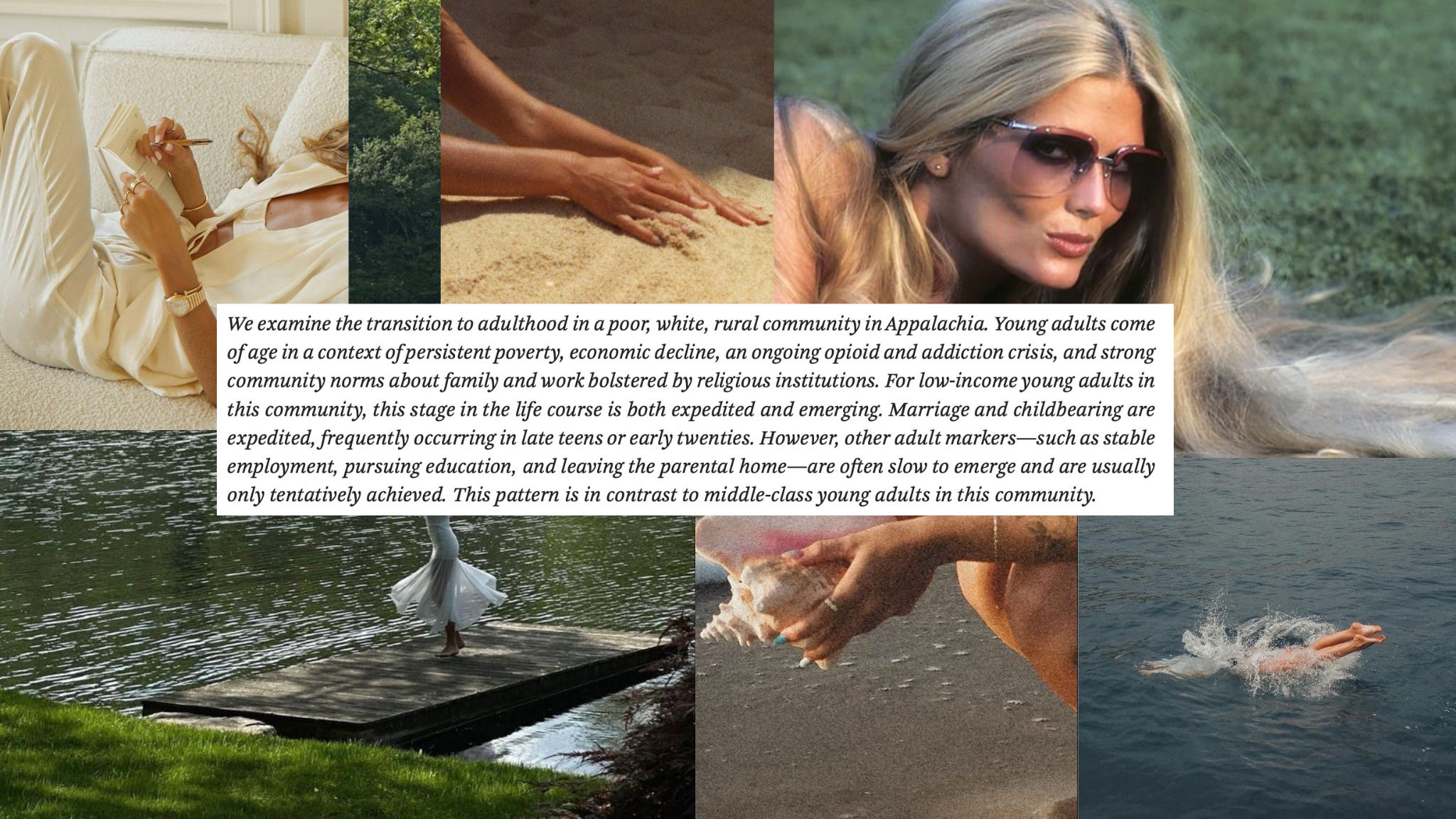
I recently came across a study titled “Coming of Age in Appalachia: Emerging or Expedited Adulthood?” It articulated—almost word for word— what I’ve been witnessing firsthand. The researchers describe a dynamic in which young adults in economically constrained rural communities (this study in particular looked at Clay County Kentucky) often experience in expedited transition into family roles—marriage and childbearing occurring in the late teens and early twenties—while other markers of adulthood such as financial independence, higher education, and leaving the parental home, emerge more slowly or remain unstable.
In other words, adulthood is assumed in responsibility, but not always supported in foundation.
“Scholars have delineated the Big 5 markers of adulthood that historically signaled adult status: leaving home, finishing school, finding work, getting married, and having children.”1
Researchers followed low-income young adults in Clay County Kentucky to conclude if they experienced “emerging adulthood” or “expedited adulthood”. What this paper finds, is that many residents do arrive at adulthood at the same rate compared to the average American. However, the lower income Appalachians are bypassing the first two to three Big 5 markers.
Falling into a trap of their economic reality looks like this: not leaving their parents house, not finishing school (whether that be high school or not advancing onto college), and not finding work. They are skipping these three crucial markers and jumping into either getting married or having children (outside of marriage).
It’s important to note that not every town in Appalachia is low-income. But, who grows up fast in Appalachia and who gets to reach adulthood at their own pace?
We cannot ignore the systems in place, many of which are set to hinder development into adulthood. It requires stepping beyond individual behavior and examining the systems that shape it—economic, structural, and cultural.
Let’s start with housing. There are very few accessible housing options for young adults trying to live independently. In many rural communities, access to independent housing is significantly limited. For young adults, particular those without substantial financial support, the transition out of the parental home is not simply delayed, it is often inaccessible. As a result, traditional markers of adulthood—independence, autonomy, and self-sufficiency—are postponed, even as other adult roles are assumed.
Next we have the economy. Economic growth is limited in some small Appalachian towns. Opportunities may be scarce. Stability is delayed not by choice but by lack of access. Job availability, wage growth, and pathways for upward mobility are limited, which narrows the range of viable life trajectories for young adults. What complicates this further, however, is a cultural resistance to development that exists in many of these communities. Efforts toward economic expansion, whether through new businesses, housing developments, or infrastructure, are often met with hesitation or opposition, rooted in a desire to preserve the character and familiarity of the town. While this instinct is understandable, it creates a paradox: the very growth that could increase opportunity, competition, and affordability is the same growth that is resisted. For example, when a single grocery provider dominates a region, prices rice with little competitive pressure. Yet, the introduction of additional options is viewed as disruption rather than relief. Over time, this limits not only economic mobility, but the range of choices available to the next generation.
Cultural and religious institutions also play a central role in shaping norms around family, responsibility, and identity. In many cases, churches serve as spaces of acceptance and support for young mothers, which is both meaningful and necessary. However, there appears to be less emphasis placed on preparation:
“the formation of a stable partnership prior to parenthood”
“the development of personal identity; identity in Christ”
“or the cultivation of a strong emotional, spiritual, and practical foundation before starting a family”
This raises an important complex question: What is being modeled as the ideal pathway into adulthood and what is being left unaddressed?
In regions where faith plays a central role in daily life, there is a significant opportunity for religious leadership to engage more deeply in conversations around:
intentional family formation
personal development; development of the self in Christ
the long-term stability of both individuals and households
Not from a place of condemnation but from a place of formation, guidance, and stewardship.
It also invites a broader reflection on leadership and responsibility within these spaces. When difficult or countercultural conversations are absent, it is worth asking:
“Is it a reflection of cultural sensitivity?”
“A desire to avoid shame-based messaging?”
“Or a broader discomfort with addressing topics that may challenge existing norms?”
These are not simple questions and they do not have singular answers. But, I believe they are necessary to consider if the goals is not only to support individuals in the present, but to strengthen the conditions that shape future generations. Support without structure sustains the present—but does not always transform the future.
Additionally, there is a piece to this concept that isn’t strictly social — it’s biological, emotional, and generational.
When young women are:
nutritionally depleted
dysregulated
lacking support and nourishment
exposed to toxins
they don’t just struggle themselves — they pass that instability to the next generation (their children). I see this in my work all the time. Mineral depleted, nervous system dysregulation, copper toxicity, chronic stress patterns — all layered on top of environments that never allowed true stability to form.
The issue isn’t necessarily early motherhood alone. It’s becoming a mother before ever becoming yourself. Knowing yourself. Understanding yourself. Your triggers, what makes you unique, your talents, the things you like, the things you hate, your identity, your past wounds, etc. This isn’t just about when women are having children. It’s about the fact that many are stepping into motherhood before ever being supported in becoming themselves.
There is very little space in these communities for a woman to:
discover who she is outside of a relationship
understand her body, her emotions, her patterns
build stability within herself before becoming responsible for someone else
and so what happens in motherhood becomes her identity before she ever had the chance to form one. You cannot pour from a self you’ve never met. Who are you?
When a woman hasn’t been nourished—physically, emotionally, or spiritually—she enters motherhood already depleted. A dysregulated nervous system, unprocessed trauma, mineral depletion, metal toxicity, chronic stress patterns. None of this magically disappears when a child is born. In fact, it illuminates. It gets passed down.
Generational trauma.
This is how the cycle continues. It isn’t because women don’t care but because they they were never given the tools, the time, or the support to build a foundation within themselves first (then their marriage second). These children are raised inside of nervous systems that are still trying to survive: fight or flight, sympathetic dominance.
Then, when those children grow up and leave the house, a woman is left asking:
Who am I … outside of being a mother … outside of being needed?
Because she was never given the space to find out.
This is why I believe so deeply in a different approach.
The foundation of the self before marriage.
The foundation of the self before children.
Not in a selfish way, because I know there may be some reading this that may be thinking this is where I’m going with this article. In the most selfless way possible. A regulated, nourished, grounded woman doesn’t just change her own life—she changes the trajectory of her children’s lives too.
True femininity isn’t found in rushing into roles. Many women are rushing into engagement, marriage, and children. True femininity is found in:
embodiment
nourishment
emotional depth
knowing who you are
and having the capacity to hold life, not just react to it
on top of becoming a mother, that woman becomes a safe place. A well-regulated woman creates a well-regulated home. The generational trauma halts.
Whether we want to realize it or not, our children inherit something from us. Our patterns, our regulation, our nourishment. The question isn’t if it impacts them, the question is how it impacts them.
Growth—economic, structural, cultural— is not a threat to these communities. It is an opportunity to expand what is possible.
For most families in Appalachia, this is all they’ve known. For generations. Many are stuck in their ways, but is their way offering true success, happiness, and support for generations to come? Or is it only furthering the idea that we need to carry on a legacy of tough times, hardship, and struggle?
No posts
Comments
Nothing yet. Say the first thing.
Sign in to join the conversation.