
I am currently working on a new book on Ssanggeom—the Korean art of double swords—as part of my continuing study of the Muye Dobo Tongji series.
After completing my earlier work on Ssangsudo, the two-handed saber, and Jedokgeom, the commander’s sword, I found myself drawn to a very different question. Both of those books deal with sword systems in which the body’s power is concentrated through a single blade. Ssanggeom, by contrast, begins with a more complex problem: what happens when both hands become independent weapon-bearing systems?
At first glance, double swords may appear to be simply a more spectacular or visually attractive form of swordsmanship. Two blades seem more dramatic than one. Yet the deeper I study Ssanggeom, the more I am convinced that it raises a much older and more fundamental question about the human body itself.
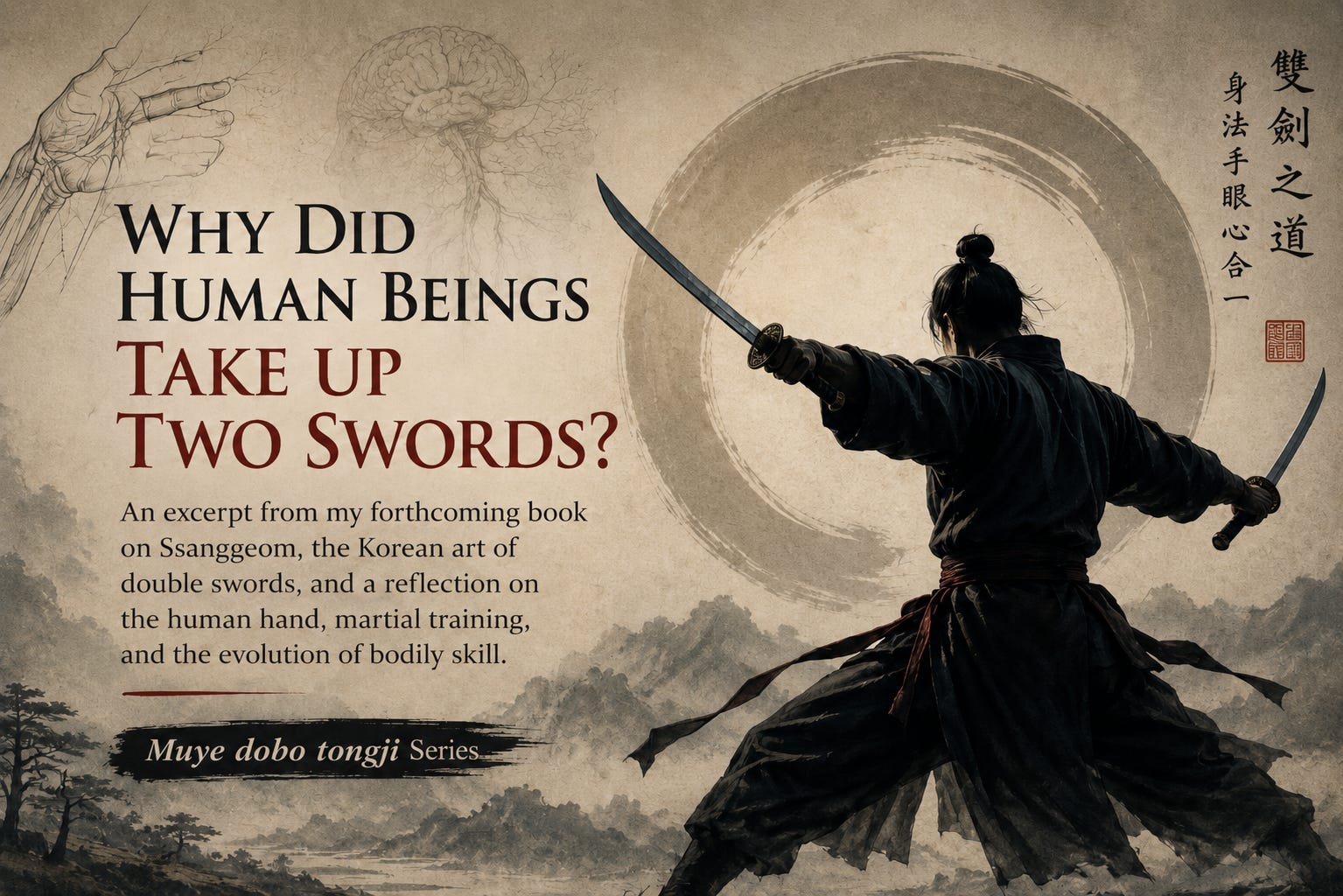
Why did human beings take up two swords?
This is not merely a question about increasing the number of weapons from one to two. It is also a question about the human hand, the human brain, bodily coordination, spatial awareness, and the martial imagination.
The following essay is adapted from the opening chapter of my forthcoming book on Ssanggeom.
Why did human beings take up two swords?
I believe this question reaches the heart of a book devoted to Ssanggeom, the art of double swords. Why two, rather than one? This is not simply a question about why the number of weapons increased from one to two. Perhaps it is also a question about the nature of the human being itself.
This may seem like too much meaning to attach to two swords. Yet when we consider the complexity of Ssanggeom, the question cannot be dismissed so easily. Ssanggeom is not merely a weapon system in which two swords are used at the same time. It is a distinctive martial result produced by the human body, the brain, the use of the hands, spatial awareness, and combat perception.
Human history is often explained through great turning points: the use of fire, the birth of language, the beginning of agriculture. Human beings mastered fire and overcame darkness and cold. Through language, they shared memory and experience. Through agriculture, they drew the rhythms of nature into the structure of human life. Yet behind all these transformations, there was always the human hand. Through the hand, human beings touched the world. Through the hand, they made tools. Through the hand, they transformed themselves into beings distinct from other animals.
Bipedal walking did not merely mean that human beings began to walk on two feet. It also meant that the forelimbs—the hands—were released from the task of locomotion. For a four-legged animal, the forelimbs remain organs of movement and balance. But once human beings began to stand upright, the two hands gradually acquired new possibilities. They were no longer bound only to the ground, no longer limited to supporting the weight of the body. Freed from this function, the hands began to grasp, manipulate, throw, cut, and combine objects.
This change did not merely provide convenience. The liberation of the hand changed the way human beings related to the world. Humans picked up stones, broke branches, sharpened bones and rocks. They did not simply use what nature had already provided. They began to alter things, reshape them, and adapt them to human purposes. In this process, human beings evolved from ordinary primates into Homo faber, the tool-making human.
Yet it is not enough to define the human being only as a tool-making animal. In my earlier book, A Brief History of Korean Martial Arts, I proposed another way of looking at the human being: Homo Martialarticus, the martial arts-practicing human. This is an intentional neologism. By Homo Martialarticus, I do not mean simply a human being who fights, nor a human being defined by violence. I mean the human being who trains the body, handles weapons, and reorganizes physical and mental capacities through martial practice.
From this perspective, martial arts were never merely combat techniques. Hunting and warfare were central conditions of human survival, and through them human beings developed more efficient ways of using the body. Throwing a spear, drawing a bow, casting a stone, or wielding a sword were not simply acts of attack. They were highly developed physical skills integrating distance, timing, balance, rotation, force, and speed. Human beings used weapons in order to fight, but in using weapons, they also refined and transformed their own bodies.
Consider hunting. Human beings were not as fast as many beasts. They did not possess sharp teeth or powerful claws. Yet they could hold tools in their hands. They could throw stones, thrust spears, draw bows, and coordinate their movements within a group. Weapons compensated for human weakness, but they also reorganized human physical capacity. A human being with a weapon was not merely an animal holding an object. He became a being who calculated distance, angle, speed, direction, and timing.
The human hand evolved in a highly distinctive direction when compared with the hands of other primates. Human beings did not merely develop the ability to grasp strongly. They also developed an extraordinary capacity for fine manipulation through the fingertips. In modern anthropology and evolutionary biology, this is often explained through the development of the power grip and the precision grip. The power to grasp made survival possible. The ability to manipulate precisely made civilization possible.
The power grip was necessary for holding weapons and transmitting force. To swing a club, drive a spear forward, or hold a sword hilt firmly, the hand required strength. Yet the precision grip required another level of ability. To pick up small objects with the fingertips, control the angle of an edge, tie cords, draw a bowstring, or refine the details of a tool, strength alone was not enough. The human hand developed both force and precision, and the union of these two capacities made tools and martial arts possible.
To shape a sharp stone tool was not simple labor. It was the result of the co-development of hand and brain. As the human hand became more refined, more complex tools appeared. More complex tools, in turn, stimulated the human brain. The movement of the hand developed the nervous system, and the developing nervous system made more precise use of the hand possible. If the human brain did not suddenly expand in a single explosive moment, then we may say that human beings gradually expanded the range of their perception and thought through the use of the hand.
In this sense, martial arts mean more than violence or combat technique. They are among the most complex systems of coordination the human body can produce. Throwing a spear requires distance calculation, rotational movement, timing, and muscular coordination. Shooting a bow requires the two hands to perform completely different roles. One hand pushes the bow; the other draws the string. Swordsmanship, too, is not merely the use of force. The angle of the wrist, the pressure of the fingers, the rotation of the arm, and the movement of the center are constantly joined together. As human beings used weapons, they learned to tune the body more precisely, and that process changed their senses and perception.
Martial training is the process of integrating many elements of the body into a single flow. The hand alone cannot use the sword properly. A strong arm alone cannot handle the spear accurately. The feet move the body. The waist changes the direction of power. The eyes judge distance and timing. The hand controls the weapon at the end of all these movements. Therefore, the hand is not merely a peripheral organ. In martial arts, the hand becomes the final point where the power and judgment of the entire body converge.
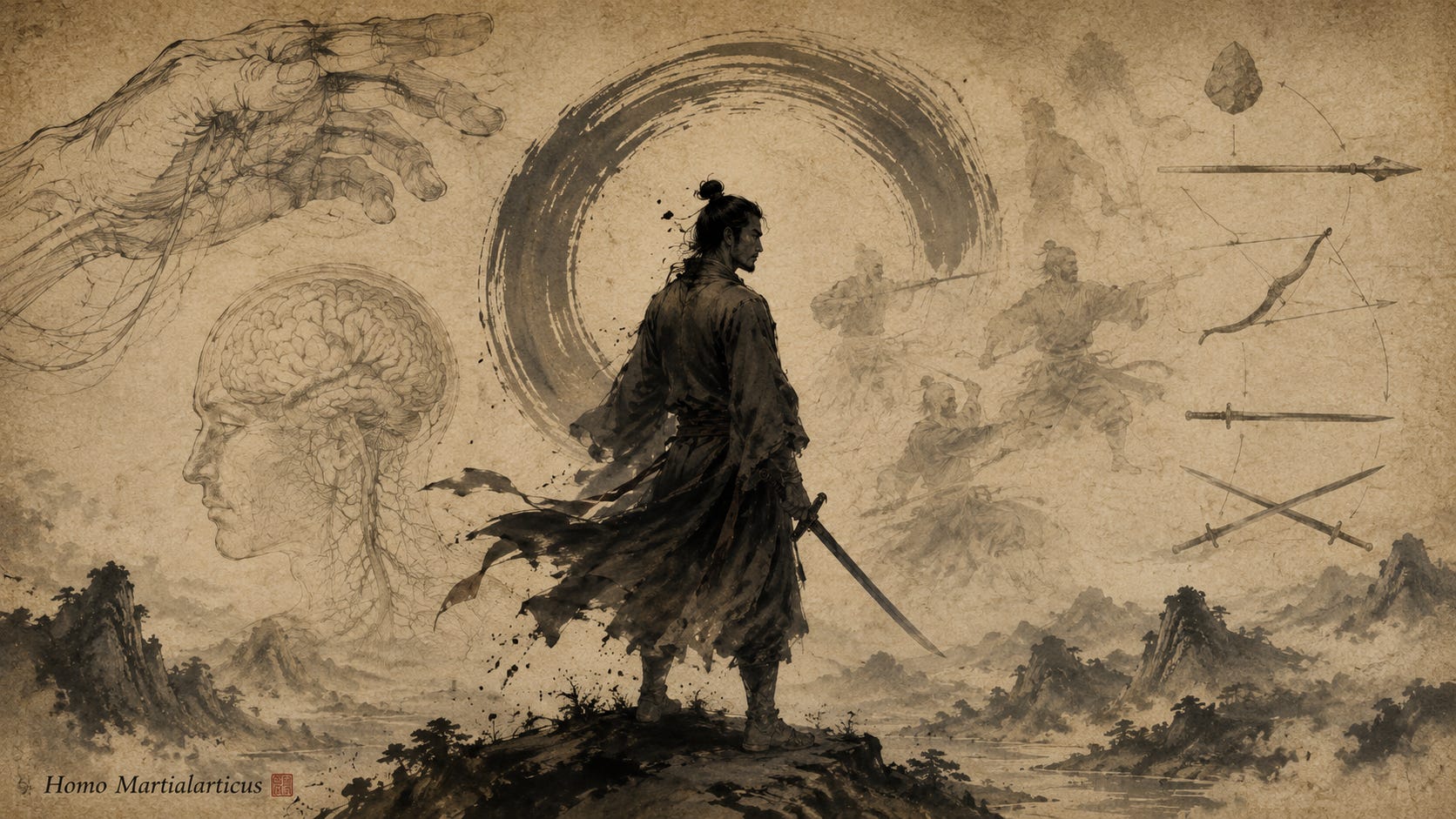
From the perspective of Homo Martialarticus, the history of human civilization is not only a history of production and consumption. It is also a history of how human beings trained their bodies, how they fought, and how they survived. Behind the rise and fall of states and empires, there were always systems of bodily training and combat organization. The formation of agricultural society, the expansion of cavalry empires, and the emergence of gunpowder weapons were all closely connected to changes in the human body and martial systems.
In the process of human evolution, the hand became more than an organ of survival. It became an instrument that expanded human perception itself. Human beings made tools with their hands, wrote characters with their hands, and handled weapons with their hands. The hand was an organ of labor, an organ of expression, and an organ of combat. It is no exaggeration to say that a considerable part of human civilization began at the fingertips. Martial arts were one of the fields that pushed the possibilities of the hand to their extreme.
What is particularly interesting is that human combat techniques required bilateral coordination from a very early stage. Human beings did not fight with one hand alone. In many combat situations, one hand attacked while the other maintained balance, defended, or prepared the next movement. One hand held a shield while the other held a spear. One hand pushed the bow while the other drew the arrow. Even in unarmed fighting, human beings constantly crossed left and right movements, pushing, pulling, striking, and blocking. Human combat developed within a system of bilateral coordination.
Bilateral coordination does not simply mean moving both hands at the same time. What matters is that the two hands perform different roles while being integrated toward a single purpose. In archery, the two hands do not do the same thing. One hand pushes the bow, while the other draws the string. The same is true of shield and sword. One hand blocks or diverts the opponent’s attack, while the other thrusts or cuts into an opening. In many weapon systems, the two hands perform distinct functions and thereby complete a single combat structure.
Ssanggeom goes one step further. Many weapon systems divide the roles of the two hands. Ssanggeom transforms both hands into independent agents of weapon use. One hand does not merely support while the other leads. Each hand holds a sword, and each moves within its own direction and rhythm. This is not simply the addition of one more blade. It is an attempt to expand the human hands, nervous system, spatial awareness, and combat perception into a more complex martial structure.
In Ssanggeom, the two hands are not placed in a simple symmetrical relationship. When the right hand moves, the left hand does not merely imitate it. At times, one sword attacks while the other defends. At times, one sword draws the opponent’s attention while the other delivers the real attack. At times, the two swords flow in the same direction and create one large rotation. At other times, they separate in different directions and open the left and right spaces of the body simultaneously. The complexity of Ssanggeom begins precisely here.
The human body is not perfectly symmetrical. Most human beings have a dominant hand, and movement tends to feel more natural in certain directions. A right-handed person feels the movement of the right hand more naturally. A left-handed person receives the movement of the left hand more easily. The direction of bodily rotation, the transfer of weight, and the handling of the gaze are not perfectly equal either. The human body may appear bilaterally symmetrical in form, but actual movement always tends to lean toward one side.
Nevertheless, human beings have tried to overcome this asymmetry through training. Martial training is part of this process. Martial arts do not merely follow the body’s natural habits. They correct habitual movement, strengthen the weaker side, and transform unfamiliar actions through repetition until they become part of the body. Ssanggeom is one of the weapon systems that most clearly reveals this character of martial training. To use double swords is to move beyond dependence on the dominant hand and to seek a more independent and refined use of both hands.
The difficulty of Ssanggeom lies in the fact that both hands hold swords. If one hand is empty, it can help with balance, protect the body, or support the next movement. But in Ssanggeom, both hands are armed. Neither hand can remain merely auxiliary. The two hands must move independently without interfering with each other. Each sword must have its own path while still being unified within the movement of the whole body. This is not only a problem of the hands. It is a problem of the entire body, and at the same time a problem of perception and judgment.
For this reason, Ssanggeom should be understood from the perspective of Homo Martialarticus. To take up two swords was not simply to add another weapon. It was an attempt to expand the human hands, nervous system, spatial awareness, and combat sense into a more complex dimension. Through repeated training, the practitioner of Ssanggeom controls the asymmetrical body, moves beyond dependence on one hand, and learns to make both hands move independently while still forming a single whole.
Of course, this is not easy. Two swords expand possibility, but they also increase confusion. The movement of one hand may interfere with the movement of the other. The paths of the two blades may collide. The judgment of attack and defense becomes more complex. The practitioner must deal with a wider space than when using one sword, and must develop faster judgment and more precise bodily control. Therefore, Ssanggeom is not merely a beautiful or spectacular technique. It is a martial art that tests the degree of complexity the human body and perception can bear.
This is also why Ssanggeom is so fascinating. Two swords give human beings more possibilities, but those possibilities do not open by themselves. At first, they may make the body more confused, entangle the movements of the hands, and disturb the center. But as training deepens, the two hands gradually begin to perform different tasks within a single flow. Left and right, attack and defense, rotation and advance, force and softness become connected within one system. At that moment, Ssanggeom is no longer merely a double-weapon system. It becomes a training system that reorganizes human physical capacity.
Perhaps human beings have been testing the possibilities of the two hands since very ancient times. With one hand, humans could survive. With two hands, they made tools, built civilization, and developed methods of combat. And with those same two hands, human beings once again took up weapons. In this sense, Ssanggeom is not merely a combat technique. It is an expression of the possibilities contained within the human being. Homo Martialarticus is the being who has continuously expanded the body, the senses, and the methods of combat within those possibilities.
Therefore, the question “Why did human beings take up two swords?” is a question about the origin of Ssanggeom, but it is also a question about how far the human body can be extended. One sword turned the human hand into a weapon. Two swords demanded something more difficult: the integration of two hands, two directions, and two fields of perception into a single combat system. Ssanggeom is the result of that attempt.
My forthcoming book will explore how this attempt was organized, recorded, and transmitted within the martial tradition of Joseon Korea.
Comments
Nothing yet. Say the first thing.
Sign in to join the conversation.