
In Korean martial arts, titles are everywhere. We hear sabumnim, kwanjangnim, gyosanim, seonsaengnim, master, grandmaster, and many other forms of address. In international Korean martial arts communities, these are often shortened into abbreviations such as SBN for sabumnim and KJN for kwanjangnim. These terms appear in dojangs, seminars, certificates, websites, social media profiles, and promotional materials.
In many cases, they are used with good intention. Students want to show respect. Practitioners want to acknowledge seniority. Organizations want to identify rank, role, or responsibility.
However, titles are also frequently misused.
This may seem like a small issue, but it is not. Martial arts are not only about techniques. They are also about how we stand, how we bow, how we speak, and how we understand our place in a tradition. If Korean martial arts are to be transmitted properly, we must also understand the language and etiquette that surround them.
A note on romanization may be helpful before going further. In this article, I use the spellings sabum and kwanjang because they are familiar in many international Korean martial arts communities and correspond to common abbreviations such as SBN and KJN. In standard Revised Romanization, these would more accurately be written sabeom and gwanjang. The spelling may vary, but the cultural distinction remains the same: sabum and kwanjang describe roles, while sabumnim and kwanjangnim are honorific forms of address.
The problem is not that titles exist. Titles are necessary. The problem begins when titles become self-decoration.
One of the most common misunderstandings concerns the words sabum and sabumnim.
In Korean martial arts, sabum means instructor. It is a functional term. It describes a role, position, or responsibility. Therefore, it is perfectly acceptable for someone to introduce himself by saying:
“I am the sabum of this dojang.”
“I teach Taekwondo here as a sabum.”
“I am Kim, the instructor of this school.”
There is nothing arrogant about this. It is simply a description of one’s job or position.
The problem begins when the honorific suffix -nim is attached to oneself. Sabumnim is not merely a job description. It is a respectful form of address. It is something students or others may call a teacher. It is not something a teacher should normally use to elevate himself.
A person may be a sabum. His students may call him sabumnim. But he should not introduce himself as “Sabumnim Kim.”
This difference may seem small to non-Korean speakers, but in Korean social usage it is important. The suffix -nim carries respect. That respect is given by others. It is not something one attaches to oneself.
The same principle applies to kwanjang and kwanjangnim.
Kwanjang means the head of a school, hall, or institution. In martial arts, it usually refers to the person who runs a dojang or leads a kwan. It can be translated as school head, director, or chief instructor, depending on the context.
Again, it is acceptable to say:
“I am the kwanjang of this dojang.”
“I run this school.”
“I am the head instructor here.”
This is a factual description of one’s role.
But saying “I am Kwanjangnim Park” is different. Kwanjangnim is an honorific form used by others. It expresses respect toward the school head. When a person uses it for himself, the title changes from a description of responsibility into a form of self-honorification.
This is where many problems begin.
In Korean martial arts, we should distinguish between three things: role, rank, and honorific address. A role describes what you do. A rank identifies your level within an organization. An honorific address expresses respect from others. When these three are confused, titles become inflated and etiquette becomes distorted.
A sabum teaches. A kwanjang leads a school. A dan rank indicates technical or organizational level. But sabumnim and kwanjangnim belong to the language of respectful address.
Respect should be received, not self-declared.
In many international Korean martial arts communities, people use abbreviations such as SBN and KJN. SBN usually means sabumnim. KJN usually means kwanjangnim.
These abbreviations are not necessarily wrong when students use them to refer to their teachers. For example, in a message between students, someone may write, “SBN will teach the seminar tomorrow,” or “KJN will visit our school next month.” In that context, the abbreviation functions as shorthand for a respectful form of address.
But the abbreviation does not remove the honorific meaning.
If SBN means sabumnim, and KJN means kwanjangnim, then using these abbreviations for oneself still means attaching an honorific title to oneself. Saying “I am KJN Kim” or “I am SBN Park” is not much different from saying “I am Kwanjangnim Kim” or “I am Sabumnim Park.”
The letters may look modern, convenient, and less formal. But the cultural problem remains the same.
This is especially important in social media profiles, seminar posters, email signatures, and certificates. When someone repeatedly presents himself as SBN or KJN, he may think he is simply using a martial arts title. But from the standpoint of Korean usage, he is effectively placing an honorific form before his own name.
A better solution is simple. Use the functional title when describing yourself.
“I am a Taekwondo instructor.”
“I am the head instructor of this dojang.”
“I serve as the director of this school.”
“I teach Hapkido in Amsterdam.”
There is no need to decorate the name with self-applied honorifics.
Another source of confusion comes from comparing Korean and Japanese martial arts terms too mechanically.
For example, Korean sabum and Japanese shihan share the same Chinese characters: 師範. Because of this, many people assume they mean exactly the same thing. But this is not quite correct.
The characters are the same, but the social usage is different.
In Japanese budō, shihan often carries a more formal and elevated nuance. It may refer to a senior instructor, master instructor, or someone officially recognized within an organization. It is not simply a casual word for anyone who teaches.
In Korean martial arts, sabum is more functional. It commonly means instructor. Of course, it can still carry respect depending on context, especially when combined with -nim as sabumnim. But the word sabum itself is not identical in nuance to Japanese shihan.
This matters because martial arts people often become fascinated by characters, titles, and old terminology. They see that two words share the same Chinese characters and assume they must carry the same cultural meaning. But language does not work that way. Words live through usage. The same characters can develop different meanings in Korean, Japanese, and Chinese contexts.
The same issue appears with seonsaeng and sensei.
Korean seonsaeng and Japanese sensei also share the same Chinese characters: 先生. Yet their use is different. In Japanese, sensei already functions as an honorific form of address. A student may naturally call a teacher “Tanaka Sensei.” The word itself carries the respectful address function.
In Korean, however, seonsaeng by itself is more neutral and incomplete as a respectful address. In most cases, one says seonsaengnim. The suffix -nim gives the word its clear honorific force.
The English-speaking martial arts world adds another layer of complexity.
In many Korean martial arts schools outside Korea, sabumnim is translated as “Master.” A senior teacher may be called “Grandmaster.” These terms have become common, especially in Taekwondo, Hapkido, Tang Soo Do, and other Korean martial arts communities.
Here we need to be careful. English usage is not exactly the same as Korean usage.
In English-speaking martial arts contexts, “Master Kim” can function as a conventional form of address for a senior instructor. Students may say:
“Master Kim will teach today.”
“Thank you, Master Kim.”
“This is Master Choi, our instructor.”
In such cases, the expression may be perfectly acceptable. It functions within the English-speaking martial arts environment as a respectful title for a teacher.
It is also true that English allows professional titles before names in ways that Korean honorific usage does not. People may say, “I am Dr. Smith,” “I am Professor Lee,” or “I am Father Michael.” Therefore, saying “I am Master Kim” is not grammatically impossible in English, and in some martial arts environments people may understand it as normal.
Still, it is stylistically delicate.
When someone introduces himself by saying, “I am Master Kim,” it can sound self-important, especially in intercultural settings. It may be understood as a simple professional title, but it may also sound like the speaker is demanding recognition. Much depends on context, tone, audience, and local custom.
For this reason, a more modest and culturally safer introduction would be:
“My name is Kim. I am the instructor here.”
“I am Kim, the head instructor of this dojang.”
“I teach Taekwondo at this school.”
“I am a master instructor in our organization.”
The last example is especially useful because “master instructor” functions as a role description rather than a self-applied honorific attached to the name.
So the issue is not that the English word “Master” is always wrong. It is not. The issue is whether the title is being used to clarify one’s role or to elevate oneself.
There is also a danger of inflation. Once titles become marketing tools, they begin to lose their meaning. “Master” becomes “Grandmaster.” “Grandmaster” becomes “Supreme Grandmaster.” “Founder” becomes “World Founder.” Soon, the title says more about the person’s desire for recognition than about his actual responsibility, skill, or contribution.
A real teacher does not become greater by using a greater title.
In fact, excessive titles often create the opposite impression. When someone insists too strongly on being called “Grandmaster,” we may begin to wonder why the title needs so much protection. True authority does not usually need to shout.
A good teacher is recognized through practice, character, knowledge, and service. His students know who he is. His contribution speaks for itself.
It is also important to distinguish rank, certification, and form of address.
A dan grade is a rank. A teaching license is a qualification. A position in an association is an administrative or institutional role. These may be listed in a formal biography, website, or certificate.
For example, it is acceptable to write:
“7th dan, certified instructor.”
“Head instructor of the Korean Martial Arts Center.”
“President of the Dutch Sibpalki Association.”
“Director of the dojang.”
These are factual descriptions. They tell people what position someone holds or what qualification has been granted.
But this is different from demanding that people use those terms as personal titles. A certificate may recognize your qualification. An organization may appoint you to a role. Your students may address you with respect. But none of this means you should attach honorifics to your own name.
This distinction is especially important because Korean language is sensitive to hierarchy, relationship, and context. The same person may be addressed differently depending on who is speaking. A student, colleague, senior, junior, family member, public announcer, and organizational representative may all use different forms.
Titles are not permanent ornaments attached to a person. They exist within relationships.
The distinction becomes clearer when we compare proper usage with common mistakes. The basic rule is simple: words such as sabum and kwanjang can describe one’s role or position, while sabumnim and kwanjangnim are honorific forms of address used by others. The same logic applies to abbreviations such as SBN and KJN.
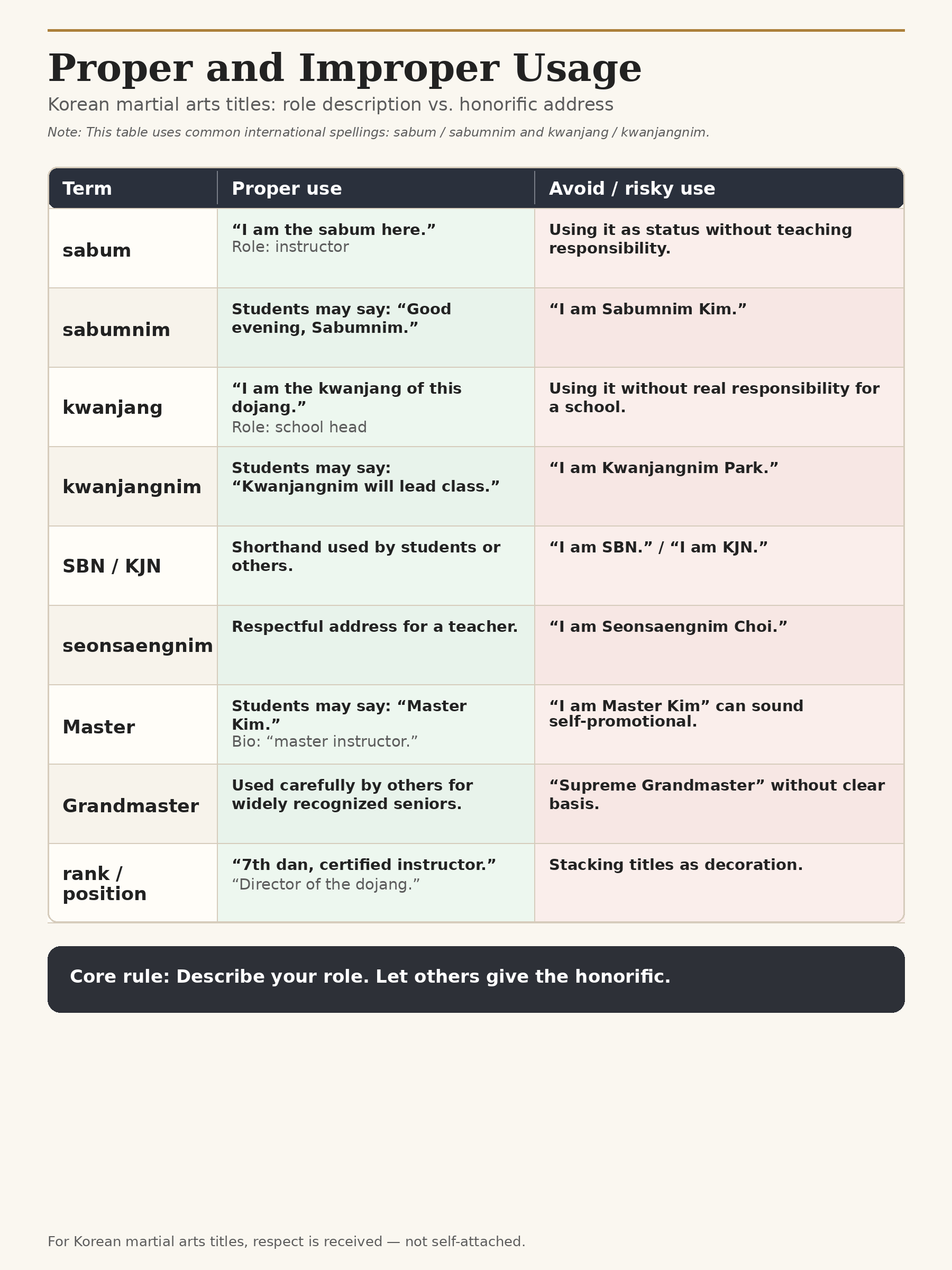
The point is not to avoid titles altogether. The point is to use them according to their proper function: describe your role when speaking about yourself, and let others give the honorific.
Some may say this is only language. But in martial arts, language is never only language. It reflects how we understand respect, hierarchy, responsibility, and tradition.
Korean martial arts are not merely collections of techniques. They are cultural practices. If we use Korean uniforms, Korean terminology, Korean etiquette, and Korean titles, then we also have a responsibility to understand them properly.
The basic rule is simple: describe your own role, but let others give the honorific. One may say, “I am the sabum of this dojang,” or “I am the kwanjang here.” But one should avoid saying, “I am Sabumnim Kim,” “I am Kwanjangnim Park,” “I am SBN,” or “I am KJN.”
English “Master” is more nuanced, because English has its own conventions for professional titles. Still, even there, a modest introduction is usually better: “My name is Kim, and I am the instructor here.”
A title should not be a costume. A title should remind us of responsibility.
A sabum must teach. A kwanjang must guide a school. A senior instructor must preserve and transmit the art. Without responsibility, a title is empty. Without humility, a title becomes decoration.
In the end, the best title is not the one printed before your name.
It is the trust that your students, your colleagues, and your tradition place upon you.
Comments
Nothing yet. Say the first thing.
Sign in to join the conversation.