
Recently, I came across an article reporting that virtual taekwondo may be adopted as an event at the 2026 Aichi-Nagoya Asian Games. The final decision has not yet been made and is expected to go through the organizing committee’s board meeting. Still, this news seems to mean more than the simple addition of a new sporting event. It invites us to think about where martial arts are heading today, and what form martial arts may take in the future. [Source 1] [Source 2]
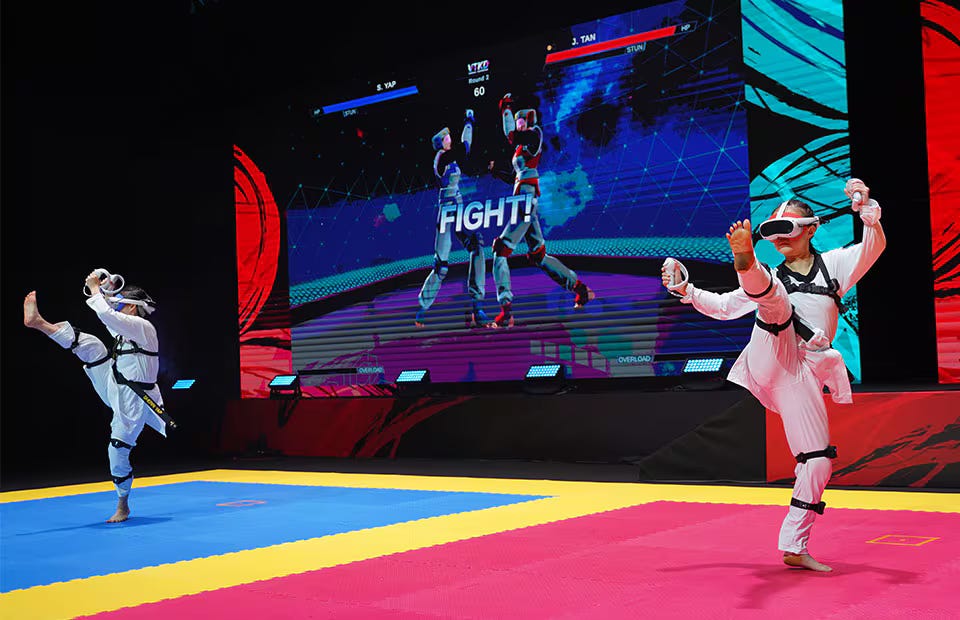
Virtual taekwondo uses VR headsets and motion-tracking sensors to transfer the athlete’s movements into a virtual space. The athletes still move their physical bodies, but those movements are represented digitally. Instead of directly kicking or striking the opponent’s body, sensors read the movement and the system determines the result. The match is reportedly decided by depleting the opponent’s power gauge within the time limit, or by retaining more power than the opponent when time runs out. [Source 1] [Source 3]
At first, this sounds unfamiliar. To some people, it may even sound strange. It is taekwondo, but bodies do not directly collide. It is sparring, but there is no actual physical impact. The opponent is in front of you, and yet at the same time exists inside a virtual space. Then can we still call this taekwondo? More broadly, can we still call this martial arts?
I think this question is very important. It is important because it does not concern virtual taekwondo alone. It may be a question that all martial arts will eventually have to face.
Martial arts have always changed with the times. When we think of traditional martial arts, we often imagine old forms, unchanging methods, and fixed techniques passed down across generations. But in actual history, martial arts were never so static. When weapons changed, martial arts changed. When the structure of the battlefield changed, techniques also changed. In the age of mounted warfare, in the age of bows and spears, in the age of gunpowder and arquebuses, and later in the age of modern nation-states and school physical education, martial arts continued to take on different forms.
Taekwondo is no exception. The taekwondo we know today is not simply the result of an ancient tradition continuing unchanged. Rather, it is a modern martial art that was reorganized within the historical conditions of post-liberation Korean society, connected to national identity, and developed into a global sport. Taekwondo has already changed its form many times. It moved from dojang training to the sports arena, from a Korean martial art to a global sport, and now even toward digital space.
In this sense, virtual taekwondo is not merely a strange phenomenon that suddenly appeared. It may be another scene along the path of transformation that taekwondo has already been following. Still, this change appears more radical. This time, even direct physical contact — which many people regard as one of the most basic elements of martial arts — is being reconstructed through digital technology.
Here, we need to think more carefully. What is the essence of martial arts? Is it the act of actually striking an opponent? Is it the exchange of pain and impact? Or is it distance, timing, balance, reaction, judgment, and the process of bringing body and mind together?
Of course, physical contact is very important in traditional martial arts. We learn a great deal by actually feeling the pressure of an opponent, by experiencing the fear of an incoming attack, and by going through the process of losing balance and recovering it. Martial arts are not learned only through the head. They are learned through the body. This cannot be easily replaced, no matter how advanced technology becomes.
However, this does not mean that every form with reduced contact should automatically be dismissed as non-martial. Many martial arts have already been regulated and sportified in various ways throughout history. Swordsmanship became fencing. Archery became Olympic archery. Various combat skills were reorganized into sports such as judo, wrestling, boxing, and taekwondo. In this process, the danger of actual combat was reduced, and rules and scoring systems were introduced. Something disappeared, but at the same time, something new was created.
Virtual taekwondo may be part of a similar process. The difference is that this transformation is now taking place not merely in the sports arena, but in virtual reality.
One interesting feature of virtual taekwondo is that it attempts to move beyond differences of gender and age to some extent. According to reports, if virtual taekwondo is adopted as an Asian Games event, a mixed-gender individual competition is being considered for athletes between the ages of 17 and 35, with a round-of-16 tournament format under review. [Source 1] [Source 4]
In actual combat sports, weight class, gender, and age matter greatly. Differences in body size, strength, speed, and impact can have a major influence on the outcome of a match. But in virtual taekwondo, direct physical impact is reduced, and the system evaluates movement. As a result, the traditional divisions may become less decisive. This is why mixed-gender competition becomes possible.
This is certainly an interesting possibility. More people may be able to participate safely, and the risk of injury may be reduced. It may also offer a new approach for those who feel burdened by full-contact sparring. For younger generations, it could become another doorway into taekwondo.
But at the same time, we should not forget the question on the other side. If force, impact, physical pressure, and the fear of facing an actual opponent are reduced, might some important part of martial arts also become weaker? Martial arts are not made only of fast movement and accurate reaction. The tension that arises when facing a real opponent, the experience of recognizing the limits of one’s own body, and the humility gained through repeated training are also essential parts of martial arts.
In this sense, virtual taekwondo is both an opportunity and a warning. Technology can open martial arts to a wider world. But technology cannot replace the depth of martial arts.
In the future, martial arts will not develop in only one direction. Some martial arts will continue to exist as traditional training. The way a teacher and student meet in the dojang, repeat basic techniques, establish the center of the body, and reflect on life through technique will remain important. I consider this to be the deepest layer of martial arts.
At the same time, martial arts will continue to develop as sports. More refined judging systems, safer equipment, and more objective data analysis will be introduced. Taekwondo has already been moving in this direction through electronic protectors and video review systems. Virtual taekwondo can be seen as a further extension of this trend.
And now we are seeing a third current: digital martial arts, or martial arts in extended reality. VR, AR, motion capture, AI coaching, and remote training systems may significantly change the way martial arts are practiced. Practitioners may train together without gathering in one physical space. They may spar with people from other countries in virtual environments. They may analyze their own movements through data.
This is clearly a possibility of a new era. But the fact that something is possible does not mean that it is the completion of martial arts.
What matters most in martial arts is ultimately the human being. More precisely, it is the human body. No matter how sophisticated virtual reality becomes, no matter how accurate sensors become, and no matter how quickly algorithms judge the result, the movement is still produced by the human body. It is the body that kicks. It is the body that loses balance. It is the body that feels fear and then regains its center.
For this reason, I do not want to see virtual taekwondo simply as the disappearance of the body. Rather, it may be a new translation of the body. The movement of the body is translated into digital language, and certain elements of martial arts are reconstructed inside virtual space. Yet, as with every translation, something survives in the process, and something else disappears.
Therefore, what we need to do is not to condemn this change unconditionally, nor to welcome it uncritically. What matters is discernment. What is being preserved? What is disappearing? And does what is newly created deepen the spirit of martial arts, or does it reduce martial arts to mere entertainment?
I do not think virtual taekwondo is the end of martial arts. Nor do I think it represents the whole future of martial arts. But it is clearly an important signal that makes us think about that future.
Martial arts have always been a mirror of the times. In the age of war, they were skills of survival. In the age of the nation-state, they became tools of discipline and identity. In the age of sport, they became arenas of competition and record. Then what question is martial arts asking us in the digital age?
Can martial arts still be martial arts in virtual space?
I do not want to answer this question too easily. But one thing seems clear. As long as martial arts are alive, they will change. And if martial arts are to remain truly alive, they must not lose the human body and spirit in the midst of change.
Technology can open a new door.
But it is still the human body that passes through that door.
And how we understand and train that body will remain the most important question in martial arts.
What do you think?
Is virtual taekwondo an expansion of taekwondo, or a movement away from its essence?
What must martial arts preserve, and what must they newly accept, in order to survive in the digital age?
[Source 1] Chosun Ilbo Korean article
“VR 쓴 ‘버추얼 태권도’ 日 아시안게임 채택 유력,” May 22, 2026.
[Source 2] Yonhap News Korean article
“올해 日 아이치·나고야 아시안게임에 ‘버추얼 태권도’ 추가(종합),” May 21, 2026.
[Source 3] The Chosun Daily English article
“Virtual taekwondo likely for Japan Asian Games with VR debut,” May 22, 2026.
[Source 4] The Dong-A Ilbo English article
“Virtual taekwondo set for Asian Games debut,” May 22, 2026.
[Source 5] Korea JoongAng Daily English article
“No pain, same gain: Asian Games athletes may soon be able to medal in virtual taekwondo,” May 21, 2026.
Comments
Nothing yet. Say the first thing.
Sign in to join the conversation.