
English and Continental are the two most familiar labels for how knitters hold their yarn: in the right hand for English, in the left for Continental. Today, the names are broadly, if imprecisely, true. Most knitters in England do hold the yarn in the right hand, most in continental Europe hold it in the left. But has this always been the case? Both names seem to be relatively recent, and there are a few documented cases that show a national ‘tradition’ being moulded over the last 150 years, sometimes within a single generation. Each time, the shift can be tracked to a specific teacher, manual, or policy, showing that these names are not always inherent to the location.
English and Continental are themselves umbrella terms, and several other named styles fold into one or the other. Within English knitting there’s throwing, flicking, parlour knitting, and Irish Cottage style. Continental sometimes gets called picking, along with German or Swiss style, depending on the source. There’s also Norwegian knitting, which usually means Continental knitting where the purl stitch is worked without moving the yarn to the front, although a similar kind of purl can be done in the English style too. The exact definition of these sub-terms varies from source to source, and they can sometimes overlap.
Already, you can see why the terminology gets confusing. Ann Feitelson, who has studied Shetland knitting closely, put it plainly: “Holding the yarn in the left hand is not ‘continental’, nor is holding it in the right ‘English’. It is just holding it in the left or right hand.” Beth Brown-Reinsel made a related point in a piece for Threads magazine in August 1990: profiling 6 knitters who each used a different method showed how much diversity 2 labels like ‘English’ and ‘Continental’ can paper over.
How people actually knitted in the past follows a clear pattern: styles have shifted around the world within the last 150 years.
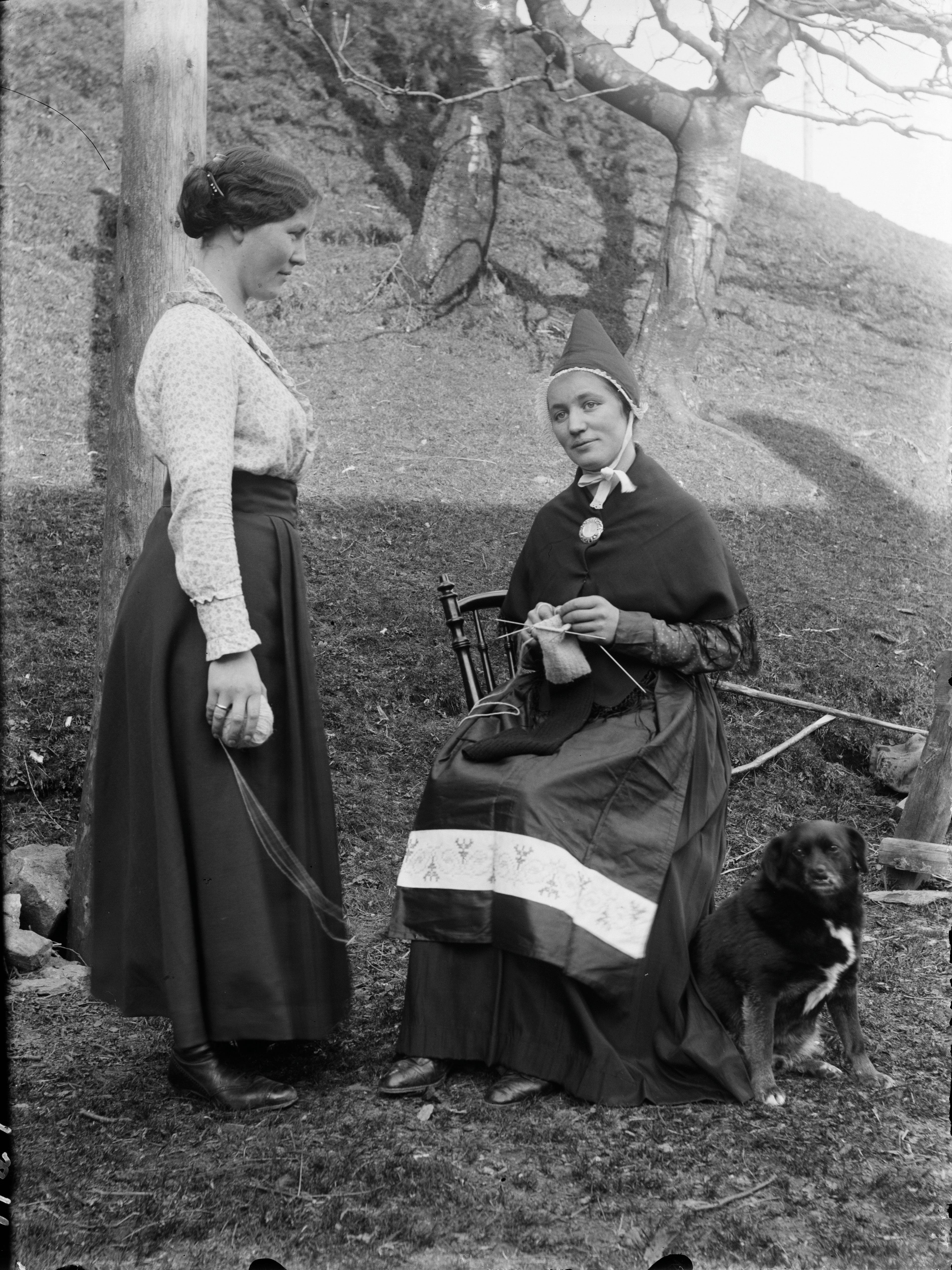
In England, the standard account on knitting styles describes a shift: before the 19th century, knitters held the needle braced under the palm. The genteel “parlour style” associated with Victorian ladies, with the needle gripped like a pen, came later and was both slower and less efficient (Richard Rutt’s words, not mine). Many assume that the older style is more similar to how most English style knitters hold their needles today, somewhat like a knife rather than a pen. However, the older method in England was more likely sheath knitting, where the right needle is supported in a knitting sheath worn at the hip or waist. This was also the predominant knitting style in nearby countries, such as the Netherlands, and was favoured by production knitters, supposedly allowing them to sustain a punishing pace for hours. Whether sheath knitters typically held the yarn in the left or right hand isn’t clear from the sources I’ve found, and my own guess is that it was predominantly the right hand, but not as a hard rule, since it’s also possible to knit ‘Continental’-style with a sheath. Penelope Hemingway, a knitting historian, wrote about her own family history, which is a useful anecdote here: she was taught to knit ‘Continental’-style as a child, by her mother’s family, farmers in a remote part of Yorkshire who had stayed outside the reach of the 1870 Education Act and the polite, school-taught ‘English’ style that went along with it. Her family’s experience suggests hand-side wasn’t fixed within England, despite the name.
Swedish knitters are recorded as having knitted with the yarn held in their right hand up until the late 19th century. Hulda Lundin, the state supervisor of craft education, published a manual in 1892 promoting the ‘German method’, where the yarn is held over the left index finger. Because the manual went directly into teacher training, the Continental method became the one most Swedish schoolchildren learned within a generation. The prescriptive knitting curriculum coincided with the decline of a knitting tradition in Sweden, known as two-end (or twined) knitting (tvåändsstickning in Swedish). This technique is worked by twisting two strands of yarn together between every stitch to make a dense, windproof fabric. A characteristic of this technique is that it was knitted with the yarn in the right hand. Of course, there were likely several reasons for the decline of the technique, but discouraging right-handed knitting may well have contributed to it. I haven’t yet tried the technique myself, but it is apparently much more convenient to do it with yarn in the right hand compared to the left. The technique was nearly lost until 1974, when a glove was recovered from a mining slag heap at Falun in Dalarna; researchers later found that over 95% of the knitted objects collected from the same region had been made using the two-end method.
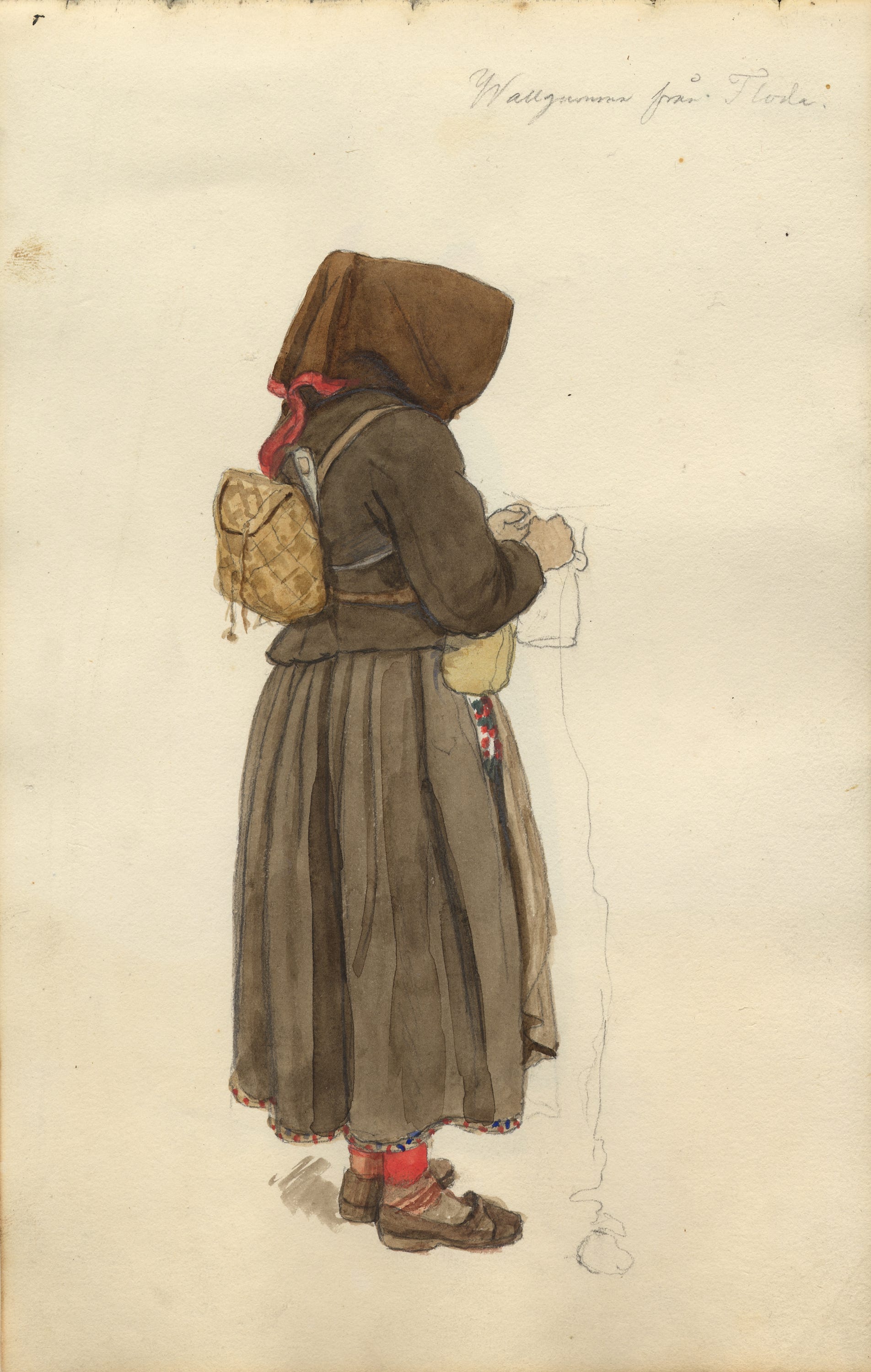
There’s evidence of a similar pattern in Finland, where I currently live and almost exclusively encounter continental knitters. Both left- and right-hand knitting were taught at home in the past, with ‘English-style’ knitting still being passed down as late as the 1950s. Again, teacher training programs prioritised holding the yarn with the left hand, cementing the Continental method across the country. One of the teachers trained this way, Elina Häkkinen, crossed the Baltic Sea and started teaching in Estonia. She then went on to write an influential home economics textbook in 1924 which showed only the Continental method of knitting, which subsequently became the method taught in schools. Depictions of Estonian knitters before this time show them primarily tensioning the yarn in their right hand.
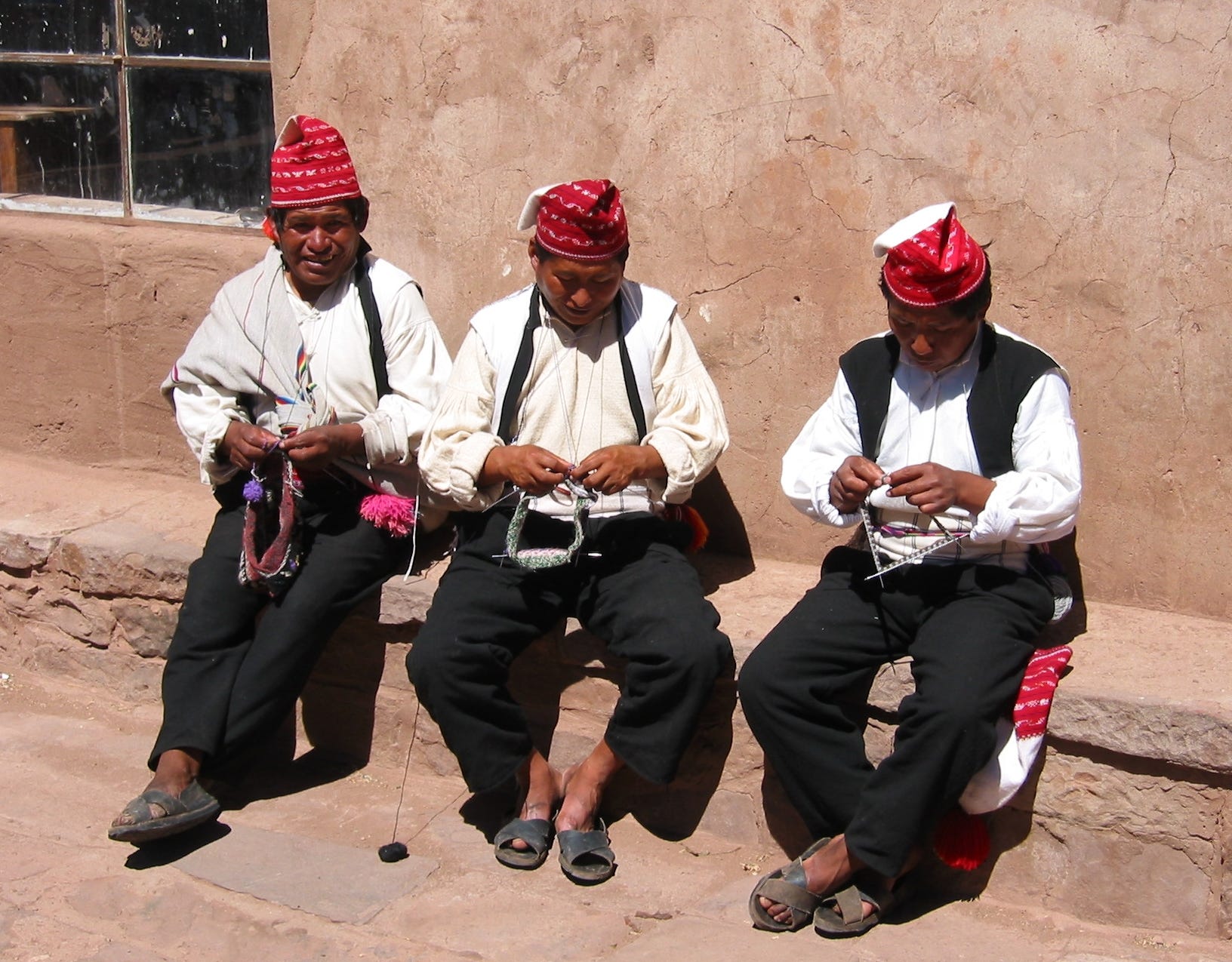
One style of handling the yarn that doesn’t fit neatly into ‘English’ or ‘Continental’ is tensioning it around the neck or off a pin, often called ‘Portuguese’ knitting, though it’s also documented in parts of Greece, Egypt, and South America. It’s hard to know exactly where the style originated, how old it is, or how it spread between these places. In this style, though, the purl stitch is generally the easier, more natural one to work, since the yarn sits in front of the needle, not behind it. That’s almost unthinkable for most English or Continental knitters, for whom purling is usually the fiddlier of the two.
So far, all of the knitting styles mentioned are defined by how the yarn is handled and possibly also by how the needle is held, but there is another aspect of knitting style which we sometimes talk about. This is whether we are knitting Western style or Eastern style, which is a description of stitch mount, meaning which way the working leg of a stitch sits on the needle before it’s worked. Both Eastern and Western knitting can be done regardless of how the yarn is handled or the needles are held. Combined knitting, a term coined by the knitting writer Mary Thomas in 1938, knits the Western way and purls the Eastern way. Western knitting tends to be the prominent style in western Europe and North America, while Eastern and combined knitting are associated with eastern Europe and Russia. As a result, English language patterns generally assume a Western mount without saying so, so a knitter working the other way can end up confused, or with unexpectedly twisted stitches, without necessarily knowing why.
This year I hit a kind of slump: more than 30 pairs of socks knitted, a wardrobe full of sweaters, scarves, and hats, and I noticed I was picking projects for one reason only: something new to learn. Since then I’ve bought a knitting machine, a Shetland knitting belt, a Portuguese knitting pin, and also a knitting sheath.
I tend to get annoyed when I hear someone say a particular knitting style is better or worse than the others. It might be true for that person, but it’s rarely universal. Beth Brown-Reinsel, who profiled 6 different knitters in 1990, admitted that early in her teaching career she started every beginner on Continental, telling them it was faster and better than English. Years of watching students changed her mind. No style, she concluded, is better than another, though some may have certain advantages in particular situations.
For me, I choose a particular knitting style depending on what suits my hands, where I’m sitting, how portable the project needs to be, what materials I have to hand, or simply because of what it means to me. That need to find the ‘best’ way overwhelmed me plenty when I started knitting again, and the same feeling is creeping up now that I’m learning to spin. I sometimes need to remind myself to relax and just do what feels best.
English knitting will probably always feel like home to me, since it’s how my grandma taught me. It’s not my primary method, but when I do use it there’s an added sense of nostalgia. With spindles, supported spinning suits me far better than a drop spindle does, mostly because I’m disabled and spend a lot of time sitting on the sofa, where there isn’t much room for a spindle to swing free. The knitting sheath is a bit impractical for me day to day, since it needs somewhere on my body to tuck into, but the whole point of trying it was to find out what it would actually feel like to knit a fine-gauge stocking the way it would have been done in period, so I’m sticking with it for that project regardless. Plenty of knitters say the Norwegian purl changed their life. For me it’s too much movement for my stubby fingers, and I’ve settled on the combined method when knitting Continental instead.
None of this makes English or Continental meaningless as labels. They’re broadly accurate shorthand for how most knitters in each place actually work today. But these labels don’t tell the whole story about how people used to knit. What looks like a country’s established character may just be a snapshot of whatever one influential teacher or textbook happened to prefer 100-odd years ago, creating a monoculture in place of diversity.
I’m also not saying everyone should go and learn 6 different methods to be knitting properly. You don’t need to always be chasing the single best or most efficient way to do something, whatever that would even mean (the optimising instinct that pushes us toward that is probably capitalism’s fault more than curiosity’s, but that’s an essay for another day). But if you are curious, don’t be scared of trying a method that isn’t yours by habit or upbringing. It might change how you choose to craft entirely, or at the very least it exercises a few muscles, literal and mental, that don’t usually get much use. Either one seems worth it to me.
Beth Brown-Reinsel, “Knitting Traditions: More Than One Right Way,” Threads (Aug 1990):
Richard Rutt, A History of Hand Knitting (1987): description on polite knitting style in Victorian Britain.
Olle-Petter Melin, Methods of Multicolored Knitting (2017): survey of published knitting instructions, including knitting style. Source for information on knitting style in Sweden and two-end knitting.
Nancy Bush, “Tvåändsstickning: Sweden’s Two-End Knitting,” PieceWork (2023): more information on two-end knitting.
Ritva Koskennurmi-Sivonen et al., “Knitting as a Cultural and Bodily Practice,“ Reinventing art of everyday making (2008): description of knitting in Finland, and a survey of knitting styles among contemporary students in teacher training.
Anu Pink, “Knitting Style: The Grace of Noble Ladies or the Speed of Peasant Girls?” Studia Vernacula 11 (2019): history of peasant knitting in Estonia, with details about how knitting style shifted over time.
Comments
Nothing yet. Say the first thing.
Sign in to join the conversation.