
One of the responses to my recent post asked a thoughtful question:
Do you put AI in the same family of tools as pens, paper, typewriter, personal computer?
My answer is yes...and no.
No, I don’t think AI is simply another pen or another typewriter. Pretending it’s no different from those technologies ignores some very real differences.
But I do think it’s a tool. Dictionaries define such as “a handheld device that aids in accomplishing a task” or “a means to an end.”1
Perhaps a better comparison than a typewriter would be a power saw. A power saw belongs in the same broad family as a hand saw, but no sensible person would say they’re identical. One multiplies what a person can already do. It also introduces new possibilities, new dangers, and new responsibilities.
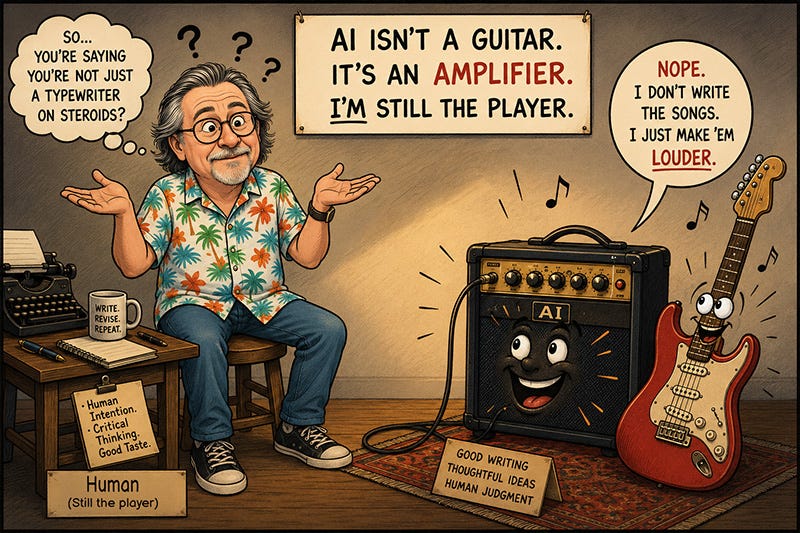
Yet another comparison: AI isn’t a guitar. It’s an amplifier. I’m still the player.
(And, by the way, just as in that previous post I rebelled against those who would think they can spot AI because of em dashes, which I’ve been using as a writer since at least 1972, I’m tempted to throw salt into the tea of anyone who would prohibit me from using “it’s not this; it’s that,” something I used in magazine writing in the late 1970s, and that AI now uses because it has long been the tool of effective writing.)
When I first began playing guitar as a teenager, the amplifier for my ruby red electric guitar made my cringeworthy playing a lot louder. It also made my (I hope) better playing from my college years louder. As I was saying, AI is just an amplifier. It’s going to make slop louder and faster. Used effectively, it will also amplify good writing. But it’s only going to amplify what you put into it.
Maybe an even better comparison is this: I don’t experience AI primarily as a mechanical tool, but more like a conversation partner.
That doesn’t mean it’s a person or that it’s conscious. I don’t believe it is. I still prefer conversations with knowledgeable friends. But I’ve also learned that my friends are not always knowledgeable, and if I adapt the ARC copy of my latest book to their response to a genre they don’t read or know anything about, it will worsen the book.
Human does not automatically mean higher quality.
It does mean that my interaction with it feels much more like thinking out loud with someone than typing on a keyboard. When I set up the interaction properly, it asks questions I hadn’t considered or points out a weakness in my reasoning, a hole in my plot, or an unresolved arc. Sometimes it offers an idea I reject, and it doesn’t get its feeling hurt when I do. Sometimes it helps me uncover what I already believed but hadn’t yet put into words.
That’s a very different experience than using a word processor, a typewriter, or an ink pen. It’s not the same as a knowledgeable friend, but at 2 a.m. it’s available.
So, in a sense, it is like a typewriter in that it’s not going to write it for me. I still have to drive it to get something meaningful. The fact that some people use it like a Magic 8 Ball or a Ouija board doesn’t change that.
On the other hand, none of this means we should stop asking hard questions. In fact, I think we should ask more of them.
I have seen several solid studies suggesting AI weakens critical thinking, memory, or reasoning. I have also seen other studies suggesting that, when used differently, it can actually strengthen those same abilities. They don’t contradict each other. Like most social science studies, they examine slightly different research questions, or have different methodologies. It’s all so new, it will take a while to see what happens when people replicate the studies using the same methodologies and populations.
I’m not trying to settle that debate here, and I suspect it won’t ever have a single answer anyway. The effect probably depends as much on how we use the technology as on the technology itself.
But history gives us reason to be cautious without requiring us to panic.
For instance, Plato in Phaedrus places a discussion of the newfangled technology of writing into the mouth of Socrates. In the dialogue, Socrates tells a story about the Egyptian god Theuth presenting writing to King Thamus. Theuth claims writing will improve wisdom and memory. Thamus answers that it will do something closer to the opposite. “This invention will produce forgetfulness in the minds of those who learn to use it,” he says, “because they will not practice their memory.”
He wasn’t wrong, either. Writing did change the way people used memory, and it probably reduced the need for certain kinds of memorization. It just didn’t kill thinking the way Plato worried about. Plato’s Socrates treats writing as potentially useful as a reminder, but inadequate as a replacement for living knowledge and conversation.
It seems ironic because we would know nothing about Socrates’ criticism of writing if Plato hadn’t written it down. But it actually helps see the “middle ground” in the current debate. Plato himself may have believed writing was valuable when it supported philosophical conversation, but dangerous when mistaken for wisdom itself.
Sounds a lot like AI, doesn’t it?
Filippo de Strata, a fifteenth-century Dominican friar and scribe in Venice, petitioned the Doge of Venice against the spread of the printing press innovation. He accused printers of corrupting readers, prioritizing money, and distributing morally dangerous material, writing, “The pen is a virgin; the printing press is a whore.”
Critics worried about a lot of things regarding the printing press, including:
that inferior or corrupt texts would spread rapidly;
obscene, heretical, or foolish material would reach ordinary readers;
commercial printers would value profit over truth and craftsmanship;
scribal work, including its spiritual and intellectual disciplines, would disappear;
the sheer volume of books would overwhelm readers and fragment attention;
political and religious authorities would lose control over circulating ideas.
So, look back and consider this: the critics weren’t wrong. Those things did happen. But the printing press still proliferated, and writers learned to take advantage of it to yield benefits to society despite the very real challenges.
Similarly, late nineteenth-century writers resisted the use of the typewriter, the tool that many today consider to be more pure than computers and especially than AI. As noted by the American Diplomacy journal, “Many saw the typed page, unlike messages written out in longhand by the sender, as implicitly discourteous; they were viewed as impersonal and lacking in privacy because a clerk, not the person who signed the message, presumably had to turn out the typed page.”
The handwriting teacher Platt Rogers Spencer claimed good penmanship “refines our tastes” and “makes us better men.” A. N. Palmer argued that penmanship training could help reform “bad” children.2
Later, Martin Heidegger argued that the typewriter severed language from the distinctive human hand, while Nietzsche and his friends noticed that typing appeared to change the rhythm and shape of his prose.3
Once again, the critics weren’t entirely wrong. The typewriter did change how people composed and how readers experienced the writer’s presence. It just didn’t eliminate meaningful writing.
The printing press changed us, as did the typewriter, electricity, the personal computer, and the Internet. Each innovation created genuine losses alongside remarkable gains. Civilization didn’t stay the same after any of them. Why would we expect AI to be different?
When I was teaching communication skills to college students, I developed our college’s first online public speaking course. That was twenty-six years ago. Some of my colleagues then asked whether an online public speaking class could ever be as good as one taught face-to-face.
I thought then and still think that was the wrong question. Such a course could never be the same as one taught face-to-face, but the “as good as” assumes something about a classroom as the standard.
A classroom isn’t the same as a handful of students walking with Socrates around the hills of Athens, following wherever the conversation leads. The classroom itself was already an adaptation to changing educational needs.

So I had a choice. I could spend my energy arguing that online education should never exist. Or I could help make it as good as possible for the students who were going to choose it anyway.
I chose the second path.
I still prefer teaching in person. But I also wanted online students to have the best education I could help provide.
That’s how I think about AI. I don’t believe it’s going away. We are not going to uninvent it any more than we’re going to uninvent electricity or the Internet.
So my question isn’t whether to use AI. My question is how.
Can it become a substitute for thinking? Absolutely. Not for good thinking. But we already suffer from an “education” system that mistakes attaining a degree for education, wiping out requirements for liberal arts classes that actually develop critical thinking in favor of mere vocational training.
I don't deny that AI can be used as a substitute for thinking, just as writing can become a substitute for remembering. I deny that it must become a substitute. That's not a property of the technology. That's a choice made by the person using it.
Can it become a substitute for doing difficult creative work? Of course. Not effectively, but it can be used as a substitute, just like cardboard can be used as a substitute for wood.
Can it encourage laziness? Without question.
But those aren’t the only possibilities.
A typewriter can produce a ransom note. The same typewriter can produce a love letter, a recipe, or a novel that changes someone’s life.
The machine doesn’t determine the purpose. The human does.
That’s why I find myself asking a different question than many of the public conversations seem to ask.
How do we use AI in ways that make us more human rather than less human? How do we use it to deepen curiosity instead of replacing it? How do we use it to sharpen our thinking instead of outsourcing it?
Those are conversations worth having. But they’re different from deciding that everyone else must use the technology exactly as “I” do (whoever the “I” legislating might be).
That was really the point of my previous article. I’m willing—even eager—to discuss how we ought to use AI. I hope those conversations continue for years. They’ll shape the future.
What I’m not willing to do is appoint myself the ethics police for every other writer.
If someone asks how I work, I’ll tell them. If someone asks for my opinion, I’ll gladly give it. If someone chooses differently than I do, that’s their decision, their business.
And if all I have is a suspicion that someone used AI, I certainly don’t have the right to damage that person’s reputation, question their integrity, or organize a campaign against their work.
Conversation isn’t legislation. Persuasion isn’t prosecution. We are all trying to figure out how to live wisely with a technology that appeared almost overnight and is changing by the month.
That calls for humility. It also calls for remembering that the real story has never been the tool. It has always been the human being holding it. I don’t see that changing.
Here at King’s Chronicles, we explore books, creativity, storytelling, and the complicated work of being human.
If you enjoy thoughtful conversations and encouraging resources for difficult seasons, I’d love for you to subscribe and join the community.
Ironically, a dictionary is, itself, a tool.
I got this from The New Yorker. I haven’t seen the original, but I tend to believe them, even though the writer used a keyboard for the article.
No posts
Comments
Nothing yet. Say the first thing.
Sign in to join the conversation.