
When did French cuisine become the standard for cooking technique in the food world?
It’s a question that I find myself mulling over fairly often, even as I have leaned into this training for the better part of almost two decades.
This was my thought in particular this past weekend, as I was “nyaming down” (Trinidadian slang for heartily eating) a bowl of curry chicken with channa, a big, healthy side of curry mango, and some buss up shut, my favorite style of roti.
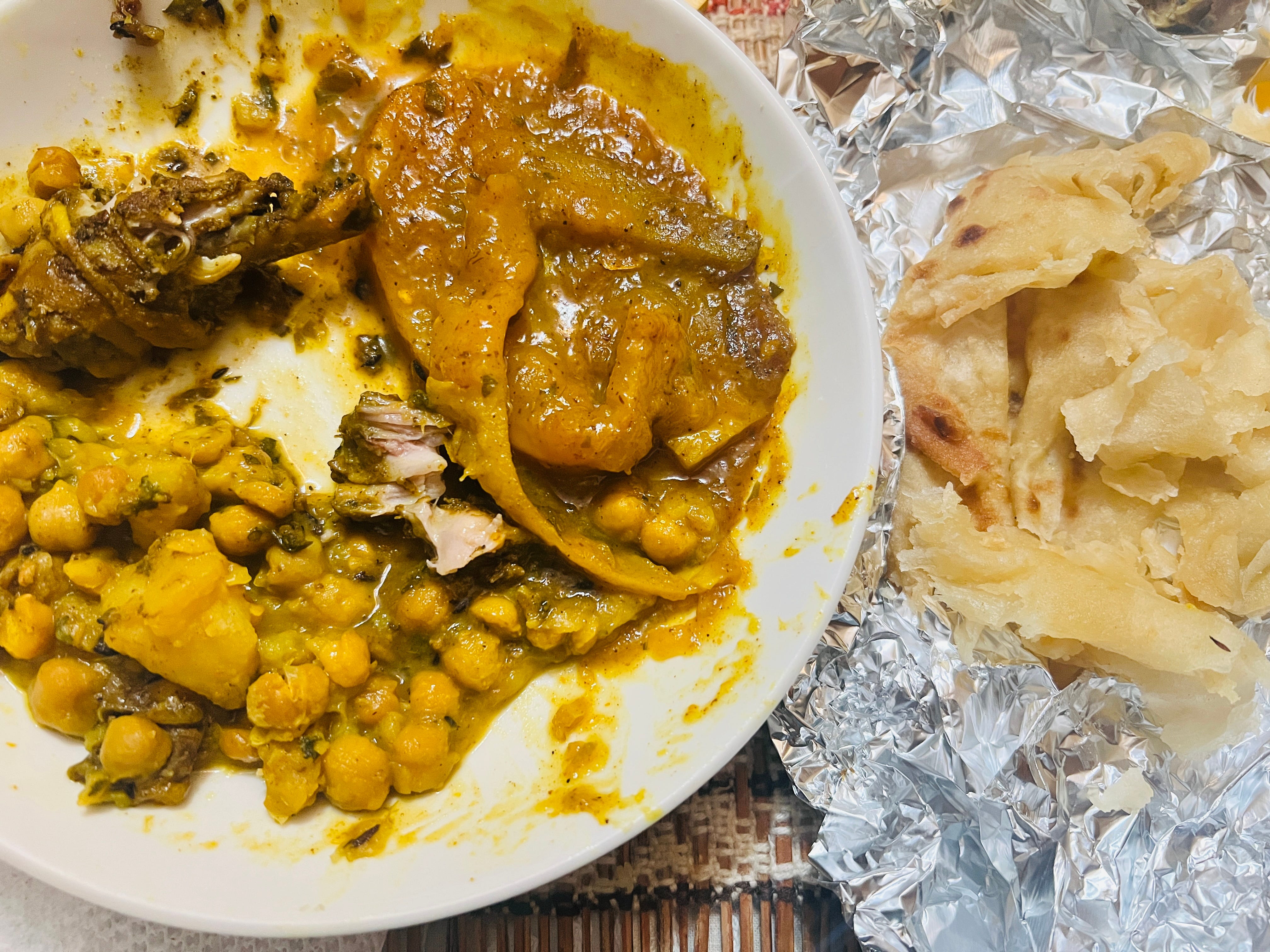
I’d bitten into the edge of a piece of garlic, singed to the point of being almost burnt, mixed in with the gravy. I was admiring the contrast in the flavor with the curry - and immediately, my brain went to replay a random moment I’d seen.
In this case, the moment was a fellow chef and content creator who was cooking off garlic for his pasta, him commenting to make sure that as we recreated the dish, that we didn’t burn the garlic. Burnt garlic was not good.
And yes, it’s true, burnt garlic in pasta is not at all tasty.
Burnt garlic in curry, though? It’s delicious.
The Rest of the World Meets the “Official” Story
Of course, different world cuisines have different techniques for their cooking - this is a given. A multitude of African countries rehydrate dried meats and fish with their fresh ingredients and tougher greens to make stews that have become delicacies.
In Korean cuisine, various cuts of pork are commonly simmered low and slow in their soups, and they often ferment or pickle fresh vegetables to have during the colder months. They serve them as banchan with other specialties at their kitchen tables.
Even still, Chinese people, similar to countries in Africa, use every single part of the animal that has been butchered, to cook with.
If you look at any individual culinary style from different countries, you will find things that are alike, and things that are different - but when you go to many restaurants, specifically upscale and above, the underlying format of their kitchens is rooted in French cuisines and their kitchen set up.
Why?
It’s hard to gauge at what point of the story I should start, so I think the easiest way to go about this is to start with what I mean by “rooted in French cuisines”.
So let’s start in culinary school.
The average culinary school’s educational program teaches the basics of cooking techniques, sanitation, kitchen organization, and cuisines. Specifically as it relates to cooking techniques, the style of cooking that is taught is rooted in Auguste Escoffier’s methods of cooking and organization.
Who is Auguste Escoffier, you might ask?
Often categorized as “the father of modern cuisine”, Escoffier is the French chef that identified a streamlined flow in the kitchen, specifically as it pertained to professional kitchens. Aside from popularizing the kitchen brigade system, the system that dictates the kitchen hierarchy so that each person knows who to follow (executive chef, chef de cuisine, sous chef, etc.), he is the one credited with creating the format of the recipe that we all know today. He also designated the five mother sauces - tomato, veloute, hollandaise, espagnole, and bechamel - that often create the foundation for any sauce that you could think of.
These are just a few of the things that he is credited with in terms of impact to the culinary world.
That should answer my original question, right? Seems pretty straightforward, especially when you see all that he’s been credited with, right?
Not exactly.
What Had Happened Was…Follow the Fritter
Escoffier’s reign in kitchens happened primarily at the turn of the 20th century, between the 1890’s and the early 1900’s. As we all know for sure, though, cooking has been happening for eons prior to that.
From a French perspective, prior to Escoffier is Marie-Antone Carême, another French chef who is often credited as the first celebrity chef, whose rags-to-riches story made him the leading baker and pastry chef of his era, and whose techniques Escoffier would later build on.
To be clear, this is not to discredit either one of their impacts. This is more about looking at how the impact of other cultures and cuisines is often diminished or glossed over. One could easily argue that someone before Escoffier was teaching recipes, organizing kitchens, and showing cooking methods.
Take Le Guide Culinaire, Escoffier’s first book, written in 1903, the guide for which his entire culinary legacy rests. In the book, he has a section on Beignets et Fritters, a five point system (one that he seems to favor) with recipes of fritters, varying from sweet to savory, using a high temperature, quick cooking technique to allow the elements of the fritter to rise and cook without absorbing much of the oil.
The thing is, though - the technique evolves from a technique that already existed.
When I did my first salt & soil supper club, I did a savory fritter trio, connecting the styles of fritter across the diaspora: pholourie from the English Caribbean countries of Trinidad and Guyana, hush puppies from Black American culture, and akara, a West African fritter made from black eyed peas.
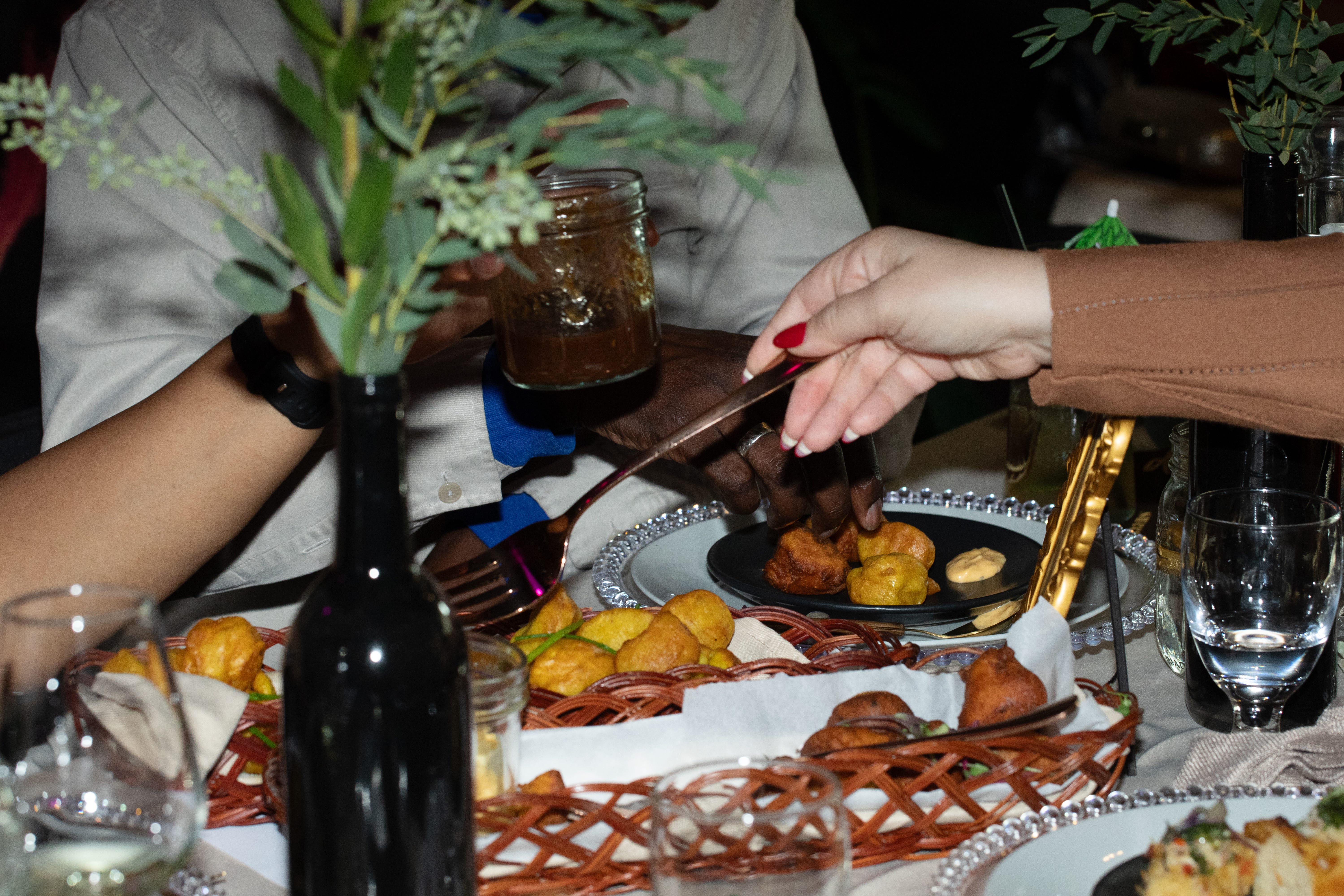
It is this latter fritter that appears to have paved the way for the other fritters, including some of the very ones in Le Guide Culinaire.
Frying goes even further back, to ancient Egyptian and Mesopotamia cultures, who popularized the method via making tiger nut cakes, with the images inscribed in the tomb of Vizier Rehmire in 1450 BC.
As you follow the culinary timeline, you can trace the exact moments when European traders brought both the knowledge and, in most cases, the people who carried it back with them to their respective countries.
Asian cultures have been sautéing foods at high temperatures since almost the beginning of time. Both Native Americans and African cultures understood the Maillard reaction very early on, as they often use open flame fires for roasting and grilling. The Polynesian people, pre-Hawaii days, built large pits that they turned into open flame roasting.
Yet only Escoffier is credited?
Perhaps there’s a better way to explain this.
History IS Written By The Victors
They say that history is written by the victors. This is often true. A (not so) random example of this is Mercator’s map - found in encyclopedias throughout the world, the first cylindrical map depicted in the mid 1500s.
For centuries, based on the map, the continent of Europe was more than half of the size of the continent of Africa, which was often depicted as equal or lesser in size than that of, say, North America.
Arno Peters, another German historian & geologist, created an up to date version of the world map in 1973, where he criticized the Mercator version, noting that there was no way that the continent of Africa and the continent of Europe were even close in size. In actual fact, it soon came to be realized that the contiguous United States, Europe, India, and China, could all easily fit within the land mass of Africa.
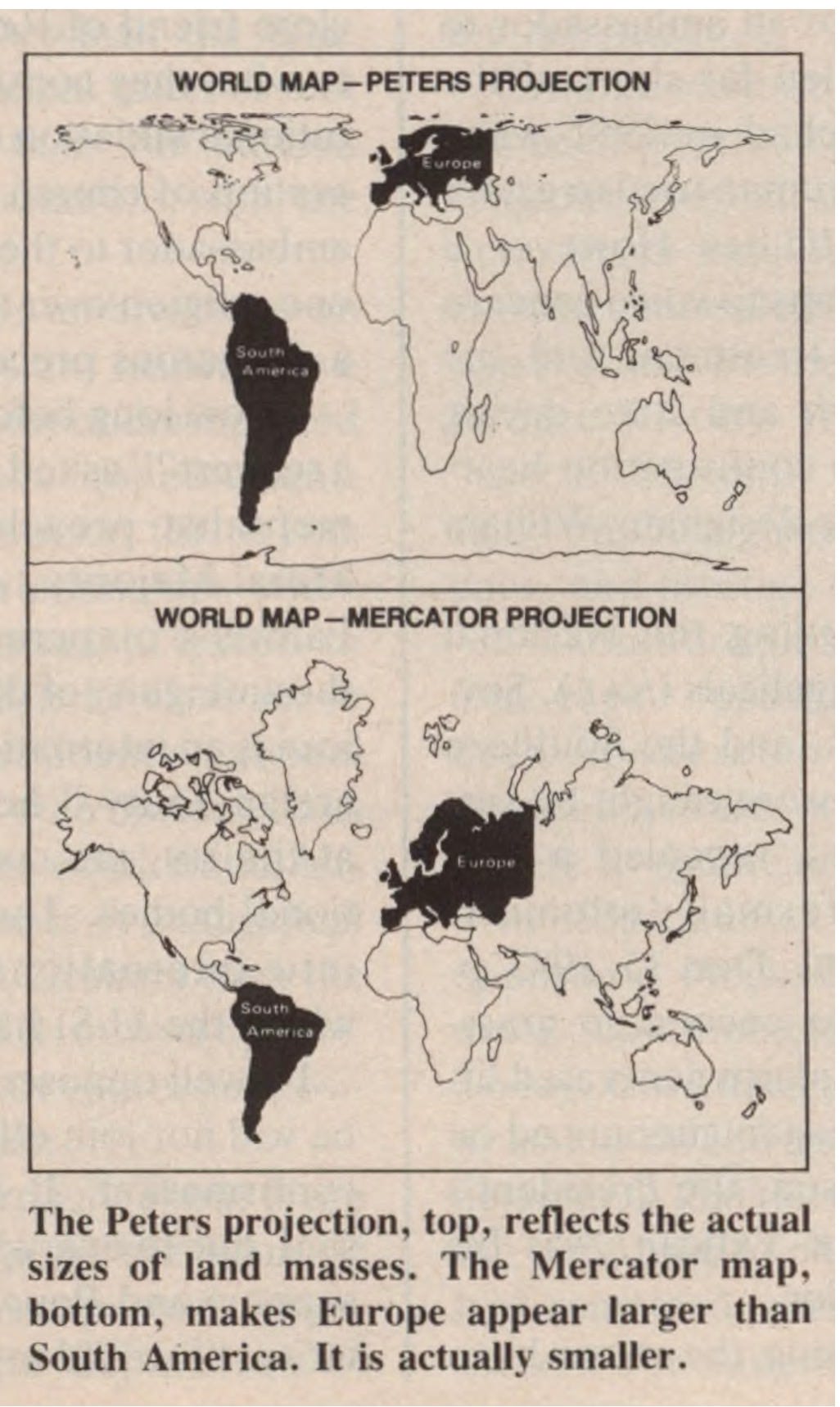
That said - the Mercator map was created at the height of exploration across the global canvas, and was used as the primary map which made it easier for further explorers post-Christopher Columbus to navigate the new trade routes.
This brings us to “The Columbian Exchange”.
*cues a Shawn Corey Carter lyric (1:04)*
The Uncomfortable Truth of it All
The Columbian Exchange is what historians cite as the vast European colonization and global trade between 1492 and approximately 1800, prompted by explorer Christopher Columbus, who found himself in the Americas when he thought he’d sailed to India. It implicitly highlights the vast crops and other commodities that were transported transcontinentally, as well as the livestock.
What it also now highlights is the uncomfortable part that we often avoid talking about: the commodification of the actual knowledge and labor that were also transported during this boom against their will.
For example, Judith A. Carney talks about rice, one of the most important commodities that became a part of this exchange, in her piece African Rice in the Columbian Exchange. She goes into depth about the agricultural domestication of the various grains that traveled during this exchange, with the expansive water systems that kept them growing and thriving. During the exchange, this knowledge and labor traveled with enslaved Africans, who then carried this knowledge into the colonies and the countries that profited from their labor.
It always comes back to this moment, this realization: what is often documented as fact eliminates the body, the work, the blood of the people who often are the true waymakers of the very thing being praised.
In this case, while what is in history books is that the Columbian Exchange revolutionized the global trade system, and paved the way for the Carêmes and the Escoffiers, the uncomfortable truth is that this very system exploited the labor and the people that it encountered, and used their techniques to profit, without ever crediting them as the source.
Almost sounds like this other article I wrote, huh?
That’s Technique, Too
I finished that bowl of curry thinking about how that curry even got to Trinidad - another tale of trade and colonization, but for another day.
I couldn’t help but think of all the hands that carried this plate to my table: my first cousin, who emigrated here thanks to my dad, and who built a life here. Her mom’s hands, my aunt, the first person who ever took the time to show me how to make that very roti that I adored, and one of the first chefs I ever knew.
My dad, who let me stand on that little tiny yellow stool in the kitchen as a kid, while he made curry, and showed me how and why he ‘chunkayed’ garlic before adding in his curry powder.
Even quietly walking behind my Gran as she fried fish cakes in our kitchen in Brooklyn, and pilfering two to every five that she made.
All of these people came from Caribbean kitchens that taught them before any culinary school ever could.
None of it shows up in Le Guide Culinaire. All of it is technique.
The burnt garlic in my curry isn’t an accident, and it certainly isn’t wrong. It’s a method of cooking, and it’s one that predates the kitchen brigade system, predates Le Guide Culinaire, predates Escoffier entirely.
It just doesn’t have a fancy French name.
That’s the pattern that I keep finding myself coming back to. The knowledge travels. The labor travels. The credit never does.
And until culinary history is willing to follow the food all the way back…past the Savoy Hotel, past Carême, past the Columbian Exchange, to the people who created the foundations for the cooking and the techniques that others profited off of?
We’re only ever telling half the story.
No posts
Comments
Nothing yet. Say the first thing.
Sign in to join the conversation.