
I tend to be an Instacart girly when it comes to grocery shopping, and it’s not because I don’t like to grocery shop in person.
(Okay, maybe a tiny bit. But not all the way.)
The bigger reality for me is that I have a diverse yet picky palate, and it’s easier for me to be able to source all of the things that I like to eat from my couch, over having to get up and travel miles to find, say, gochujang. Or good quality broccolini. Or fruit that doesn’t look like it got into a fight and lost.
That in and of itself says a lot, because I live in a working middle class area in NYC.
If I’m already having to do the most to source my produce from here, what does that say for everyone else? Either way, Instacart it is.
Every now and then, though, I take myself down to my local supermarket. Some things just require an in person touch, you know? On this day in particular, I was looking for recao, broccolini, galangal, maybe some Thai curries, and a good ribeye - so I went to a supermarket that’s about ten minutes away from me driving, that usually carries a good range of multicultural products.
This tomato is one of the first things I saw. Right up front, not hidden, and not the only one.
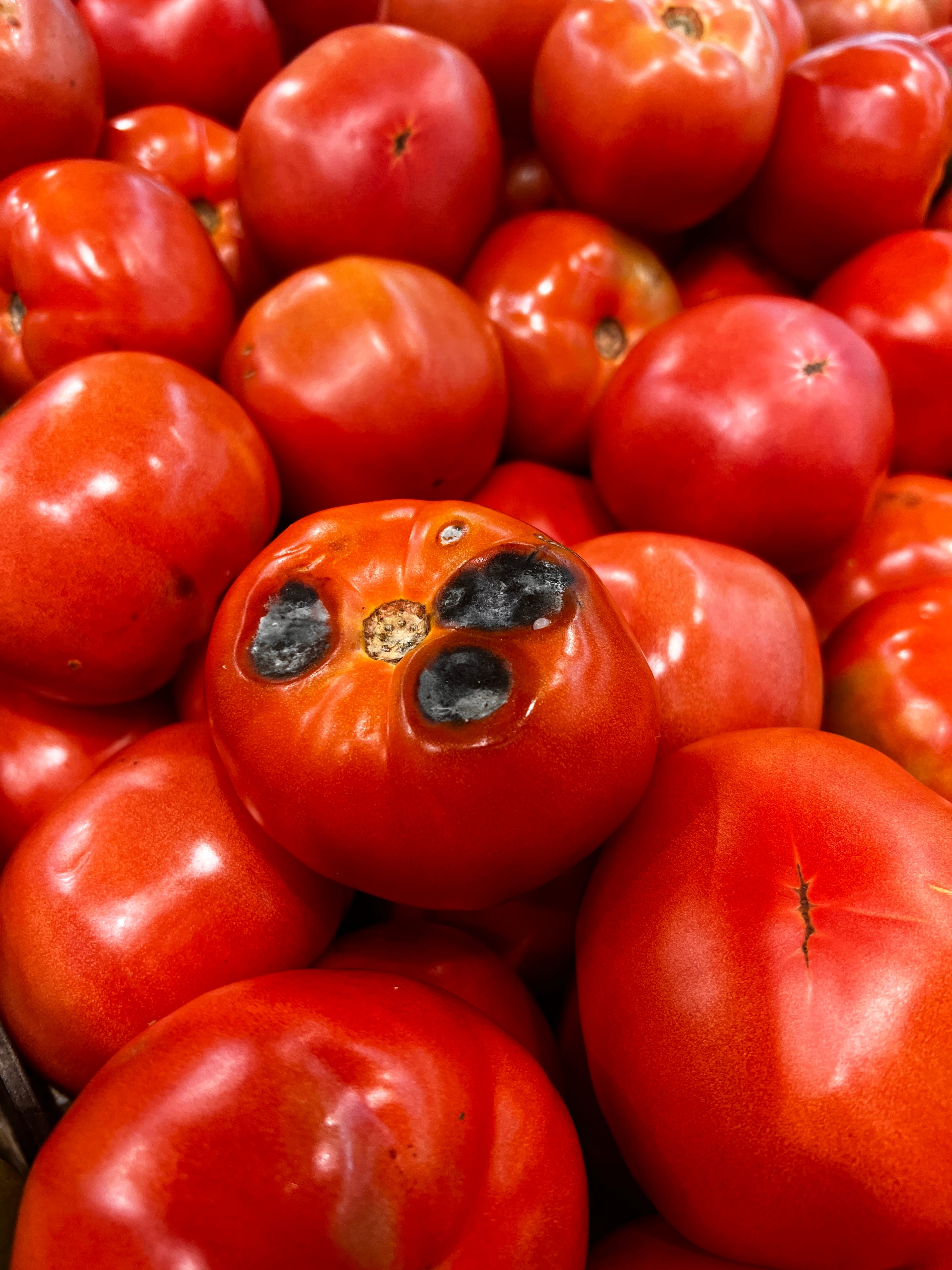
Eww, right?
I remember calling it out to one of the staff who said, “oh, I don’t know what happen miss”, and (eventually) moved it. At least, they moved this most egregious one.
Side eye.
Depending on how long you’ve been hanging out at this kitchen table with me, you know how my ADHD brain works - it connects seemingly random things that actually form a pattern. So that tomato got me to thinking about this infographic that I saw before, not even a few days prior, about when you should use a potato.
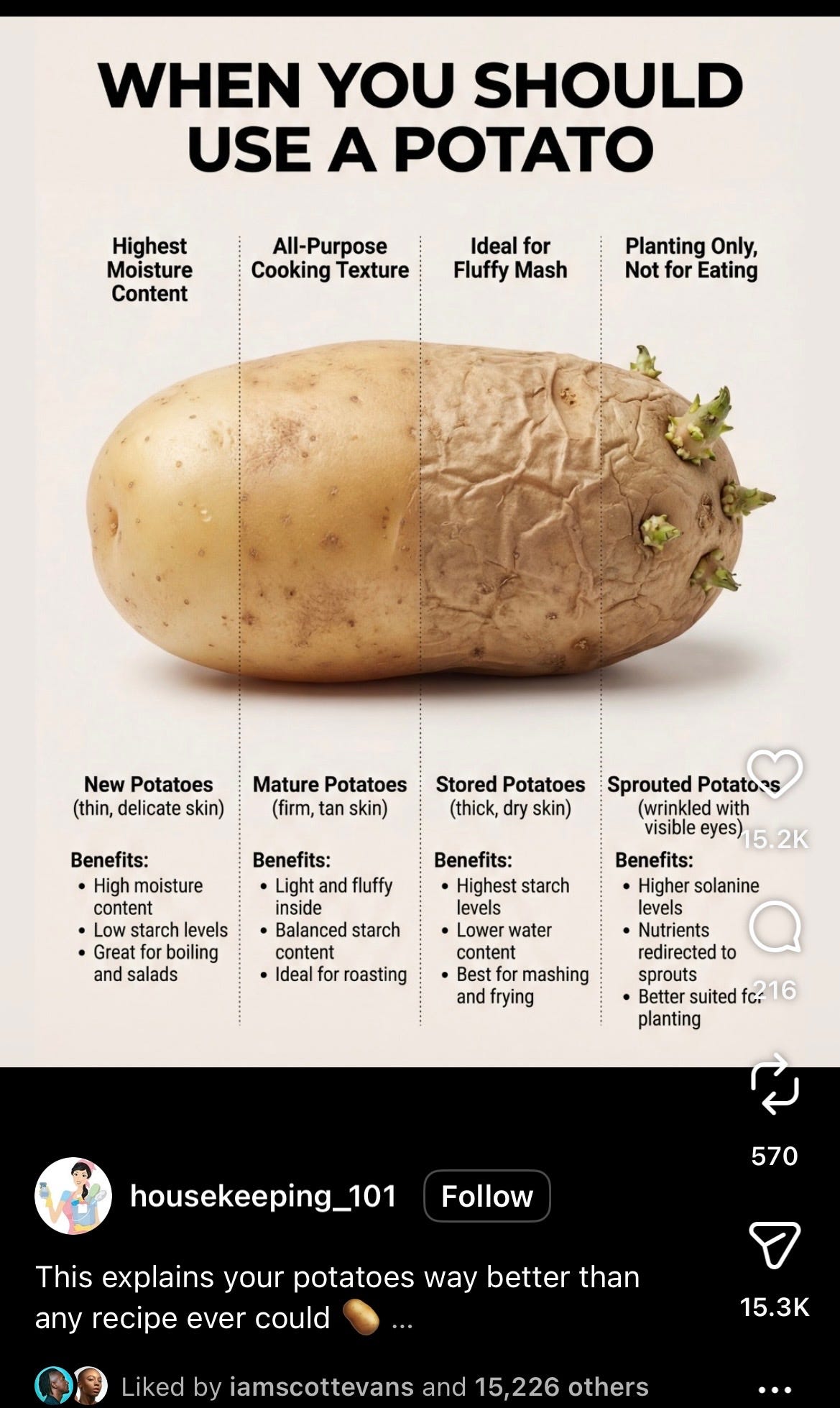
Which then made me think about how this one infographic could easily be seen as a privilege to so many who, perhaps, grew up in homes where you just picked off the sprouts and cooked the potato. If we’re keeping it a buck…I could tell you myself how many times, even recently, that I’ve had to double check the bags of potatoes before I buy them to make sure that there weren’t any spoiled or sprouted ones already in the bag.
This made me think about our pantries in general, and how, when I started talking about them a few weeks back, I found myself wanting to talk about food deserts in places where one might least expect - in this case, New York City, the financial capital of the world and one of the “wealthiest” cities in the country.
But why is that a thing that I, or anyone, have to think about at all?
So. You may or may not have heard the phrase “food desert” before - in conversations about food banks, to gain funding for impoverished neighborhoods, perhaps as a buzz word during interviews…but what exactly is a food desert?
According to the USDA, a food desert is a low income, low access area, where the residents lack convenient, affordable, and nutrient dense foods. In proximity, if 33% of the population lives in an urban area and have to travel more than a mile outside of their neighborhood, or 10 miles in a rural area, to access a large supermarket or grocery store, then they are considered to live in a food desert.
Affordable, though? That one word does a lot of heavy lifting in this definition. Because what determines affordability?
In theory, it is about income.
Traditional definitions create the following parameters: a poverty rate of 20%, or a median family income of at or less than 80% of the income of the area, are the usual markers for being considered a food desert.
So if we do the math (not my favorite thing to do by far, but let’s humor ourselves here), we need to start with an area, right? Let’s do two different areas of NYC, but in the same borough - Manhattan.
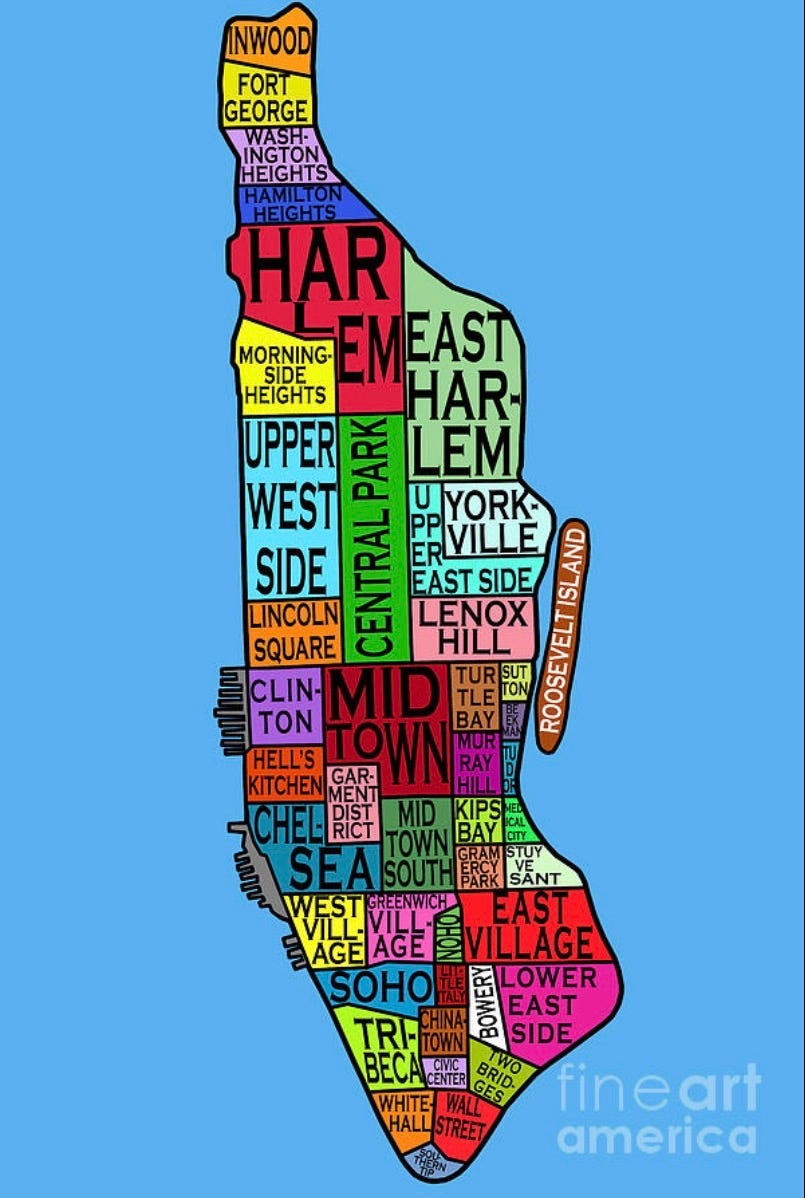
Manhattan is broken up into anywhere from 50 to 60 different neighborhoods: TriBeCa, Midtown, Flatiron, Upper West Side, Harlem, etc. For the purposes of this little experiment, let’s look at the Upper West Side, versus Harlem.
The Upper West Side, which stretches about a three square mile radius from W 59 Street, to W 110 Street, has approximately 230,000 people, and is considered one of the densest areas of the city, carrying a median income of $150,000.
By comparison, Harlem, which stretches closer to four square miles (depending on where you define the invisible line which Harlem starts), has a population of approximately 200,000, and a median income of $50,083. The city average is close to $80,000.
I picked these two areas for a good reason - the two neighborhoods sit practically adjacent to each other, for one, and for two: the lines which define where Harlem sits have shifted often throughout the years.
Without me even having to calculate 80% of the income, one can clearly see that Harlem would be considered a food desert.
Which brings me back to the USDA, and how funding is allocated to food deserts. For the most part, funding tends to come in the form of grants and federal programs, which brings access to food banks and pantries, as well as local nonprofit organizations that advocate for the community to receive that which is needed to access healthy foods in the area.
But what happens when the line that defines who and what needs help - keeps moving?
Generally speaking, Harlem’s unofficial borders have shifted multiple times over the last fifty years, in large part due to gentrification. The Center for Urban Research, a part of CUNY’s Graduate School, even put together an interactive map that highlights the shift over the years.
What this ends up meaning for resources, though? If what is considered the median income of an area becomes blurred on account of where the invisible line moves from - this ends up leading to mismatched funding, residents being even more condensed in an already overpopulated area, and even less equitable or affordable access to basic needs - like food.
That’s intentional. One might even call it systemic. Karen Washington certainly does.
A food justice advocate, farmer, organizer, and activist, based right here in NYC (the Bronx specifically), Washington first coined the term food apartheid in 2018, as a means to better speak to the systemic inequities urban communities, specifically Black and Brown communities, faced.
She felt strongly that the existing language let the wrong people off the hook.
In her words: “..food desert is an outsider’s term. It describes a location, but not access. The fact of the matter is that people in low income neighborhoods and people of color have food - but we don’t have healthy options”.
It is this thing she says here that sticks with me as someone who is constantly calling out the ways that people choose to remain comfortable in a dysfunctional system: “‘Food desert’ makes people feel safe. It doesn’t resonate as much as food apartheid - because apartheid is about racial segregation”.
And therein lies the uncomfortable truth of the matter.
For context - apartheid, the racist ecopolitical system that plagued South Africa for decades until the late 90’s, felt like a more appropriate way to describe what often happens to urban residents who are uprooted and shuffled into specific areas with less nutritional access. Specifically, she notes: “healthy, fresh food is accessible in wealthy neighborhoods while unhealthy food abounds in poor neighborhoods… Food apartheid underscores that this results from decades of discriminatory planning and policy decisions.”
And she’s not wrong.
A desert is a natural occurrence. It’s not designed - no one signed off on it, no one profits off of it. Calling what is happening a food ‘desert’ implies that naturally occurring drought and lack of resources brought about the neglect.
It’s not just about a lack of access to nutritious food, either. It’s a layered system of failures that includes pricing, produce quality, cultural relevance, and deliberate corporate disinvestment - which is a lot more than just “having a supermarket within a mile of your neighborhood”.
What’s been happening in communities like Harlem: the constantly shifting borders, the mismatched funding, the produce quality gap, the deliberate absence of full service affordable grocery stores - that’s not natural. That’s crafted policy.
Which makes calling it “apartheid” apropos - it is intentionally designed. It has an architect, and more often than not, the architects are the very governing bodies that are meant to provide.
It’s systemic.
Enter…Whole Foods?
There is now a Whole Foods in Harlem, as of 2017, not due to need specifically, but in much larger part thanks to the same gentrification that I mentioned earlier. Whole Foods, now owned by Amazon, is the organic supermarket originally founded by two groups of supermarket owners in Texas who joined forces. Its claim to fame? Fresh, truly organic produce, meats, and high quality ingredients.
Pricey, of course - but often worth the investment.
I can’t speak to how the quality is now, and you might see my take that Harlem received a Whole Foods because of gentrification as hyperbole - but I have first hand knowledge. You see, for a number of years, I ran multiple Whole Foods Prepared Foods departments in the city, including opening the one that came to the Upper East Side on 86th Street.
I can also tell you the exact moment when I realized that their core values and their bottom line often crossed, and didn’t reflect the community’s needs.
Story time.
I started at Whole Foods in 2012 as a part time cook in TriBeCa. At the time, I was just looking for something to bridge the financial gap as I built my catering business. One of my supervisors took a liking to me and pushed me to apply for a training program that they offered that would put me into management. I graduated from the first level and became a supervisor in Union Square in six months - but that’s not the important part.
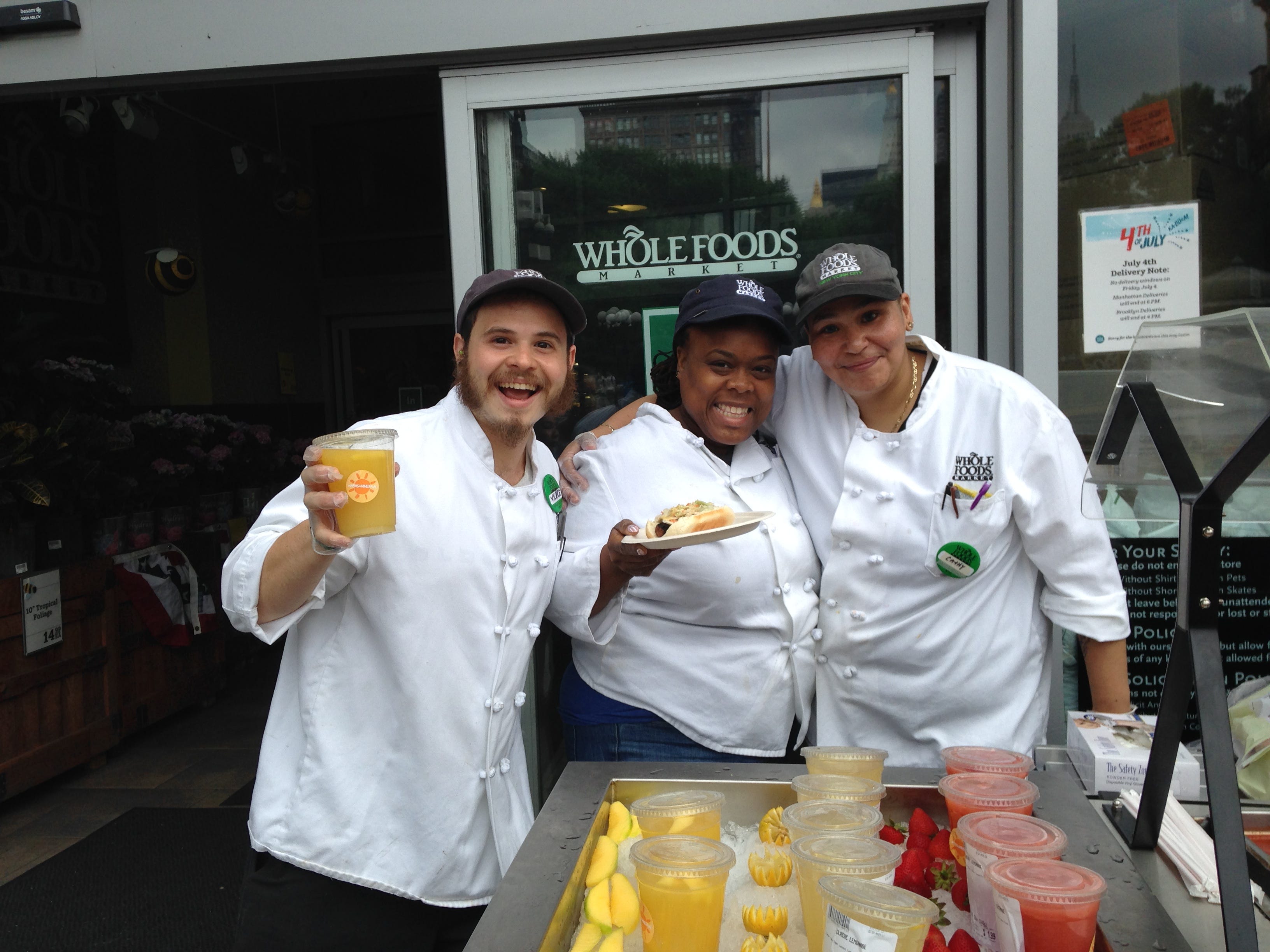
The important part is the week before I started at Union Square, as my days were winding down at TriBeCa. The regional director used to do mini social moments for team members in each store, where they would have fun things like Taco Tuesdays, or a sweets social, and the team members would get to ask regional management “burning questions”.
The ice cream social they did for us was four days before I moved to the next store, and I had my question ready: when was Whole Foods coming to Queens? I knew there was a market - so many of us commuted from Queens to jobs in the city, and we loved Whole Foods. We’d probably do more shopping there, if it didn’t mean having to bring our groceries back an hour plus to our homes, sometimes on public transportation, right?
So as I got my strawberry shortcake ice cream bar, I went in for my question: when?
The regional director told me, “not likely. There’s just no market for it in Queens”.
Baffled was an understatement. But years later, I came to understand what the real issue was: corporate redlining with a green juice aesthetic.
Because how did Brooklyn wind up with three Whole Foods, and Queens, the most diverse area not just in the city, but in the country, not have a market for one? Instead, Whole Foods, which expanded rapidly in my three years there, and even more so afterwards, consistently placed their markets in highly competitive, gentrified areas.
A values decision, dressed up as a market decision much?
It’s a thought process like this, which is exactly why a public grocery store model makes perfect sense. Give the people what they actually need, in the areas they need it, at a truly affordable price - and you still get to feed capitalism a bit.
Mayor Zohran Kwame Mamdani, the underdog Democratic Socialist candidate who ran a grassroots funded, completely by the people campaign to win and become the first Muslim mayor of New York City, introduced the first of five government run grocery stores in NYC, set to open over the course of his four year mayoral term.
The idea behind the stores is simple: use municipal costs and public ownership to bypass and, in some cases, eliminate expanded grocery costs, thereby passing the savings on to the consumer, specifically in lower income neighborhoods. The first one, La Marqueta, is set to begin development and procurement in Harlem by late 2027, with the remainder in each borough to come soon after that.
Of course, as with many things that are deemed either low cost, free, or coming from a Muslim Democratic Socialist mayor (which shouldn’t actually matter, but I digress), there was a bit of backlash from corporations and wealthier folks in the city.
Except that the Mayor’s plan is not an entirely new one to New York City.
La Marqueta, a vendor centered market in East Harlem, was originally the Park Avenue Retail Market, a pushcart vendor market opened by Mayor Fiorello LaGuardia in 1936. It was originally created to bring East Harlem’s pushcart vendors, primarily Jewish and Italian at the time, under one roof, in order to expand and affordable access to fresh food for working-class New Yorkers.
As waves of Black and Hispanic immigrants transformed the neighborhood into Spanish Harlem in the decades that followed, the market evolved into its present day name.
And the evidence for the market makes perfect sense, especially when you look at the pricing of other spaces in the neighborhood. We’ve already established that Whole Foods tends to have a higher price point, on account of its organic and higher quality premise. Other local supermarkets, such as City Fresh Market, boasting competitive pricing, which on average matches what you might find in the average supermarket in an urban area, provided that you stick with specific types of staples.
That said, there are still questions about, why specifically there? City Fresh Market sits around the corner from the proposed site for the new city run grocery store, a fact that their franchise owner points out in an interview with Mamdani and MSNOW anchor Chris Hayes. It is here that Mamdani points out that ‘pricing begets pricing’ - if the idea is to ensure that there are truly affordable options in an area, it has to start by truly assessing the area, and pricing accordingly. This in turn pushes the competition to adjust to the needs of the actual neighborhood - not the needs of the owners pockets.
The only potential downside to Mamdani’s grocery store plan is the idea that it could be seen as governmental overreach: in a city where free trade and small businesses are encouraged, how does one keep up with pricing that only a government entity can get? Can they keep up?
For me, the real question is always going to come back to this, simply: who stands to benefit the most?
My answer is always going to lean towards those who need it the most. Yes, I value making a profit, just like anyone else. I have to survive, too. But I will never believe that hoarding wealth in the name of having “earned it”, when there are so many others struggling to survive - is a plausible answer. Not in 2026.
No one should have to be lining up at a food bank to get their groceries with million dollar properties on the corner of their block.
Which brings me back to my little old spoiled tomato, in my grocery store, in my middle class neighborhood. I know I’ve said a lot today, but I think about all of the things that I’ve brought up. I think about what I tend to go through, even to get the best produce for myself and my family.
And I have to ask: what does it say about the state of our society, that this is still the conversation in 2026?
No posts
Comments
Nothing yet. Say the first thing.
Sign in to join the conversation.