
I’ve said this before but it bears repeating: Food? It’s political.
Sure, a lot of people (usually those who are aware that their stance would be considered problematic in the current political climate) will try and dispute that until the cows come home.
It doesn’t matter, though. Food is political. Always has been.
And to tell you the truth? I don’t really see that changing in my lifetime, or even my daughter’s lifetime.
I bring this up now because the fact that food is highly politicized is proving to be more troubling than ever. From large food distributors merging and shrinking the reach of smaller providers, to increased lobbying widening the financial impact of certain food industries…the politicization of food is increasingly impacting both Main Street businesses and consumers alike.
It’s…very not good. At all.
Welcome to Part 2 of This Land Feeds Me Not: Dispatches from America’s Unequal Table, an ongoing series on food justice, policy, and the systems that shape what and how we eat. You can read Part 1 here.
Sysco & Michelin: A Dysfunctional (?) Marriage Raising Eyebrows
Sysco is back at it again…and by ‘back at it’, I don’t mean selling food products.
Depending on how long you’ve been here At the Kitchen Table, you’ve probably seen me talk about the restaurant and food distribution behemoth at length before, here:
Since then, Sysco has quietly (or not, depending on your perspective) merged wholesale cash-and-carry favorite Restaurant Depot with their current business model this past March, as well as become the main corporate supplier for the Michelin Guide, the restaurant and hotel guide recognized internationally for highlighting premier destinations for food.
Most recently, they partnered to announce the winners of the coveted Michelin Star.
What might be more interesting, though? The latter partnership happened last year.
This begs a few questions, to be honest: Why are we only now hearing about it? And, more importantly (at least to me, anyway): What does it mean when the largest food distributor in the country looks like it’s playing a nationwide game of Pac-Man? Or even more so, when they get a stamp of culinary excellence that might not be earned?
I went down the rabbit hole, so you don’t have to.
So boom. Let’s take a quick step backwards.
As a long time professional chef, food entrepreneur, and restaurant consultant, I’ve worked with Sysco before. In fact, I’ve set up multiple accounts for them via the restaurants I’ve consulted for, and one thing that I can confidently say is that gone are the days that Sysco is known solely for hospital-style food, mozzarella sticks of all kinds, and random concession-style items. Through the restaurants I’ve worked with, I’ve been able to purchase good produce, quality steaks, even fresh fish for specials and the occasional microgreens.
This is a good thing, right?
Not necessarily.
A big part of the reason that many of these items were able to be purchased with Sysco is because of multiple third party partnerships with food producers that they’ve acquired since going public in 1970. Forty, to be exact. From upscale restaurant suppliers like Edward Don, to niche quality fishmongers in Alaska, Sysco has been steadily growing their list of food suppliers. Prior to their most recent acquisition in Restaurant Depot, Sysco went for broke and started the process of acquiring their biggest competitor, US Foods, for $8.3 billion in 2013.
What stopped them? The Federal Trade Commission and a US District Circuit Court judge, two years later.
The (obvious) rationale? The merger would create a monopoly, which would violate the Clayton Antitrust Act that was passed in 1914.
And here’s the thing, right? Working with them aside, I’ve clocked game from Sysco before. In my post The Quiet Cost of Sameness, I’ve talked about how their acquisitions cut out the local producer at the regional level, thereby doing away with Main Street small businesses. It decimates the food supply chain and creates a vacuum that most other producers can’t really compete with.
So if all that’s true – why do we keep letting them do it?
Well.
I’d say, aside from our country being based on capitalism as a whole, one of the biggest markers of this particular sign of the times is the current presidential administration being decidedly pro-business. Ergo, no push to regulate any companies dancing on the edge of monopolism.
But this isn’t the root of the concern that surrounds the latest in the Sysco saga, which is them partnering with the Michelin guide.
I first found out about Sysco partnering with Michelin on my favorite social media platform (as some of you already know), Threads. I was randomly scrolling and this popped up on someone else’s feed:
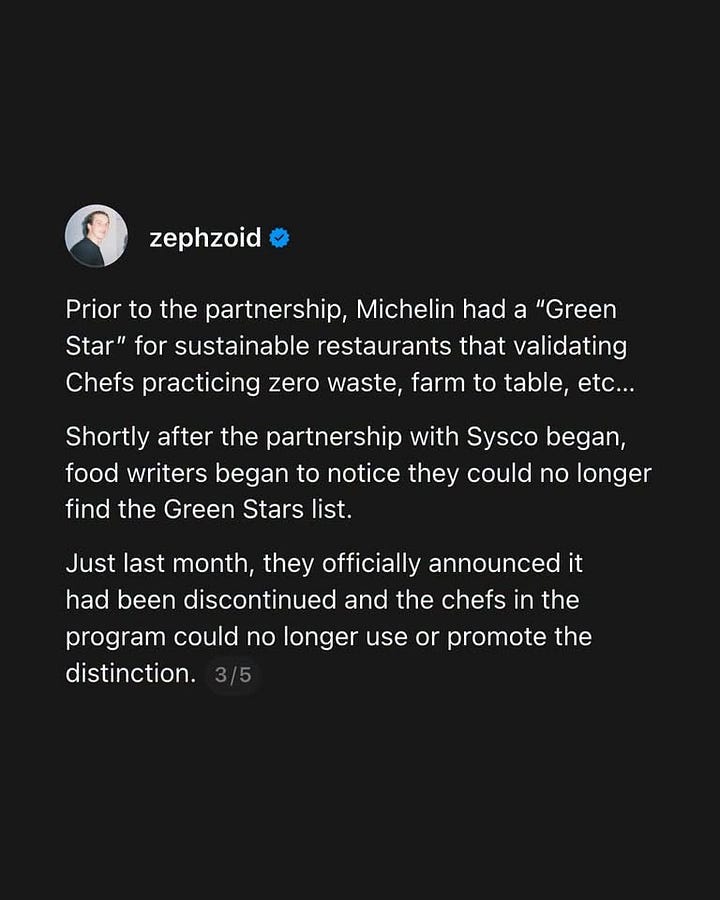
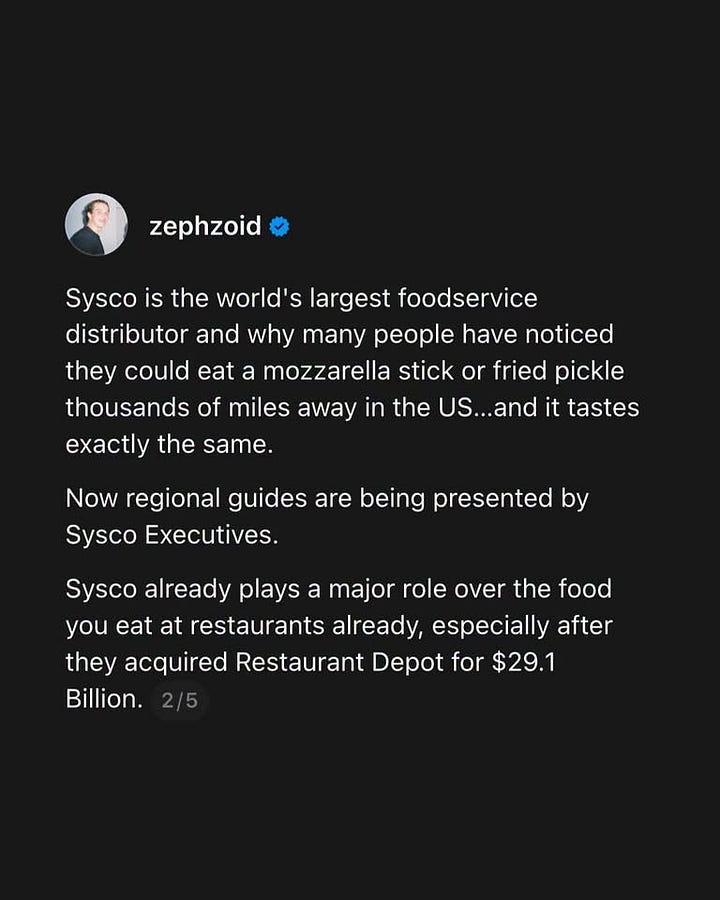
Now. You saw me mention before that the problem with Sysco lies in how it swallows up smaller businesses in the wake of their expansion. This partnership with the Michelin guide is no different.
Prior to this, the Michelin guide had created a Michelin Green Star, which was given to restaurants that prominently featured sustainable methods, such as zero-waste initiatives, ethical sourcing, and more. But as app developer and founder of digital farmers market Localize Zephyr Zoidis pointed out in his thread, the Michelin Green Star program was the first thing to go when the partnership occurred.
I think what is even more important to note, though, is how Sysco uses its growing influence (and coffers) to influence public food policy.
More specifically, the millions of dollars that they’ve spent over the last 5 years to lobby Congress, as well as maintain PACs to ensure that their supply chain needs are met.
Food is Political? Sure Is. Here Are The Receipts.
*cracks knuckles before she gets into the tea*
The machinery behind the American food system has always served someone other than the farmers that fuel it and the consumers that sustain it.
Repeat that in your mind. Let it simmer.
Then look no further than the Farm Bill that’s been running on extensions for the past three years, or the same lobbyists that I just mentioned who work on Sysco’s behalf, to see the proof of this.
But this idea that food policy is driven by the political system is far from a new concept by any means. Let’s walk it back to when I was growing up, shall we?
Around when I first started drafting the helter skelter notes to help me put together this piece, I wrote down “Beef: It’s What’s For Dinner”. It was one of the first things that ‘randomly’ popped into my head. Of course, it wasn’t really random per se - it just seems that way to the outside person looking in.
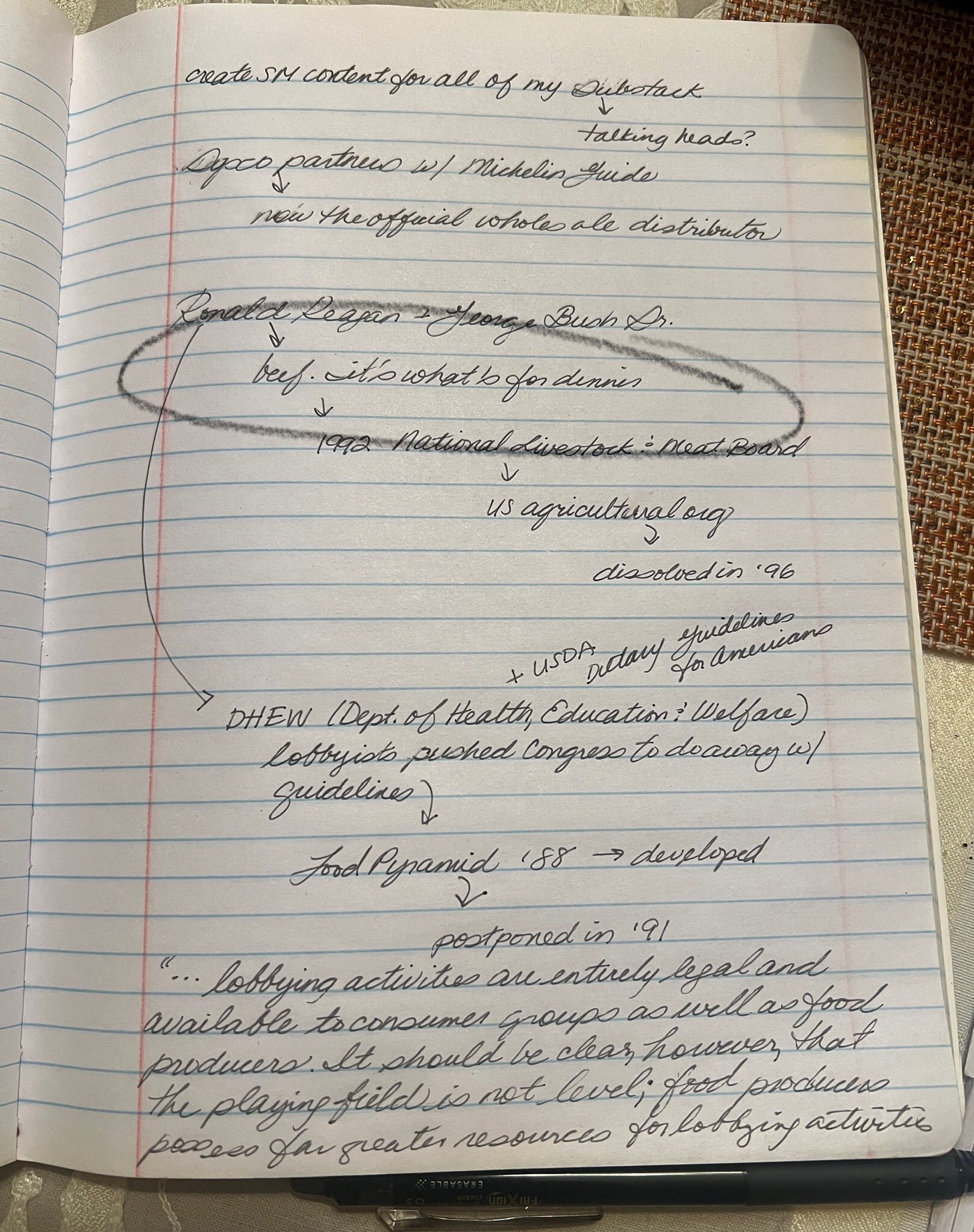
(One of the actual benefits of having ADHD, I suppose, is that pattern recognition helps me in cases like this.)
So anyway. The slogan “Beef: It’s What’s For Dinner” lived rent free in my head as a child of the 80’s, right along with the colorful posters of random grazing cows in fields that would hang out aside the breakdown of the Food Pyramid, telling us youngsters how much of each thing was in our best interest to eat. The posters used to be accompanied by actual commercials, that I can also still see in my head, all of these decades later.
Who was responsible for that? Why, lobbyists from the meat industry, with support from both the Reagan and Bush administrations, and the USDA, of course.
Of course, Air Heads and Sour Power were a more major food group to me than, say, a burger, back then - but that’s another story for a different time.
The National Livestock & Meat Board, an agricultural organization dedicated to the promotion of the consumption and production of, well, meat, was founded in 1922 and was a major force in the shaping of agricultural policies, as well as industry advocacy and funding. You can thank them for the catchy “Beef” slogans. It was originally centered around providing community and support for cattle homesteaders and ranchers, who were losing their voice amidst the meat packing industry. Founded under a different name at the close of the 19th century, they became an influential voice in the meat industry for over six decades, before being folded into the National Cattlemen’s Beef Association, and eventually the USDA.
While starting for auspicious and necessary reasons, organizations such as this and other similar ones (the fight between corn and sugar immediately springs to mind) have managed to normalize the abnormal marriage between government and industry.
In fact, lemme see how I can break it down without going too far down the rabbit hole - I’m already in there, but you don’t have to be!
For example, I mentioned before the food pyramid that likely showed up in the bulk of schools’ lunchrooms across America in the early 90s. It was developed in 1988 as part of an ongoing policy stemming from the 1977 Farm Bill, which called for the United States Department of Agriculture (USDA) to assume responsibility for providing dietary guidelines to the general public.
A committee that was a part of the USDA worked in tandem with the Department of Health, Education, and Welfare (DHEW) to generate Dietary Guidelines, which then created the Food Pyramid as the physical accompaniment to said guidelines. Within that pyramid, it suggested that proteins, dairy, and healthy fats consist of 2-3 servings daily. It also suggested that the bulk of a healthy diet consists of fresh fruits and vegetables at the base, the largest part.
Lobbyists for the meat and grains industries threw so much of a fit that the idea was shelved for years. It finally produced a pyramid that everyone was satisfied with in 1992.
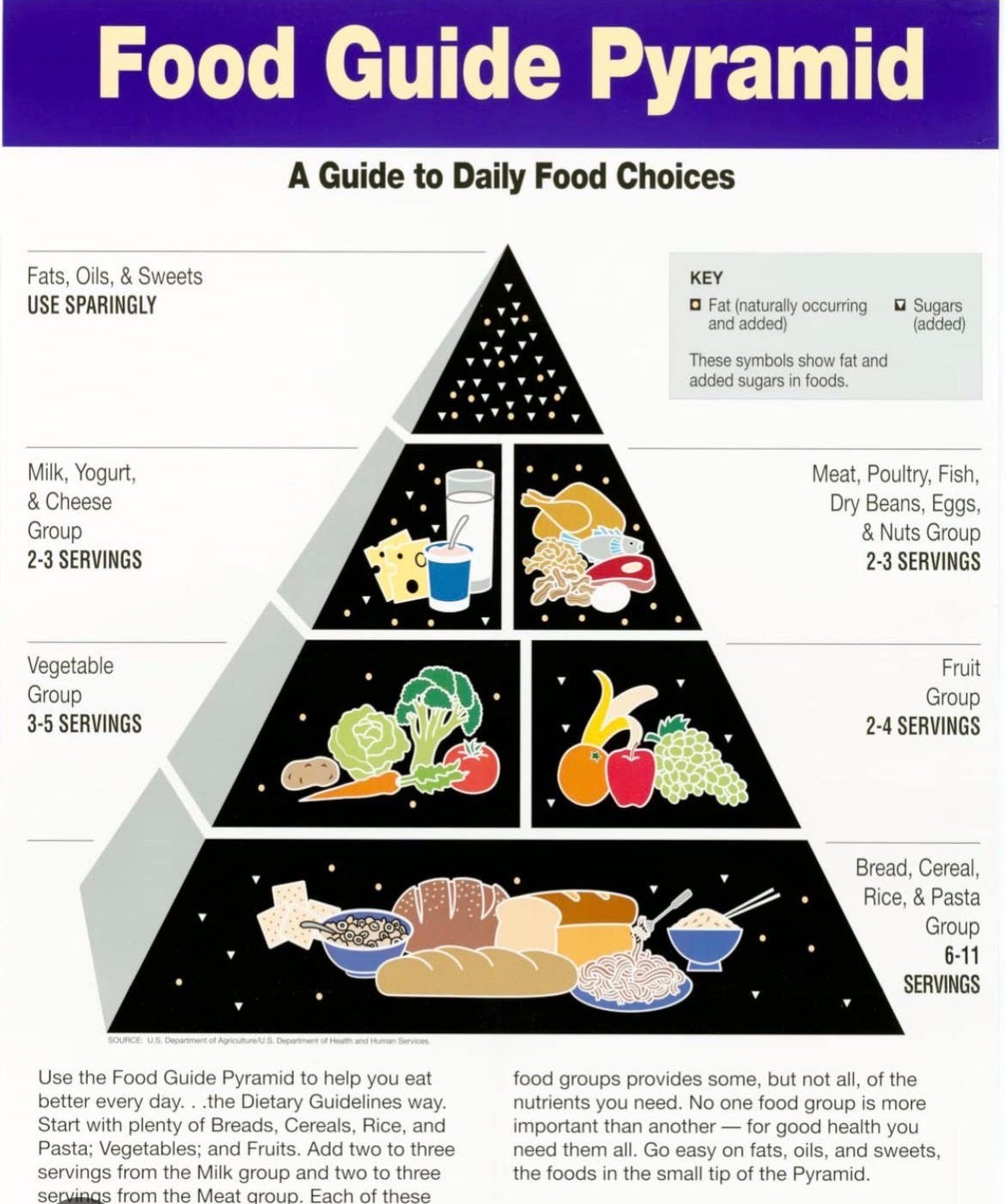
Sit with that for a minute. The beginning of the daily dietary guidance that we have been receiving for the past close to 40 years is directly shaped by political groups.
Marion Nestle, molecular biologist turned nutritionist and public health advocate, noted in her book Food Politics: How the Food Industry Influences Nutrition and Health:
“...lobbying activities are entirely legal and available to consumer groups as well as food producers. It should be clear, however, that the playing field is not level; food producers possess far greater resources for lobbying activities than do consumers”.
When large organizations such as this fundraise millions of dollars and create lobbyists groups in order to direct government policies in the direction of their specific sector, you can practically guarantee that they are focused on doing so for the benefit of profit versus the consumer.
The playing field is grossly imbalanced - almost by design.
Which brings me to the Farm Bill. Perhaps you’ve heard of it.
Dollars, Farmers, and Gaps That Make No Sense (Cents)
The Farm Bill is a multi-year piece of legislation that determines the governance of nutrition, agriculture, and forestry nationwide. The bill is passed every five years and is the major determining factor in how funding for each of these initiatives are provided.
The last time the bill was passed was in 2018.
I know. I know. I just said every five years, right? The Republican majority clashing with the Democratic minority is the cause of that.
Partisan clashing over funding for SNAP (Supplemental Nutrition Assistance Program), climate conservation, and pesticide liability have prompted 3 individual years of stopgap extensions to ensure that any funding from the bill does not lapse while Congress dukes it out. While the bill is, indeed, named the Farm Bill, it should be noted that 72% of the current funding that is allocated by it goes towards SNAP - or food stamps.
The other 28% of that funding, though? Pretty significant for farmers.
The Farm Bill was originally created by FDR as a means to provide funding for struggling farmers during the Great Depression - and it still does - at least, when it’s been funded, of course. The bulk of this funding tends to now benefit larger farms with crops like soy and corn, since the bill also covers crop insurance in the event of a bad harvest.
Some numbers for you: as of 2021, 89% of farmers in the US were small, family or individually owned farms. Only 5% of the remaining 11% are large farms - but those large farms provide over 50% of the profit to the farm industry and control over a third of the land.
Small farms are already on life support. There hasn’t been a new Farm Bill passed in almost a decade, and the three stopgap extensions that have followed certainly don’t fill that gap. When Sysco expands and larger farms maximize their profits by absorbing what’s left of the smaller ones, the supply chain doesn’t just shrink — it consolidates into fewer and fewer hands. And when that happens, the person standing in the grocery store aisle paying $10 for eggs and $8 for bacon is the one holding the bill.
Then let’s throw the even more disenfranchised into the mix. Black farmers, who have yet to be compensated for the billions of dollars in value of lost land since the post-slavery/Jim Crow era, become more marginalized under this model. Even though the landmark class action Pigford vs. Glickman filed against the USDA for decades worth of discrimination was successful; the average amount of money that farmers received from that settlement was $50,000 plus the occasional tax offset.
$326,000,000,000 collective revenue. Whittled down to $50,000. Imagine.
Mercedes “Dee” Davis, my latest innanet bestie, talked a bit about these very struggles of the Black farmer and the Farm Bill with none other than New Jersey Senator Cory Booker, who, like Davis, also has generational roots in the South. They got to chatting about the legacy of Black farmers, and the impact that the Farm Bill funding has on both farmers & consumers alike:
How the Politics Plays Out (If It Ever Does)
Like most things that come to light, the Sysco and Michelin partnership didn’t happen in a vacuum. It’s just the latest, most visible chapter in a story that has been written and rewritten for decades: consolidation dressed up as excellence, monopoly dressed up as progress.
For me, I think that the more stark reality is this: the bar for culinary recognition is now being set, at least in part, by the same company that is systematically absorbing the suppliers those restaurants depend on.
What it signals for small farms is even starker. We already know the impact that it’s having on Main Street.
And what it signals for food sovereignty; like the idea that communities should have meaningful control over what they grow, distribute, and eat, is that the distance between that ideal and the current reality is getting wider, not narrower.
The food system in this country was not built to feed people. It was built to feed power. Power has become very good at disguising itself as progress, as innovation, or, in this case, as a Michelin star. The farmers know it. Black farmers, who have watched their land, their labor, and their legacy be systematically devalued, know it better than most.
The consumer standing in the grocery aisle, doing the math on a carton of eggs, is starting to figure it out too.
The question is what we do with that knowledge.
No posts
Comments
Nothing yet. Say the first thing.
Sign in to join the conversation.