
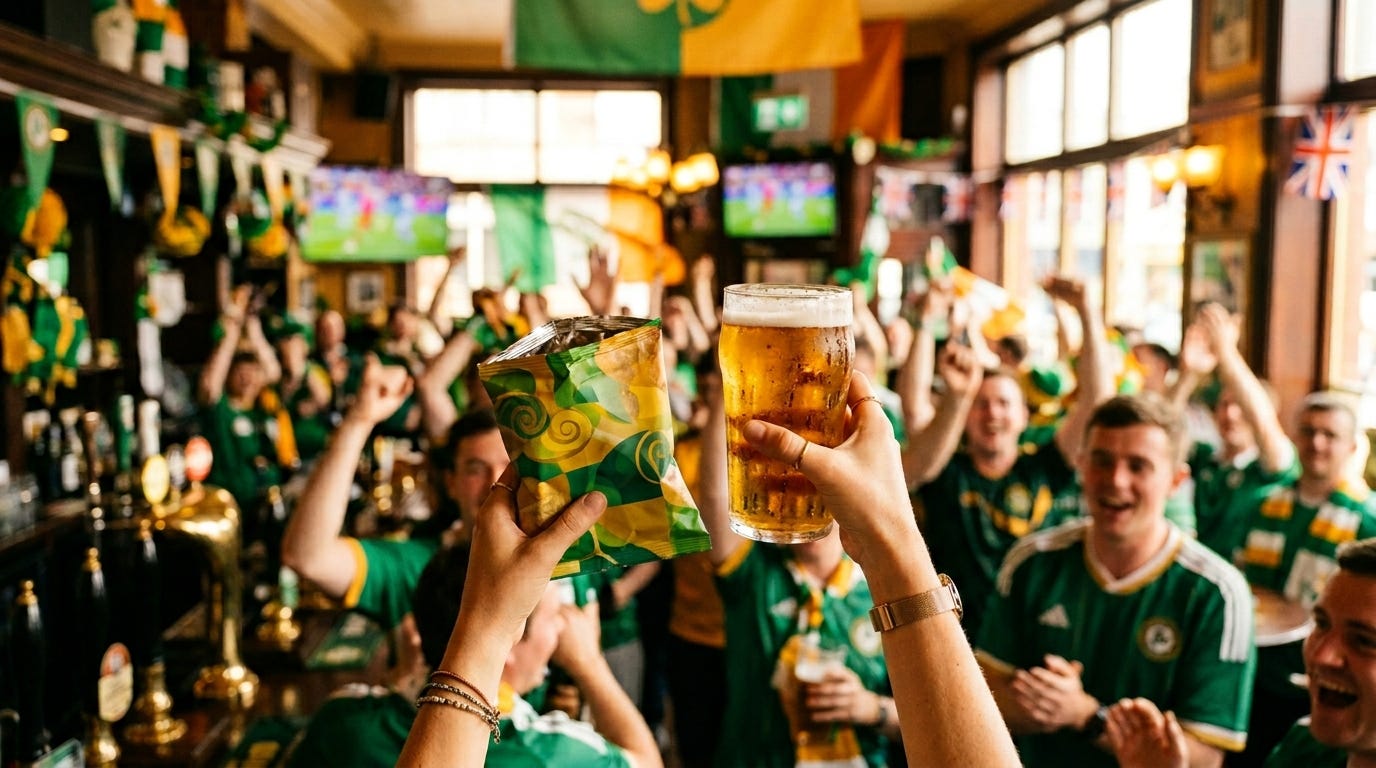
Last week I wrote about what the World Cup does better than any brand on earth — that almost miraculous ability to make millions of strangers feel like they belong to the same thing. This week I’m looking at the brands smart enough to get out of the way of that feeling and let themselves become part of it instead.
Because there’s a version of World Cup advertising that is very expensive and very forgettable. Logo on a jersey. Thirty-second spot with slow-motion footage of a ball hitting a net while someone whispers about legacy. Stadium signage that six billion people technically saw and zero people remember . . . And then there’s the other version. The one where the brand actually shows up inside the fan experience rather than hovering around the outside of it, waving.
Three brands are doing the second thing very, very well right now. Let’s dive in.
Stella Artois: Work From Bar
So, while Europeans (and others) are all over here flaunting their generous PTO and disposable income, a lot of Americans who want to enjoy the games are stuck behind a desk from 9 to 5, when the majority of the games are happening. Which means tens of millions of fans are watching games on their phones under their desks, pretending to be in a meeting, and feeling vaguely guilty about it. Stella noticed. And their response was brilliant: take $100,000 of their marketing budget and turn it into an expense account for fans, literally reimbursing the bar tab for anyone who takes their laptop to a pub and watches the game properly, in the company of other humans, the way football is supposed to be watched.
They’ve also opened a Work From Bar HQ in Manhattan with TVs, outlets, and — this is my favorite detail — a bookable conference room. For watching football. During business hours. I’ve definitely been known to work from the bar in my day, so this one hits home for real. LOVE.
The brand’s own VP of marketing said it best: “The best moments of the tournament happen in the stadiums outside the stadiums, where the real energy of the game lives.” Tapping into that is a real strategy, folks. And it’s a beautiful one.
Lay’s: No Lay’s, No Game
Lay’s has been running this platform for four years now, which already tells you something — consistency is its own kind of brand power. For the World Cup they went bigger than ever: Messi, Beckham, Thierry Henry, Alexia Putellas, and Steve Carell surprising unsuspecting shoppers in a Florida supermarket parking lot to invite them to a watch party. The campaign then extended into a WhatsApp broadcast channel with more than ten million followers, where the stars share voice notes, memes, and behind-the-scenes content throughout the tournament. Real-time, conversational, a little chaotic. Exactly like an actual group chat during a match.
The Steve Carell casting is the smart detail most people glossed over. He’s not a football person. He’s there for the snacks and the good time, which is exactly how Lay’s describes him. He represents everyone watching who doesn’t know the offside rule and doesn’t care, and his presence makes the whole thing feel welcoming rather than gatekeep-y. Lay’s called their strategy “scaled intimacy.” I might steal that phrase.
I love the inclusiveness of this one and the understanding of fan motivations and behavior and integration with all of that.
The best brand moments at a World Cup don’t interrupt the fan experience. They become part of it.
IKEA Canada: Assemble the World
This one might be my favorite, and not just because of the idea. Because of what it proves — and the universality of the message.
IKEA is not an official FIFA sponsor. No broadcast rights. No stadium signage. No player endorsements. What they have is a product catalogue with thousands of items in every color combination imaginable, and a brand that has always been about home. And it turns out that’s everything you need.
In Canada, Dentsu Creative looked at that catalogue and thought: we could build flags out of this. So they did. Eighteen national flags, each one assembled entirely from IKEA products — furniture, lighting, rugs, plush toys, home accessories — arranged with enough precision and playfulness that you have to look twice to realize what you’re seeing. Every single product in every flag is shoppable. Click on the green rug that forms the base of the Brazilian flag, add it to your cart, bring a little of the tournament home with you.
Meanwhile in Colombia, Sancho BBDO went in a completely different direction with the same brand truth. “Welcome to the Home Cup” turns everyday living rooms into personal football fields — because with IKEA, you don’t just watch the game. You prepare your home to play it.
Two agencies. Two countries. Two completely different ideas. The same insight underneath both of them: the World Cup lives in homes as much as stadiums. And IKEA is the home brand. That’s it. That’s the whole strategy.
The Canadian campaign executive creative director said you can “shop it, share it, sit in it, or just print it and tape it to your car window.” Not sure anyone is actually doing that, but the fact that you could is kind of the point.
The sponsorship assumption.
The idea that you need official rights to show up at a cultural moment. IKEA Canada just proved, rather elegantly, that you don’t. What you need is a genuine understanding of what people are feeling, a creative idea that fits naturally into that feeling, and the confidence to do something interesting with what you already have. The official logo is nice. The right idea is better. Cut the assumption that one is required for the other.
Next time a big cultural moment comes around — a tournament, an awards show, a viral news cycle, whatever your audience is genuinely paying attention to — ask yourself where the fans actually are. Not where the cameras are. Where the people are. That’s where your brand belongs.Kristin
Creative director. Brand obsessed. Agency life ex-pat. ✌️
No posts
Comments
Nothing yet. Say the first thing.
Sign in to join the conversation.