
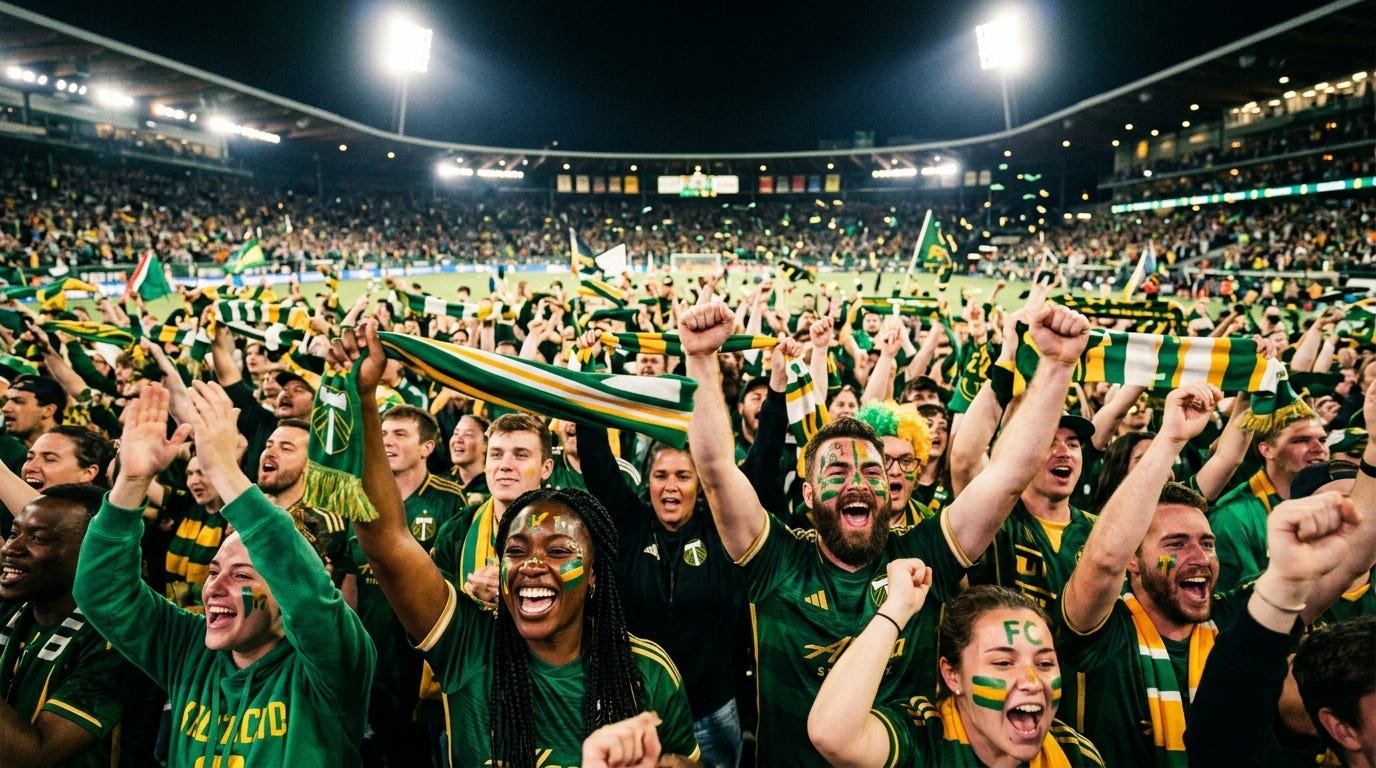
Something is happening right now that has nothing to do with football and everything to do with what it means to belong to something. It’s called the World Cup. And it’s the greatest brand experience on earth.
Let’s talk about Cabo Verde.
If you weren’t watching, Cabo Verde is an island nation of roughly 600,000 people off the coast of West Africa. They tied Spain. SPAIN. In the final minutes of a match that had no business being that close, in a tournament where they had no business being that dangerous, a country most of the world couldn’t place on a map held one of the greatest footballing nations on earth to a draw. And somewhere in living rooms and bars and fan zones across the planet, people who had no particular reason to care about Cabo Verde were on their feet — including me and my husband, who’d taken a break from calls and were watching in awe.
That’s the World Cup doing what the World Cup does. And no brand on earth does it better.
Belonging isn’t something you can buy with a media budget. But you can study the things that create it — and the World Cup is the greatest masterclass in belonging that exists.
Every few years, a brand manager somewhere stands up in a meeting and says "we need to build a community around this." And then a lot of money gets spent on content and influencers and hashtags and activations, and the community either doesn't materialize or quietly repels the very people it was supposed to attract. Because belonging isn't something you declare into existence with a campaign. It grows — slowly, sometimes unexpectedly — out of the right conditions. The right experience. The right touchpoints. Enough trust built over enough time that people start to feel something real. You can't schedule that in a content calendar. But you can build the environment where it's possible.
The World Cup has figured out those conditions in a way that’s worth studying. First: a shared stake. Everyone watching has something riding on the outcome — a nation, a story, an underdog they’ve adopted for ninety minutes. Second: genuine uncertainty. Nobody knew Cabo Verde was going to tie Spain. Nobody scripted that tension. The unpredictability is what makes it real, and real is what makes it matter. Third: a common language. You don’t need to speak the same language as the person next to you in a fan zone to understand exactly what just happened when the final whistle blows.
Most brand “communities” fail on all three counts. The stakes are manufactured. The outcomes are predetermined. And the language is corporate. Which is why they feel like communities in the same way that a focus group feels like a dinner party.
The brands that create real belonging don’t do it with campaigns. They do it by giving people something genuinely worth caring about together.
The host cities are feeling it right now in ways that money genuinely cannot buy. The Scottish drank Boston out of beer. Koreans and Mexicans are dancing together in Houston. The ladies of Atlanta have banded together on a mission to get a date with a DR Congo player when they arrive here next week. Restaurants full of strangers becoming temporary friends, neighborhoods draped in flags that have no business being neighbors, people showing up for each other across every line that usually divides them. That’s not sponsorship activation. That’s what happens when a brand experience is so powerful it spills out of the stadium and into the street.
The lesson for your brand isn’t “be the World Cup.” It’s: what is the thing your brand stands for that’s genuinely worth caring about? Not the mission statement version. Not the approved-by-legal version. The real thing — the thing that would make someone in a bar turn to a stranger and say “you too?” Because that moment, however small, is where belonging actually starts.
Cabo Verde showed up. They played like they belonged there. And for ninety minutes, the whole world belonged to them. I don’t know about you, but that’s the feeling I want to help brands create. Even a little bit. Even once.
The word “community.”
It appeared in a brand brief as both the goal and the strategy. “We want to build a community” is not a strategy. It’s a wish. A community is what happens when people find each other around something that genuinely matters to them — it’s the byproduct of a brand doing something real, not the objective of a content calendar. Cut it from the brief. Replace it with the specific thing your brand is doing that’s worth gathering around. If you can’t name that thing, the community problem is actually a brand problem. Start there.
Homework: Watch one World Cup match this week — any match, any teams — and pay attention to what you feel. Not the football. The feeling. Then ask yourself honestly: Does your brand create anything close to that? And if not, what would it take?
Kristin
Creative director. Brand obsessed. Agency life ex-pat. ✌️
No posts
Comments
Nothing yet. Say the first thing.
Sign in to join the conversation.