
Recently, three people reached out to me from completely different directions.
They did not know each other. They were not responding to the same post. They were not using the same professional language. But all of them were circling the same question.
The first was a trauma therapist. She told me she had started reading my Architecture of Childhood work because she wanted better language than the stale “kids these days” arguments that show up whenever adults are frustrated with children.
Then something unexpected happened.
She found herself using the framework not only with children, but with adult survivors of childhood abuse and neglect. The language was helping some of her clients name crucial developmental needs that had gone unmet early in life. More importantly, it was giving them a way to see how those missing childhood experiences were still showing up in their adult lives.
Movement. Play. Autonomy. Safe exploration. The freedom to want something. The chance to try, fail, and try again. The ordinary body confidence that comes from moving through the world before the world has convinced you to shrink.
She told me that when she read the section on physical health and coordination, something clicked. She recognized the adult who still walks into walls, drops things, holds their body like an apology, or carries the physical residue of a childhood where ordinary body confidence never had enough room, safety, or practice to develop.
The second message came from a mother asking about her young adult son.
He still lives at home. He had spent much of his adolescence in screen-based isolation. Because of this, he had not gotten enough practice with the friction and work of ordinary, real-world life. Now, looking back, she felt deep regret about how much had been avoided, outsourced, or smoothed over during those years. But she could not go back and parent his adolescence again.
She was not asking me for a lecture about screen time. She was asking for a road map forward from here.
The third message came from a woman with a deep background in developmental and educational neuroscience. She has spent years doing similar childhood work and told me that reading my posts made her feel profoundly “heard and seen.”
Then she shared something that shocked me.
She works with incarcerated men. When she offers voluntary classes on childhood trauma, around 800 sign up. Due to safety and capacity she is only allowed to accept 25. Many of these men, she wrote, explicitly trace their current, life-altering struggles back to childhood issues.
That changed everything for me.
Because when I read that I realized this conversation is much larger than anxious children, overwhelmed parents, struggling teachers, screen-isolated teens, or schools wondering why children seem less regulated than they were decades ago.
It is about the long arc of unmet developmental needs.
It’s about what happens when neglect, abuse, chronic disconnection, lack of repair, lack of belonging, and lack of real-world practice compound over years. It’s about what happens when the missing inputs of childhood do not disappear, but change shape and compound.
Eventually, some of the missing inputs of childhood become some of the defining struggles of adulthood.
I want to be careful here. I am not saying every adult struggle traces neatly back to childhood. I am not saying missing inputs explain everything. I am not saying painful childhoods become destiny. Human beings are more complicated than that.
Some adults are carrying the effects of severe trauma. Others are carrying the quieter costs of loneliness, overwork, screen-saturation, lost community, sedentary life, constant performance, and years without enough responsibility, repair, or belonging.
The point is not to reduce adults to their childhoods.
The point is to ask what kinds of practice, support, and lived experience human beings still need in order to grow.
For the past five years, my central argument has been relatively simple: children are not broken, but most are missing the developmental inputs childhood used to provide naturally.
Unstructured play. Real independence. Physical movement. Safe risk. Boredom. Mixed-age peer life. Outdoor exploration. The trust of adults. Community belonging. Social negotiation. Meaningful contribution. Freedom from constant adult management and surveillance.
Children need more than physical safety and direct instruction. They need embodied experience. They need real experiences in the real world. They need real practice being real humans interacting with other real humans.
A child used to practice frustration tolerance by losing a backyard game and having to keep playing because going inside meant there was nothing to do except stare at wallpaper and reconsider their life choices.
A child used to practice social courage by walking up to a group of kids and figuring out how to enter the game without an adult assigning partners, naming success criteria, or hovering nearby with a laminated conflict-resolution chart.
A child used to practice independence by biking somewhere, remembering the way back, judging time, dealing with a forgotten item, and discovering that the world was at least somewhat navigable.
A child used to practice boredom by being bored long enough for a stick to become a sword, a pile of dirt to become a kingdom, and a cardboard box to become a store with a deeply unstable business model.
A child used to practice repair by being annoying, getting called out by other kids, feeling the sting, figuring out how to come back, and learning that relationships can bend without always breaking.
This was never perfect. Some children were unsafe. Some were excluded. Some were bullied. Some adults ignored things they should have stopped. I’m not arguing for a return to some imaginary golden age where every child roamed happily through safe neighborhoods while the village whistled in four-part harmony.
But at its best, the old childhood gave children something many children are missing now.
Reps.
Reps with conflict. Reps with frustration. Reps with boredom. Reps with movement. Reps with friendship. Reps with responsibility. Reps with repair. Reps with wanting something, trying for it, failing publicly, feeling embarrassed, and surviving. Those reps built strength - emotional strength, social strength, physical strength, and capability and resilience strength.
Then, reading those three messages, I realized the adult version of this same question had been sitting quietly in front of me the whole time.
If children need an architecture for a thriving life, adults need one too.
Especially now.
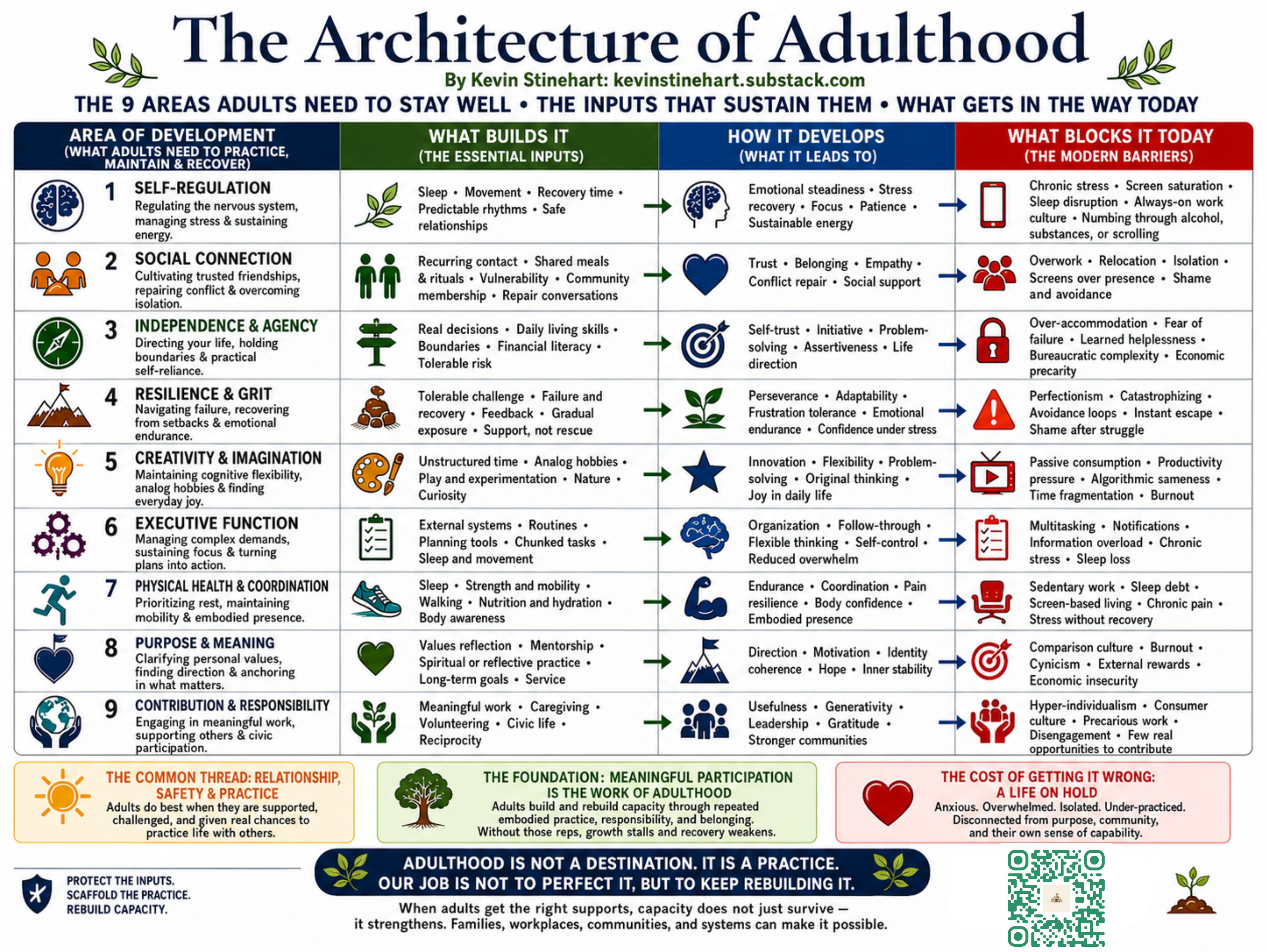
The Architecture of Adulthood is the broad map. It names the core capacities every adult needs to keep practicing, maintaining, and, when necessary, recovering: self-regulation, social connection, independence and agency, resilience, creativity, executive function, physical health, purpose, and contribution.
Those are the same nine domains I use in The Architecture of Childhood, because development does not magically start over or finalize when a person blows out eighteen candles.
The child who needs movement becomes the adult who still has a body.
The child who needs friendship becomes the adult who still needs belonging.
The child who needs responsibility becomes the adult who still needs contribution.
The child who needs space to fail becomes the adult who still needs repair.
The child who needs freedom to explore becomes the adult who still needs agency.
This is where I get excited, because the science here is really hopeful! Brain development is not a simple arc of childhood, adolescence, and then a static “done.” Recent lifespan brain research suggests that brain organization changes across broad eras of life, and decades of neuroplasticity research show that the adult brain remains capable of change.
That does not mean adults can simply think their way into becoming different people by next Tuesday.
It means the brain and body remain responsive to experience. Adult change is possible, but it often requires intention, repetition, support, safer relationships, embodied practice, repair, and actual participation in real life.
Childhood builds the first architecture. It is not the final draft.
For some adults, these capacities keep growing through ordinary life. They get a job. They make friends. They lose friends. They pay rent. They make massive mistakes. They apologize. They cook dinner. They ask for help. They show up anyway. They try again tomorrow. There is nothing particularly glamorous about it.
It is just life, quietly asking us to practice adulthood one mundane demand at a time.
But for other adults, adulthood starts demanding capacities that were never safely practiced enough to become stable.
The child who never got safe independence may become the adult who is terrified of making ordinary decisions.
The teen who avoided face-to-face social risk may become the adult who experiences a job interview, a hard conversation, or even a simple text message as a cliff edge.
The child whose body was never allowed to be a source of joy or confidence may become the adult who feels chronically tense, clumsy, weak, disconnected, ashamed, or braced against the world.
The teen whose universe narrowed to glowing screens may become the adult who desperately wants a real life, but does not know how to tolerate the first uncomfortable steps back into one.
From the outside, this can look like laziness. Sometimes it is something deeper. Underdevelopment is meeting demand.
Many adults are not broken. They are under-practiced.
That does not erase responsibility. It does not blame every parent, reduce every struggle to childhood, or turn trauma into an excuse. But it also does not mean anxious, neurodivergent, isolated, or overwhelmed adults need another lecture about toughness and grit.
It means some adult capacities only grow through repeated, embodied, relational, real-world experience. Reps.
People do not develop in isolation. They develop inside families, environments, cultures, bodies, relationships, and time. When the necessary experiences were chronically unsafe, absent, interrupted, displaced, or simply never repeated enough to become stable, adulthood will eventually ask people to perform skills they never had a fair chance to build.
A friend recently put it in a way that I think is perfect:
“The body carries experience, the world provides or withholds inputs, and the mind builds a story about what it all means.”
That, to me, is the heart of it.
From a developmental perspective, being under-practiced often means a person has not had enough safe, repeated experience for a capacity to become capable and resilient. The brain and body learn through repetition, relationship, movement, stress, recovery, and real-world use.
When an adult struggles, it may not be a permanent character flaw. It may be a capacity that never had enough safe practice to become stable.
There is a cruel version of this argument, and I reject it completely.
Trauma survivors do not need shame. Anxious young adults do not need lectures. Neurodivergent adults do not need their disabilities rebranded as character flaws. Struggling people do not need one more successful adult standing over them saying, “Well, when I was your age...”
But some struggling adults may need something far more demanding, and far more humane.
They may need scaffolded adulthood.
By scaffolded adulthood, I do not mean lowering expectations forever. I mean building supports that help adults practice real responsibilities until those responsibilities become more stable.
Not rescue.
Not abandonment.
Presence while responsibility transfers.
Scaffolded adulthood begins by asking a better question:
What capacity is life asking of this person that they may not have had enough safe practice building?
That question changes the entire conversation.
Instead of asking, “Why won’t he just get a job?” we can ask, “Which parts of work has he never truly practiced: waking up to an alarm, commuting, tolerating critical feedback, completing boring tasks, handling small rejections, speaking to supervisors, or recovering from a mistake?”
Instead of asking, “Why is she so dependent?” we can ask, “Where did decision-making become unsafe, punished, overwhelming, or completely outsourced to someone else?”
Instead of asking, “Why are they always online?” we can ask, “What crucial need does the screen provide that real life has not yet provided safely: belonging, mastery, escape, control, relief, or a place to feel competent?”
Instead of asking, “Why can’t they just grow up?” we can ask, “What would the next tolerable adult step actually look like?”
Tolerable is the key word.
A step that is too easy does not build much. A step that is too hard can confirm the person’s worst fear: I cannot do this. I am hopeless. Real life is too much. I should retreat again.
The work is finding the stretch that is possible without being crushing. That is true for children. It is true for adults.
The Missing Inputs Recovery Map
The Architecture of Adulthood names the broad human capacities.
The Missing Inputs Recovery Map translates those capacities into ordinary adult life.
It asks a more practical question: if an adult capacity is under-practiced, what kinds of safety, structure, repetition, responsibility, belonging, embodiment, and real-world participation might help rebuild it?
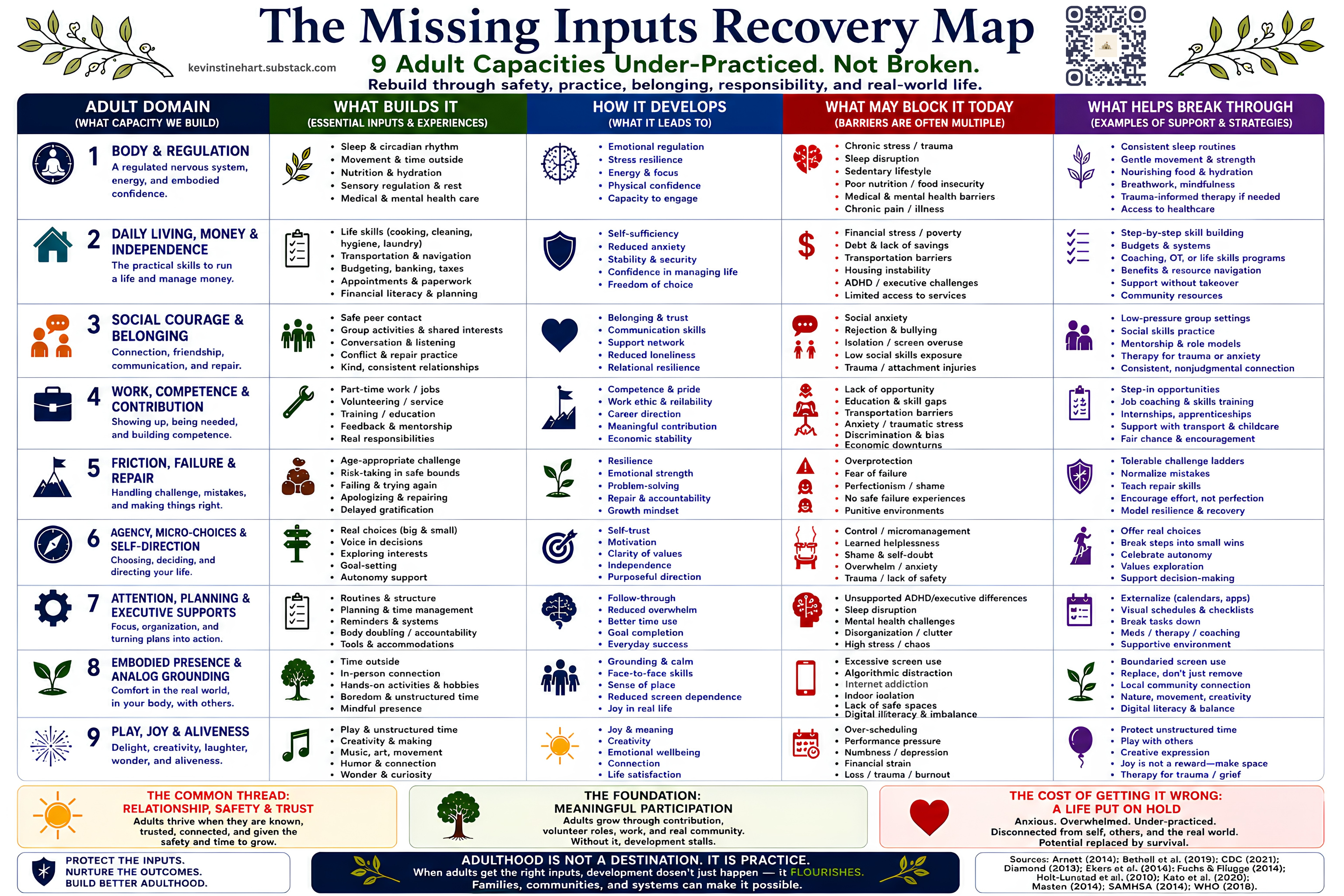
This map is a reflection tool. It is not a replacement for therapy, diagnosis, medical treatment, crisis care, disability support, trauma care, addiction treatment, or professional guidance. It exists to help name the adult capacities that may need rebuilding through real life.
The basic idea is simple.
Body and regulation come first because no one recovers from the neck up only. Sleep, movement, food, medical care, sunlight, daily rhythm, physical strength, sensory regulation, and embodied confidence are not optional side quests. A “stuck” adult may not be unmotivated. They may be exhausted, dysregulated, physically deconditioned, anxious, depressed, overstimulated, ashamed of their body, or living on a fractured sleep schedule that makes ordinary life nearly impossible.
Daily living, money, and independence include the dull machinery of running a life: cooking, cleaning, laundry, transportation, appointments, paperwork, budgeting, paying bills, buying groceries, and navigating insurance. These are learned capacities, not moral virtues. Some people were never taught. Some were never allowed to practice. Some have been trying to manage ADHD, autism, anxiety, trauma, depression, poverty, or learning differences without nearly enough scaffolding.
Social courage and belonging matter because friendship is a practice. Conflict is a practice. Asking for help is a practice. Initiating plans, surviving awkwardness, joining a group, repairing a rupture, allowing yourself to be known, and showing up again after acute embarrassment are all developmental experiences. Humans are not meant to become adults alone in their bedrooms.
Attention, planning, and executive supports matter because some adults do not need one more lecture about responsibility. They need actual tools: calendars, alarms, routines, body doubling, medication when appropriate, coaching, visual systems, reduced clutter, external structure, or occupational therapy.
“Try harder” is not an executive function strategy.
A scaffold is the bridge between a good intention and an actual action.
Embodied presence and analog grounding ask a better question than “How do we reduce screen time?” The better question is, “How do we strategically rebuild comfort in physical life?” Recovery requires replacement, not just restriction. It may mean walking outside, eating meals with others, working with your hands, making physical things, tolerating boredom, allowing yourself to be seen, being useful, and physically putting your body in rooms where real life is happening.
Play, joy, and aliveness may be the easiest domain for serious people to dismiss, which is exactly why we need to take it seriously. Some adults did not only miss out on practical skills. They missed out on delight. Safe foolishness. Raw curiosity. Aimless wandering. Making art. Laughing loudly. Wanting things. Choosing freely. Feeling fully alive without the pressure of performing.
You cannot assign joy like homework. But you can create the conditions where it finally has a chance to return.
Some missing inputs are rebuilt through reps: repeated, concrete, real-world practice.
A young adult can practice making phone calls, cooking dinner, interviewing, showing up on time, apologizing, budgeting, cleaning, driving, asking for help, or walking confidently into a room.
But trauma recovery is not a gym routine. Joy is not a productivity metric you can track on a spreadsheet. Secure attachment is not a checklist. Grief is not a habit you can “hack.”
Not every missing input in adulthood needs a harder, faster workout.
Some just need a safer room.
I have been thinking about this daily because of a much smaller, more ordinary version in my own life. Last month, I hurt my back doing heavy landscaping in my yard. With the help of a physical therapist, I have been slowly helping my back heal.
That is obviously a small example compared with the deeper repairs many adults are trying to make. But it has reminded me of something true and something humbling: repair is not always a matter of doing more reps until it works.
Some things take time. Some things take wise outside guidance and scaffolding. Some things take gentle, modified practice. Some things require a slow, deliberate weaning from support. Some things need sheer strength. Some things need rest. And some things absolutely need safety first.
Human development is like that too.
If you are the adult reading this and you feel profoundly behind in life, I want to say this plainly: you are not a failure.
You may have avoided hard things. You may have lost entire years of your life. You may have hidden online, disappeared into comfortable fantasy, numbed yourself, people-pleased everyone around you, trusted no one, used anger, chased perfection, isolated yourself, or collapsed under feelings you did not know how to carry.
That may be true. It may also be true that you adapted the only ways you knew how.
The way forward does not begin with a miraculous transformation. It begins with small, honest contact with real life.
Choose one domain from the Recovery Map, not all nine. Pick one tolerable challenge, not a total life overhaul. Make it concrete enough that you can actually do it this week. Add support where support is genuinely needed. Raise the level of challenge slowly.
If phone calls terrify you, call a local store and ask for their hours.
If money overwhelms you, open your banking app and write down the exact number that is actually there.
If your social life is gone, attend one recurring, low-stakes group where you do not have to impress anyone.
If your body feels alien to you, take a simple ten-minute walk.
If your parents still manage your medical appointments, sit beside them while you dial the phone and make the call yourself with their guidance.
If glowing screens have become your main escape hatch from reality, begin by asking what real-world experience could replace one small piece of what that screen provides.
The question is not, “How do I fix my entire life?”
The better question is: What is the absolute smallest honest contact with the real world that I can tolerate today, and repeat tomorrow?
Repeat it gently enough, and often enough, that your body begins to learn it is survivable. Then you can think about the next small, tolerable step on the staircase.
For Parents of Stuck Young Adults
Parents desperately need a version of this framework too.
Support is not the same thing as rescue.
If your adult child lives at home, the goal is not to yank the scaffolding away in a fit of tough-love frustration. The goal is to transfer the heavy weight of responsibility gradually.
“You make the call. I’ll sit nearby.”
“You are in charge of cooking dinner once this week.”
“You apply to two jobs today. I’ll help you proofread the resume.”
“You drive the route to the community college with me for one week, then afterwards you drive it alone.”
That is scaffolded adulthood in miniature. Presence while responsibility transfers. And if you haven’t yet seen this video yet, here is a great mom showing how it’s done with levity and presence:
If your adult child lives elsewhere but remains functionally stuck, the work changes. You may not be doing their daily laundry anymore, but you may still be absorbing their crises, sending emergency money every month, or staying emotionally on call all night long.
Sometimes, without meaning to, parents become the emergency operating system for an adult child’s life. The goal is not to disappear. The goal is to stay lovingly connected without becoming the machinery that makes avoidance possible.
You might say, “I love you. I am not disappearing. But I cannot keep funding a pattern that is keeping you from thriving on your own.”
That will not fit every family. Some situations require much more professional guidance, especially when addiction, serious mental illness, disability, violence, suicidal risk, or dangerous instability are involved. But for many families, the basic principle rings true.
Parents can offer support that builds capacity instead of support that absorbs responsibility forever.
That might mean paying directly for therapy instead of sending open-ended cash. It might mean providing transportation help while requiring the adult child to make the appointment. It might mean setting up a weekly planning call instead of staying emotionally available for every crisis text at 1:00 AM. It might mean temporary rent help tied to a written weaning off plan. It might mean job-search accountability, training support, or one clear next step that everyone can see.
The ultimate goal is deep relational connection alongside a gradual, unyielding return of personal responsibility, independence, and thriving.
I want to say this clearly. Sometimes the very next right step is intensive professional help. If there are serious safety concerns, severe clinical depression, addiction, dangerous behavior, untreated complex trauma, suicidal risk, psychosis, violence, or a level of impairment that goes far beyond what any family can safely handle, this framework alone is not enough.
“Missing inputs” language can clarify the root of a problem.
It cannot replace clinical care.
Still, I believe this language matters deeply.
Contempt has not worked. Panic has not worked. Screaming lectures have not worked. Heavy shame has never worked.
Our culture keeps swinging back and forth between two remarkably shallow explanations for human struggle. One pathologizes struggling adults as completely broken. The other moralizes them as inherently weak.
There is a better, truer frame.
The child is not just a brain. The adult is not just a set of choices.
Both are developing inside systems - and not always healthy systems.
Because human beings remain capable of change, a missing input does not have to become the whole story.
Many people are simply under-practiced.
And being under-practiced does not mean you are hopeless. It means human development is patiently asking for another chance.
Through safety. Through intentional scaffolding. Through taking responsibility. Through physical embodiment. Through finding belonging. Through the messy work of repair. Through repeated, courageous contact with real life.
That is the work.
Scaffolded adulthood.
Special thanks to Joy Winchester, whose thoughtful feedback and neuroscience lens helped me clarify how this framework applies across adulthood.
If this language helps you name something you have been seeing but could not quite explain, I hope you will share it with someone who needs a better frame than shame, panic, or despair.
No posts
Comments
Nothing yet. Say the first thing.
Sign in to join the conversation.