
A society can inadvertently become hostile to children without ever announcing that children are unwelcome. It happens one reasonable decision at a time.
A field is fenced because someone might get hurt. A school playground is locked outside school hours because no one wants the liability. A library removes the chairs where teenagers gather because they are too loud. A neighborhood is built without sidewalks because everyone will probably drive anyway. Recess gets shorter. The school day gets tighter. The hours after school fill with activities that require registration, transportation, equipment, fees, and an adult available to coordinate it all.
None of these decisions alone destroys childhood.
They simply make it harder to access.
Eventually, nearly every meaningful experience in a child’s life must be purchased, scheduled, supervised, driven to, signed off on, and formally approved.
Childhood stops being an environment children naturally inhabit.
It becomes something families must build privately from whatever time, money, transportation, and social connections they possess.
Parents are now expected to assemble nearly every condition their children need to thrive.
They must somehow secure friendships through playdates, outdoor time through a drive to a local park, creative expression through after-school art or instrument lessons, community through scheduling time with other families, exercise through family gym memberships, and on and on.
Modern parents must compare programs, remember registration deadlines, pay fees, sign waivers, arrange carpools, monitor group texts, and try to determine whether an activity is building confidence or simply producing another exhausted child.
Even free play can require substantial adult coordination.
What looks like a child “just playing” may require a parent to find another available family, coordinate three calendars, choose an acceptable location, arrange two cars, manage a group text, and remain reachable throughout.
Some people call this over-parenting, as if parents all decided to watch and control everything, but often they are just making up for what children no longer naturally have.
When communities stop providing accessible places, recurring peer life, and permission for children to occupy public spaces, families must manufacture those conditions themselves.
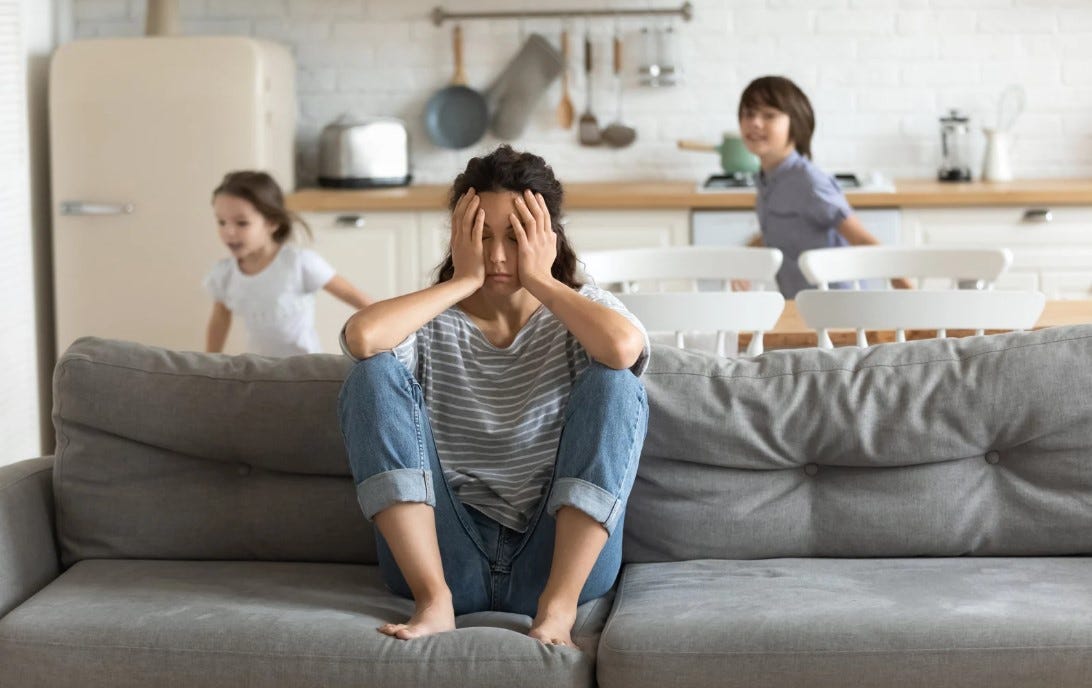
The developmental work did not disappear. It was transferred onto households. We removed childhood from the commons and reassigned its costs to individual families, and it’s draining parents. Manufacturing a healthy childhood is now a part-time job for parents.
This is not an argument that childhood in the past was universally safe, fair, or humane. It was not. Many children were excluded, endangered, ignored, or denied freedoms other children received automatically. Nostalgia can conceal as much as it reveals.
But public life once performed a developmental function that becomes easier to recognize as it disappears. It exposed children to a world that was not perfectly arranged around them.
Children learned which places welcomed them, which adults could be trusted, how to enter a group already in progress, and how to occupy time no adult had planned for them.
The ordinary world supplied friction.
Another child disagreed. The rules were unclear. The older children said no. The joke did not land. The fort collapsed. A friend walked away. The group became bored.
Nobody immediately arrived to repair the experience so the children had to respond.
The value of these moments did not come from adults secretly embedding a lesson inside them. Their value came from being real. The disagreement mattered because the game could end. The plan mattered because it belonged to the children. The responsibility mattered because someone else was depending on them. The choice mattered because an adult had not already made it.
These were not enrichment programs. They were children participating in the world.
In my Architecture of Childhood work, I have argued that capacities such as self-regulation, agency, resilience, social connection, creativity, and responsibility are built through repeated experience.
The world before adults planned everything supplied many of those repetitions without labeling them, measuring them, or turning them into another adult-directed lesson.
Once childhood becomes something families must pay for, arrange, organize, and assemble, inequality expands rapidly. I’ve seen it again and again over my nearly two decades teaching in high poverty schools.
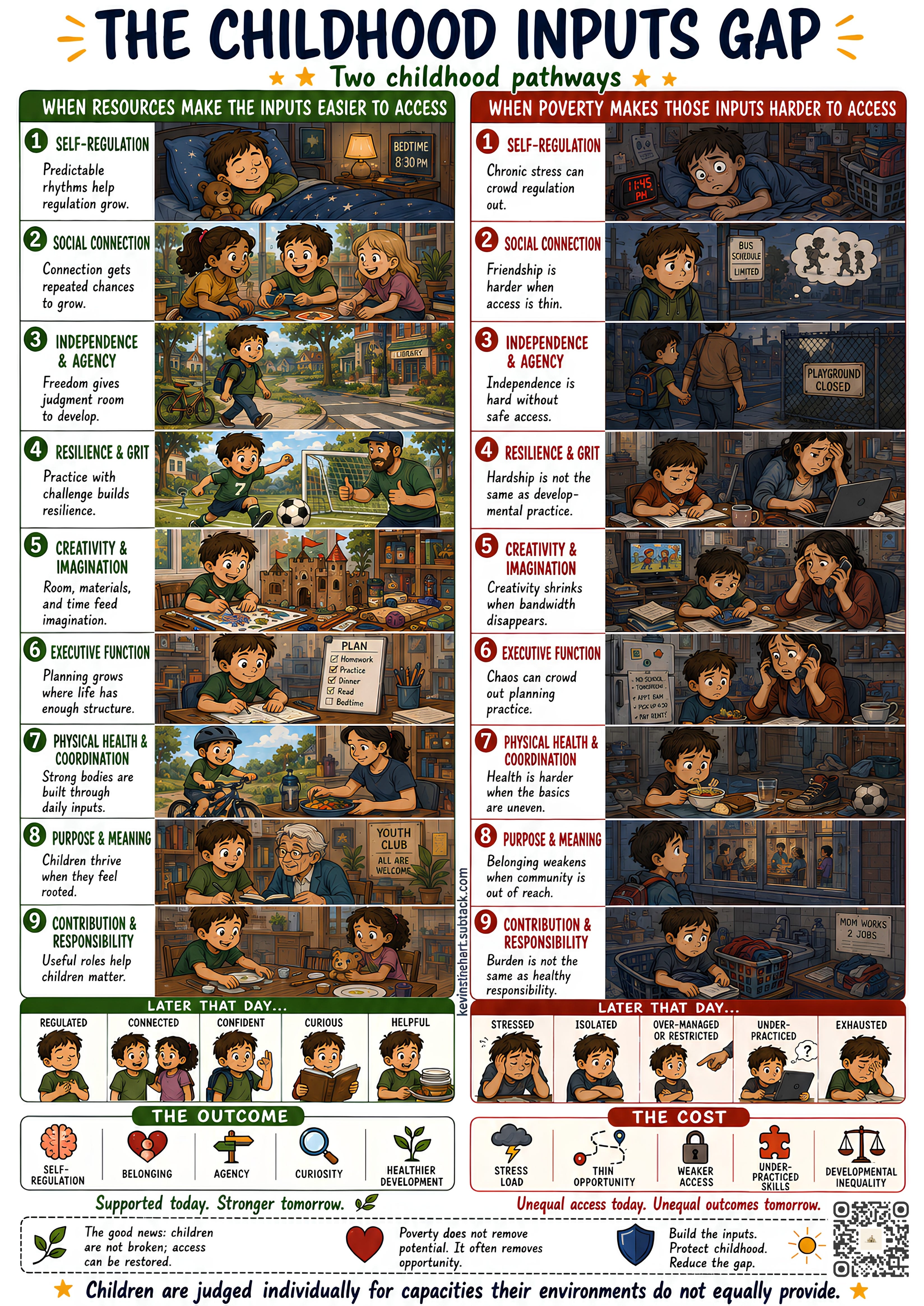
One child lives near sidewalks, trees, friends, and a public park. Another lives beside a busy highway with no sidewalk to walk on.
One family can pay for travel sports, lessons, and summer camps. Another is calculating whether a $50 registration fee will disrupt the grocery budget.
One parent has the schedule and transportation necessary to coordinate afternoon activities. Another is working during every hour those activities occur.
One child can move through public space and be interpreted as independent. Another may be viewed as suspicious, disruptive, endangered, or neglected.
These children are not receiving different amounts of healthy childhood inputs because one set of parents cares more and works harder.
They are living inside different ecosystems.
Yet we routinely interpret the results as individual family choices.
We praise some children for being confident, resourceful, physically capable, and independent without asking what their surroundings repeatedly allowed them to practice.
We worry that other children are hesitant, isolated, or dependent on adults without asking whether they have ever had somewhere safe to go, people to meet, or meaningful choices to make without an adult directing them.
Children are judged individually for outcomes shaped in large part by geography, transportation, public investment, social trust, local beliefs, family work schedules, and adult availability.
This is why the Architecture of Childhood cannot be only a parenting framework.
Architecture determines access.
A developmental input that depends on private purchase is not equal - and a childhood that must be privately purchased will reproduce the inequalities of the adult world.
Here’s what I mean about the two different ecosystems kids now grow up in:
When ordinary developmental opportunities become scarce or uneven, the consequences do not remain inside individual homes.
They arrive wherever children gather.
Schools experience them as difficulty with transitions, peer conflict, low frustration tolerance, disengagement, dependence on adult mediation, and trouble recovering after setbacks.
Families experience them as exhaustion, guilt, stress, and the sense that every unfilled hour has become their responsibility.
Clinicians and counselors experience them as rising demand from children and adults who are genuinely struggling, even when those struggles cannot be reduced to a diagnosis or a single cause.
None of this means that disability, trauma, mental illness, temperament, or neurodevelopmental differences are products of poor community design.
They are not.
It means specialized care is increasingly being asked to operate inside a broader environment that often supplies too little ordinary developmental practice.
We ask teachers, counselors, pediatricians, and therapists to build social confidence, emotional endurance, independence, and judgment inside brief, structured encounters.
But a 30-minute social-skills lesson cannot replace a social world. A poster about resilience cannot compensate for too few encounters with manageable, real-world difficulty. A regulation strategy cannot fully offset a day designed with too little movement, recovery, ownership, or belonging. An independence checklist cannot create somewhere meaningful to go.
In “We Have a Tier 0 Problem,” I argued that schools are investing heavily in increasingly specialized interventions while neglecting the universal developmental conditions beneath them.
Movement.
Peer life.
Play.
Belonging.
Agency.
Responsibility.
Recovery.
Those conditions are not replacements for Tier 2 or Tier 3 support. They are the foundation that prevents every difficulty from becoming the sole responsibility of specialized adult intervention.
We fund increasingly sophisticated repairs while allowing the surrounding environment to deteriorate.
Treating childhood as infrastructure does not mean creating another program run by adults. It means building places where children can act without adults planning every move.
A sidewalk does not tell people where to walk. A library does not tell them what to think. A park does not tell children what game to play. Good infrastructure creates access, safety, and possibility.
All children need that foundation.
They need school playgrounds that stay open after the final bell, recess that cannot be taken away as punishment, libraries where young people are allowed to gather, and neighborhoods with sidewalks, slower traffic, and safe ways to travel.
They need free places to return to, familiar groups to join, and useful work that matters.
They also need adults willing to accept the noise, mistakes, movement, conflict, loitering, and unfinished skills that come with childhood. Those are not signs that children do not belong. They are signs that children are still developing.
My Play Deprivation Delay Theory argues that when children have too few chances to lead, negotiate, create, move, and solve problems together, some skills may develop later or less smoothly than adults expect.
But children cannot fix that deprivation. They cannot create public spaces, safe routes, recurring groups, open schoolyards, or a culture that trusts them. If the problem is partly structural, the solution must be structural too.
We often judge communities by how many programs they offer children: sports, camps, tutoring, clubs, and enrichment.
Those programs can be valuable. But they mostly measure what adults have organized.
A better test is simpler:
Can children find one another without an appointment?
Can they spend time somewhere without buying something?
Can they move, create, help, and solve problems without every activity becoming a class, competition, or performance?
Can they gradually travel farther from home without one parent having to fight the entire culture alone?
Can they exist in public without being treated as a problem?
A child-friendly community does not constantly entertain children.
It simply makes room for them. It makes childhood look natural and normal again.
Schools should ask the same questions. A school children want to return to gives them more than lessons and incentives. It gives them a role, a group, a responsibility, an unfinished project, and a reason their presence matters.
We have replaced too much of childhood with adult-managed services. When children need friends, we schedule them. When they need movement, we enroll them. When they need creativity, we teach a class. When they need independence, we design an activity while quietly keeping control. When they struggle, we search for a professional intervention.
Programs and professional supports matter, but they cannot replace an entire developmental habitat.
Children need an abundance of time, accessible space, recurring relationships, useful roles, sensible freedom, and places where belonging does not require payment.
The Architecture of Childhood shows us what children need. Tier 0 shows us where schools and communities must begin. Play Deprivation Delay Theory helps explain what may happen when those ordinary experiences disappear.
Now we must act.
Open the playground.
Protect recess.
Slow the traffic.
Build the sidewalk.
Welcome children into libraries, parks, neighborhoods, and public life.
Give them real work, real freedom, and real responsibility.
Stop asking individual parents to rebuild childhood one playdate at a time.
Children cannot build the environments that build them.
That is our job - not because families have failed, but because no family was ever meant to provide an entire world.
My essays stay free so this work can reach the adults shaping children’s lives. Paid subscribers make that possible and get immediate access to the Missing Inputs Resource Folder, which includes dozens of resources.
No posts
Comments
Nothing yet. Say the first thing.
Sign in to join the conversation.