
The boy became perfect the moment the iPad lit up.
He had been squirming in the restaurant booth, talking too much, looking around, asking when the food was coming, struggling in the very ordinary way children struggle when they are hungry, tired, bored, and expected to act like miniature monks in a vinyl booth for twenty minutes. Then the dad across from him handed him a screen.
Silence. Stillness. Peace. It worked.
That phrase has been stuck in my head lately.
It worked.
But did it help?
If the goal was a quieter restaurant table for the next fifteen minutes, then yes. Absolutely. Mission accomplished. Tiny ambassador of public compliance. But if the goal was helping that boy become more patient, more able to wait, more capable of tolerating boredom, more practiced at conversation, more able to manage his own restlessness without outsourcing it to a glowing rectangle, then no. It did not help at all.
It solved the adult’s problem.
It may have weakened the child.
And no shame on that dad. I’m sure I have done the same thing on occasion. Many parents today are under immense pressure, and the iPad is the most entertaining babysitter ever invented.
A personal hero of mine, Father Greg Boyle, has a line I have not been able to shake since hearing it years ago, “Not everything that works helps, but everything that helps, works.”
That may be one of the most important things adults can remember right now, because modern childhood is full of things that work. Read that line again, “Not everything that works helps, but everything that helps, works.”
The iPad works.
The bribe works.
The threat works.
The silent hallway works.
The silent cafeteria works.
The overstructured school day works.
The fenced field works.
The packed schedule works.
The adult who steps in immediately and settles every conflict works.
The question is not whether these things can produce short-term order. Of course they can. The question is what they are helping children become.
That is the harder question. And it’s the one I think we keep dodging.
When I first started teaching at my school almost a decade ago, children spent the half hour before school sitting silently in the hallway from 7:30 until 8:00. They were supervised, contained, and quiet. It worked. The building was orderly. Adults knew where everyone was. No one was running. No one was arguing. No one was whispering about who won the football game at the rec center the night before. No one was laughing.
It worked beautifully if the main goal was management.
But children are not meant to be successfully stored like luggage until instruction begins.
They are social creatures. Physical creatures. Meaning-making creatures. They wake up with stories to tell, energy to burn, friendships to tend, hurts to repair, jokes to share, games to start, and bodies that would very much prefer not to begin the day being seen but not heard.
What those children needed at 7:30 in the morning was not a big dose of stillness. They needed movement. They needed laughter. They needed each other. They needed some room to act like children (humans) before being asked to act like students.
So eventually we opened the playground.
And what happened was so obvious it almost felt rude. Children came alive. They ran, negotiated, played, argued, settled things, connected, laughed, and then walked into class far more ready to learn. Teachers often feel like they are playing whack-a-mole with student talk because children are deeply social and school keeps trying to suppress that reality. Give them no time to connect, and they will spend math trying to discuss the thing they have been dying to tell each other since 7:30. Give them time to be together first, and many of those needs stop hijacking the lesson later.
Thankfully, I had the forethought to film the transition, so take a look:
The hallway worked.
But the playground helped.
That distinction reaches much farther than schools.
It reaches into restaurants and car lines and pediatric waiting rooms and places of worship and ballfields and libraries and living rooms and public parks and every single place where adults are deciding, consciously or not, whether the point of childhood is smoothness or human development and healthy childhood formation.
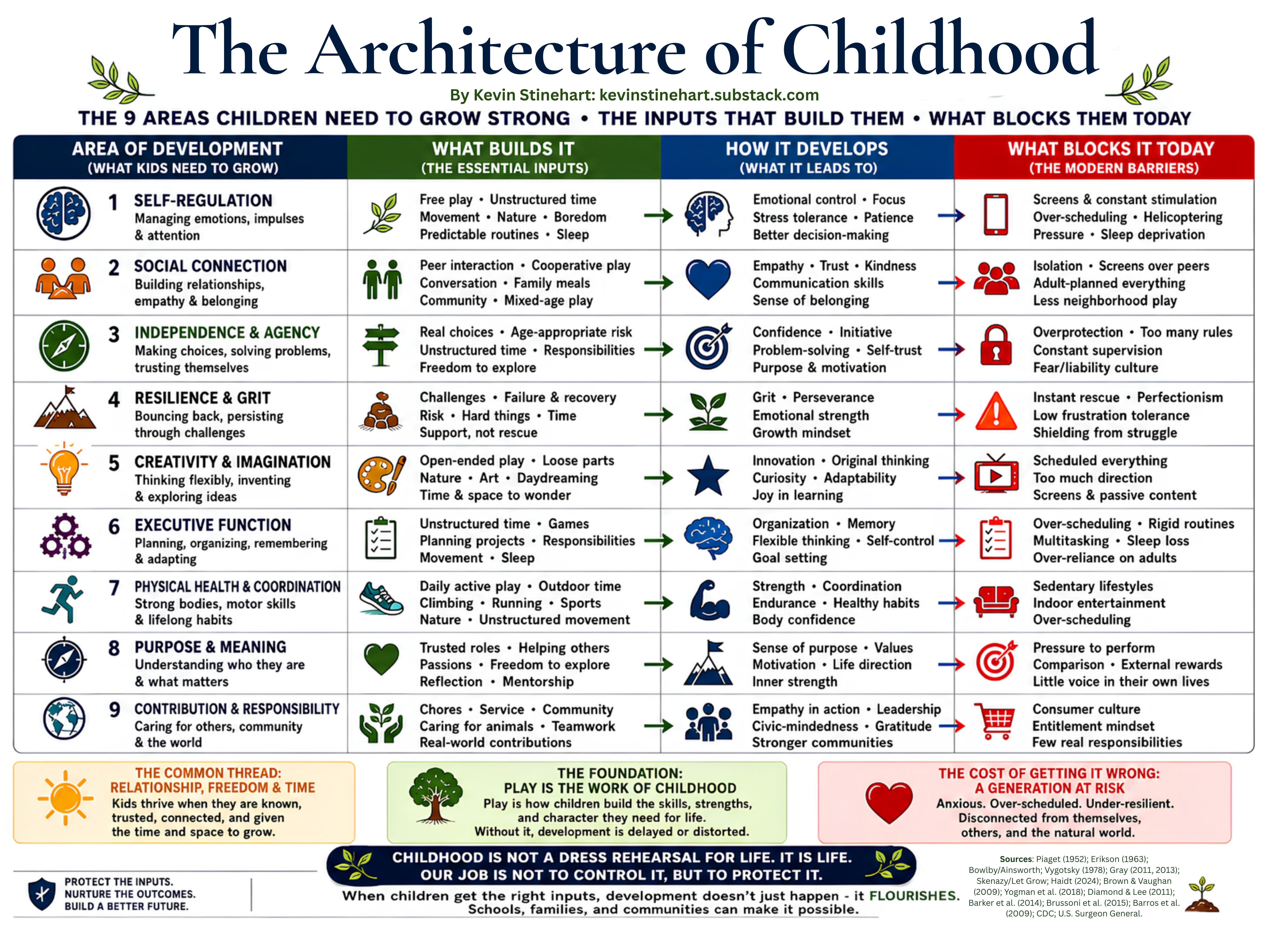
That is where The Architecture of Childhood matters.
I built that framework because I kept seeing the same thing over and over. Children do not merely need academic content, supervision, and correction. They need the conditions that grow them in specific areas:
Self-regulation
Social connection
Independence and agency
Resilience and grit
Creativity and imagination
Executive function
Physical health and coordination
Purpose and meaning
Contribution and responsibility
Once you begin looking through that lens, a lot of modern adult decisions start revealing themselves for what they are.
The iPad in the restaurant may produce outward self-regulation while quietly blocking the deeper growth of actual self-regulation. It stops the squirming while also reducing practice with patience, boredom tolerance, conversation, and impulse control.
A silent cafeteria may reduce conflict while also thinning out social connection, humor, belonging, and the daily low-stakes practice of being a human among other humans.
A hyper-organized childhood may make a child look well-managed and simply developing skills for a child’s future career, while they grow weaker in independence, agency, executive function, and self-trust.
A childhood with little risk may feel safer while producing less resilience, confidence, judgment, and real courage.
A childhood packed with passive content may keep children occupied while starving creativity, imagination, initiative, and wonder.
A life where children are rarely needed for anything real may produce less contribution, responsibility, purpose, and a thinner sense that their presence actually matters.
This is the part that makes the whole conversation more morally serious for me. Adults keep choosing what lowers friction for us right now, then acting confused when children seem less sturdy later.
We keep choosing efficiency over formation. We keep choosing control over growth. We keep choosing what calms the moment over what builds the person.
To be clear, I understand why we constantly do what works. Parents are exhausted. Teachers are carrying impossible loads. Principals are balancing safety, staffing, district expectations, legal realities, parent concerns, and the daily chaos of actual schools. Communities are afraid of liability, complaints, conflict, traffic, noise, and damage.
None of this is hard to understand. But children are still being formed by what we choose for them.
The nine areas of development do not grow because adults announce that they matter or introduce morning meetings and social emotional curriculum. They grow because children get repeated reps inside the kinds of lives that build them:
A child becomes patient by repeatedly practicing waiting.
A child becomes socially capable by repeatedly having to navigate other children.
A child becomes resilient by repeatedly facing mild frustration without immediate rescue.
A child becomes imaginative by repeatedly being bored long enough to invent something.
A child becomes independent by repeatedly making small-stakes decisions before they feel fully ready.
A child becomes responsible by repeatedly carrying small responsibilities.
A child develops purpose by repeatedly belonging to something larger than themselves.
A child becomes physically confident by repeatedly climbing, running, balancing, digging, throwing, building, and moving through the world in a real body rather than a screen.
That is why I keep returning to the same uncomfortable question: What is this helping the child become?
Not, did it make the next ten minutes easier? Not, did it lower the noise level? Not, did it create a cleaner-looking and smoother environment for adults?
Those questions matter, but they are not enough. A child is not just a logistical challenge to contain. A child is a person under construction. And a lot of what we call “successful adulting” around children is really just a professional-grade interruption of the construction process.
We smooth the edges too early. We solve the conflicts too quickly. We relieve the boredom too fast. We hand over the screen too automatically. We remove the chances to wait, wonder, negotiate, improvise, recover, try again, or carry something hard.
Then, years later, we lament that children seem less patient, less socially fluent, less resilient, less creative, less self-directed, less physically confident, and less able to handle ordinary life without help.
Well, yes. We kept doing what works short-term instead of doing what helps long-term.
I recently wrote here on Substack about my local friend Dr. Lisa Cassidy, who transformed her middle school by replacing silent lunches and tightly controlled mornings with recess, games, movement, conversation, and screen-free time with friends. She stopped asking only what made students easier to manage and started asking what helped them belong, grow, and want to come to school. Predictably, attendance improved, discipline improved, academic proficiency increased, and Liberty became one of only two Title I middle schools in the entire state of South Carolina to earn an “Excellent” rating. She stopped choosing what merely worked, and discovered that what helped worked far better.
This is why I get uneasy when people talk about giving children “what works” as though the phrase settles the matter. Plenty of things work in the short term if your main goal is compliance, quiet, and adult convenience. A child can be made quieter, easier, stiller, and more outwardly manageable in all sorts of ways.
But a well-managed child and a well-formed child are not necessarily the same child.
That may be one of the great mistakes of modern adulthood. We have become so skilled at producing outward order that we sometimes fail to notice inward erosion.
The child looks calmer. But are they growing in self-regulation?
The child looks successful on their report card. But are they growing in agency?
The child looks occupied after school. But are they growing in imagination?
The child looks protected. But are they growing in courage?
The child looks supervised. But are they growing in responsibility?
The child looks quiet. But are they growing in belonging?
Those are Architecture questions. And they cut deeper than behavior.
So yes, the iPad worked in the restaurant. The silent hallway worked. The tightly managed cafeteria worked. The childhood built around control, convenience, and constant adult intervention works in a thousand tiny ways every day.
But children do not become strong because adults got them to be quiet. They become strong because life keeps giving them chances to practice being human, and loving adults are wise enough not to interrupt all of that practice in the name of keeping things frictionless.
That is the distinction that haunts me. What works makes adulthood easier right now. What helps builds the child who will one day be able to live without us.
No posts
Comments
Nothing yet. Say the first thing.
Sign in to join the conversation.