
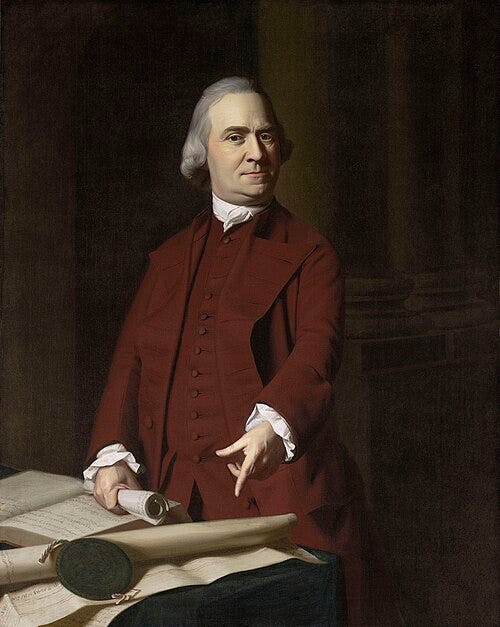
A portrait of Samuel Adams by John Singleton Copley, 1772. Museum of Fine Arts, Boston.
Here, Adams points to the Massachusetts Charter, which he viewed as a constitution protecting colonists’ rights against the Crown.
This week’s Founding Father is the unforgettable Bostonian, Samuel Adams. Adams was born on September 27, 1722, at Quincy, near the city of Boston, Massachusetts. His father, Samuel Adams Sr., was a wealthy Puritan merchant who was actively involved in Massachusetts politics and was an advocate for the rights and freedoms of colonial citizens. Samuel Adams was one of twelve children, only three of whom lived to adulthood. The younger Samuel Adams was educated at the Boston Latin School and then went on to Harvard University at age 14 where he studied law and political science and distinguished himself in those fields. Though his main interest was politics, Adams initially went into the mercantile trade alongside a man named Thomas Cushing, a distinguished merchant who later became an active patriot. Adams lost this job not long after it started as Cushing felt Adams was not paying proper attention to the business. Adams attempted to start his own business but failed miserably. He was then given a job at a malthouse owned by his family where he helped make malt for beer brewing. He married Elizabeth Checkley in 1749. She would tragically die in childbirth in 1757. She had given birth to six children in those years, with only two living to adulthood, Samuel, born in 1751, and Hannah, born 1756. Adams remarried seven years later to Elizabeth Wells, but they had no children.
Adams finally launched his political career in 1747 when he was elected as a clerk for the Boston market and then elected as a tax collector. As in business matters, tax collecting did not hold his attention. He would often forget to help collect taxes, which endeared him, naturally, to the Boston populace. As early as 1763, he was boldly expressing his sentiments relative to the rights and privileges of the colonists. He wrote up instructions for the General Assembly, in a decided stand against the Stamp Act, denying Parliament the right to tax the colonists without their consent when the British determined to collect taxes from the colonies to help make up the deficit from prosecuting the global war known as the French and Indian War.
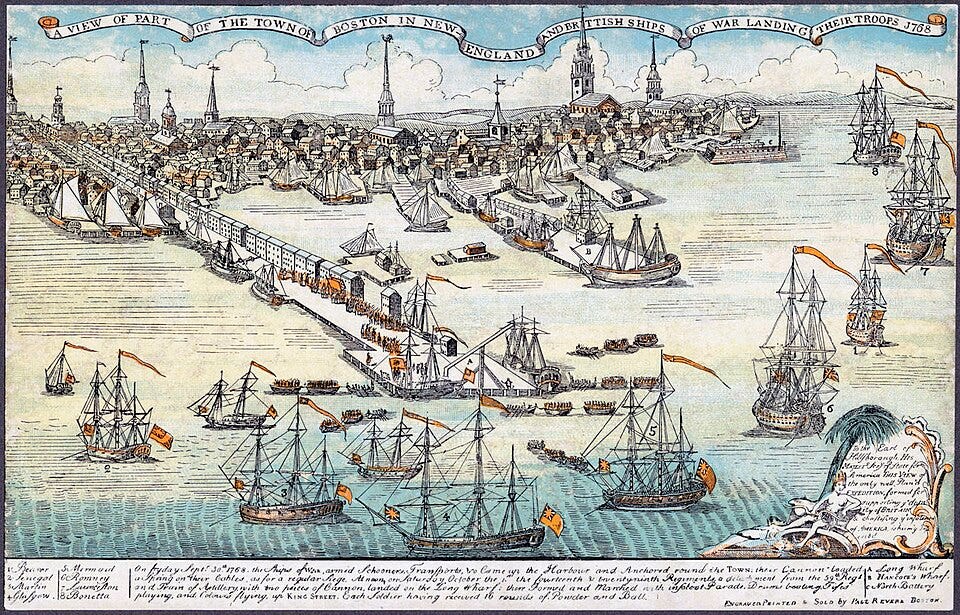
Paul Revere's 1768 engraving of British troops arriving in Boston was reprinted throughout the colonies.
Adams immediately began publishing tracts against the taxes in the Boston Gazette in order to rally the people against British Parliament. In 1765, he was elected to the general court of Massachusetts, furthering his political career and his outcries against Britain. When the Townshend Acts of 1767 were passed, Adams helped convince Bostonians to place a boycott on British goods. Thus, when he observed his world becoming occupied with British troops, as, for example, in 1768, depicted here in an engraving by Paul Revere, he suggested a union of the colonies against British aggressions, in the first such public expression of that idea. In addition, Adams tried to negotiate a withdrawal of the British troops to the outskirts of the city.
After the Boston Massacre in 1770, the British decided to withdraw one regiment from Boston. Samuel Adams’s patriotic followers began calling themselves the Sons of Liberty. In 1772, at the Boston Town Meeting, held at Faneuil Hall, Adams proposed the formation of the Committee of Correspondence to unite the colonies. He authored a Declaration of Rights presented at the meeting in November 1772. Adams helped organize the Boston Tea Party in 1773, though the extent of his participation is unknown. Britain passed the “Intolerable Acts” as a punitive measure for the Tea Party, and Samuel Adams gave up on any hope of reconciliation.
He was made a delegate to Continental Congress in 1774, and he would retain his seat there until after the Revolutionary War. He signed the Declaration in 1776 and served on numerous committees formed by Congress throughout the war and was noted for seconding John Adams’s motion to appoint George Washington as commander in chief of the continental army. Adams favored harsh treatment of Loyalists, and advocated confiscation of Loyalist property and prohibition on their returning to live in the colonies, on the theory that they could undermine the new government.
He returned to Boston in 1781 to find that his home on Purchase Street had been destroyed and looted.The windowpanes were etched with insults and caricatures were drawn on the walls. His garden was trampled, the outbuildings knocked down, and the house was robbed of all its furnishings. Adams was unable to fix the house, so he moved his family to Dedham, Massachusetts, where he would live for the rest of his life. He attempted to get back into politics several times as he was an outspoken Anti-Federalist and was concerned that the new American government might consolidate too much centralized power.
He served as governor of Massachusetts until 1797, after which he retired permanently from political life. He died on October 2, 1803, at the astonishing age of eighty-one. His grave can be found in the Granary Burying Ground in Boston.
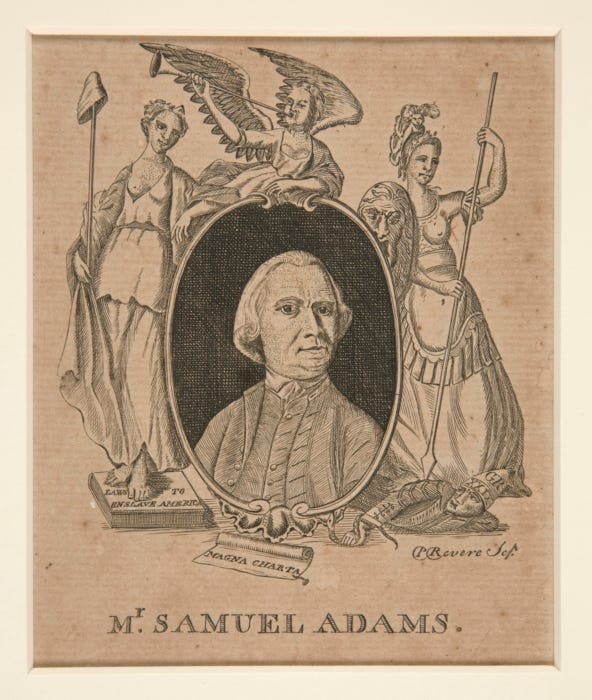
“Mr. Samuel Adams,” by Paul Revere, 1774. Yale University Art Gallery, New Haven, CT.
Thanks for reading Kent's Substack! This post is public so feel free to share it.
No posts
Comments
Nothing yet. Say the first thing.
Sign in to join the conversation.