
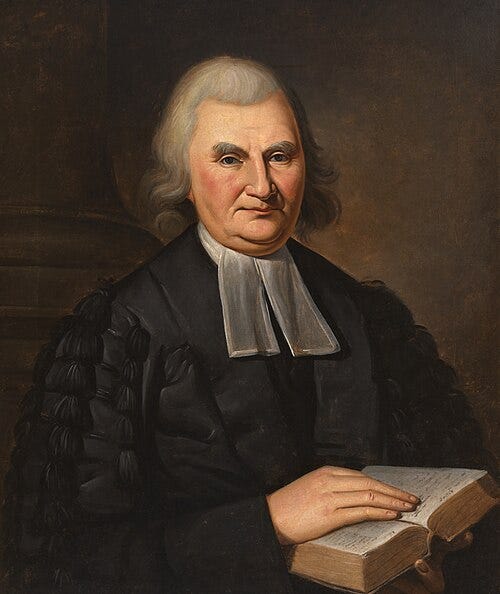
A portrait of John Witherspoon by Rembrandt Peale, 1794
This week’s Founding Father is the Scottish-born Presbyterian minister, John Witherspoon. Witherspoon was born on February 5, 1723 in Gifford, Scotland. His father sent him to Haddington Grammar School for his early education, and when he was just fourteen, he began studying at the University of Edinburgh. He had a mind to follow in his father’s footsteps and studied divinity in order to become a minister. By the age of twenty, he had a doctorate in Theology. He was made the minister of Beith, Scotland and it was here he married Elizabeth Montgomery. They would have ten children total; only five lived to become adults and emigrate to America.
Witherspoon was a devout Protestant; he was taken prisoner after the Battle of Falkirk, which was fought between the British Crown and the Jacobites, when Scottish supporters of Prince Charles Stuart tried to restore that Catholic Stuarts to the British throne. He was released after the Jacobite defeat several months later, but his reputation caught the attention of political leaders in New Jersey.
Witherspoon was not involved with America until 1768, when he was asked by Richard Stockton and Benjamin Rush to become the president of Princeton College. He found the college in a sorry state and immediately began raising funds and restructuring the syllabus based on the model at the University of Edinburgh. He donated several hundred of his own books to its library. In addition to his administrative duties, Witherspoon taught courses in literature, history, divinity, and moral philosophy. Although the college was originally focused on producing clergymen, Witherspoon broadened its purpose to include potential political and cultural leaders. Among his students were a host of men who would play important roles in American political and cultural life including James Madison and Aaron Burr.
On the eve of the Revolutionary War, Witherspoon had observed the harsh laws implemented by Great Britain upon the Colonies. Having long been a supporter of republicanism, even before his arrival in America, he was sympathetic to the Patriot cause. As a Presbyterian minister, he was especially disturbed by the Crown’s efforts to appoint an American Anglican bishop. He joined the New Jersey Committee of Correspondence in 1774. He expressed concerns about the British state church and other efforts of the Crown and Parliament to interfere in colonial affairs in his 1776 sermon, “The Dominion of Providence over the Passions of Men.” When he was elected to serve in the Second Continental Congress, alongside his friends, Stockton and Rush, in 1776, he was of the firm opinion that independence was the proper course of action. He was the only signer who was an active member of the clergy and a college president.
Princeton College was broken up during the Revolutionary War and its funding ceased. Witherspoon had to evacuate the college before the Battle of Princeton in 1777. The main building, Nassau Hall, was badly damaged, and his papers and personal notes were lost.
Later that year that he received word that his son, James Witherspoon, who had graduated from Princeton in 1770 and served as the aide-de-camp to General Francis Nash, had been killed in the disastrous defeat of the Patriot forces at Germantown. Witherspoon now dedicated himself mostly to political tasks. He continued to serve in Congress, becoming one of its most active members, as well as serving on many of its committees. He helped draft the Articles of Confederation and was elected to represent Somerset County in the New Jersey Legislature in 1780 where he aided in ratifying the Constitution.
In 1780 he was elected to a one-year term in the New Jersey Legislative Council representing Somerset County and was a candidate for Congress in 1789 and 1791. By 1783, Witherspoon had largely retired from political life, though he continued to serve as a minister and president of Princeton. Witherspoon was responsible for the reconstruction of Nassau Hall after the war, which caused him great personal and financial difficulty. He paid for Princeton’s repairs after the war with his own money which nearly left him impoverished. In 1791, at age 68, he married a 24-year-old widow, Anne Marshall Dill, with whom he had two more children. His health began to decline, however, and he went blind in 1792. Two years later he died on November 15thand was buried in the Princeton Cemetery.
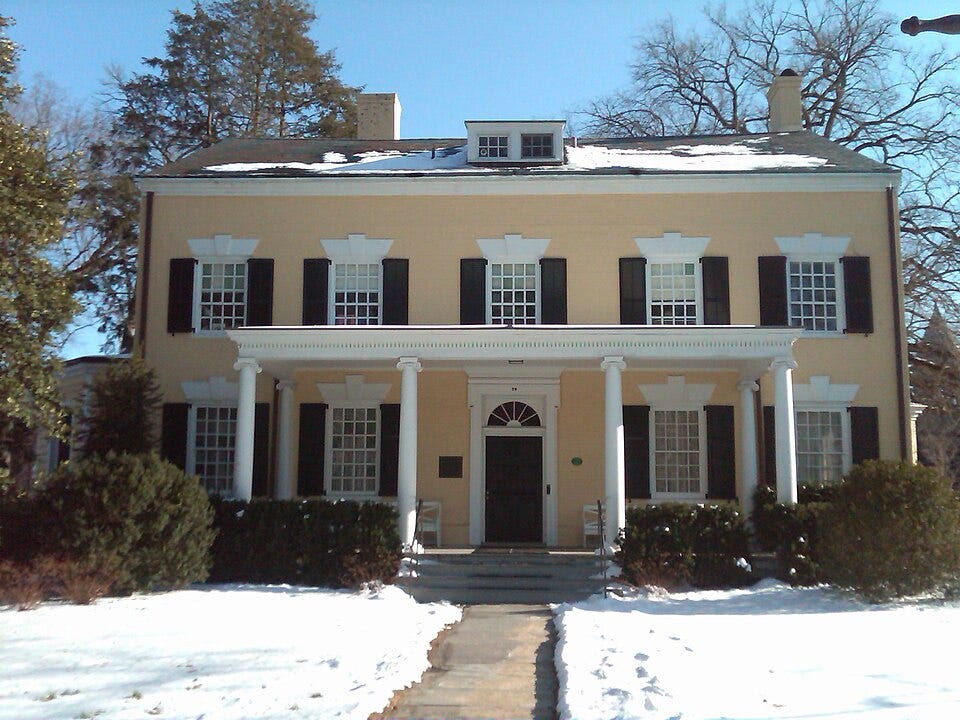
The President’s House, Princeton University, completed 1756. Witherspoon lived here from 1768 to 1779. Wikipedia, https://creativecommons.org/licenses/by-sa/3.0, Fullmetal2887, own work.
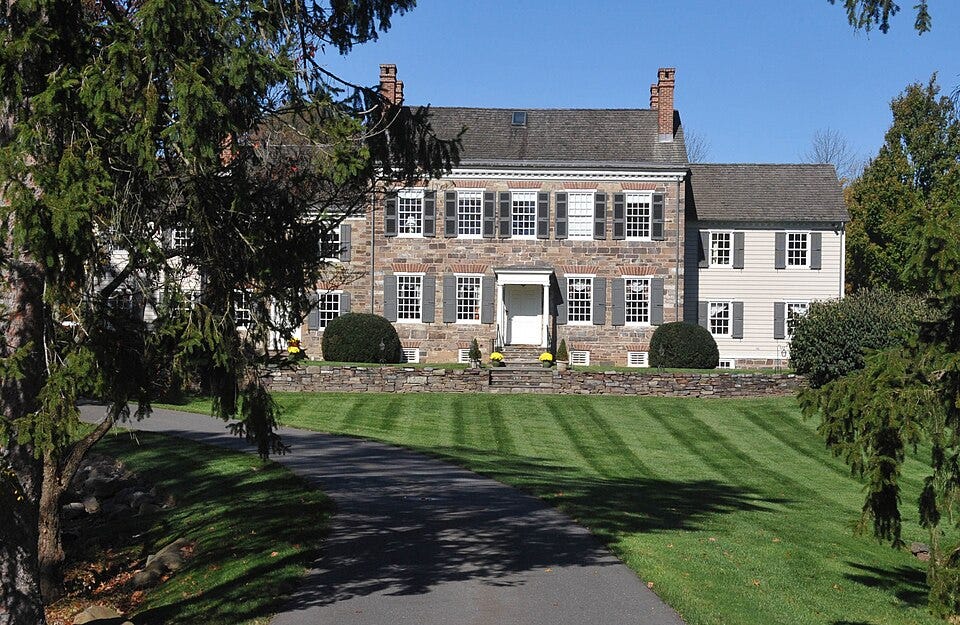
Built in 1773 by John Witherspoon, a Georgian Farmhouse, known as “Tusculum” built as a summer residence and ultimately where he retired. He died here in 1794. Jerry and Raye Klotz, M.D., own work, https://creativecommons.org/licenses/by-sa/3.0
No posts
Comments
Nothing yet. Say the first thing.
Sign in to join the conversation.