
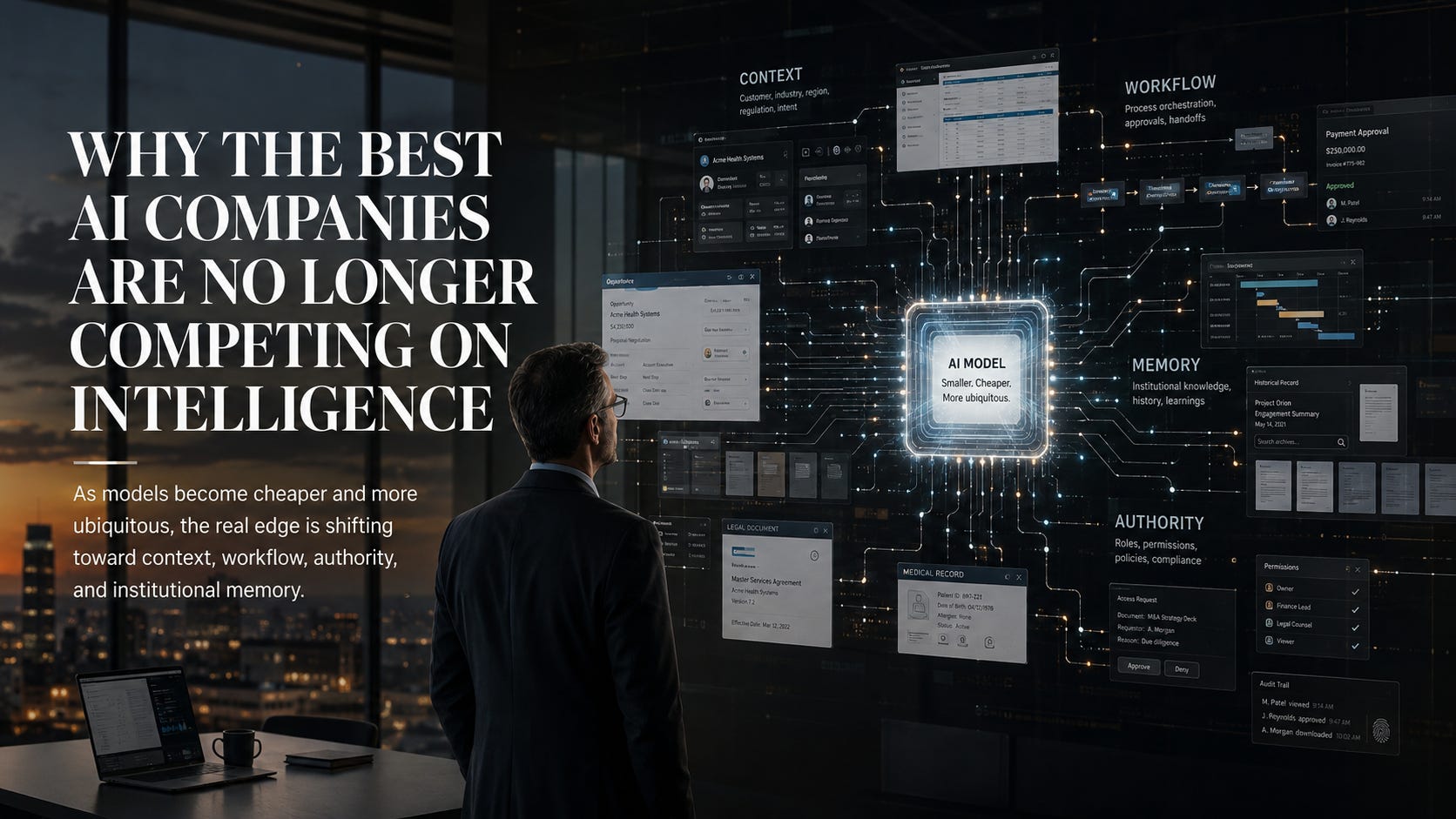
As models become more affordable and ubiquitous, the real edge is now shifting toward context, workflow, authority, and institutional memory.
In July, Microsoft made a subtle yet telling adjustment to Microsoft 365 Copilot, hinting at a broader shift in the software landscape. Users could now summon Word, Excel, and PowerPoint agents directly within Copilot Chat. Instead of opening traditional applications, you could simply request a document, spreadsheet, or presentation, and it would appear without the need to launch separate software. The applications still exist, but they now work in the background.
For decades, this would have seemed peculiar. Software operated on a simple premise: launch an application, and it would dominate your screen, capturing your attention and strengthening your relationship with the company behind it. Word was synonymous with documents, Excel with spreadsheets, and PowerPoint with presentations.
Microsoft’s update signals a new paradigm: you start with an intention, and the software aligns itself to meet it.
Copilot now included with Word, Excel, PowerPoint, Outlook & OneNote
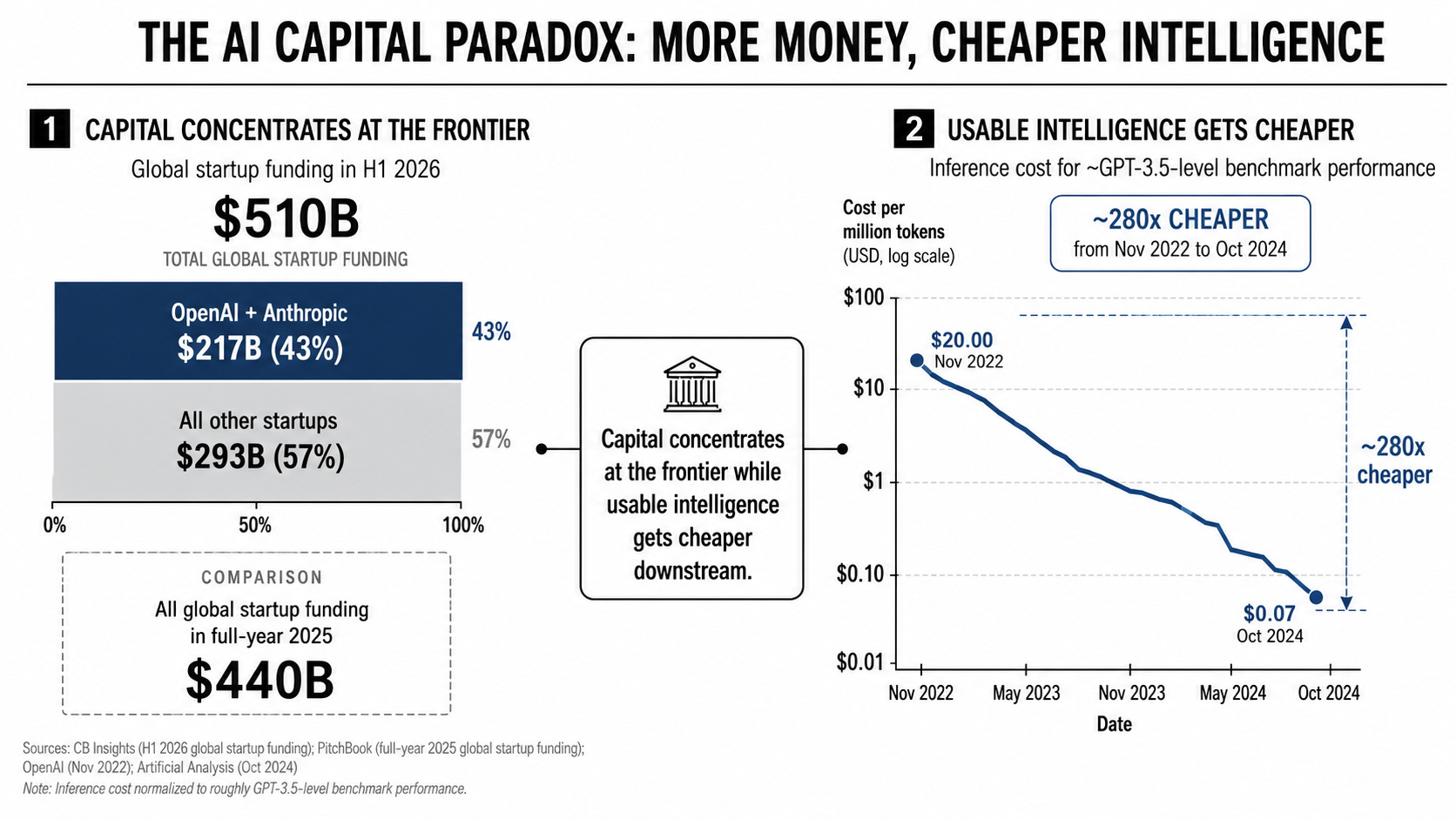
This shift coincides with a remarkable capital boom in technology. According to Crunchbase, global startup funding soared to about $510 billion in the first half of 2026, surpassing the $440 billion invested throughout 2025. OpenAI and Anthropic alone accounted for $217 billion, or 43%, of this total.
Yet, within these numbers lies an intriguing contradiction. Capital markets are placing higher value on artificial intelligence, even as access to functional intelligence becomes more affordable. Stanford’s 2025 AI Index demonstrated how quickly costs can plummet. Between late 2022 and late 2024, the cost of achieving GPT-3.5-level performance on a widely used benchmark dropped significantly, even as the most advanced models continued to demand a premium.
This second point is crucial. Models still matter. Frontier reasoning, latency, accuracy, specialized training data, scientific capability, compute efficiency, and inference economics can all provide a genuine edge. But for a growing number of everyday business tasks, accessing intelligence is becoming routine. This shifts the critical question from “How smart is your AI?” to “What does your company possess that remains valuable when intelligence is universally accessible?”
Google made the economics visible in January 2025. Features of Gemini, which once required a separate Workspace add-on, became part of standard business plans. Google illustrated the impact: A Business Standard customer, who had been paying $32 per user monthly for Workspace plus Gemini Business, would now pay $14 with AI functionality included.
The capability didn’t lose its value; its role in the package changed.
Adobe is navigating a similar path from a different market segment. By June 2026, Adobe expanded its Creative Agent to encompass Photoshop, Premiere, Illustrator, InDesign, Frame.io, and Firefly. Users could now describe their desired outcomes while Adobe’s software orchestrated the steps within tools already familiar to creative professionals.
Salesforce offers perhaps the clearest illustration of the installed-base advantage. In its fiscal first quarter of 2027, Agentforce achieved $1.2 billion in annual recurring revenue, a 205% increase year over year. Salesforce reported that 3.8 billion Agentic Work Units were delivered across Agentforce and Slack, with over half of Agentforce and Data 360 bookings coming from existing Salesforce customers.
This detail is crucial. An established company doesn’t always need to persuade another to establish a new vendor relationship, migrate data, set up a new permission architecture, or convince security teams to trust a new system. Much of this groundwork is already laid.
The startup must earn its place in the institution. The incumbent might merely need to activate something.
An old story resurfaces repeatedly in technology. Hipstamatic thrived by offering digital filters and film effects. Instagram, too, had filters, but it integrated them into a broader ecosystem—a free social network centered around sharing, following, commenting, liking, and discovering.
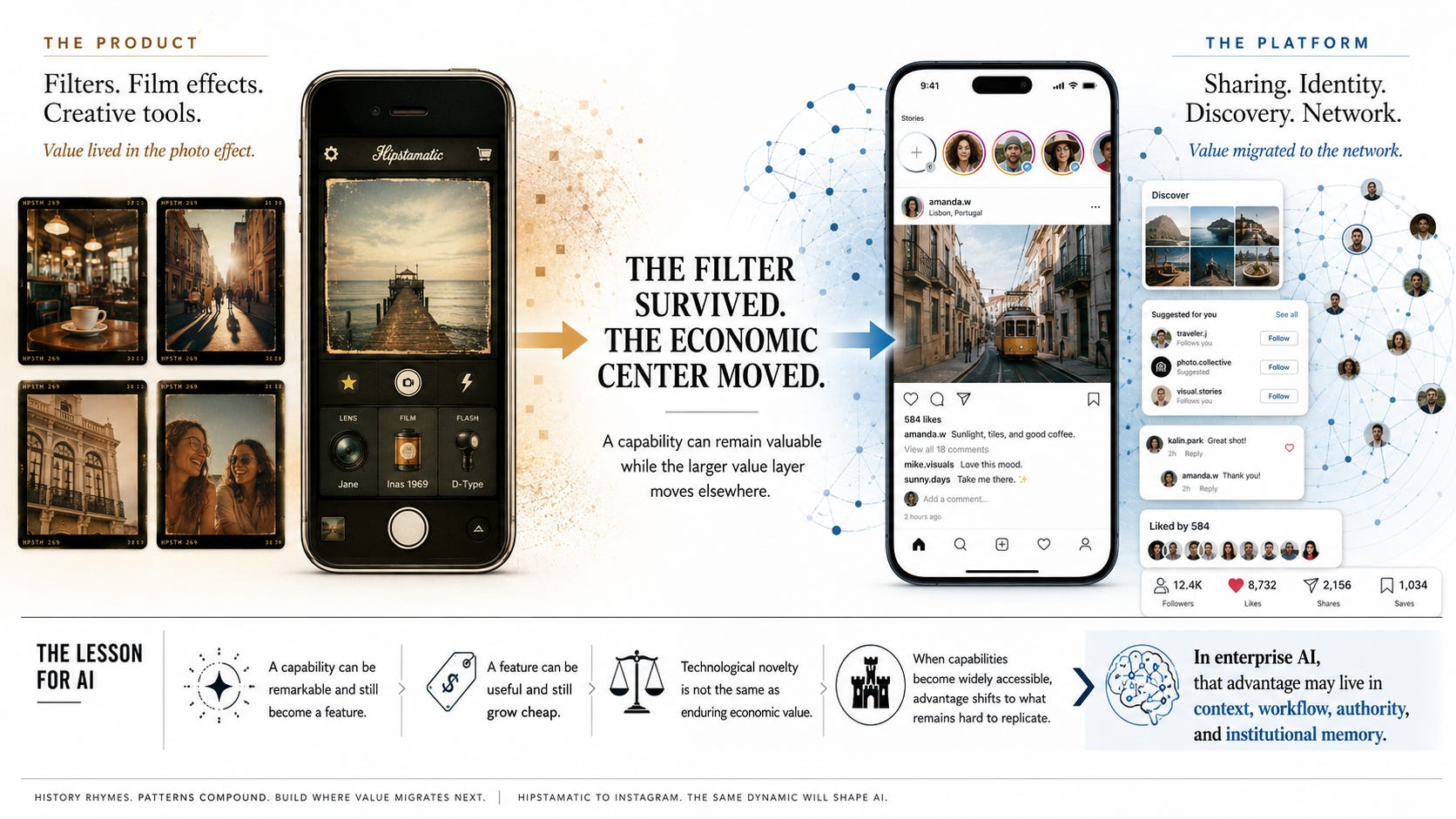
The filters endured; the economic epicenter shifted. Filters retained their value, yet the network surrounding them grew more valuable.
AI companies now confront a similar challenge, albeit on a grander scale. A capability can be remarkable and still become a feature. A feature can be useful and still grow cheap. A product may remain technically excellent while customers’ willingness to pay for that capability in isolation dwindles.
This is where AI strategy often gets muddled. The error lies in equating technological novelty with enduring economic value. They aren’t the same.
When a capability becomes widely accessible, the advantage gravitates toward what remains hard to replicate. Sometimes it’s distribution, other times, brand, network effects, or proprietary data. Increasingly, in enterprise AI, it may be something else.
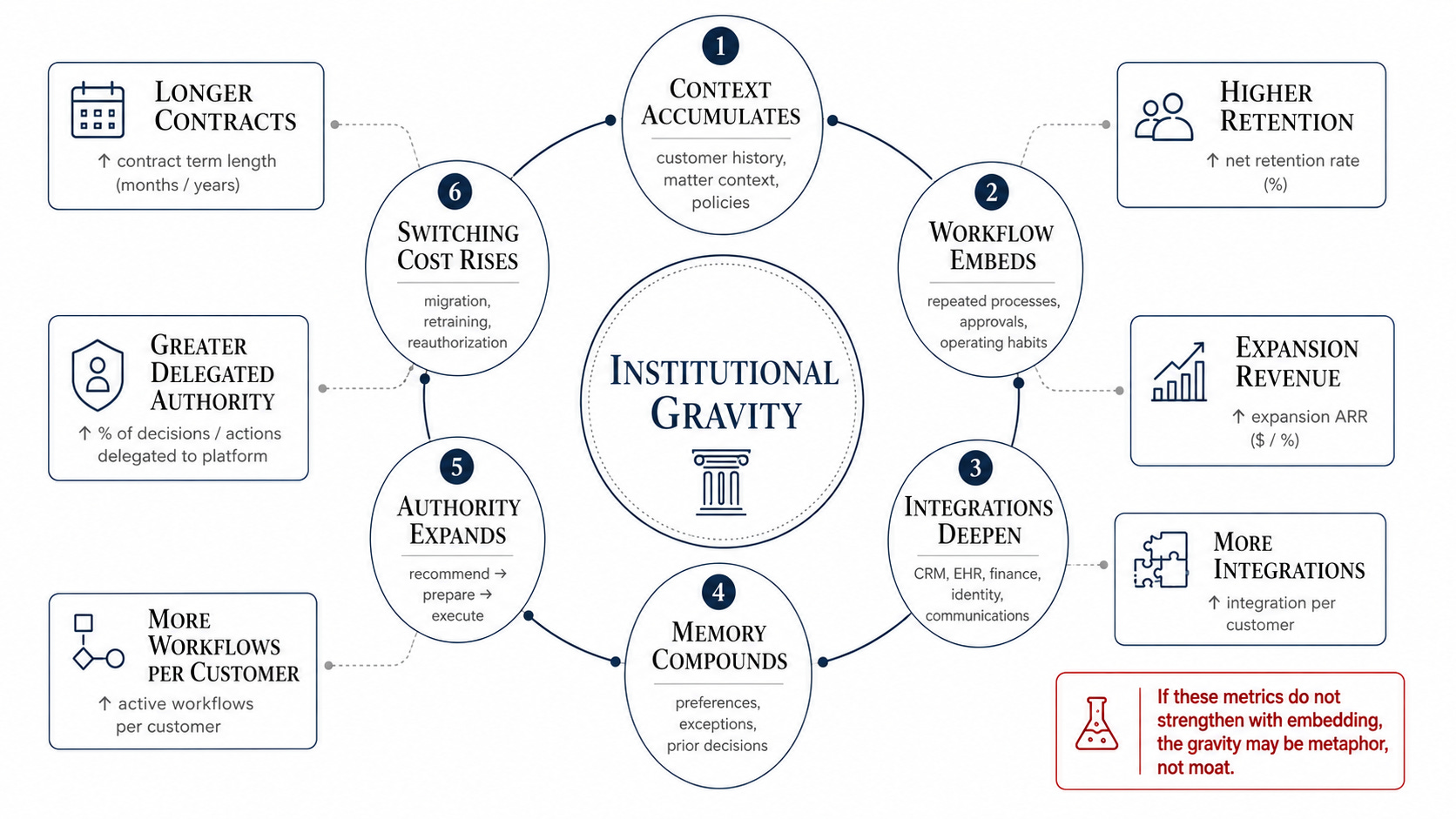
Some enterprise AI companies aim to amass what could be termed institutional gravity - not merely intelligence, but context, workflow, memory, permissions, and authority. It’s the quiet reliance that emerges when software evolves from a tool used occasionally to an integral part of how an institution recalls its past and decides its future.
Institutional gravity makes a system costly to replace. If swapping software involves only switching one model endpoint for another, there’s little gravity. But if it entails reconstructing five years of history, rebuilding thirty integrations, recreating permissions, retraining users, restoring matter context, revalidating compliance controls, and teaching another system how the organization functions, that’s something else.
This notion should be testable. If institutional gravity holds true, certain changes should occur as a system becomes more entrenched. Contracts should lengthen, retention should strengthen, customers should expand into more workflows, more institutional history should accumulate, and more systems should interconnect. Crucially, customers should gradually allow the software to do more.
If these don’t occur, institutional gravity may remain merely a metaphor rather than an economic mechanism. This distinction is significant. A trendy phrase is no substitute for a moat.
There’s good reason to believe some expertise forms will become easier to distribute. A study of 5,179 customer-support workers by Erik Brynjolfsson, Danielle Li, and Lindsey Raymond found that a generative AI assistant boosted productivity by about 14% on average. Among novice and lower-skilled workers, the gain was approximately 35%. The researchers noted that AI seemed to help less experienced employees adopt practices used by stronger performers.
This doesn’t mean expertise vanishes. It signifies that some expertise can now travel more easily than before. A sound method can be encoded, a useful answer generated again, a writing pattern replicated, and a reasoning process reproduced.
However, other elements don’t transfer as seamlessly. A customer’s entire history, a law firm’s matter context, a hospital’s clinical conventions, a company’s policy exceptions, a permission matrix approved by three committees, the contractual right to move money, and the reliance of fifteen other systems on what your software does next these aren’t merely intelligence. They are institutional state.
Institutional state might become one of the AI economy’s most treasured assets.
Building AI agents on Google Cloud
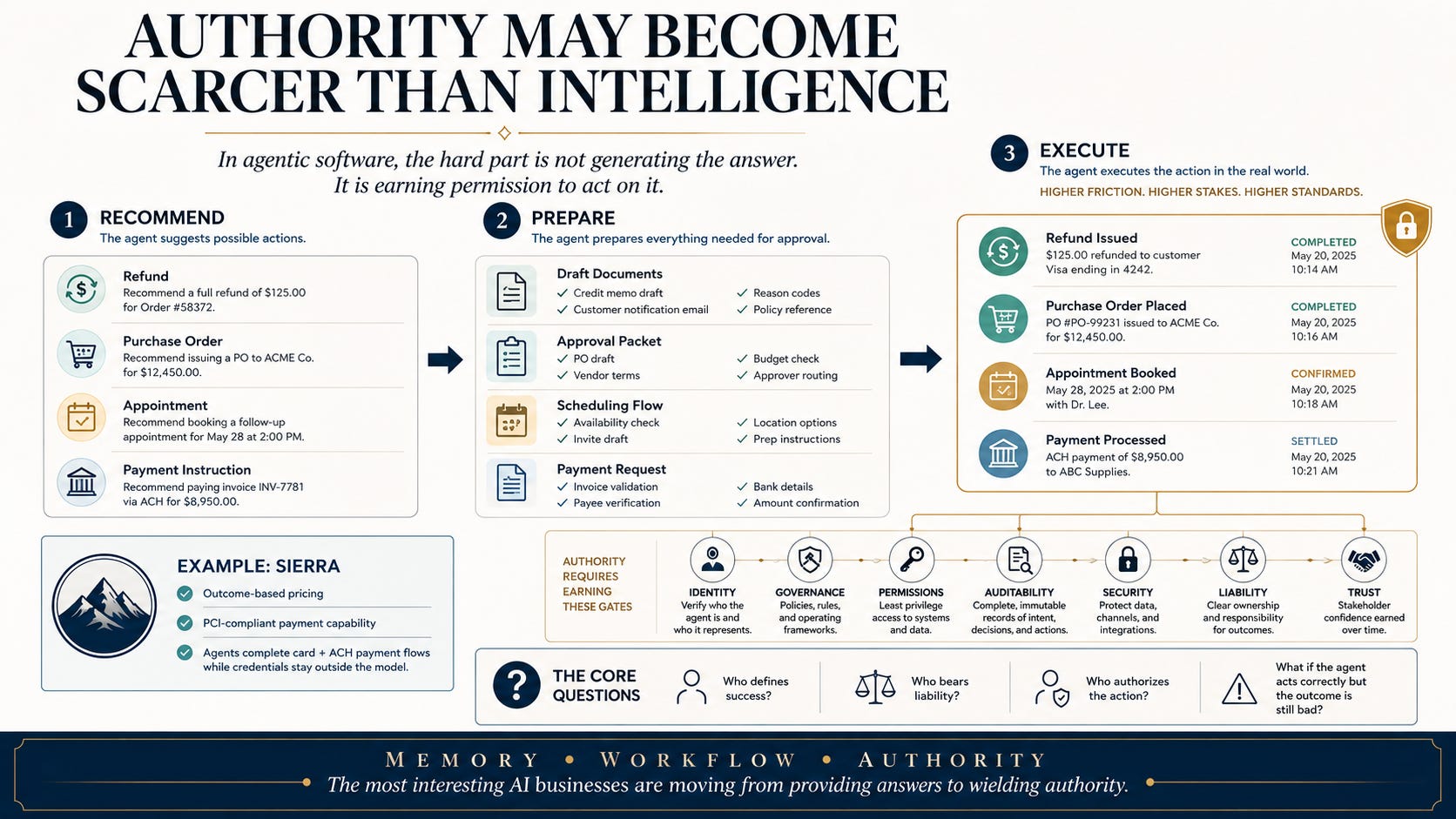
A more significant hierarchy lies beneath the surface. Software that suggests an action is one thing; software that prepares it is another. Software authorized to execute it is something else entirely. Recommending a refund isn’t issuing it. Drafting a purchase order isn’t placing it. Suggesting an appointment isn’t booking it. Writing payment instructions isn’t transferring money.
Authority demands more than a good model. It requires identity, governance, permissions, auditability, security, liability, and trust. This introduces a different scarcity form: Intelligence can be copied faster than authority can be granted.
In agentic software, authority might eventually become scarcer than intelligence. Sierra illustrates this vividly. The company has embraced outcome-based pricing rather than merely charging for software access, tying fees to specific results. In April 2026, Sierra launched a PCI-compliant payment capability, allowing agents to complete card and ACH payment flows while keeping raw payment credentials outside the model and core agent infrastructure.
This isn’t just an improved chatbot. The system edges closer to the economic event itself. As software approaches the event, the problem intensifies. Who defines success? Who bears liability? What if the agent acts correctly according to its instructions, but the outcome is still unfavorable? Who authorizes the action initially?
The more intriguing AI businesses are confronting these questions head-on because they’re progressing from providing answers to wielding authority.
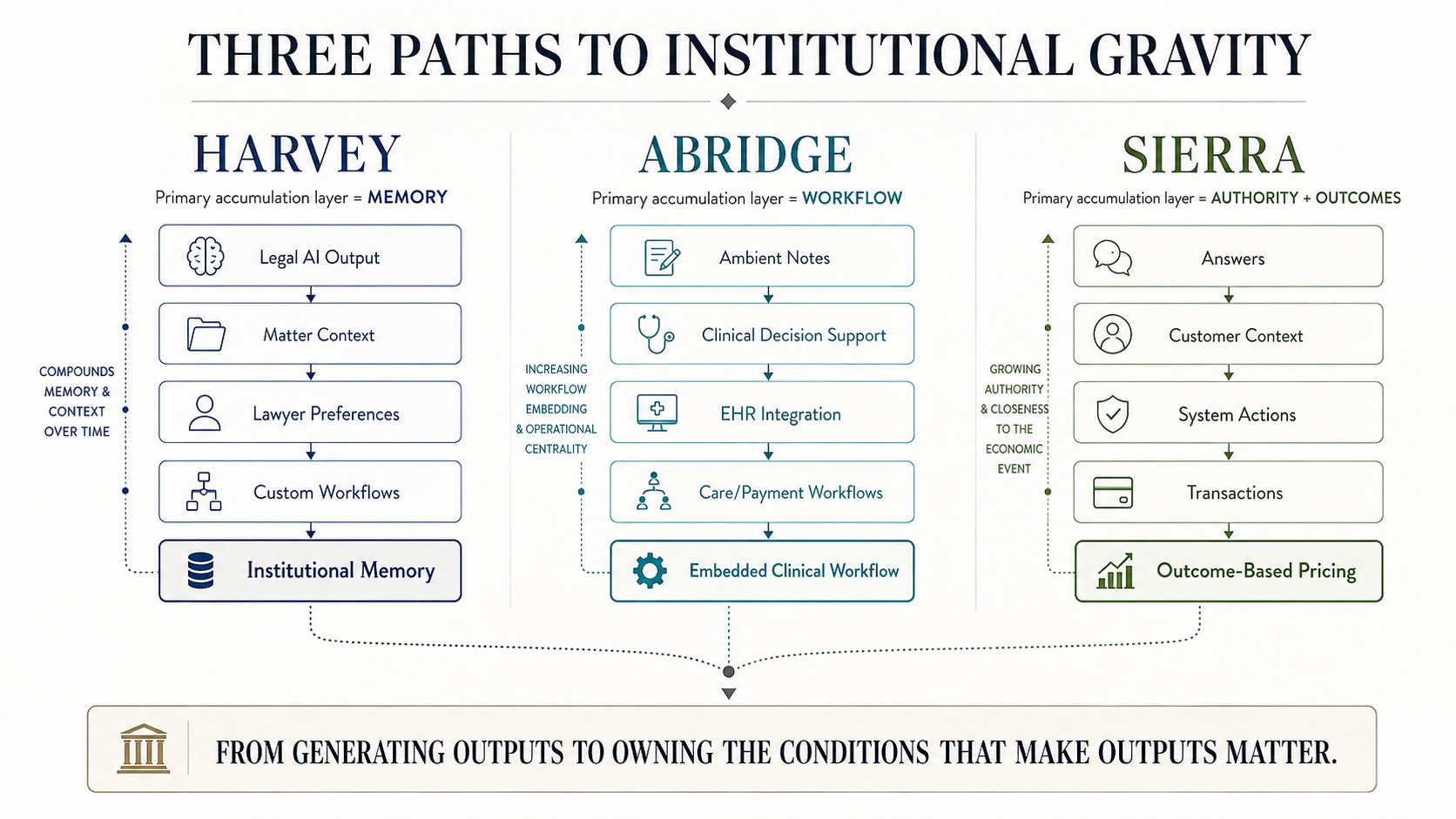
Harvey, Abridge, and Sierra embody three versions of the same strategic movement. This evidence warrants a caveat, as much of it originates from the companies themselves. Nonetheless, the direction is illuminating.
Harvey is accumulating memory. In January 2026, Harvey introduced Memory, designed to carry a lawyer’s preferred working style, matter context, and practices across interactions. By August, Harvey II pushed further, enabling agents to inherit matter history, documents, permissions, project context, and memory of how a lawyer operates. Harvey also claims that legal teams have created over 25,000 custom workflows on its platform.
The strategy isn’t that Harvey possesses the best legal model indefinitely. It’s that the system aims to know more about the lawyer and the matter tomorrow than it did yesterday.
Abridge is amassing a workflow. It started with ambient clinical documentation, a capability initially vulnerable to commoditization. But the company has expanded into clinical decision support, evidence integration, care workflows, and functions connecting clinical activity with payment. Abridge claims its context-aware clinical decision support has been adopted across more than 300 enterprise health systems representing over 250 million patients, though this is company-reported and should be interpreted accordingly.
The direction is key. The interface can quieten as the system entwines itself with what occurs before, during, and after the clinical encounter.
Sierra is amassing authority and outcomes. Its agents can connect to enterprise systems, act across customer-service workflows, complete transactions, and price some engagements based on outcomes rather than seats or token usage. Sierra acknowledges that outcome pricing becomes more challenging when success is hard to attribute clearly.
Three distinct businesses, one overarching movement. They start by showcasing AI capabilities and gradually move toward owning the conditions that render the output useful, trusted, contextual, and actionable.
This strategy comes with an uncomfortable side. The same forces that create defensibility can create dependency. What a founder calls institutional gravity, a customer may eventually call lock-in. The distinction isn’t mere semantics.
There is a substantial difference between a product being difficult to leave because it genuinely accumulates value and a product being hard to leave because its accumulated state is immovable. One is earned dependence; the other begins to resemble captivity.
Picture the progression. In the first year, the integration is convenient. A few years later, the workflow adapts around it. Then historical context resides within the system. Permissions proliferate. Other applications start relying on its outputs. Employees develop habits around it.
Eventually, switching doesn’t mean purchasing another product. It means reconstructing part of the institution. That’s when product-market fit starts resembling infrastructural power. AI exacerbates this issue because the accumulated entity might not be raw data alone; it might be a learned organizational state.
Who owns what the machine learned? Imagine an AI system working within a company for five years. It reviews documents, observes edits, learns which summaries executives favor, remembers which contractual provisions the legal team usually rejects, and learns how one manager writes and how another reviews; it accumulates context about customers, projects, exceptions, policies, and decisions.
The company likely owns its underlying data per the governing contract. But does it own what the system learned from that data? Can learned preferences be exported? Can another system ingest them? Can workflows migrate with their history intact? Can the customer take embeddings, memory structures, personalization, and agent state elsewhere? If source documents are deleted, what happens to the derived abstractions?
These questions aren’t rhetorical flourishes. They might become central to enterprise ownership. If institutional memory becomes a scarce AI asset, then memory portability becomes economically significant.
Here, the concept of institutional gravity needs further distinction. Accumulated value differs from non-portability. A system that becomes more valuable because it knows you better earns something. A system that becomes irreplaceable because it refuses or can’t allow learned information to leave creates something else.
Future arguments over AI lock-in may hinge on this difference.
Bret Taylor of Sierra on AI agents, outcome-based pricing, and the OpenAI board
Venture capital has its role in this narrative. “Feature” is rarely a flattering term in a pitch meeting; “platform” is. This creates an odd incentive.
A company can have a genuinely useful product, strong margins, loyal customers, and a defensible niche yet still be compelled to tell a larger story because venture capital economics demand a colossal outcome.
Not every feature needs to become a platform. A feature can be a thriving business. The perilous moment arises when a company starts building weak adjacent products because its financing requires it to prove it’s something larger than the market demands.
Some companies may not fail because they were features. They may falter trying to prove they were platforms.
This suggests better questions for founders and investors: What becomes harder to replicate each month the company exists? What grows more valuable with each customer interaction? What accumulates? What compounds? If the underlying model became free tomorrow, what would still necessitate this specific company?
These questions may be quieter than “How big is the AI opportunity?” but they are far more useful.
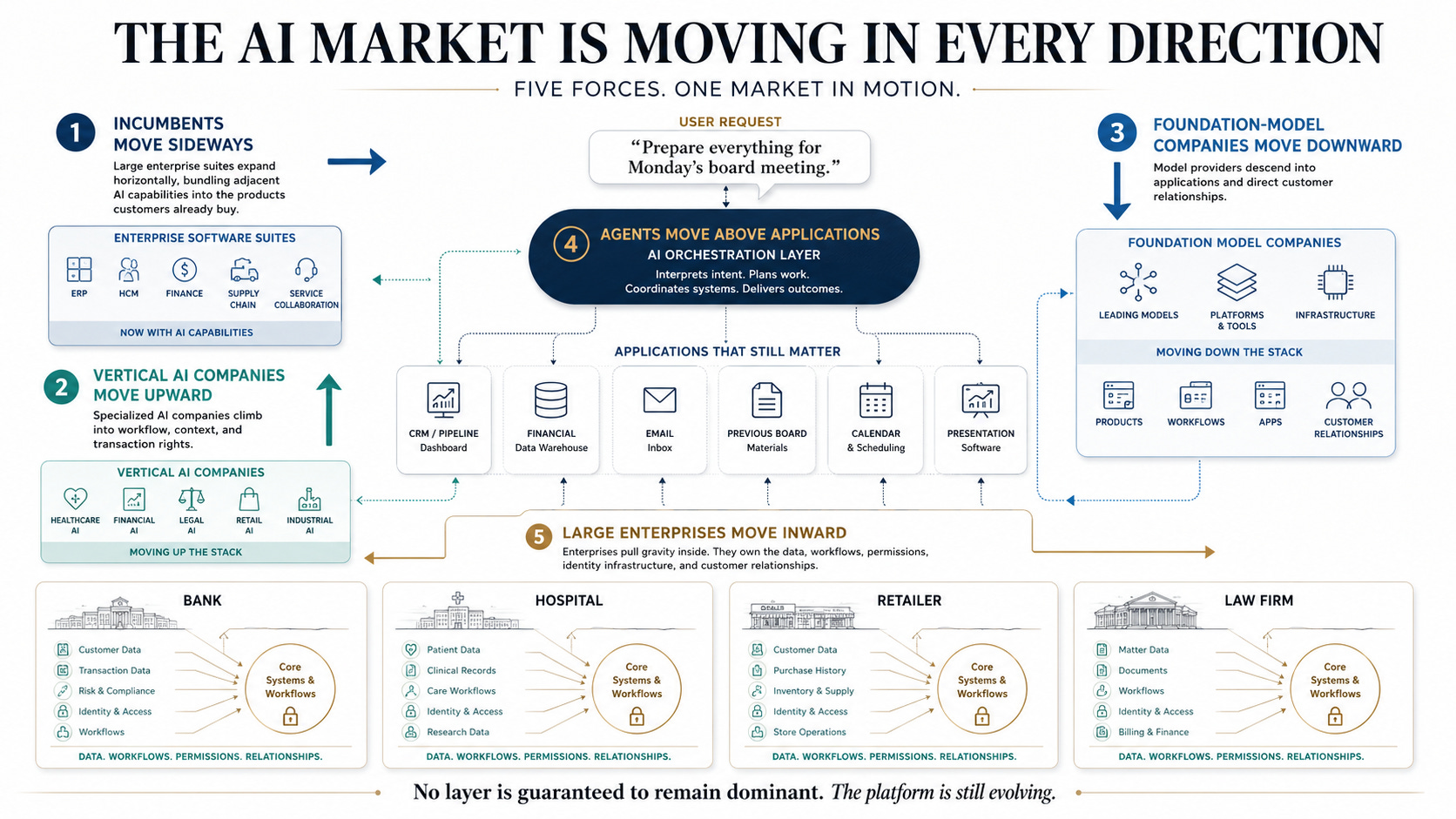
The AI market isn’t settling into a tidy software stack. Everyone is on the move. Incumbents move sideways, bundling adjacent capabilities into suites customers already buy. Vertical AI companies move upward, seeking to capture more workflow, context, and transaction rights. Foundation-model companies move downward, building applications and direct customer relationships. Agents attempt to rise above applications, owning the interpretation of user intent. Large enterprises move inward.
The last movement is easy to underestimate. A bank, hospital, retailer, or law firm may already possess the data, workflow, permissions, identity infrastructure, and customer relationship that an outside AI vendor seeks to amass.
If models become inexpensive enough, some large organizations might conclude that the natural place for institutional gravity is within the institution itself.
Imagine an agent tasked with preparing everything for Monday’s board meeting. It could retrieve pipeline numbers from Salesforce, financial data from a warehouse, relevant emails from Outlook, previous board materials, calendar information, and presentation assets. Salesforce, Outlook, PowerPoint, and the warehouse still matter, but the user’s connection may shift to the layer that comprehended the request and coordinated the work.
No layer is guaranteed to remain dominant; the platform is still evolving.
Does the Same Gravity Form Everywhere?
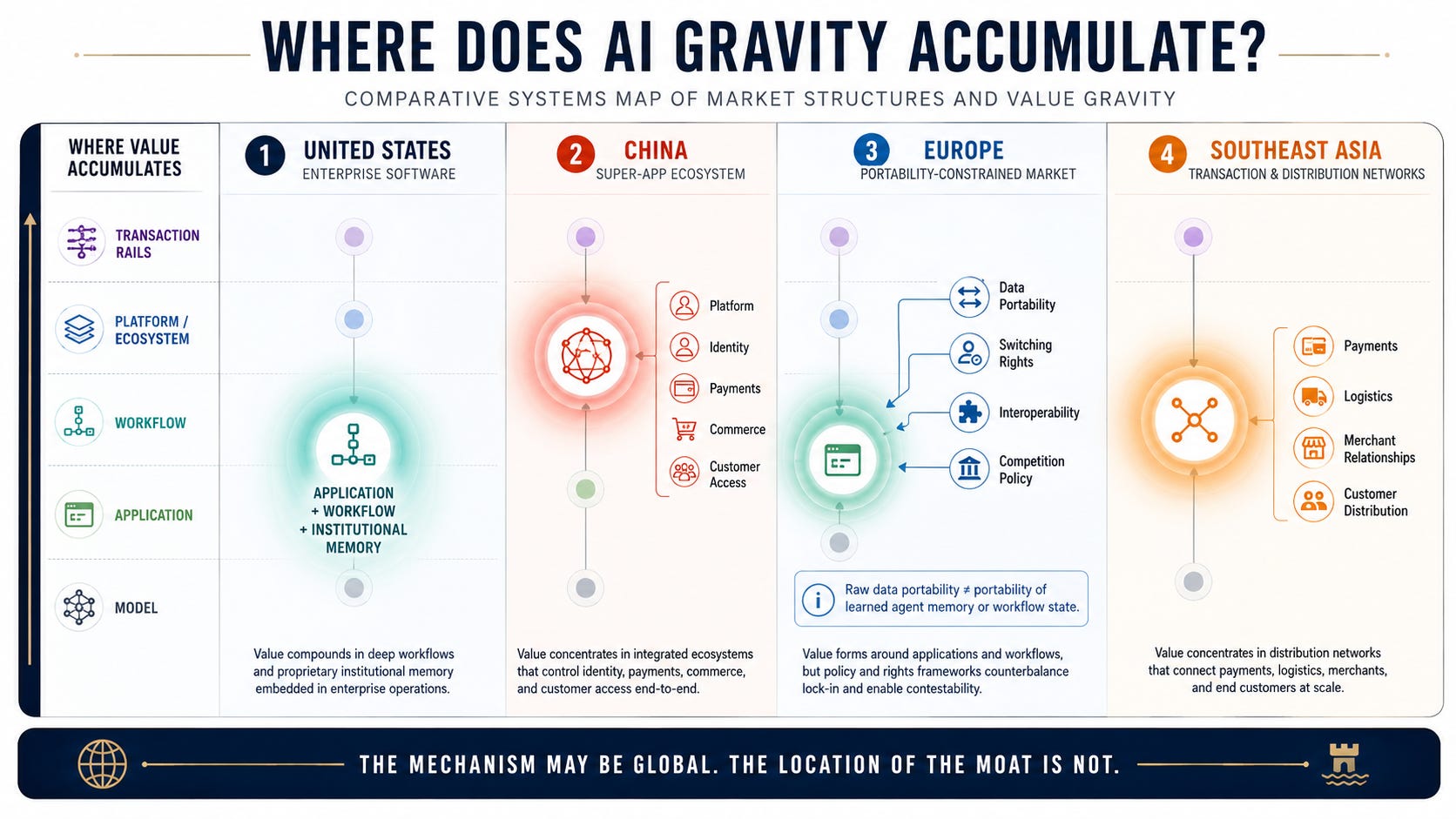
There’s another layer of complexity. Most of this argument is most evident in American enterprise software. That doesn’t mean the same gravity forms identically everywhere else.
China offers one scenario. Tencent’s Weixin ecosystem blends messaging, payments, Mini Programs, commerce, search, content, and merchant relationships. At the end of the first quarter of 2026, Tencent reported over 1.4 billion combined monthly active users across Weixin and WeChat, while Weixin Mini Programs facilitated RMB 8 trillion in gross merchandise value in 2024.
In such an ecosystem, an AI capability may not need to establish every relationship from scratch. The surrounding platform already provides much of the context, distribution, transaction infrastructure, and customer access. The scarce asset may be ecosystem access.
Europe poses a different question. The EU Data Act imposes switching and interoperability obligations on data-processing services, explicitly designed to ease provider transitions. But data portability doesn’t automatically mean portability of learned organizational state. Moving files, records, and applications is one thing; moving agent memory, learned preferences, historical behavior, and workflow context is another.
This distinction matters. Regulation can weaken certain gravity forms without eliminating others.
Southeast Asia offers another model. Grab operates mobility, deliveries, and digital financial services across more than 900 cities in eight Southeast Asian countries. One application can touch transportation, food, packages, payments, lending, insurance, merchants, and banking relationships.
In markets organized around systems like Grab’s, durable advantage may accumulate less in a traditional enterprise system of record and more around the rails connecting customers, merchants, payments, logistics, and transactions.
The mechanism doesn’t vanish; its location changes. Sometimes gravity resides inside the application, sometimes within the workflow, sometimes the platform owns it, and sometimes regulation ensures it remains movable. The question isn’t merely whether institutional gravity exists; it’s where it is permitted to solidify.
The mesmerizing AI demo is easy to showcase. A model writes a contract, builds a spreadsheet, generates a video, and produces a presentation. Visible, immediate, impressive. But the less glamorous elements are harder to display.
Ten years of customer history, thirty integrations, a permission architecture, a security review, identity controls, compliance requirements, audit trails, a record of past events, the authority to execute a transaction without disturbing the legal department—these are mundane until they become why a company can’t be easily replaced.
This is why companies building enduring positions may spend less time highlighting model intelligence and more on workflow configuration, data governance, identity, security, compliance, integrations, permissions, and transaction execution. They start by saying, “Look what the AI can do.” If they succeed, they end up discussing the conditions that allow the AI to matter.
It’s a less glamorous business; it might also be the more valuable one.
What Survives
For those building an AI company, the pertinent questions aren’t especially complex. What becomes harder to replicate each month you exist? What grows more valuable with each customer interaction? What history accumulates? What workflow embeds? What authority is the customer willing to delegate? If the underlying model became free tomorrow, what would still require this company?
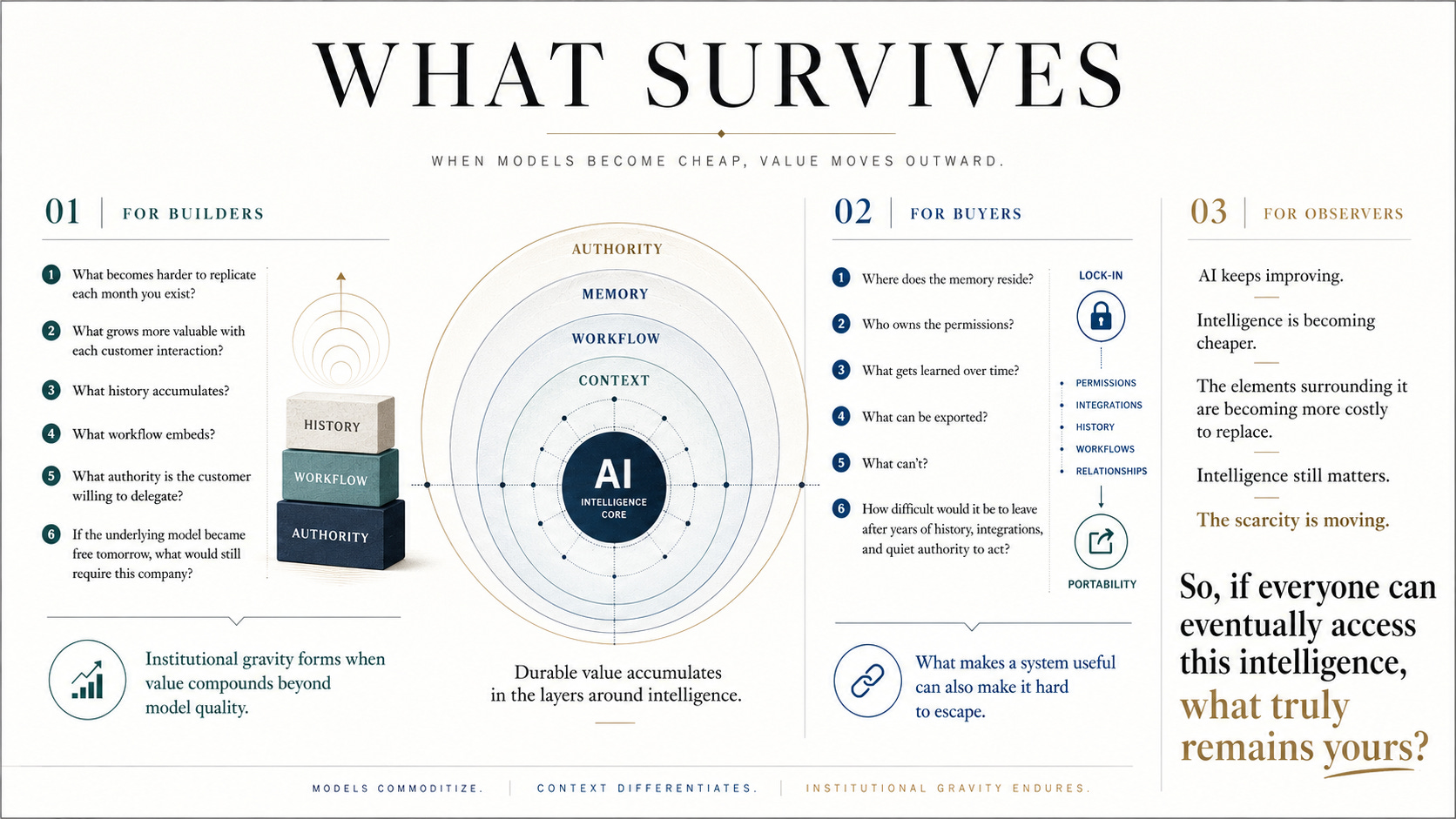
A business that can answer these questions beyond model quality and prompt engineering might be accumulating institutional gravity. A business that can’t might still rely on a capability someone else can bundle.
For those purchasing these systems, the questions reverse. Where does the memory reside? Who owns the permissions? What gets learned over time? What can be exported? What can’t? How difficult would it be to leave after five years of history, numerous integrations, and quiet authority to act?
The forces that make a vendor useful can also make it hard to escape. This isn’t an argument against adopting the technology; it’s a call to scrutinize what accumulates during its use, who owns that accumulation, and whether it can leave when you do.
And for those observing the market, note not just that AI keeps improving, but that the scarcity’s location is shifting. Intelligence is becoming cheaper; the elements surrounding it are growing more costly to replace. Intelligence still matters; the scarcity is moving.
So, if everyone can eventually access this intelligence, what truly remains yours?
Comments
Nothing yet. Say the first thing.
Sign in to join the conversation.