
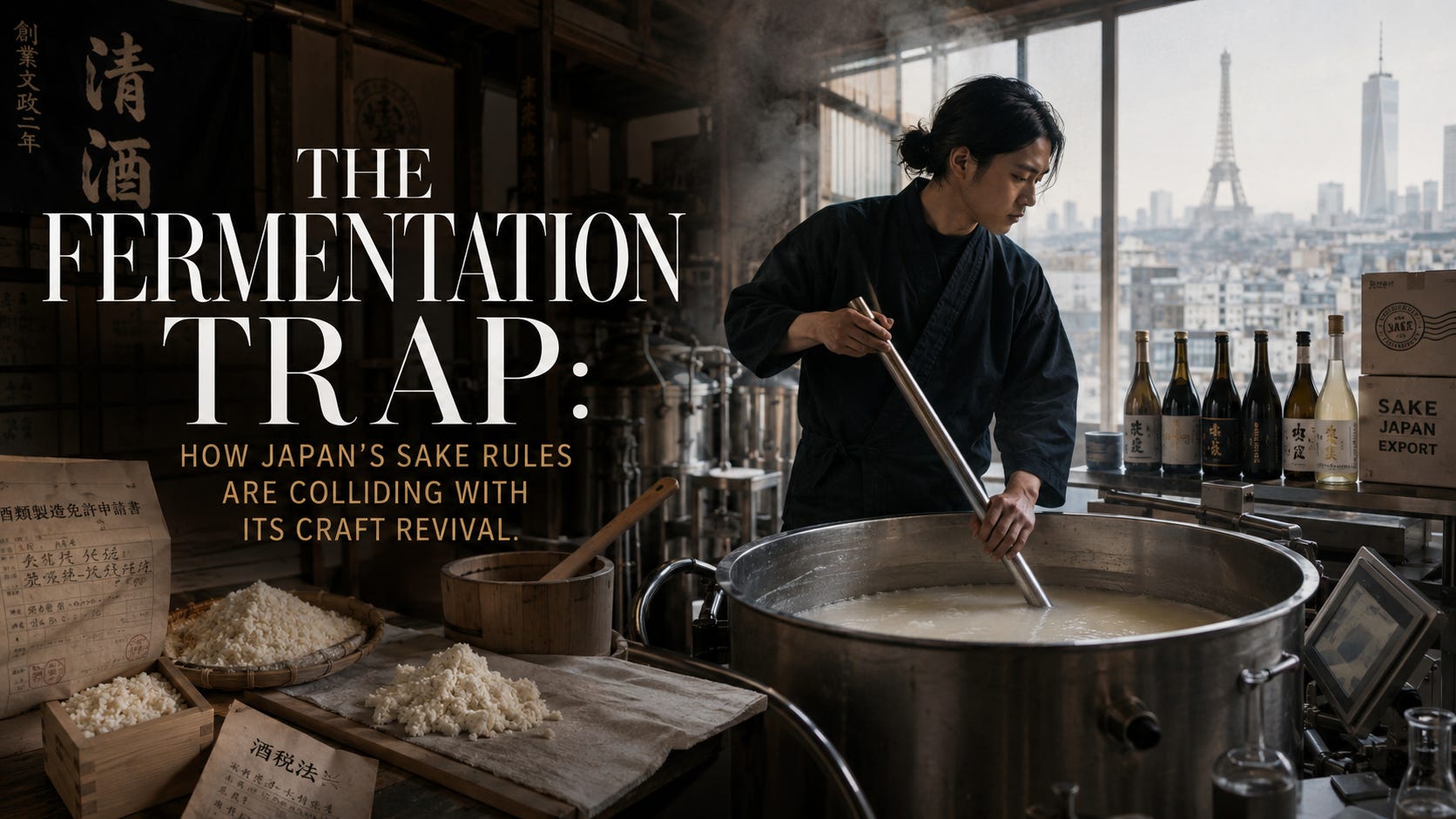
If you were to walk into a quiet brewing space in the Sangenjaya neighborhood of Setagaya, Tokyo, back in 2018, you would have found an entrepreneur named Takuma Inagawa hovering over a tank of fermenting rice, water, and koji mold. His startup, WAKAZE, was setting out to make something fresh and aromatic that could sit comfortably alongside modern food. And if you poured a glass of that cloudy, pale liquid at a dinner party in London, New York, or Paris, almost everyone in the room would taste it and casually call it sake.
Under Japanese law, though, it was nothing of the sort.
To the tax collectors at the National Tax Agency, the liquid inside those vats was officially classified as something called Other Brewed Alcoholic Beverages. If Inagawa and his team had taken that exact fermented batch, pressed it through cloth or mesh to separate the liquid from the solids, and then printed the word seishu on the label, they would have crossed a strict statutory boundary. And under Japan’s Liquor Tax Act, brewing commercial alcohol without the proper manufacturing license carries penalties of up to ten years in prison or a fine of up to one million yen.
In everyday English, we use the word sake as a loose umbrella term for almost any Japanese rice ferment. But Japanese tax administration is far narrower and far more exacting. Seishu is a strictly defined legal classification governed by approved ingredients, specific methods, and distinct license categories. And one decisive statutory rule is the requirement of straining (koshi), which tax authorities define as separating the liquid portion of the fermented mash from the remaining lees.
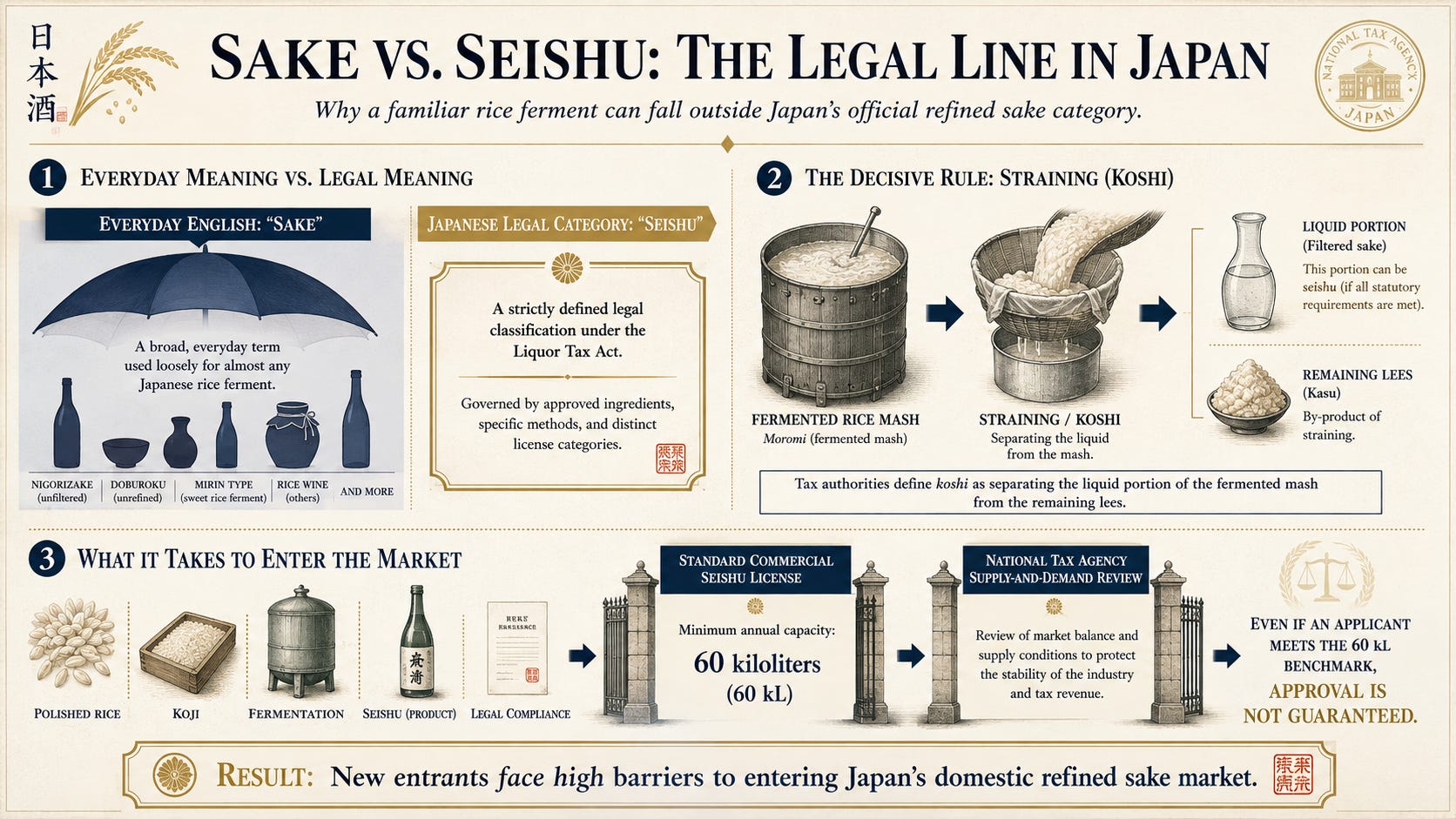
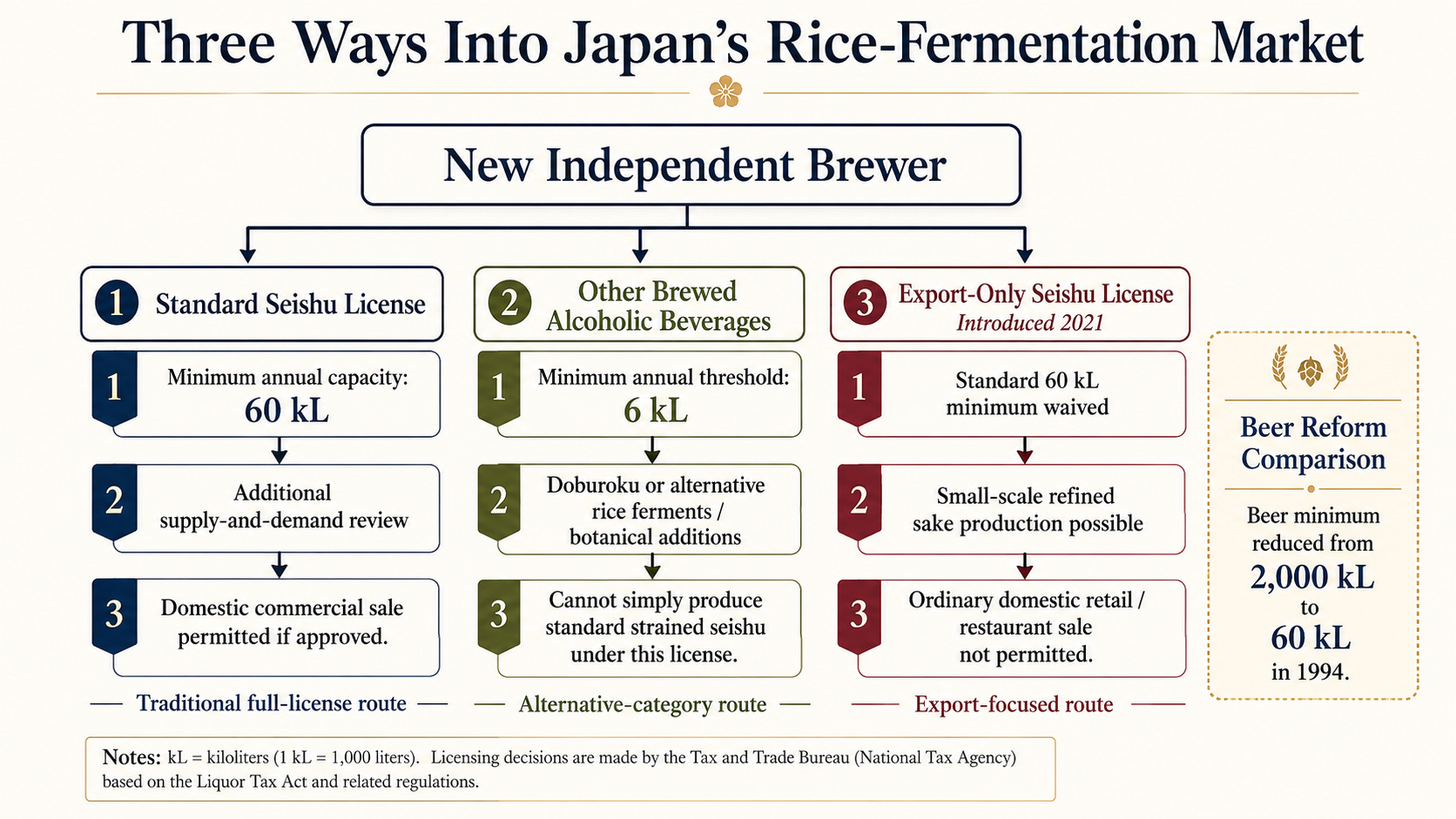
To qualify for a standard commercial seishu license, an applicant must prove the capacity to brew at least sixty kiloliters every single year. But even meeting that volume benchmark doesn’t guarantee a permit, because the National Tax Agency applies an administrative supply and demand test to preserve market stability, which makes it very hard for new entrants to enter the domestic refined sake brewing market.
The numbers reveal an extraordinary institutional divide:
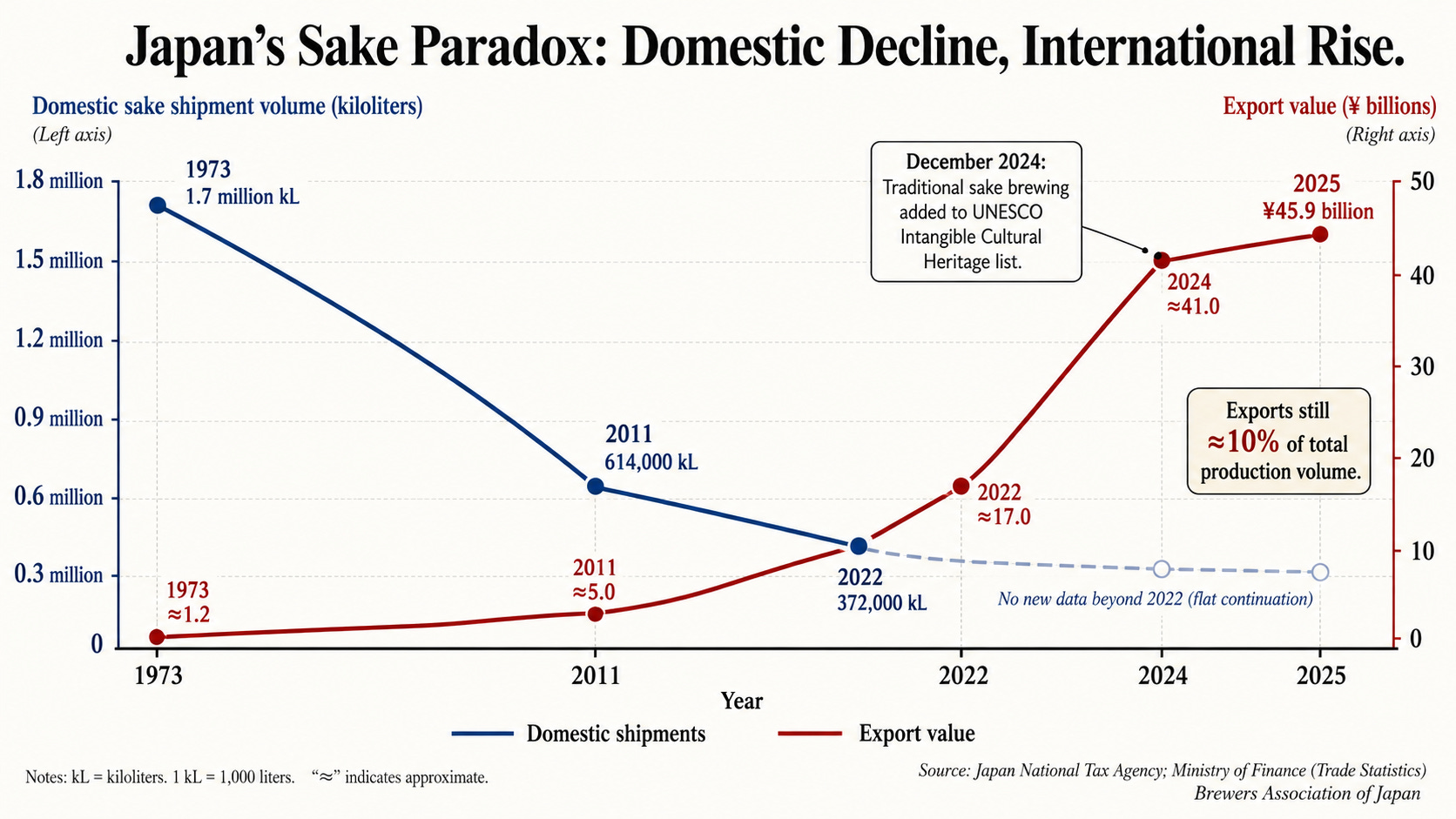
Domestic Consumption Contraction: Domestic sake taxable shipments fell from 614,000 kiloliters in 2011 to 372,000 kiloliters in 2022, dropping roughly 39.4% over the decade and nearly 70% from the historical peak of 1.7 million kiloliters in 1973.
Consolidation of Active Breweries: Over the last several decades, hundreds of regional breweries have closed, leaving roughly 1,100 licensed production premises and fewer than 1,000 active commercial tax filers in Japan today.
Record International Growth: Export value reached a record ¥45.9 billion across more than 80 destination markets in 2025, driven by an upward run bolstered by UNESCO adding traditional sake brewing to its Intangible Cultural Heritage list in late 2024.
The Scale Disparity: International shipments represent roughly 10% of total production volume, and that means foreign sales can’t offset the structural loss of demand at home.
Japan built its modern licensing system to prevent too much sake from being produced, but its contemporary crisis is that too few people want to drink what is already made. Systems designed to preserve a cultural tradition often end up preserving incumbent commercial structures instead, and so they protect the existing market rather than the conditions that allow the craft to regenerate. By regulating production volume rather than stimulating domestic demand, the state preserves inherited assets while limiting the conditions required for category renewal.
The modern licensing regime inherited its structure from a nineteenth-century revenue system.
After the Meiji Restoration, the central government used alcohol taxation as foundational fiscal infrastructure. By the late 1800s, sake levies made up the single largest source of national tax revenue, accounting for roughly 30% of total state receipts during peak collection years in the late Meiji period. And in 1899, the government outlawed household brewing so that tax collectors could systematically inspect, measure, and levy duties on all domestic alcohol production.
During the post-war decades, industrial consolidation accelerated, and tax administrators formalized production quotas and minimum annual thresholds to curb predatory discounting and protect regional producers. Rural breweries were vital local employers, steady buyers of regional rice harvests, and dependable taxpayers.
Traditional Japanese sake brewing and history
From the perspective of the National Tax Agency and regional brewing associations, the volume threshold and the supply and demand test continue to serve an explicit public purpose. In a contracting market, defenders of the current regime argue that unrestricted micro-licensing would trigger destructive price competition, compromise sanitary standards, dilute the reputation of Japanese sake, and destabilize multi-generational purchasing agreements with regional rice farmers.
When a consumer market shrinks for decades, however, rules built to manage supply become barriers to renewal.
The craft beer sector followed a very different path. In 1994, when Japan lowered its annual minimum beer production threshold from 2,000 kiloliters to 60 kiloliters, the reform helped enable a domestic microbrewing boom, creating hundreds of independent breweries, new flavor profiles, distinct packaging, and fresh retail demand. In sake, by contrast, an entrepreneur who wants to brew rice ferments on a modest scale must find alternative statutory routes.
That route is the license for Other Brewed Alcoholic Beverages, which carries an accessible threshold of 6 kiloliters per year. Under this permit, a brewer can produce doburoku, the thick, unstrained rice ferment, or formulate hybrid drinks by adding non-traditional botanicals or fruits that place the beverage outside the statutory definition of seishu.
If that brewer filters the fermented liquid clear to make standard refined sake, the batch violates the terms of the 6-kiloliter permit. And so to launch a microbrewery without buying an inherited license, an independent founder must agree to brew outside the legal boundaries of seishu.
When Takuma Inagawa founded WAKAZE in 2016, his goal was to make rice fermentation an everyday beverage on dining tables worldwide. In Tokyo, his team operated a small brewing space in Setagaya under the 6-kiloliter alternative classification. But when seeking to brew clear, refined seishu at scale, Inagawa confronted a rigid commercial binary: he could either purchase an existing licensed entity at great expense or keep domestic production restricted to alternative categories.
Inagawa chose a different path, and in 2019, WAKAZE established Kura Grand Paris in the suburbs of the French capital.
Brewing in France changed the entire commercial and culinary equation. Free from domestic volume quotas and rigid recipe definitions, the team formulated products using Camargue rice, mineral-rich French water, and wine yeast strains, creating acidity and flavor profiles tailored directly to European dining. Their flagship Paris ferment, The Classic, featured bright tartaric acidity derived from wine yeast, and that gave it a profile designed to pair with European gastronomy.
When WAKAZE expanded into sparkling canned formats and distributed across Europe and North America, established beverage companies took notice. In January 2023, Takara Holdings took an equity stake in WAKAZE through a third-party share allotment, stating that the partnership would combine Takara’s global wholesale networks with WAKAZE’s innovative direct-to-consumer product strategy.
Ultimate Japanese Sake Guide: Dassai Brewery
The Japanese government acknowledged this domestic friction in 2021 by introducing an export-only manufacturing license.
The statute waived the standard 60-kiloliter minimum production requirement for new breweries, but it restricted sales entirely to foreign markets. Under this permit, alcohol brewed in Japan can’t be sold through normal domestic retail or restaurant channels.
The reform exposed the tension in existing policy. The government recognized that high-volume requirements were locking out new businesses, yet it offered regulatory relief only for foreign consumers while keeping the domestic market closed to protect incumbents.
Under the export-only licensing rules, a Japanese brewer can secure a permit to make refined sake at a craft scale but can’t legally sell a single bottle to a neighbor down the street.
While startups navigated licensing restrictions, established producers began examining the global transfer of brewing techniques.
Asahi Shuzo, the maker of the premium Dassai brand, didn’t expand abroad to evade domestic licensing limits, because the company was already a licensed domestic producer. Instead, it sought to test whether major international markets could localize the production of high-grade Junmai Daiginjo.
In 2023, Asahi Shuzo opened Dassai Blue in Hyde Park, New York, an $80 million, 55,000-square-foot brewing facility developed with the nearby Culinary Institute of America, designed with an initial planned capacity of roughly 140,000 nine-liter case equivalents. The brand takes its name from the Japanese proverb stating that indigo dye can become bluer than the plant from which it originates.
The venture proved that sake brewing could step beyond Japanese geography while directly insulating American market supply from transpacific freight volatility and cold chain bottlenecks. By pairing local Hudson Valley water with imported Yamada Nishiki rice and training American cellar staff, the facility showed that the underlying knowledge system could be established directly within major consumer markets. And under United States regulations, the beverage is labeled and sold directly as sake, unburdened by Japan’s domestic statutory boundaries.
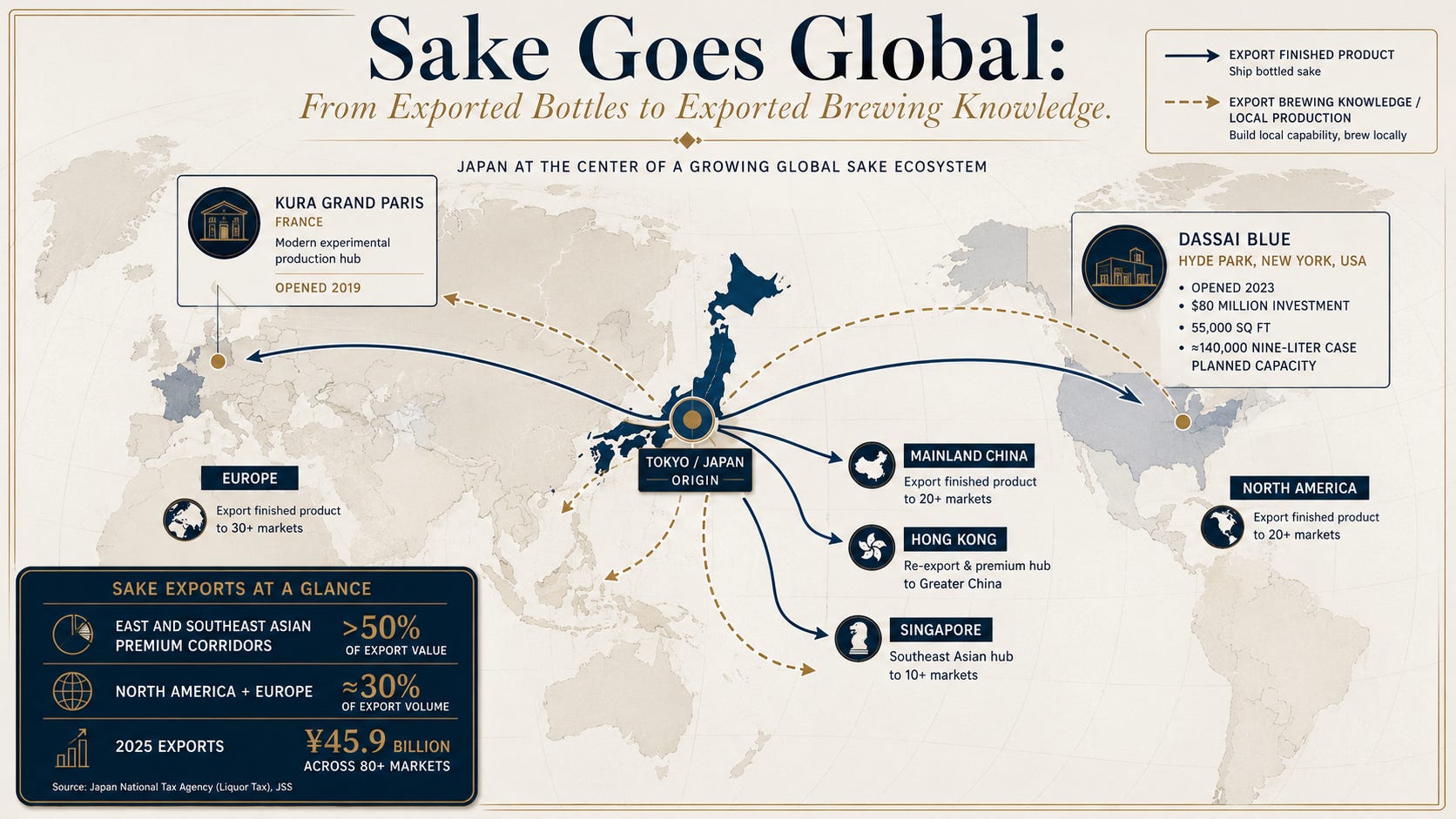
For regional breweries that export exclusively from Japan, international expansion introduces substantial logistical costs that disproportionately impact small producers.
The global export trade has two distinct commercial segments:
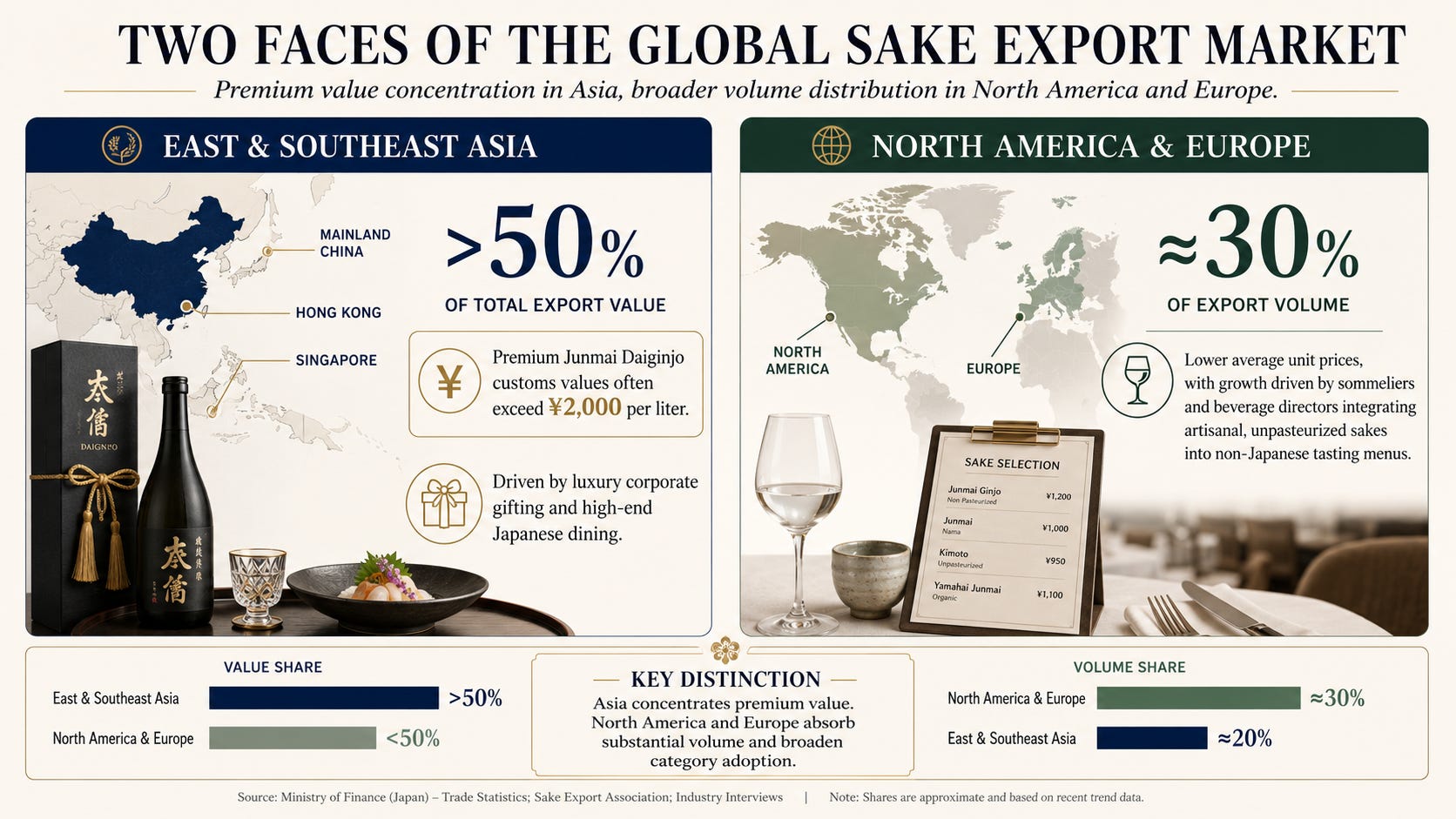
In East and Southeast Asia, markets such as Mainland China (the largest single destination by value), Hong Kong, and Singapore represent high-value corridors that account for over 50% of total export value, and where premium Junmai Daiginjo commands customs values exceeding ¥2,000 per liter, fueled by luxury corporate gifting and high-end Japanese dining.
In North America and Europe, which absorb roughly 30% of export volume at lower average unit prices, growth is driven by sommeliers and beverage directors integrating artisanal, unpasteurized sakes into non-Japanese tasting menus.
Sake is chemically fragile compared to wine. It has substantially lower titratable acidity than dry white wine, lacks natural tannins from grape skins, and is typically produced without added sulfur dioxide.
Research from the National Research Institute of Brewing shows that elevated storage temperatures accelerate the formation of volatile compounds like dimethyl trisulfide and methional, which contribute to hineka, the stale off-aroma of heat-damaged sake.
While pasteurized products can remain stable under cool cellar conditions, delicate unpasteurized styles (namazake) and premium Ginjo designations require temperature-controlled refrigerated containers. On Japan-to-US West Coast shipping routes, temperature-controlled refrigerated containers add a 15% to 25% cost premium over standard dry freight, an expense that can erode export margins for small, independent producers.
Everything You Need to Know About Japanese SAKE in Under 15 Minutes!
Comments
Nothing yet. Say the first thing.
Sign in to join the conversation.