
Who would have thought it. On 7 July I published my Substack article Trump to Zelensky/ “You don’t have the cards…” It was a cautious assessment of the 17 months since President Trump had slapped his big ‘no cards’ put down to Ukrainian President Zelensky. Things have changed.
Despite what appears to have been an aggressive anti-Ukrainian position by Trump since February 2025, Zelensky and Ukraine have demonstrated a strong strategic capacity. This includes but not limited to;
drone bombing of Russia’s most important oil production facilities deep inside Russia. The consensus is building, that in excess of 40 percent of Russia’s capacity has been taken out. Some of the drone attacks are comparative to bombing Townsville in Queensland from bases in Melbourne!
the development of what could be building to a siege of Crimea. If it occurs, this will be a massive political humiliation and a severe military collapse for Putin.
Two days after I published the ‘cards’ assessment, at a NATO meeting, Trump was suddenly all chummy with Zelensky.
Trump:
expressed support for Ukraine’s deep bombing of Russia.
Offered to assist Ukraine to co-produce Patriot missiles with US suppliers. Trump asserted that there’s a big shortage of Patriot missiles. The reality is that these are the only effective defence against Russia’s ballistic missile assaults on Ukrainian cities. Scaling up production of Patriots just for Ukraine is a big boost for Zelensky and a major setback for Putin. Production, though, will take a while.
Whichever way, this is a huge turnaround by Trump and a big winfor Ukraine.
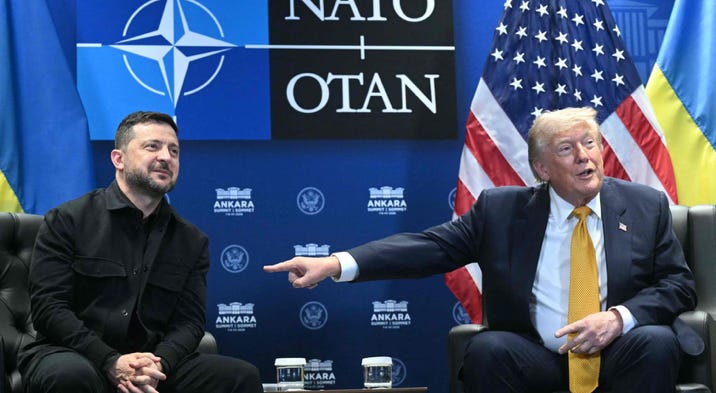
What Trump’s repositioning does suggest is that as the dealmaker, Trump aways wants to be seen on the winning side. Does Trump’s move suggest that the US military assessment now is that Ukraine has the upper hand in the war?
Certainly, the recent April (2026) election outcome in Hungary was important for Ukraine. Longtime Hungarian President Orban was anti-Ukraine and had been blocking a 90 billion euro support package for Ukraine. Trump had sent Vice President Vance to campaign for Orban but Orban suffered a humiliating electoral defeat. The new Hungarian PM has now supported the EU funding for Ukraine delivering the final EU vote that delivers the money to Ukraine.
All seems to be moving to favour Ukraine’s war efforts.
This now raises the serious question of Putin’s future. It would be totally premature to suggest that Putin is about to fall from power. He’s far too security entrenched to be subject to a political coup. Russia’s long history and that of Putin is that political opponents have a habit of falling out of high windows.
Putin’s situation needs to be considered though. To this purpose I’m thankful to one of my Substack subscribers, ‘Nebury’ for putting together a good analysis of the facts with references. He’s given approval for me to publish this. It is all his research and a good read.
Reading this analysis reminds me of the alleged quote by ex-Russian communist dictator Lenin “There are decades where nothing happens and there are weeks where decades happen.” Who knows what is to happen!
Putin’s Position- An assessment
Apparently, there is no immediate threat of collapse, but how long can Putin last! The betting markets remain to start offering odds.
Vladimir Putin faces severe domestic dangers rooted in an overheated war economy, escalating infrastructure vulnerabilities, and cracks in internal security and elite patronage. Four years into the invasion, these compounded issues have forced rare public acknowledgments of “difficulties” from the Kremlin.[1, 2, 3, 4, 5]
Economic Strain and Public Friction
Skyrocketing Inflation: Military spending consumes roughly 7% of GDP, forcing massive cuts to the civilian sector, causing grocery prices to spike, and sending interest rates surging. [1, 2, 3]
Crushing Tax Hikes: To balance the budget, the Kremlin increased the VAT from 20% to 22% in early 2026, alongside steep tax increases on small and medium-sized businesses. [1]
Severe Labor Shortages: With millions employed by the military-industrial complex and hundreds of thousands deployed or fleeing, civilian businesses face critical labor deficits. [1, 2]
The “War Trap” Dilemma: The economy is so structurally dependent on war production that halting the conflict would trigger mass unemployment for arms workers and returning soldiers, creating a dangerous social time bomb. [1, 2, 3]
Domestic Disruption and Infrastructure Collapse
Widespread Fuel Shortages: Ruthless Ukrainian drone strikes on oil refineries and depots inside major cities have triggered fuel rationing, record pump prices, and long lines at petrol stations. [1, 2, 3]
Vulnerable Urban Centers: Once insulated citizens in Moscow and St. Petersburg now face direct long-range missile and drone attacks, shattering the illusion of domestic safety. [1, 2, 3]
Digital and Social Blackouts: Extreme internet restrictions and deliberate blackouts—deployed to disrupt drone guidance systems—have stoked widespread public anger and frustration. [1, 2]
Isolation of Crimea: Constant strikes on energy grids and the Kerch Bridge have forced states of emergency, blackouts, and the collapse of the region’s crucial tourism industry. [1, 2]
Elite Fragmentation and Security Gaps
The Patronage Squeeze: Sanctions have stripped Russian oligarchs of Western wealth, forcing them to compete aggressively for a shrinking pool of state defense contracts to maintain their fortunes.
Border and Defense Failures: Incursions along the border (like Kursk) exposed deep-seated corruption in border defense, forcing Putin to fire high-level officials and straining ties with the powerful oligarchs who protected them.
Blindspots in Domestic Security: Total focus on the war effort and blaming the West has left security agencies like the FSB reactive, creating domestic security gaps vulnerable to internal threats and regional instability. [1, 2]
While these pressures have pushed Putin’s approval ratings to their lowest levels since 2022, his extensive 25-year consolidation of power and suppression of political opposition continue to shield his regime from immediate collapse.
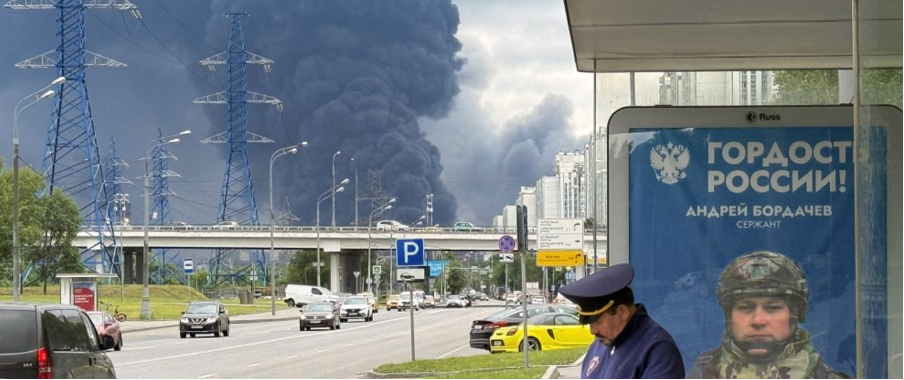
(Image from Moscow Oil Refinery - June 2026)

No posts
Comments
Nothing yet. Say the first thing.
Sign in to join the conversation.