
Last week I shared this note:
“Most commercial patterns are drafted for a B cup in pattern making terms. That means the pattern assumes your upper bust and full bust are only 2 inches apart.”
Mya B replied with a great question:
“Wait, the bust arc and back arc aren’t supposed to add up to the bust measurement? That’s how I got my measurements. I also have the book!”
Her comment made me realize my note had created some confusion. So I went back to Maria’s Bodice Block Essentials series to find the right answer.
Here’s what I found.
First, I want to clear something up.
The bust arc and back arc not adding up to the bust measurement is not a general pattern making rule. It’s specific to how Armstrong’s system measures those arcs.
I didn’t make that clear enough in my note and I want to correct that.
What Maria discovered in Armstrong’s system
When Maria was studying Helen Joseph Armstrong’s Patternmaking for Fashion Design, she drafted the block and kept getting more ease than she expected.
She redrafted it. Then again. Then again.
She thought she was making a mistake. She even bought a newer edition of the textbook — she said she really didn’t want to spend $100 just to check — but she needed to know.
The newer edition had the same result.
Eventually she found something buried in the measurement instructions section that she had completely overlooked.
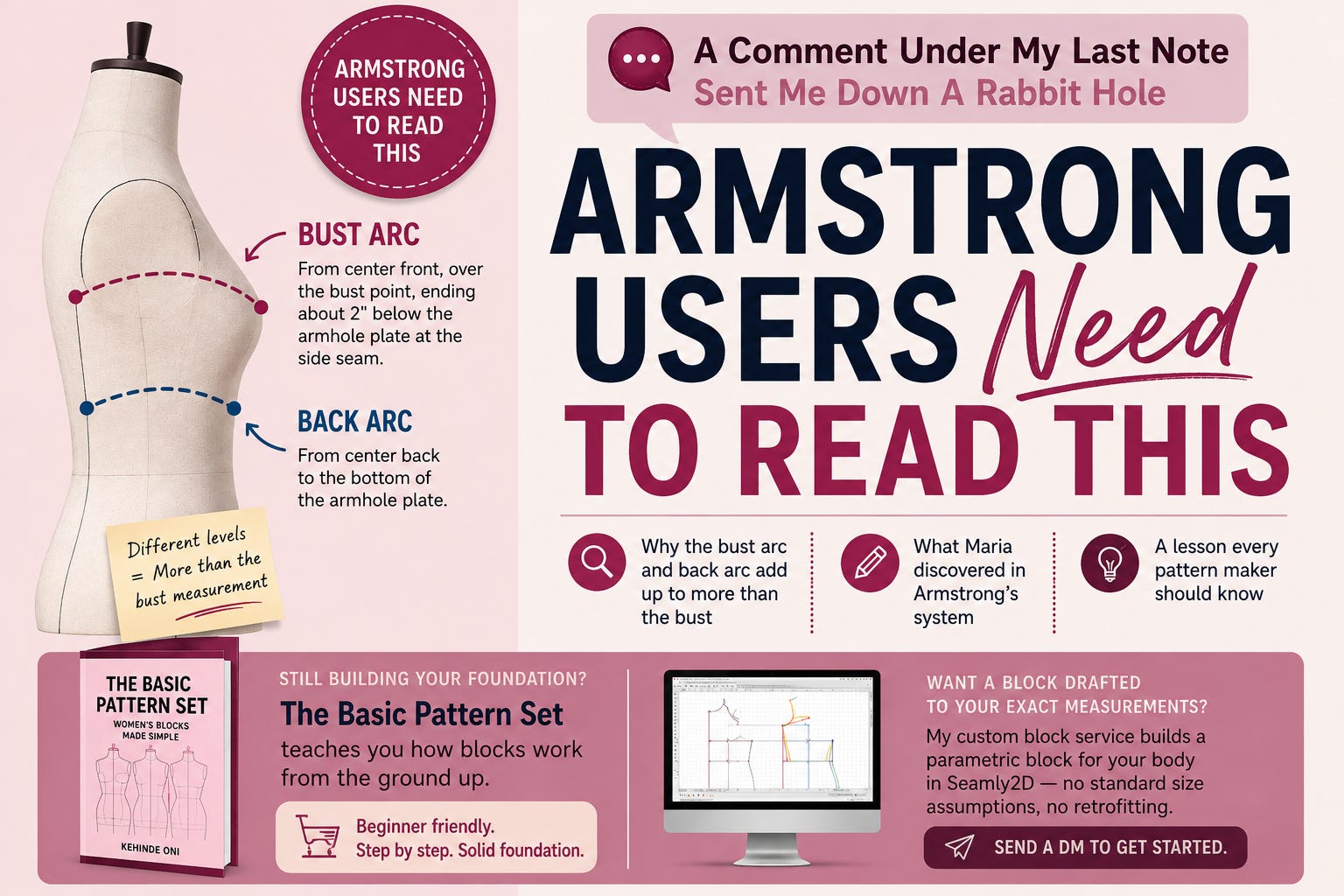
The Bust Arc and Back Arc in Armstrong’s system are measured at different levels on the body:
The Bust Arc is measured from center front, over the bust point, ending about 2 inches below the armhole plate at the side seam
The Back Arc is measured from center back to the bottom of the armhole plate
Because they’re measured at different levels, they naturally add up to more than the bust measurement.
This wasn’t a mistake in the textbook. It was a measuring convention specific to Armstrong’s system — just not clearly explained upfront.
If you have Armstrong’s book and you’re taking your own body measurements straight around at bust level — the way most people would naturally take them — you’d end up with less ease than the system intended.
Not because you did anything wrong. But because the measuring convention in that system is different to what you’d expect.
Maria wondered the same thing, whether home sewers using the book realized that the arcs aren’t supposed to add up to the bust measurement and that the block actually starts out wider than the bust measurement before ease is even added.
This is something I’m learning as I go deeper into different drafting systems.
Measurement conventions vary between systems. What seems like an error can sometimes be a convention that’s buried in the instructions and easy to miss.
It’s worth understanding exactly how your system measures before you start drafting — not just what measurements to take, but how to take them.
I’m sharing what I learned from Maria’s Bodice Block Essentials series — specifically Part 2 which covers ease and goes into this in detail.
I haven’t tested this myself yet so I don’t want to overstate what I know. Maria explains it much more clearly and thoroughly than I can.
Her channel is at DressPatternMaking.com and the Bodice Block Essentials playlist is free on YouTube. I’d recommend watching it alongside your Armstrong book.
Still building your foundation?
Before diving into the nuances of different drafting systems, you need to understand how blocks work from the ground up.
The Basic Pattern Set teaches you exactly that, step by step, beginner friendly.
Get it here:
📖 Amazon: https://www.amazon.com/Mastering-basic-pattern-set-Kehinde-ebook/dp/B08LXVPV37
📖 PDF (supports my work directly): https://kehindeoni.gumroad.com/l/basicpatternset
Want a block drafted to your exact measurements?
My custom block service builds a parametric block for your body in Seamly2D, no standard size assumptions, no retrofitting.
Send a DM (direct message) to get started.
Comments
Nothing yet. Say the first thing.
Sign in to join the conversation.