
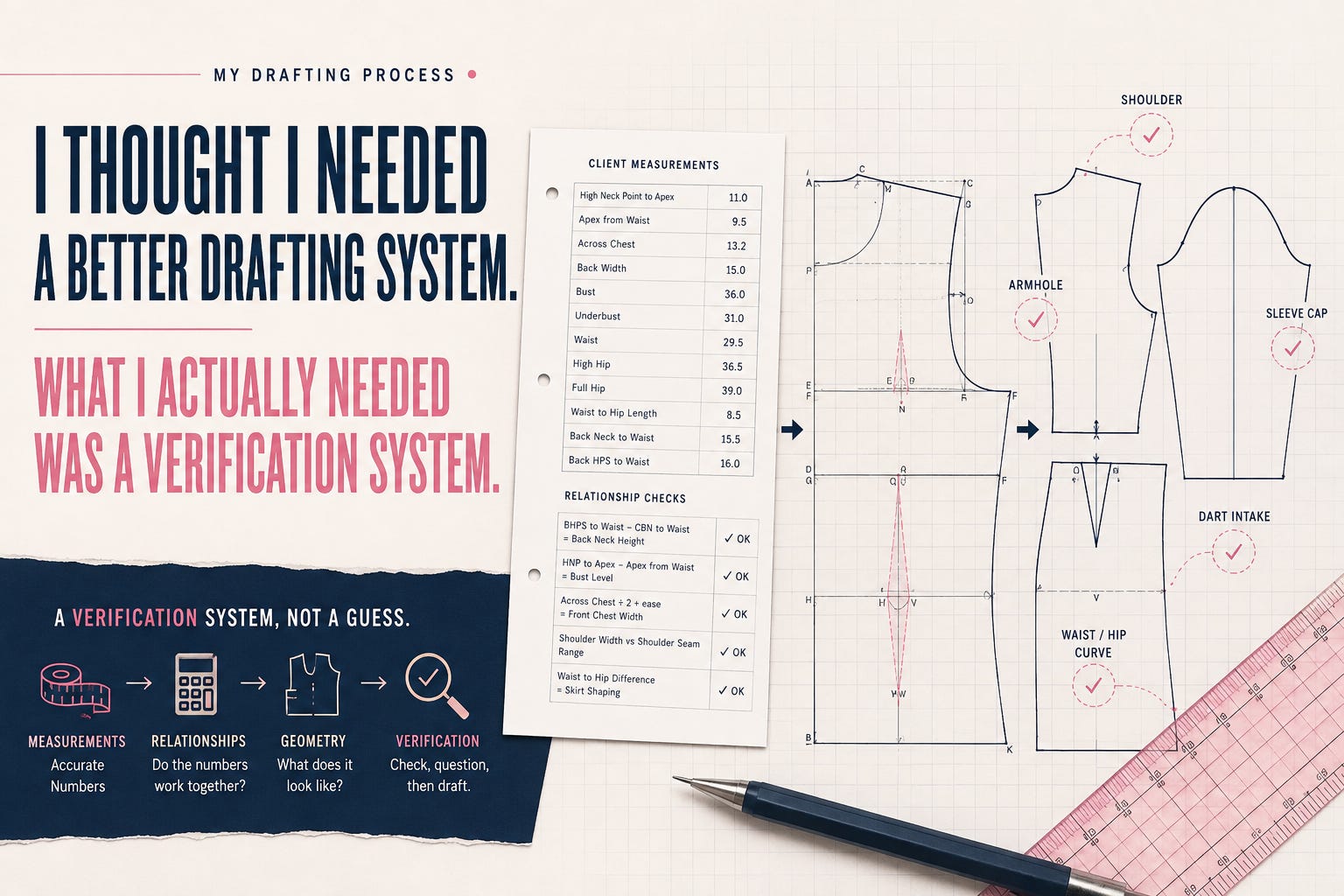
When I started beta testing my custom parametric blocks service, I thought checking measurements meant looking through a client’s measurement sheet and asking one question:
Does anything here look wrong?
A number that’s unusually large. A measurement that’s unusually small. Something obviously missing.
If everything looked reasonable, I could start drafting.
I don’t work that way anymore.
Over the past several months, measurement checking has quietly turned into something much bigger.
I now check the measurements.
Then I check the measurements against each other.
Then I check the story they’re collectively telling me about the body.
And now, before I commit to the final draft, I’m beginning to do something else:
I let the measurements draw a block and see what happens.
And this week, I realised there was still another layer I needed to add.
This was probably the first big shift in how I approached measurement review.
Imagine someone gives me a back neck-to-waist measurement of 15 inches.
Is 15 inches reasonable?
Possibly.
That question doesn’t tell me very much.
What happens when I compare it with her back high-shoulder-point-to-waist measurement?
Now I have information.
In the bodice system I’m currently working with, I can compare those two measurements to understand the vertical relationship between the shoulder, back neckline and waist.
The same thing happens with the bust.
One of the measurements I pay particularly close attention to is the apex from waist.
That measurement helps establish the bust level, and in the Chris Sartorial system I’ve been studying, that bust level influences the armhole.
So I don’t just look at the apex-from-waist measurement and ask whether it sounds reasonable.
I compare it with other vertical measurements.
If the numbers don’t agree with one another, I stop.
This has become one of the most important things beta testing has taught me:
Plausible individually doesn’t mean correct collectively.
There’s a subtle difference.
Reviewing measurements asks:
Does this number look reasonable?
Reading measurements asks:
If all of these numbers belong to the same body, what should that body look like?
A wide shoulder measurement should make sense alongside the shoulder seam.
The waist and hip measurements should make sense alongside the amount of shaping the skirt needs.
The front length, bust position and apex measurement should tell a compatible story.
The hip level should make sense for that person’s proportions rather than automatically being forced into whatever a drafting book calls “standard.”
Sometimes a measurement that initially looks unusual turns out to be completely correct.
I’ve worked with bodies that simply don’t follow the proportions drafting systems expect.
That’s why I’ve become increasingly reluctant to “correct” a number simply because it falls outside an average.
First I investigate.
This part of my process has changed too.
I could require every client to send photographs with their measurements.
I don’t.
I prefer to start with the numbers.
If something doesn’t add up, I ask for the measurement again. If I’m still hitting a wall and I need to understand how the tape or waist elastic is sitting on the body, then I may ask for a photograph.
At that point, the client knows why I’m asking.
I’m not asking for photographs because that’s simply what everyone has to do. I’m asking because I’ve found a specific question that the numbers alone aren’t answering.
And photographs have solved some very strange measurement mysteries.
But recently I’ve added another tool to the process.
This is one of the things I love about working parametrically in Seamly2D.
A parametric pattern isn’t a collection of fixed lines.
The measurements feed the construction.
Change a measurement and the geometry responds.
So I’ve started using that responsiveness as another form of verification.
Before committing to a client’s final draft, I can apply her measurements to a known working parametric construction and look at what happens.
I’m not doing this because that temporary block will become her finished block.
I’m asking the draft a question:
What do these measurements look like when they become geometry?
Suddenly, something that wasn’t obvious in a spreadsheet can become very obvious on screen.
An armhole can become unusually deep.
A shoulder can look disproportionate.
A side seam can curve far more dramatically than the waist and hip measurements seem to justify.
A back bodice can lose the taper you would expect to see in a human torso.
The draft becomes another piece of evidence.
And when the resulting block looks completely ordinary?
That’s useful information too.
It doesn’t prove that the finished block will fit perfectly. A toile still has the final word.
But the measurements have passed another sanity check.
This is probably my favourite part of this story because measurement verification can easily sound as though I’m checking whether clients have made mistakes.
That’s not what this is about.
The system has to check me too.
While looking at one of my previously drafted skirts recently, something kept bothering me.
The side seam was too curved.
Not technically impossible. Nothing was exploding on the screen.
It just didn’t look right for that client’s measurements.
Her waist-to-hip difference didn’t justify that much shaping.
I kept looking at it.
Then I found the problem.
A side-seam suppression value was still set at 1 inch.
It was a drafting input that needed to be adjusted for that particular client’s measurements, and I had missed it.
Seamly2D had done exactly what I told it to do.
The strange curve wasn’t a measurement problem.
It was mine.
That experience changed the way I’m thinking about verification again.
The chain isn’t simply:
Body → measurements → pattern
It’s more like:
Body → measurements → measurement relationships → formulas and drafting inputs → geometry → pattern
An error can enter anywhere along that chain.
A good verification system has to be capable of catching it wherever it happens.
That 1-inch discovery sent me down another rabbit hole.
If I have to remember to recalculate the same type of value for every client, can I make the pattern calculate more of it for me?
That’s what parametric drafting is supposed to be good at.
Take a skirt.
The client’s waist and hip measurements determine how much suppression is needed between the hip and waist.
That suppression then has to be distributed between darts and side seams.
Some of that requires judgement because bodies aren’t equations and different proportions may need different dart strategies.
But some of it is mathematics.
If a value can reliably be derived from measurements, I’m now asking whether Seamly2D should be calculating it instead of relying on me to remember to change it.
Every manual input is another opportunity for human error.
The goal isn’t to remove the pattern maker from the process.
It’s to automate the things that don’t require the pattern maker so I can pay more attention to the things that do.
This was my newest discovery.
I check the bodice.
Does the armhole look right?
Does the shoulder make sense?
Do the darts make sense for the measurements?
I check the sleeve.
Does the bicep make sense?
Does the sleeve taper naturally toward the wrist?
Does the sleeve cap look reasonable?
Both can pass those checks.
But there’s another question:
Do they work together?
A sleeve doesn’t exist independently of its bodice.
The front sleeve cap has to correspond appropriately with the front armhole.
The back sleeve cap has to correspond appropriately with the back armhole.
And the total sleeve cap and total armhole have to produce the amount of ease the sleeve system was designed to have.
It sounds obvious when I write it.
And yet it was a verification step I wasn’t consistently documenting.
So now it’s being added.
Not just:
Does this block look right?
But:
Does this block agree with the block it has to connect to?
My drafting process has evolved during this beta phase.
My current bodice work is increasingly based around the Chris Sartorial system, while the sleeve construction I’ve been using came from the system I previously used with my torso block.
That doesn’t automatically make the sleeve wrong.
But it does give me a question worth testing.
If I’m using one system to construct the bodice, would the sleeve system designed alongside that bodice give me a better starting relationship?
I don’t know yet.
And rather than assume the answer, I’m going to test it.
I’ll compare my current sleeve method with the Chris Sartorial sleeve method against the same bodice and measurements and see what each one actually produces.
That’s another thing beta testing has changed about me.
I’m becoming much less interested in whether a drafting method sounds right.
I want to see what happens when I use it.
It’s no longer one check.
It’s layers.
First:
Do the individual measurements make sense?
Then:
Do related measurements agree with one another?
Then:
Do all the measurements collectively describe a coherent body?
If something doesn’t add up:
Can remeasurement explain it?
If not:
Would seeing the tape or elastic placement answer the question?
Then:
What happens when those measurements become geometry?
Then:
Are the drafting inputs and formulas doing what I intended?
And finally:
Do the separate blocks agree with the pieces they’re supposed to connect to?
Numbers.
Relationships.
Geometry.
Compatibility.
That’s the verification system I’m building.
And I say building deliberately.
Because I’m clearly not finished.
I’ve been talking a lot about the update to The Basic Pattern Set: the additional drafting methods, the new layout, the diagrams, the measurement instructions.
But beta testing is making me think about something deeper.
Teaching someone how to draw a block isn’t enough.
They also need to know how to look at what they’ve drawn and ask:
Does this make sense?
What should I check before I continue?
Which measurements should agree with each other?
When is an unusual shape evidence of an unusual body, and when is it evidence that something has gone wrong?
How do I know whether the sleeve I’ve just drafted actually belongs in the armhole I’ve just drafted?
Those questions are becoming just as important to me as the construction instructions themselves.
Because following a drafting formula perfectly doesn’t guarantee a good block if the information entering that formula is wrong.
And apparently, neither does having a parametric system.
The computer will very efficiently draw exactly what you tell it to draw.
Even when you accidentally leave the side seam at 1 inch.
Six months ago, I thought becoming better at custom drafting meant learning more drafting methods.
I have learned more methods.
But I think something more important has happened.
I’m getting better at questioning the result.
Not because I expect something to be wrong.
Because verification is what allows me to trust what’s right.
And every time the process catches something, whether it’s a client’s measurement, an assumption built into a drafting method, or one of my own forgotten inputs, the system gets a little better.
That’s what I’m building now.
Not just a way to draft blocks.
A way to know when the blocks I’ve drafted make sense.
The Basic Pattern Set is where I teach the foundations of drafting your own bodice, sleeve and skirt blocks from measurements, step by step.
And everything I’m learning through this verification process is feeding into the updated edition I’m currently building.
If you purchase the current edition now, you’ll receive the updated edition at no additional cost when it’s ready.
Get The Basic Pattern Set here →
If you’d rather have the blocks drafted for your own measurements, I also offer custom parametric blocks in Seamly2D. The process you’ve just read about is part of the care that goes into reviewing and drafting each set.
Send me a DM (direct message) to get started
Comments
Nothing yet. Say the first thing.
Sign in to join the conversation.