
In my last article, Real AI, Not Anti-AI, I argued that AI is real but that most organisations cannot put it into production yet, because they are not standing on level ground. I said the divide that separates who can from who cannot deserved an article of its own. This is that article.
The first thing to understand is that the divide is bigger than AI. AI is simply the sharpest current example of it. The divide is the gap between organisations in their ability to offer advanced IT services at all. Not whether they own computers, everyone does. Whether they can adopt, integrate, and operate advanced capability fast enough to stay competitive.
This is not new. Before AI it was cloud. Before cloud it was the web, then mobile, then before all of that, the mainframe. Every wave widened the gap between the organisations that could ride it and the ones that could not. AI is just the steepest wave yet, and it is moving faster than any before it.
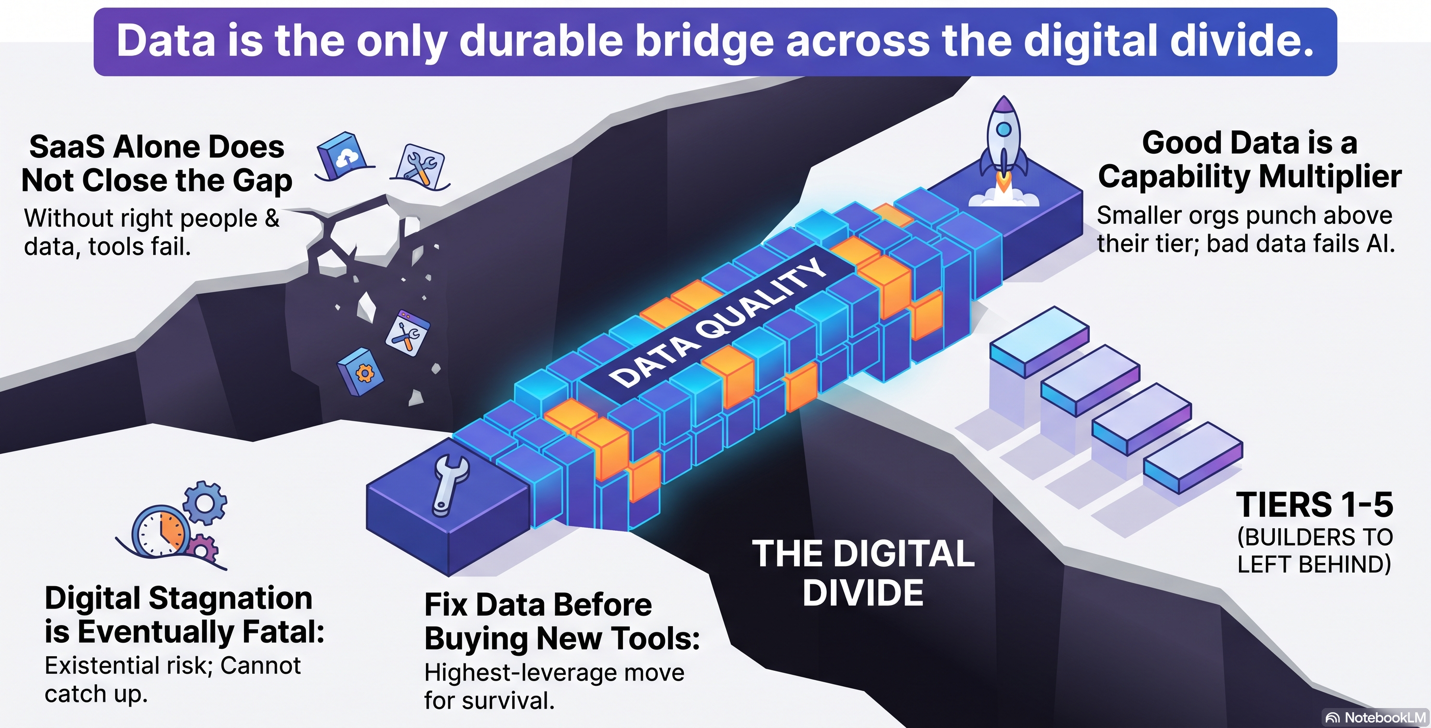
There is a thread running through every one of those waves, though, and it is the argument of this article. The organisations that crossed the divide were rarely the ones with the biggest budgets. They were the ones whose data was in order. Data is the bridge across the divide. Good data carries you over it, and bad data is the reason the bridge never holds. Hold that thought, because everything else here leads back to it.
In the previous article I set out five forces that decide where an organisation sits: budget, allowable risk, talent gravity, purpose and social relevance, and regulation and compliance. Those forces are not just about AI. They govern your ability to offer any advanced IT service. A bank and a local council are not playing the same game, and they never were.
What matters here is the consequence of those forces. They do not sort the world into two neat piles of haves and have-nots. They spread organisations across a spectrum. And it helps to give that spectrum some shape.
When people talk about the digital divide they usually imagine two groups: the organisations with budgets and the ones without. The reality has more texture than that. I find it more useful to think in five tiers. (Five forces, five tiers. The matching number is a coincidence, not a mapping.)
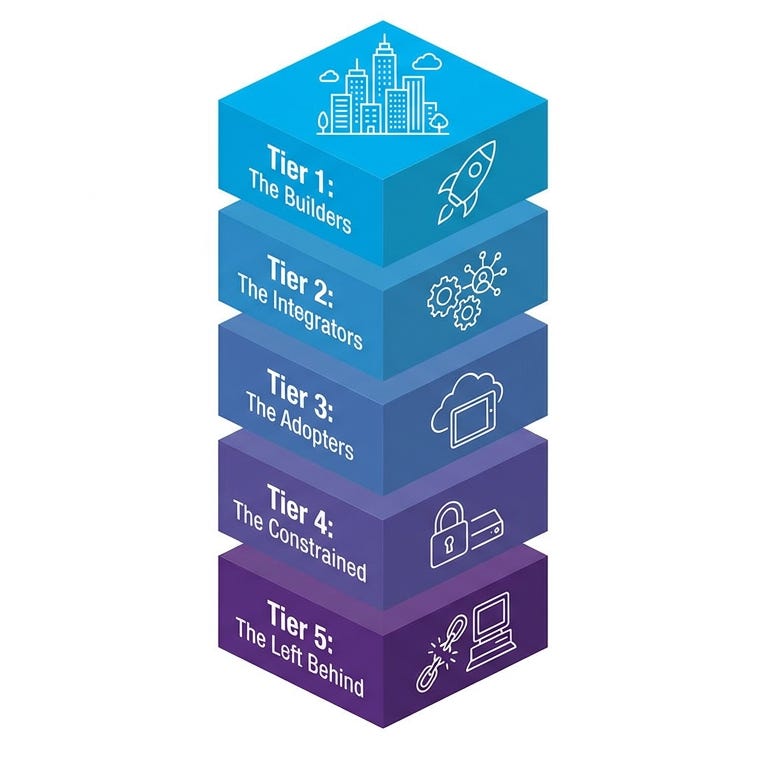
Tier 1, the Builders. Technology is the business. They build the frontier themselves. Hyperscalers, the largest banks, the big technology firms. Vast budgets, the best talent, and when the build-versus-buy question comes up the answer is usually build.
Tier 2, the Integrators. Technology is strategic, not the product itself. They do not build the frontier but they adopt it early, integrate it deeply, and often extend it. Large enterprises with serious, well-funded IT functions.
Tier 3, the Adopters. Technology is important but supportive. Solid IT team, sensible budget, but they wait for capability to mature before they take it on. This is mainstream large and mid-sized business, and for them SaaS is the main lever. What separates the Tier 3 organisations that climb from the ones that stall is almost always the state of their data.
Tier 4, the Constrained. Technology is treated as a cost to be minimised. Small, stretched IT function, limited budget, and they can only take on what arrives neatly packaged. Entirely dependent on what they can buy off the shelf, with little ability to customise.
Tier 5, the Left Behind. Minimal capability, technology seen as overhead, no real mandate from the top. They cannot attract the people, cannot fund the change, and often do not realise how far back they have fallen.
Most organisations know, in their gut, which tier they are in. The honest ones admit it. The dangerous position is the one that believes it is a tier higher than it actually operates.
The obvious objection is that Software as a Service has democratised all of this. You can now rent capability you could never have built. A Tier 4 organisation can buy AI features, cloud infrastructure, and analytics that were the exclusive preserve of Tier 1 a decade ago. That is true, and it is genuinely good. SaaS raises the floor.
But raising the floor is not the same as closing the gap, for three reasons.
First, the frontier keeps moving, and the higher tiers move with it. Tier 1 and Tier 2 do not just buy the same SaaS, they buy it and build on top of it, compounding each new tool against the data and integration they already own. The ceiling rises faster than the floor. The gap can widen even as everyone gets more capable.
Second, SaaS gives you the tool, not the ability to use it, and the hardest part to wield is your data. This is the lesson from the AI article. A capable platform dropped onto siloed, untrusted data delivers very little. The thing in the box is the tool. The thing that makes it work is data, and that you cannot buy. Integration, governance, and change management all sit on top of it.
Third, if everyone can buy the same thing, it stops being an advantage and becomes table stakes. The differentiation moves to who combines those tools best, which lands you right back at people, process, technology, and data. SaaS lowers the cost of entry. It does not hand you the capability to compete.
This is the heart of it. Of the four foundations, data is the one that most directly decides whether you can move up the divide. It is also the one most often ignored, because it is invisible until something depends on it.
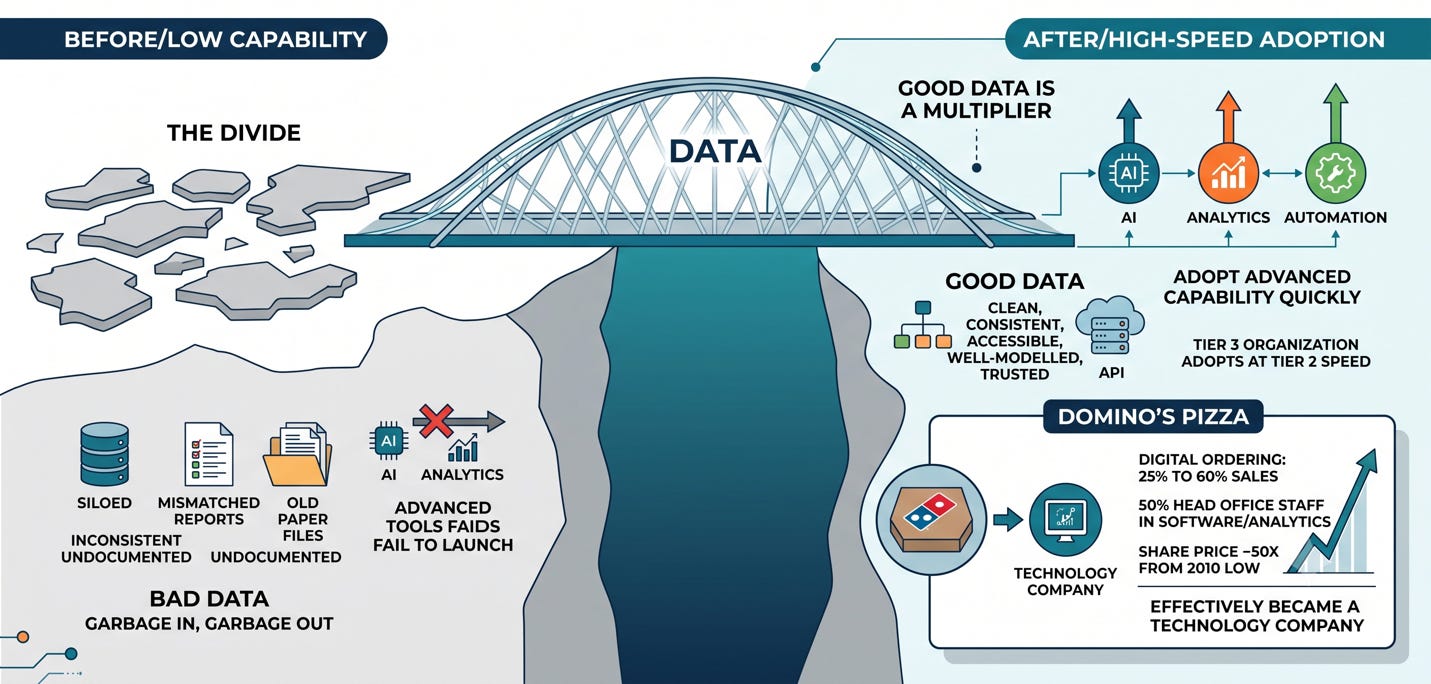
Good data is a multiplier. When your data is clean, consistent, accessible, well modelled, and trusted, you can adopt advanced capability quickly. AI, analytics, and automation all run on it. An organisation with genuinely good data can punch above its budget and headcount, because the moment a new capability arrives it already has something solid to point it at. Good data lets a Tier 3 organisation adopt new capability at Tier 2 speed, even without Tier 2 budgets.
Domino’s Pizza is the clearest example I know. On paper a pizza company, the sort of mainstream retailer you would file at Tier 3. Over a decade it built serious analytics and digital-ordering capability and effectively became a technology company that happens to sell pizza. Digital ordering grew from around a quarter of sales to roughly sixty percent, about half its head-office staff now work in software and analytics, and the share price rose something like fiftyfold from its 2010 low. That is what crossing the divide looks like, and data was the vehicle that carried it across. (The transformation is well documented.)
Bad data is the opposite. It is a hard barrier, and no subscription removes it. It is siloed, inconsistent, undocumented, locked inside ageing systems, and self-contradictory from one report to the next. Drop the best AI tool in the world onto data like that and it delivers nothing. Garbage in, garbage out is not a cliche; it is the single most common reason advanced initiatives quietly fail. The tool gets the blame, but the data was the problem.
There is one more reason data deserves to be called out on its own. Tools commoditise. Everyone ends up with access to the same models and the same platforms. Your data, and your ability to use it well, do not commoditise. They are genuinely yours, and they are the most durable advantage you have. For most organisations, the highest-leverage move to cross the divide is not buying another tool. It is getting their data right.
For a Tier 3 organisation, the divide is a competitiveness problem. Fall behind and your margins erode, your costs creep up, your customers get a better experience elsewhere. Painful, but survivable, and recoverable with the right investment.
For Tier 4 and Tier 5, it is something sharper. The effects compound. An organisation that cannot keep up with customer expectations, cannot match a competitor’s cost base, and cannot adapt quickly does not just lose ground. It loses the ability to catch up at all, because catching up itself requires the capability it does not have.
We have watched this happen for twenty years. Retailers who could not move online. Media businesses that could not move to digital. The taxi industry against rideshare. Blockbuster against Netflix. None of those failures were really about one missed product decision. They were about an organisation sitting on the wrong side of a widening divide, unable to cross it before the market moved on without them.
That is the part worth being blunt about. For some businesses, crossing this divide is no longer about advantage. It is about survival. The ones that cannot adapt will not simply underperform. Some of them will not be here.
This is not a counsel of despair. It is a call to be honest and deliberate. A few things follow from it.
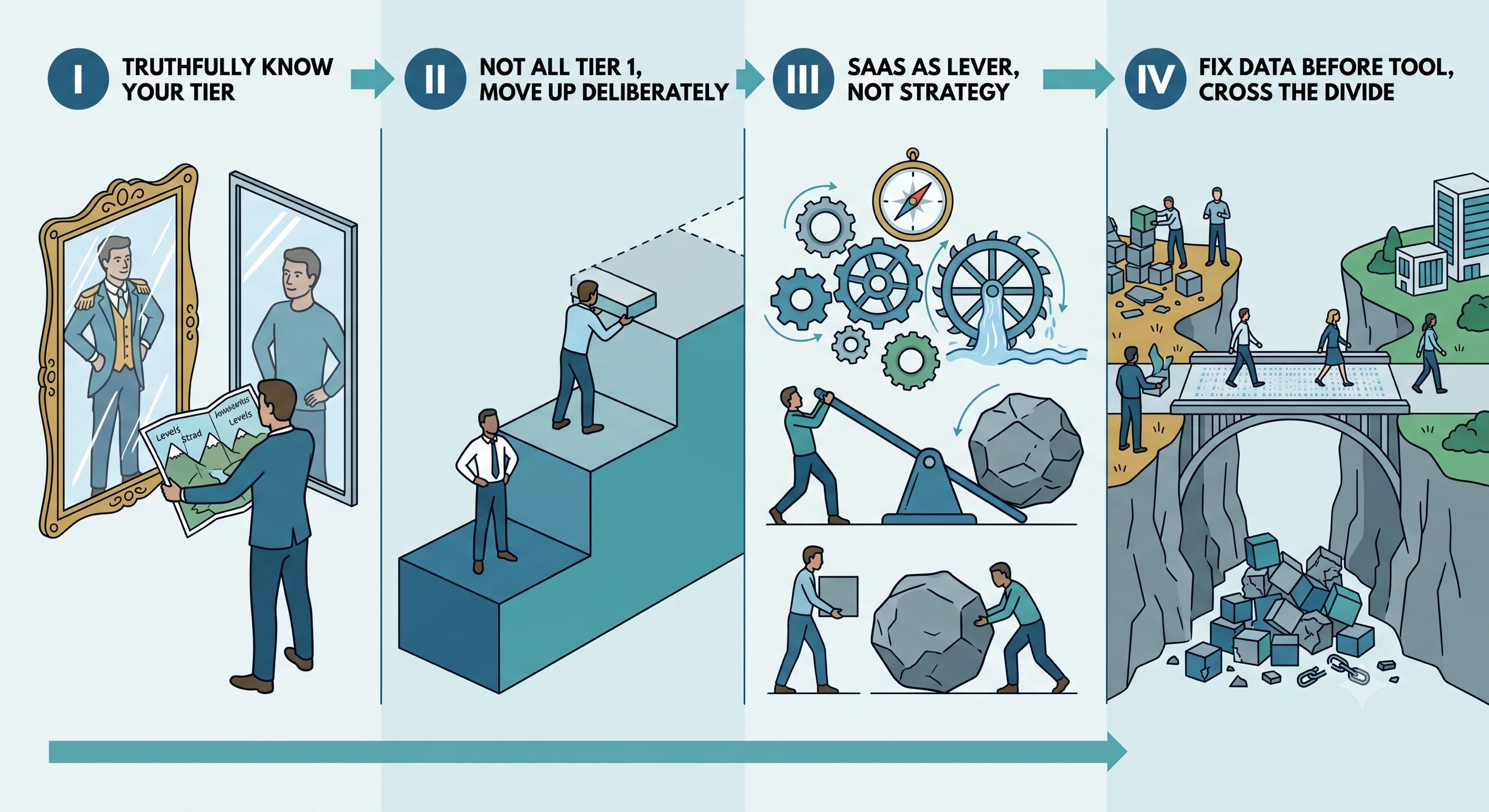
Know your tier, truthfully. You cannot set a sensible strategy from a flattering self-assessment. Work out where you genuinely operate, not where your slide deck says you do.
You do not have to be Tier 1. Very few organisations should try. The goal is not to leap to the frontier, it is to play your tier well and move up deliberately when it makes sense. A Tier 3 organisation that executes brilliantly will beat a Tier 2 organisation that wastes its advantages.
Treat SaaS as a lever, not a strategy. Buying the tool is the easy ten percent. The ninety percent that creates the value is the people, process, and data around it. Invest there or the subscription is money spent to stand still.
Fix your data before you buy the next tool. It is the least glamorous line item on any roadmap and the one that moves you furthest. Good data is the bridge across the divide. Bad data is the reason every initiative on top of it quietly fails. If you do one thing this year, make it this.
Do not mistake activity for crossing the divide. A signed contract and a pilot are not the same as capability in production. The organisations that fall behind often do so while feeling busy and modern.
And the same advice I gave in the last article still holds. Get people, process, technology, and data right, in that order of attention. Slow is smooth, and smooth is fast. But there is another half to that truth: standing still is fatal. Deliberate is not the same as slow, and the divide does not wait for anyone.
The great digital divide is real, it is widening, and it is already deciding which organisations get to keep playing. The question is not whether it applies to you. It is which side of it you are on, and whether you are willing to do the patient, unglamorous work of getting your data right. That work, more than any tool you could buy, is the bridge that carries you across.
No posts
Comments
Nothing yet. Say the first thing.
Sign in to join the conversation.