
I recently facilitated a LEGO® Serious Play® workshop with the network team of a Queensland state government department. These are deeply technical people who keep critical infrastructure running. If you asked them in a normal meeting why their work matters, you would get sensible answers about uptime and availability.
Nobody built a LEGO router.
One engineer built a plane with the whole team aboard, flying out to remote locations to learn what their customers actually needed. The story behind it was about being closer to the people they serve. Another built a model of a mobile team, able to go anywhere and help wherever they were needed. Around the table, model after model surfaced the same themes: teamwork, and a connection to the people at the end of the network that no dashboard will ever show you.
As a lifelong LEGO fan I have always loved the tactile satisfaction of clicking bricks together. But moments like that one are why I trained as a facilitator. The bricks are not the point. What comes out of people when they build is the point.
LEGO® Serious Play® (LSP) has a more serious pedigree than most people expect. It was not invented by an HR department looking for an icebreaker. It was developed in the mid-1990s by two business school professors, Johan Roos and Bart Victor at IMD in Switzerland, at the request of the LEGO Group’s own CEO, who was frustrated with the uninspiring results of conventional strategy planning. The method was built to fix real strategy work at a real company, was commercialised in 2002, and was open-sourced by LEGO under Creative Commons in 2010.
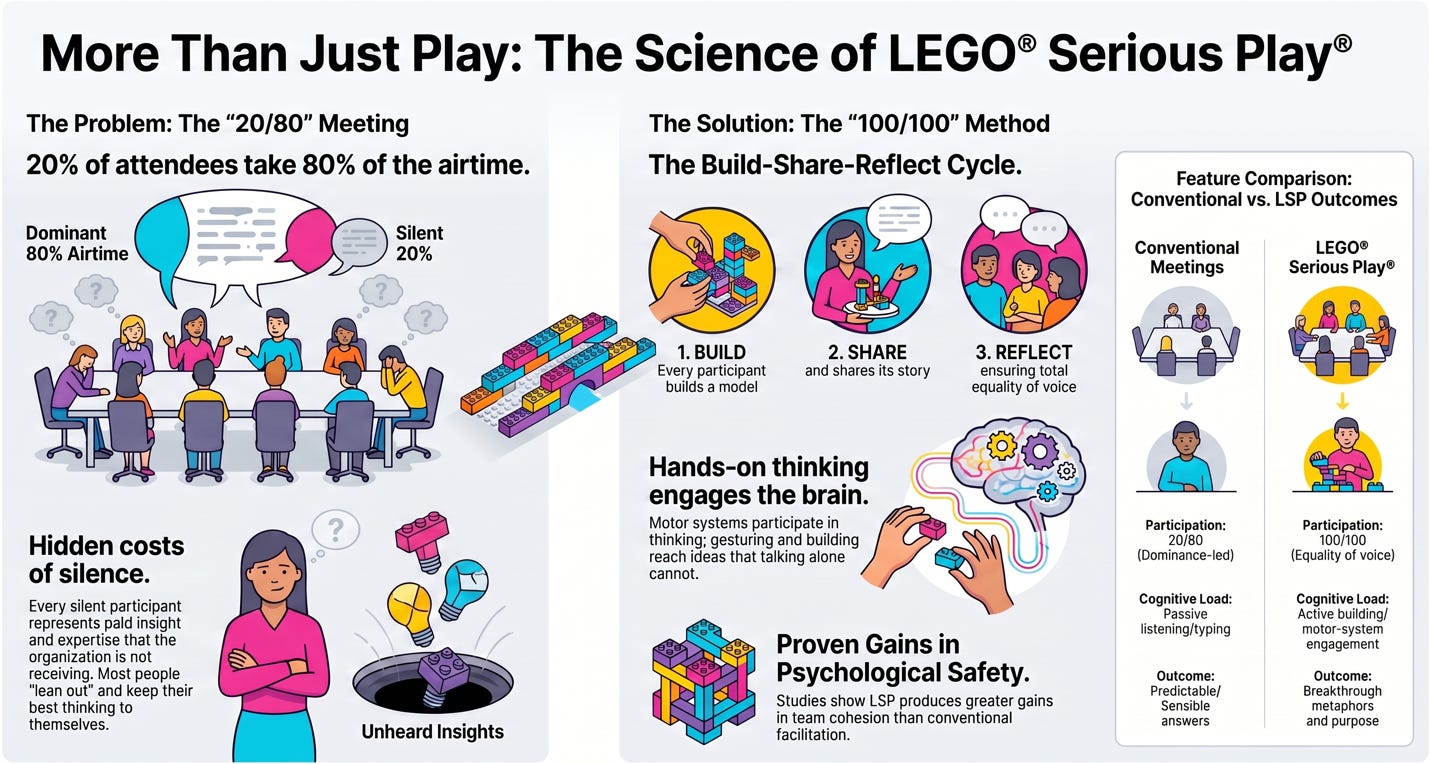
The process itself is straightforward and rigorous. The facilitator poses a question. Every participant builds a model that answers it. Every participant shares the story of their model. The group reflects, and the cycle repeats, going deeper each round. Two rules do most of the work: everyone builds and everyone shares, and the meaning of a model belongs to the person who built it. Others can ask about it. Nobody gets to reinterpret it for you.
I completed my certification in the method with Michael Fearne of The LSP Method, whose training network has taught hundreds of facilitators worldwide and whose book, The LSP Method, is the best practical guide to running sessions I have found.
Here is the business case, and it has nothing to do with toys.
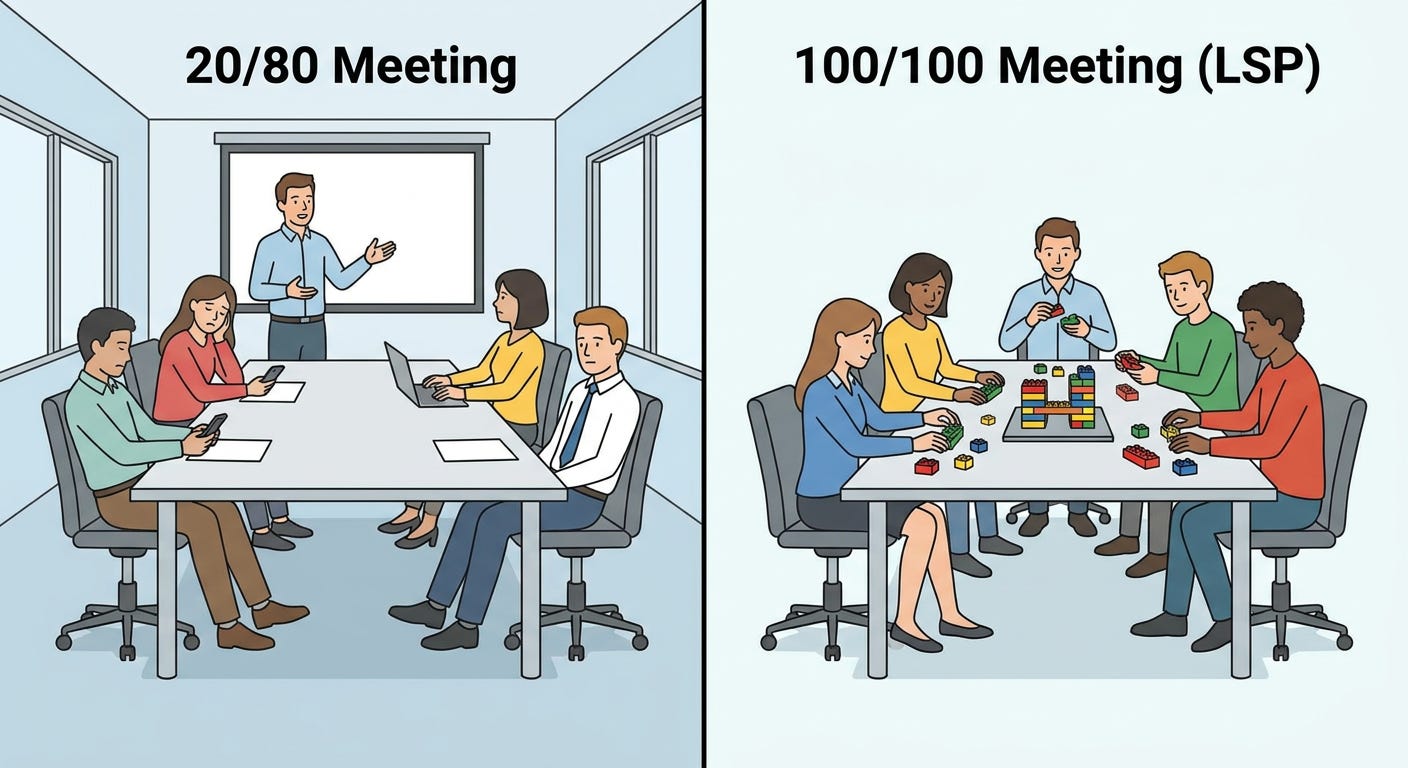
The method’s master trainers describe most meetings as 20/80 meetings: 20 percent of the attendees take 80 percent of the airtime, while everyone else leans out, checks email, and keeps their best thinking to themselves. Every one of those silent people is someone you are paying for insight you are not receiving.
LSP is engineered to produce the opposite, what the trainers call a 100/100 meeting. Because everyone builds and everyone shares, there is no way to lean out and no way to dominate. The quiet senior engineer gets exactly the same airtime as the confident manager. A peer-reviewed study found LSP enabled genuine equality of voice across diverse groups, which is precisely what most meeting formats fail to do.
I saw it directly in that workshop. One exercise asked each person to pick a model someone else had built, name it, and explain why they liked it. The engagement was remarkable. People who might say ten words in a status meeting spoke with care and specificity about a colleague’s thinking. Try getting that from a slide deck.
I am careful with evidence, in this article especially, because the wellness-workshop industry is full of claims that evaporate under scrutiny. So here is what genuinely holds up.
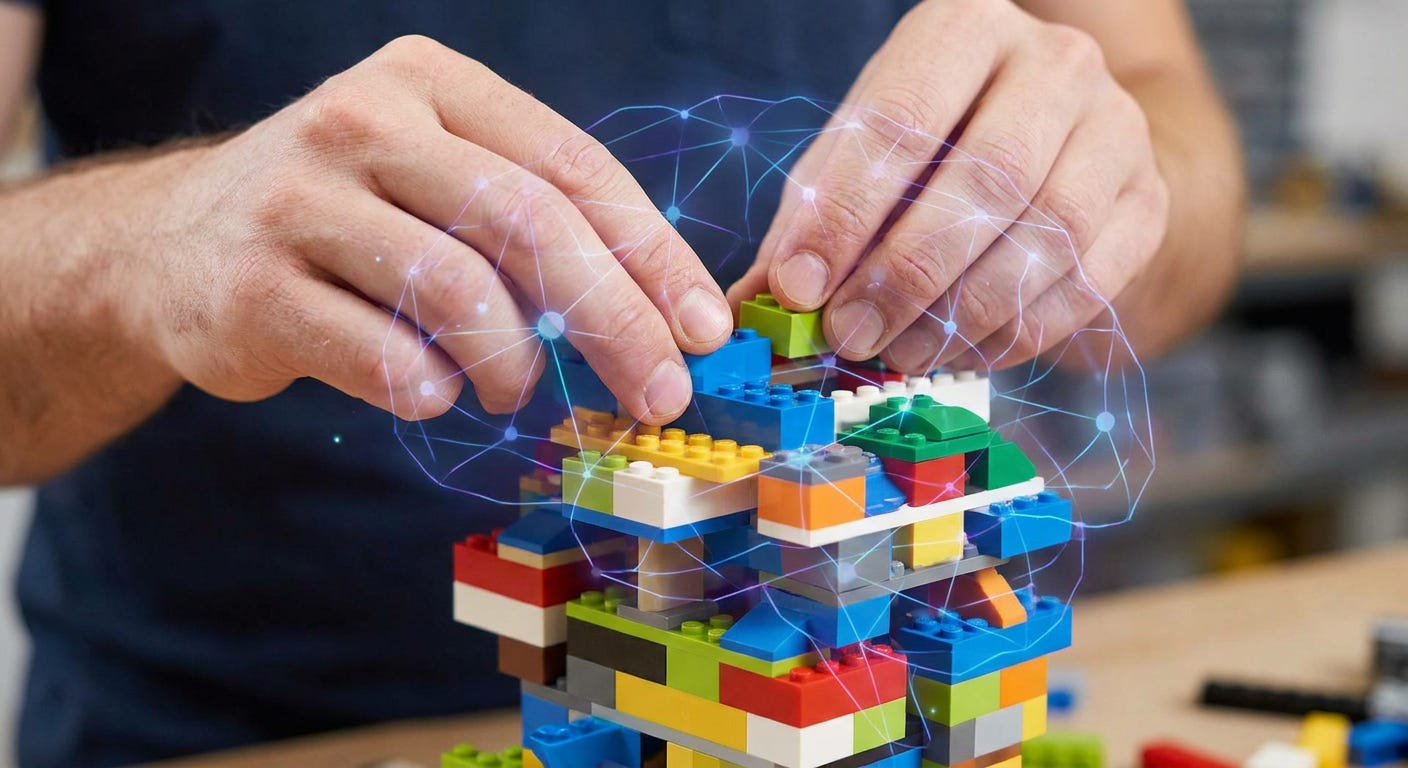
The strongest science is on hands and thinking. Research by Susan Goldin-Meadow at the University of Chicago has shown, across decades of replicated studies, that gesturing does not just express thought, it changes it: learners instructed to gesture while explaining a problem learn more from subsequent teaching than those told to keep their hands still. A 2024 EEG study found handwriting engages far more widespread brain connectivity than typing. That study measured connectivity, not learning outcomes, so I will not claim more than it showed, but the direction is consistent: our motor systems participate in our thinking. This is the foundation Seymour Papert built constructionism on decades ago, and it is why building a model reaches ideas that talking alone does not.
The workplace evidence is younger but real. The first randomised controlled trial (RCT) of the method, published in 2025, found LSP-based team coaching produced greater gains in psychological safety and team cohesion than conventional facilitation. That matters because psychological safety is one of the best-established predictors of team learning and performance, going back to Amy Edmondson’s landmark research. And Teresa Amabile’s diary studies of 222 employees across seven companies showed that positive affect does not just accompany creativity, it precedes it, with effects lasting up to two days.
Organisations noticed long before the rigorous evidence arrived. Beyond LEGO itself, documented cases include strategy work at BASF and UNICEF, the original field experiments at Tetra Pak, Hydro Aluminium, and Transport for London, and, as recounted by the method’s chief architect Robert Rasmussen, a 2003 session helping integrate the engineers forming NASA’s new Engineering and Safety Center after the Columbia disaster.
Honesty requires the other side, because LSP can absolutely be wasted.
The failure mode is the expensive icebreaker: a one-off workshop that produces interesting models, warm feelings, and no follow-through. The evidence base, while promising, is still young, and outcomes depend heavily on the facilitator and on what happens after the session. If the insights that surface do not feed into how the team actually works, the effect fades like any other workshop glow.
There is also a lesson in the research on workplace fun generally: mandated fun backfires. The research is consistent: play lifts people when they consent to it and drags them down when it is imposed. This is exactly why LSP’s structure matters. It is not forced jollity. It is a disciplined process where the play is the medium, the questions are serious, and your model means what you say it means. In that room the skeptics, there are always a few, were leaning in by the second build.
I have run hundreds of business workshops over my career using many methods. What LSP does better than any of them is surface what people already know and feel but have never been given the structure to say. A network team that builds planes to reach its customers, not routers, has just told you something about purpose and culture that you could not have gotten from a survey, an offsite, or another 20/80 meeting.
Play is not the opposite of serious work. Done properly, it is one of the most serious tools you have.
If you want to learn to run these sessions yourself, start with Michael Fearne’s The LSP Method. And if your team has things it has never quite managed to say to itself, whether that is strategy, culture, purpose, or the way you work together, I would love to help. I am a certified LSP facilitator, and you can find me at tek42.io.
No posts
Comments
Nothing yet. Say the first thing.
Sign in to join the conversation.