
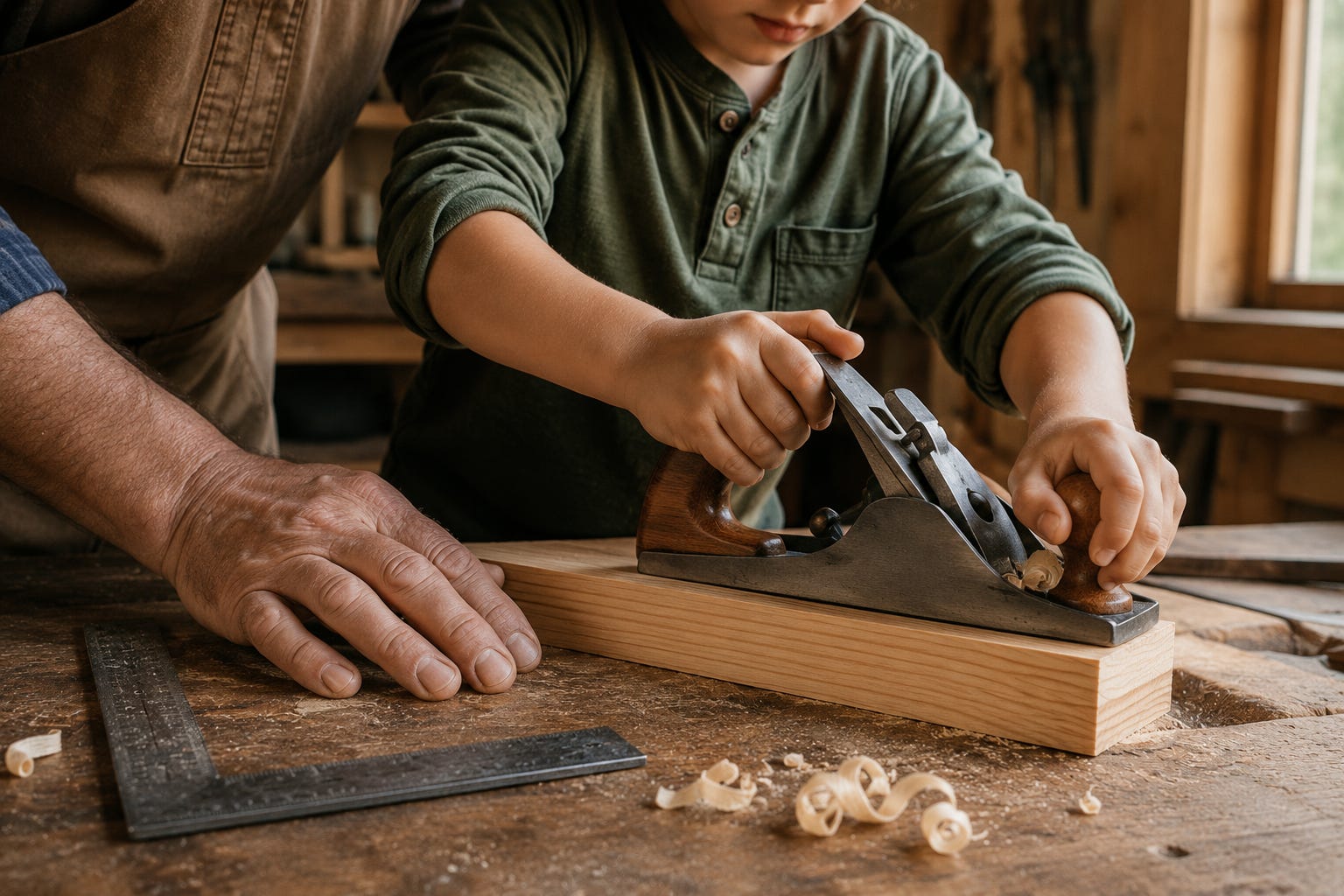
For nearly all of human history, children learned inside the daily life of their community, not inside an institution built to sort and rank them. They learned by watching, helping, asking, and being trusted with real responsibility, the way every child learns the things that matter to the people raising them. Compulsory schooling, in the form most of us went through, is a recent invention, built less than two hundred years ago to produce obedient workers and soldiers. It has worn the costume of inevitability so well that most of us never stopped to ask whether it was the only way, or even a good one. This article asks the question that matters most once you see that clearly: what do we build instead?
If a textbook tried to teach cooking the way it teaches everything else, it might read something like this:
Cooking was invented in 1433 by James S. Cooking because he was hungry. Hungriness had been widespread since 1392, but it was only due to new developments in hot technology that allowed Cooking to expand his foodery enterprise to alternatively temperatured foodstuffs. He was awarded a patent for his invention in 1437.
Why was cooking invented?
a. There was a famine.
b. New technology allowed for the advancement in heating things that people ate.
c. The profit motive led entrepreneurs to explore new ventures.
d. The newly-opened Patent Office made it easy to earn recognition.
This is what conventional schooling does to nearly everything it touches. A living, breathing human activity, something people have done since long before written language existed, gets reduced to a date, a name, and four answer choices, one of which the test will accept as correct. Learning was never meant to be reductionist. Knowledge and skills practiced, refined, and passed down for generations by real people solving real problems in front of them. School cannot teach that origin story, so it invents a tidier, deader one instead.
The real question was never what children learn. Mathematics, science, language, history: every human community has engaged with these in some form, because curiosity about the world is not a school invention. The real question is how a child comes to know them. Whether the knowledge arrives as something to be memorized for a test and then dumped from lack of use, or as something earned through genuine pursuit and kept for life.
A carpenter does not learn geometry from a textbook imposed by an institution. A carpenter learns geometry because they want to build something true, and the math arrives in service of that want. A child in a farming community centuries ago learning to work the land was not absorbing one narrow fact. They were learning material science, mechanical reasoning, weather prediction, and risk assessment, all at once, all tied to something real, all retained for a lifetime because the knowledge belonged to them. Ask any adult whether they still use the algebra they memorized for a test. Most cannot. Algebra arrived the way the multiple choice question about cooking arrives, detached from any reason to keep it, and detachment is what lets knowledge slip away.
So what does school actually teach you to remember, after twelve years and thousands of hours? Not cooking. Not algebra. Not even history. It teaches you to remember that the correct answer belongs to someone else, that it will be handed to you on a schedule you did not choose, and that the moment the bell rings, you are free to forget the rest. That is the one lesson that sticks. It is the only one school ever fully succeeds at teaching.
A frequent and thoughtful objection raised by educators inside conventional schooling pushes back on exactly this point. Children do need something, the argument goes. They need structure, adults, correction, and access to knowledge they would not stumble onto alone. Without that, what stops a child from drifting through twelve years the way the multiple choice cooking question drifts through a single class period, present but never truly learned?
No one serious is arguing that children should be left without adults, without structure, or without access to the wider world. Every consent-based, sociocratic Self-Directed Education center, including the Spokane Learning Co-op, is full of adults, full of structure, full of deliberate access to real knowledge and real tools. The disagreement was never about whether structure should exist. It is about who gets a say in building it.
Structure built around a child by the people raising that child, with the child’s own input on what it looks like, is a very different thing from structure imposed by an institution that never asked the child anything. This is what natural learning looks like in its purest form: a child supported by adults and peers who are genuinely paying attention, not managed by a system designed for crowds. Elements of the more progressive conventional schools, such as project-based learning, real partnerships with outside organizations, and students discovering fields they would never have found alone, are genuinely good things, and they exist there because of educators who fight hard for them within a system built to resist that fight. Good things can clearly happen inside conventional schooling, through extraordinary individual effort. The question is why we keep asking individual educators to wage that fight at all, when there is a model where the fight is unnecessary because the structure was built with the child from the start, not imposed on them from outside it.
There is a particular fear that comes up often when people picture children given real freedom. The fear is that a child left free to “just run around feral” will not run toward anything at all. They will simply run, presumably in circles, in a theoretical emptiness devoid of other people, things, materials, or ideas.
That image is genuinely unsettling, and anyone who has watched a truly neglected child go quiet and far away is right to take it seriously. It is also not what Self-Directed Education is. A child in a community-based Self-Directed Education environment like Summerhill, a Sudbury school, or the Spokane Learning Co-op is surrounded by mixed-age peers building forts and inventing games; by adults who are ready for all the conversations that come up and who notice what lights them up; by ready-to-go resources, tools, and materials; and, of course, by the real responsibility of being part of a real community. The fear of feral children mistakes freedom for isolation. What actually produces a withdrawn child is not freedom. It is being left without a community to catch what they bring back, whether that child is at a desk or in a field.
Purpose arrives the way it always has for human children: through relationship, through being trusted with something that matters, through watching people they admire do work that means something. Give a child both freedom and a community paying close attention, and curiosity finds direction the way water finds a path downhill.
Underneath nearly every objection to this idea sits one assumption that rarely gets examined directly: that children, left to their own devices, will become unruly or empty, and must therefore be tightly controlled from the earliest possible age.
Centuries ago, European philosophy built a story about human nature in its raw state being brutish and dangerous. That story became the justification for increasingly strict control over both adults and children, and the strict control then got pointed to as evidence the story was true all along, a loop with no outside reference point. Anthropologists and historians examining the actual record of human societies, including the recent work of David Graeber and David Wengrow in The Dawn of Everything, have found this story does not hold up. Societies that European colonizers encountered often raised children with far more autonomy and far less discipline, and produced capable, grounded adults all the same.
Building a real learning community where children are respected as real people does not mean waiting for conventional schooling to fix itself, and it does not mean waiting for permission. It means three things, starting this week.
Find or start a circle of people willing to ask the bigger question together.
One family choosing differently is meaningful. A community choosing differently is what actually shifts what feels possible for everyone watching. If a consent-based center exists near you, show up. If one does not, find two or three other adults willing to ask what it would take to build one.
Bring your hardest question into the comments, the one you have not said out loud anywhere else.
This argument gets stronger because people argue with it. Every objection raised here started as a real comment from a real reader who cared enough to push back. If something in this article still does not sit right with you, that disagreement is useful, not just to me but to everyone reading alongside you. Say the thing you are still not sure about. It will shape a future article.
Bring one more adult into the circle this week, specifically someone who is afraid of what freedom will do to a child.
Not to win an argument with them. To let them watch. Fear of children’s freedom rarely survives sustained contact with a child who has actually had it.
This was never about choosing the better school. This is about a community of adults deciding, together, that children do not need to be managed into becoming capable, curious, and kind. They need to be trusted into it, the way human communities trusted their children for nearly all of human history, before anyone built a fence and called it civilization.
Conventional schools will keep asking exhausted, devoted teachers to fight for every inch of trust their students deserve, one classroom at a time, against a system built to resist them. Self-Directed Education starts from the place that fight was always trying to reach.
If this gave language to something you have been trying to build for years without knowing how to explain it, send it to one person who needs to hear it can be built, not just imagined.
If you want the next article in this conversation before it goes anywhere else, subscribe. This is where I keep building the argument, one objection at a time, alongside everyone willing to push back on it.
I want to know what you are building, not just what you are walking away from, and I want your hardest objection too. Tell me in the comments. I read every one.
Deci, Edward L., and Richard M. Ryan. Intrinsic Motivation and Self-Determination in Human Behavior. New York: Plenum, 1985.
Gatto, John Taylor. Dumbing Us Down: The Hidden Curriculum of Compulsory Schooling. Gabriola Island: New Society Publishers, 1992.
Graeber, David, and David Wengrow. The Dawn of Everything: A New History of Humanity. New York: Farrar, Straus and Giroux, 2021.
Gray, Peter. Free to Learn: Why Unleashing the Instinct to Play Will Make Our Children Happier, More Self-Reliant, and Better Students for Life. New York: Basic Books, 2013.
Öcalan, Abdullah. The Sociology of Freedom: Manifesto of the Democratic Civilization, Volume III. Oakland: PM Press, 2020.
Comments
Nothing yet. Say the first thing.
Sign in to join the conversation.