
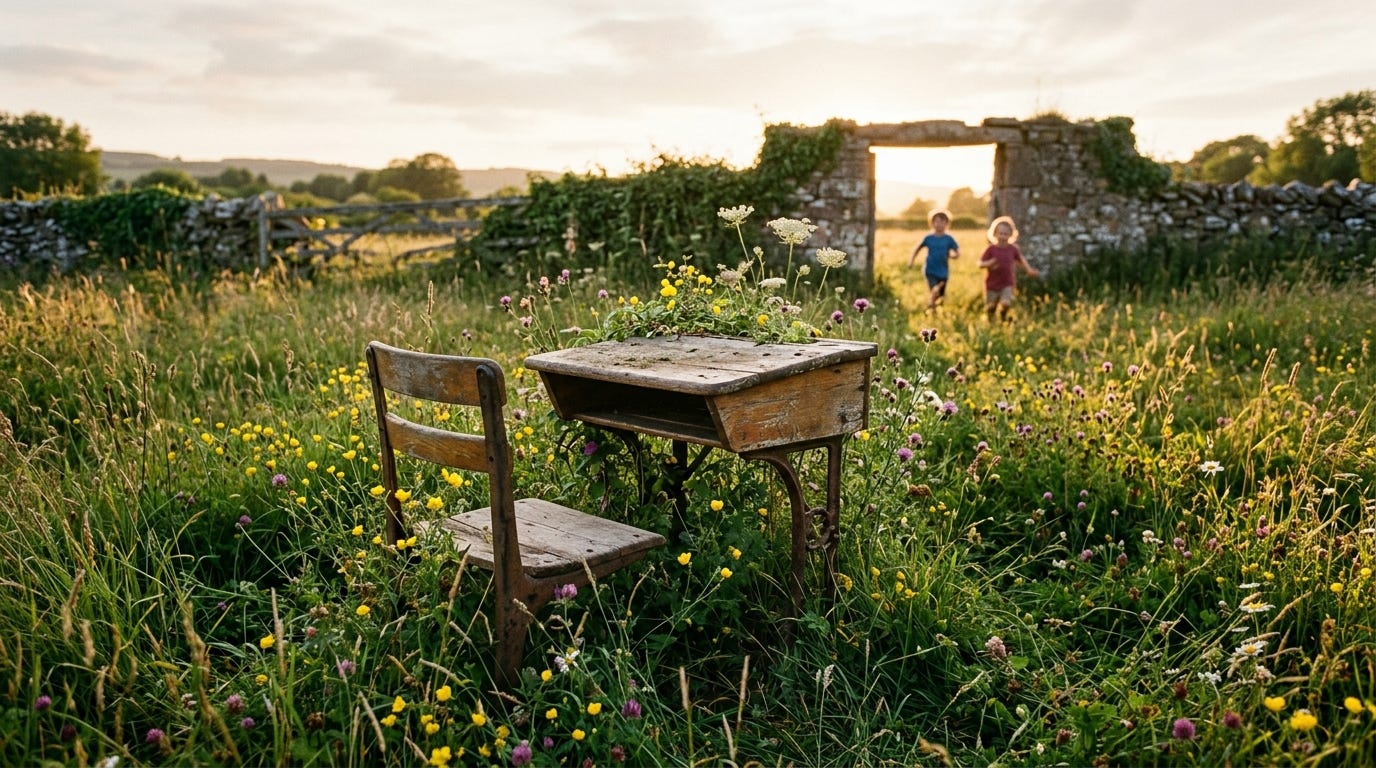
You were not born afraid of math. You were not born hating to read. You were not born believing you are not a creative person.
Somewhere along the way, something changed. Maybe it was a timed test that left your hands shaking. Maybe it was a red mark on an essay that made you stop writing for fun. Maybe it was a teacher’s sigh, a label, a reading group that told you exactly where you ranked among your classmates.
For nearly all of human history, none of this was done to children. Tthe thing we now call education, in the form we know it, did not exist. Learning was simply part of living. No one needed a separate category for it.
This article is about what changed, when it changed, and why. It is about a word, enclosure, that describes something that happened to land a few hundred years ago and something that happened to childhood not long after. Most importantly, it is about what it means for you, and for your children, and what can be reclaimed.
Peter Gray, a research professor at Boston College who has spent decades studying how children learn, has documented something that should reorient how we think about education entirely. For most of the time humans have existed, children learned everything they needed without anything that resembled a school. There were no classrooms, no curricula, no grades, and no separation between “learning time” and the rest of life.
Anthropologists who have lived among hunter-gatherer communities around the world have asked the adults there a simple question: how do your children learn? The answers, gathered across different cultures and different continents, converge on the same description. Children learn by watching, by playing, and by exploring the world around them, at their own pace, on their own terms, free to do so from morning until night.
This was a functioning system, refined over hundreds of thousands of years, producing adults with extraordinary skill, knowledge, and capacity for cooperation.
The political theorist Abdullah Öcalan, writing about the earliest forms of human social organization, describes these communities as built around solidarity rather than hierarchy, around shared purpose rather than competition for scarce resources. Children belonged to the community as members, not as a separate category to be managed, trained, or evaluated. Their learning happened simply because they lived alongside the adults around them, woven into the ordinary fabric of a shared life, with nothing imposed from outside.
Hold onto that fact, because everything else in this article depends on it. For most of human history, no child needed anyone to teach them how to learn, because no one had yet separated learning from living.
Modern research keeps arriving at the same place those communities already understood.
Patricia Kuhl, a researcher at the University of Washington, has shown that infants begin processing the sounds of language before they are born, learning their mother’s voice through bone conduction in the womb. By six months, babies can distinguish the basic sounds of their native language. By the age of five, most children have a vocabulary of thousands of words and can build grammatically complex sentences, all without a single worksheet or vocabulary quiz. As the neurobiologist Lise Eliot has explained, language is instinctive because the brain has evolved dedicated circuits for acquiring it, the same way it has evolved circuits for vision.
Curiosity works the same way. Researchers Gruber, Gelman, and Ranganath, publishing in the journal Neuron, found that when people feel curious about something, the brain’s reward circuits activate, the same circuits that respond to food. Curiosity makes learning feel better, and it makes the brain better at holding onto what it learns.
Self-Determination Theory, developed by psychologists Edward Deci and Richard Ryan, describes the conditions under which this natural drive flourishes or collapses. When people experience a sense of autonomy, competence, and connection to others, intrinsic motivation grows. When those conditions are replaced by control, comparison, and isolation, intrinsic motivation can disappear almost entirely, sometimes within a matter of years.
Children arrive already curious and driven to make sense of the world, requiring no installation and no instruction manual. The hunter-gatherer communities Peter Gray studied simply let this happen, with no theory of motivation required.
If this is true, and the evidence suggests it is, a question follows naturally. What happened? How did something this deeply built into human nature come to be treated as something that must be installed, measured, and graded?
The answer lives in a single word: enclosure.
A few hundred years ago in England, most land was shared. Families could graze animals, gather firewood, and grow food on land that belonged to the whole community, land people called the commons. Over time, that land was fenced off. Walls went up. Land that had belonged to everyone for generations became the property of a few, and the families who depended on it were locked out. Historians call this process enclosure, and its effects reached far beyond agriculture. People who had once had access to what they needed without payment now had to sell their labor for wages just to reach resources they had previously shared freely. The fences separated people from fields, from each other, and from ways of living that had worked for centuries.
Something similar happened to childhood, though it took longer and left no walls you could point to. Before conventional school existed, learning was part of the commons. It happened everywhere, all the time, inside families, inside work, inside play, inside the ordinary rhythm of community life. No one owned it. No one paid for it. No one needed permission to learn something new.
Conventional school built a fence around that. It took something that had belonged to everyone and placed it inside a building, on a schedule, under the authority of an institution. Access now requires enrollment. Progress now requires approval. These fences are invisible, and they function exactly the same way. They decide who gets in, what counts, and on whose terms.
What is called education in a society organized around competition and production is an enclosure of something that was once a birthright.
This is the lens Öcalan applies to the larger arc of human history: a small group gains control over resources that once belonged to everyone, then builds an ideology that makes the new arrangement look natural, inevitable, even beneficial. Applied to childhood, the ideology sounds like this: learning is “difficult,” children must be made to do it, and an institution staffed by trained professionals is the only place where it can happen “properly.”
That ideology has been remarkably effective. It has been repeated for so long, by so many well-meaning people, that it now feels like common sense, regardless of whether or not it is actually true.
If enclosure is real, it should leave evidence. It does, and most adults are carrying it without even knowing it.
Consider math. Jo Boaler, a professor of mathematics education at Stanford, has documented that roughly half of American adults report feeling anxious about math. The cause is not a lack of natural ability. Boaler’s research points to a specific source: timed testing, introduced to children as young as five. Neuroscientists Ian Lyons and Sian Beilock found something remarkable when they studied math-anxious adults. The act of simply anticipating a math problem activated the posterior insula, a region of the brain associated with the experience of physical pain. The anxiety is encoded in the body itself.
Consider reading. Some of the writers history now considers among its finest had brutal experiences in school. F. Scott Fitzgerald was dismissed from his school at age twelve, his early writing dismissed by a teacher as barely literate. George Bernard Shaw compared his schooling to imprisonment. The Nobel laureate Doris Lessing left school at fourteen and later described what happened there as a kind of indoctrination. These were children with obvious ability, whose relationship to learning had been damaged by an institution that could not recognize what it was looking at.
Consider the reflex so many adults still carry without noticing it: the question “will this be on the test?” Alfie Kohn’s review of decades of research on grading found that grades reliably do three things. They reduce interest in the subject being graded. They push students toward the easiest possible task, since intellectual risk becomes dangerous the moment it is being scored. They reduce the quality of thinking itself, replacing the question “is this true?” with the question “is this what they want?”
Stanford researcher Mark Lepper tracked this decline directly, finding that intrinsic motivation falls in a straight line from third grade through eighth grade. The longer a child stays inside the enclosure, the more completely the fence does its work.
None of this happened because you lacked intelligence, discipline, or talent. The institution was simply doing exactly what it was built to do.
John Taylor Gatto spent decades as a public school teacher in New York City and was named New York State Teacher of the Year before resigning publicly, in an open letter published in the Wall Street Journal. In his acceptance speech, he described what he had come to see as the real curriculum of school, regardless of subject. He called it confusion: students moving through disconnected fragments of information with no relationship to each other or to their own lives. He called it class position: students learning, through tracking and ranking, exactly where they stood in a hierarchy. He called it provisional self-esteem: a sense of worth that depends entirely on someone else’s judgment.
Ivan Illich, writing in Deschooling Society, argued that schooling teaches people to confuse the experience of being taught with the experience of learning, and a diploma with actual competence. The result, he wrote, is a deep uncertainty about one’s own ability to think, decide, or act without an expert’s approval.
“Genius is as common as dirt.”
— John Taylor Gatto
Gatto wrote that near the end of his teaching career, arguing that society suppresses this genius because it has never figured out how to manage a population of people who have genuinely learned to think for themselves.
The damage so many adults carry was never a sign that something was wrong with them. It was a sign that the institution was functioning exactly as designed, on millions of children, year after year, for generations.
There is a place, right now, where children grow up without this fence ever being built around them.
The Spokane Learning Co-op sits on ten acres in Spokane, Washington, and serves children from age one through eighteen. It operates outdoors, in every season Washington has to offer, all year long. There is no curriculum imposed from above, no grading, no ranking. Decisions about the community are made by consent rather than majority rule, which means a decision does not move forward until no one has a serious objection to it. Children are not divided into grade levels based on age. A six-year-old and a sixteen-year-old might work side by side on the same project, each contributing what they actually have to offer.
Visitors sometimes expect to see chaos. What they find instead is children who know exactly what they are doing, moving toward things that interest them with a kind of focus rarely associated with childhood anymore. Nothing here has taught them yet that their curiosity needs to be managed, scheduled, or earned.
This matters for two reasons. First, for any parent wondering whether a different way is even possible, that this is real and not a mere thought experiment. Children who grow up inside Self-Directed Education communities do not arrive at adulthood carrying the marks described earlier in this article.
Second, and just as important, it matters for adults who cannot change anything about their own children’s schooling tomorrow. The reclamation can begin with you, this week, regardless of what any institution does.
Start by naming your own enclosure. Write down three things you currently believe about your own abilities, the kind of belief that sounds like “I am not a math person” or “I am not creative.” For each one, try to remember the first time you were told it, or shown it, through a grade, a test, or a comment from a teacher. Most people find the moment within minutes. What you are looking at is a verdict an institution handed down at a specific moment, for reasons that had nothing to do with what you were actually capable of.
Then, give a child in your life one full day with nothing assigned. No worksheets, no required reading, no schedule. Simply watch, and write down what they choose to do, for how long, and how they seem while doing it. Parents who try this often expect boredom. What they usually find is a child who knows exactly what they want to do, and pursues it with more focus than any worksheet ever produced.
Finally, find the commons. If you are near Spokane, visit the Spokane Learning Co-op and watch a normal day unfold. If you live elsewhere, look for a community built on the same principles, consent rather than control, exploration rather than assignment, and see it for yourself. The fences around childhood were built over centuries. Inside your own family, they do not have to last that long.
For most of human history, children were never separated from the work of learning. They lived inside community, and learning was woven into belonging, purpose, and relationship, not delivered to them by an institution standing apart from daily life.
What gets called education in a society built on production and ranking is the enclosure of that birthright. It took something children once did as a matter of course and turned it into a system of assessment, comparison, and control. The math anxiety, the aversion to reading, the belief that you are not a creative person, and the reflex to ask whether something will be on the test are evidence of that enclosure, not flaws in you.
None of this is a personal failure. It happened on a civilizational scale, and naming it changes what comes next. Recovery is possible for adults, and for children, places like the Spokane Learning Co-op already show what learning looks like when the fence is never built. Choosing that, for your children or for yourself, means taking back what was always yours.
This publication exists to keep doing exactly this: calling out what school took, what childhood was always meant to be, and what it looks like to take it back. If this resonated with you, subscribe so you do not miss what comes next.
Someone you know is still walking around believing they are “not a math person” or “not a reader,” and they have never once stopped to ask where that belief came from. Share this with them. It might be the first time anyone has told them the problem was never them.
What is the belief you are still carrying, the one that started with a single moment in a classroom and never left? Tell us about it in the comments. Whether you are an adult still living with the mark of it, or a parent watching one start to form in your own child, you are not alone in this, and saying it out loud is part of how it loses its grip.
Boaler, Jo. Research on math anxiety and timed testing. Stanford University.
Deci, Edward L., and Ryan, Richard M. Self-Determination Theory.
Eliot, Lise. Research on neurobiology of language development.
Fitzgerald, F. Scott; Shaw, George Bernard; Lessing, Doris. Biographical accounts of early schooling experiences.
Gatto, John Taylor. “The Seven Lesson Schoolteacher,” New York State Teacher of the Year acceptance address, and resignation letter, Wall Street Journal.
Gray, Peter. Free to Learn and related research on play, curiosity, and learning in hunter-gatherer societies. Boston College.
Gruber, M. J., Gelman, B. D., and Ranganath, C. “States of Curiosity Modulate Hippocampus-Dependent Learning via the Dopaminergic Circuit.” Neuron.
Illich, Ivan. Deschooling Society.
Kohn, Alfie. Research synthesis on the effects of grading on motivation and learning.
Kuhl, Patricia. Research on infant language acquisition. University of Washington.
Lepper, Mark. Research on the decline of intrinsic motivation from third to eighth grade. Stanford University.
Lyons, Ian, and Beilock, Sian. Brain imaging research on math anxiety and the posterior insula. University of Chicago.
Öcalan, Abdullah. Manifesto for a Democratic Civilization, Volume 1.
Comments
Nothing yet. Say the first thing.
Sign in to join the conversation.