
A teacher commented on a recent article that alternatives to conventional school are prohibitively expensive and require a full time adult caregiver. He is not alone in thinking this. It is the first objection nearly every parent raises, often before they have looked at a single number. The objection sounds like math. It is not. The real answer has little to do with a bigger paycheck and everything to do with a village, the thing every family used to have and almost no family has now.
This article is for the parent who reads about self-directed education, feels something open up in her chest, and is about to close the tab because she has already decided the door is not open to her. Wait. Stay with me for one more paragraph, because I think you have decided too fast. Maybe you are a single mom who cannot work from home and cannot afford private tuition, who has concluded, with real grief, that this is simply not an option for people like you. I want to challenge that conclusion. The financial pressure is real, but the conclusion was built on a frame handed to you by the very system you are trying to leave.
Conventional school is not free. Every family already knows this, because it shows up on a property tax bill or a payroll stub whether or not a single child in the household ever sets foot in a classroom. That cost is visible, expected, and budgeted for at the level of an entire community, which is precisely why it never feels like a personal financial decision the way enrolling in something else does.
That visible tax cost is real, and it is not the whole bill. Underneath it sits a second cost that never appears on any government ledger, because no one has figured out how to itemize it. It shows up in rising rates of childhood anxiety and depression that pediatric researchers have tracked climbing for decades. It shows up in a teaching profession with attrition so severe that researcher Doris Santoro coined the term demoralization to describe what is driving experienced, capable teachers out of classrooms, the slow erosion of the ability to act on their own values. It shows up in the testing and remediation industry, a sector that profits directly from standardizing childhood into measurable units. It shows up in the adult years of millions of people now spending money on therapy to recover a sense of self-worth that was never supposed to be conditional on a grade in the first place.
No one receives an itemized invoice for any of this. It arrives later, in a doctor’s office, in a resignation letter, in a quiet moment when a grown adult realizes they have spent their whole life performing for approval instead of living for meaning. The tax dollars were always visible. This second cost is the one that stays hidden, distributed across years and across individual households so that the family standing at the schoolhouse door in August never has to weigh it against anything else.
Compare that to the family considering self-directed education. Every cost is visible up front. That visibility feels like expense. It is actually honesty, and honesty is rarely what gets chosen when the alternative is comfortable invisibility.
Here is the quiet assumption sitting underneath the affordability objection: that conventional school is the neutral, default option, and anything else is the thing that requires justification, budget, and proof of feasibility.
Ivan Illich, writing in Deschooling Society in 1971, argued that modern institutions train people to mistake the institution for the only legitimate path to the thing the institution claims to provide, in this case, learning itself. Once that substitution takes hold, anything outside the institution starts to feel risky, fringe, and unaffordable by definition, regardless of what it actually costs.
This is an easy trap to fall into because the entire system is built to make it feel like common sense. The household already pays for conventional school through taxes, a cost spread across an entire community and paid whether or not it is ever consciously weighed against anything else. Self-directed education, by contrast, asks a family to look at its full cost at once, in dollars they have to find this month, on top of taxes they are already paying. That ordering makes one option feel free and the other feel expensive, even when the tax-funded option is also carrying a second, uncounted cost that never shows up on the same bill.
That is not a measure of which option actually costs more. It is a measure of which costs are hidden and which ones are not.
The barrier was never the actual cost of the alternative. The barrier is the belief that school is the default and everything else requires justification.
Self-directed education is not one price point. It is a range of models, and several of them cost very little.
A homeschool cooperative is often the lowest cost entry point. A handful of families pool resources, rotate supervision days, and share a single rented room or someone’s living room. The primary cost is time, distributed across several adults instead of carried by one.
A community-based model expands that further, with families, mentors, and sometimes local businesses or libraries offering space, skill sharing, and supervised time in exchange for participation rather than tuition. These models exist in cities and small towns across the country, often built quietly by parents who simply decided to stop waiting for permission.
A dedicated self-directed learning center, like the Spokane Learning Co-op, the only outdoor, consent-based, sociocratic self-directed education center in Washington State, sits at the more structured end of the spectrum. It serves children from one to eighteen on ten acres in Spokane, governed by sociocracy, a decision-making process where children and adults hold real voice in how the community runs itself. A center like this carries real operating costs, the same way any dedicated space does. It is also the kind of model that grows directly out of community organizing, families coming together, pooling what they have, and building something none of them could have built alone.
Some of these models still cost real money. The point is that the range is wide, and the lowest cost models depend on exactly the resource conventional school quietly assumes families do not need from each other anymore: a village.
If you are a single parent working full time with young children who cannot be left unsupervised, supervision during work hours is the whole problem. Telling you to simply pull your children out of school without addressing it does not solve anything.
The solution is not for you to individually solve a problem that was never meant to be solved individually. The solution is the rebuilding of mutual aid, people sharing resources, time, and care directly with each other, no money changing hands, because they have agreed that nobody in the group goes it alone. This is closer to the original human default than the modern nuclear family, which absorbs every burden alone, ever was.
A mutual aid arrangement among parents can look like rotating supervision days, one working parent’s children cared for by a non-working or differently scheduled parent on Mondays, in exchange for reciprocal care another day. It can look like a retired grandparent in the network trading supervision for help with errands or home repairs. It can look like five families splitting the cost of one part time caregiver for fifteen hours a week, turning five separate, unaffordable arrangements into one shared, affordable one.
None of this requires you to have a village already. It requires you to start building one, and that work, while real, is far more achievable than most parents believe, because the infrastructure for finding other people who want exactly this already exists.
The naturalist Peter Kropotkin spent years studying cooperation in the animal world and in human communities, publishing his findings in Mutual Aid: A Factor of Evolution in 1902. His central argument ran directly against the assumption that survival is primarily a contest between isolated individuals. Kropotkin found that cooperation, not competition, was the more consistent driver of survival across species and across human societies, particularly in times of scarcity.
That finding matters here because the affordability objection rests entirely on a competition framework. It assumes each family must individually out-earn the cost of leaving school, alone, in isolation, as if community were a nostalgic extra rather than a load bearing structure. Kropotkin’s research points the other way, toward cooperation as the option more likely to hold up under real pressure.
Self-directed education researcher Peter Gray has documented something similar in his work on how children learned for nearly all of human history, embedded in multi-age, multi-adult communities where supervision, mentorship, and resources were distributed across many people rather than carried by one exhausted parent. The nuclear family, carrying every cost of child rearing alone, is a recent and historically unusual arrangement, not the timeless norm it is so often assumed to be.
This is the part of the article I most want you to read carefully, because it is the part that turns grief into a plan.
Intentional communities already exist, right now, in numbers most people never learn about. The Foundation for Intentional Community, a nonprofit that has supported this movement for more than three decades, maintains a free directory listing over 1,200 intentional communities, including ecovillages, cohousing, coliving arrangements, communes, shared homes, and housing cooperatives. Nearly half a million people visit that directory every year looking for exactly this.
Cohousing communities cluster private homes around shared common space, often including shared childcare and meals, while families keep their own income and property. Ecovillages organize around shared land and labor, frequently including shared education for children as a built-in feature. Some communities are explicitly built around shared parenting and homeschooling cooperation as their founding purpose.
You do not have to move in order to make this a reality for your family. You can start with the smallest possible version of it, a handful of families in your own neighborhood who agree to share what they have. The Foundation for Intentional Community even offers online courses for people who want to learn how to join, start, and grow an intentional community, built by people who have already done the trial and error so you do not have to start from nothing.
You do not need a deed, a charter, or a meeting agenda to begin. You need three families and one honest conversation.
Start by naming what you actually need out loud to people you trust, even partially. Not a fully formed plan, simply the truth, that you wish you had people to share this with. Grief stated out loud invites company. Grief held privately gets mistaken for a personal failure to plan well enough, which is exactly the lie this entire system depends on you believing.
Then look at what already exists near you before assuming you have to build from scratch. Visit the Foundation for Intentional Community’s directory at ic.org and search by region. Look at their forming communities listings, where new groups, sometimes only two or three families deep, are actively looking for others to join them at the ground floor. Spend just one hour checking out the website this week. You may discover you are not starting a village at all. You may be joining one that is already underway.
If nothing exists yet in your area, start absurdly small. One shared supervision day a week between two families is a village with two members. It grows from there.
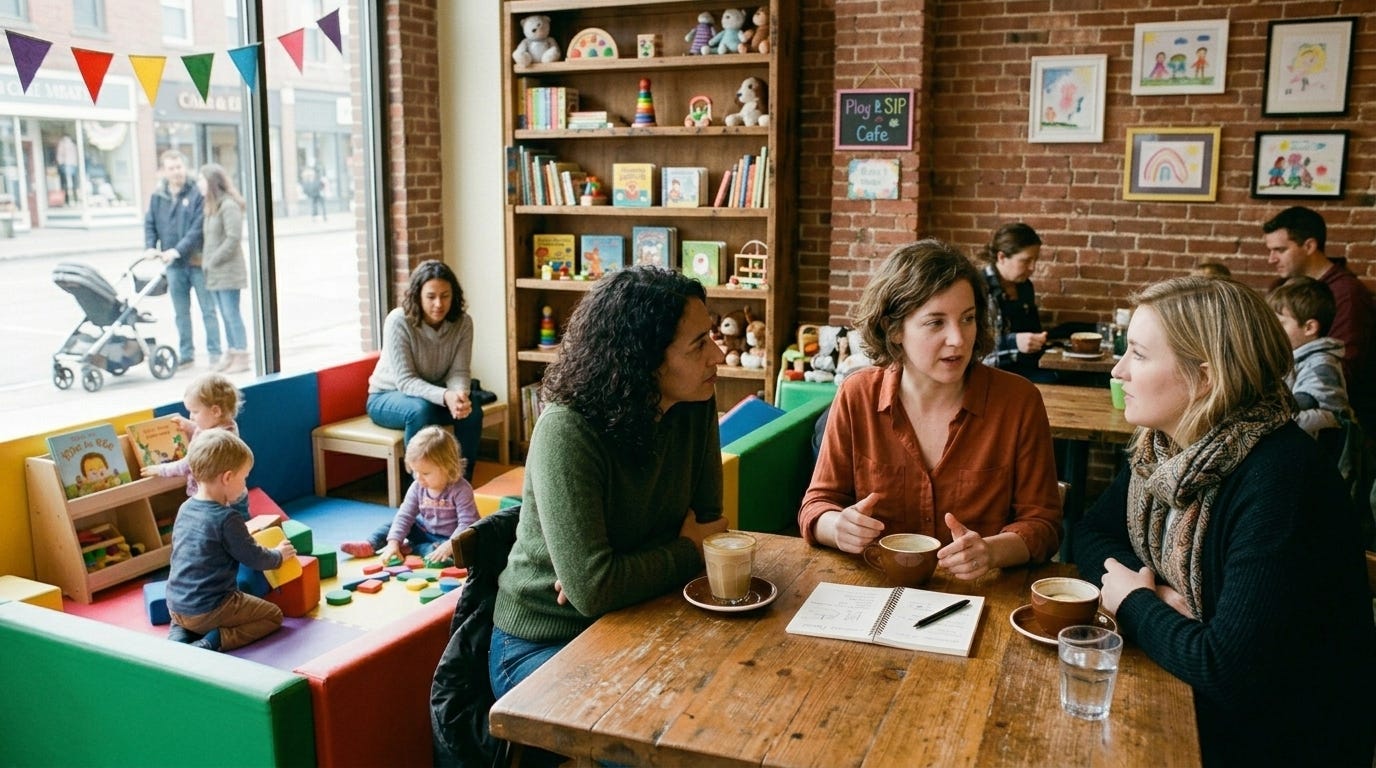
The Spokane Learning Co-op did not begin as a finished institution with a budget line for everything. It began with me, a teacher, spending a year having coffee with parent after parent, asking what they wished existed. Those conversations turned into a grant from VELA, funding that helped get the doors open, but the grant came after the relationships, not before them. The structure that emerged is consent-based and sociocratic, meaning children and adults share real decision-making power over how the space runs. It now serves children from one to eighteen on ten acres in Spokane.
Money mattered. It always does. But the thing that actually built the Co-op was a year of showing up to talk with people, one cup of coffee at a time, before there was a grant or a site or a single child enrolled.
If you read this and felt something tighten in your chest, that feeling is grief, for a kind of support that should have surrounded you and your children from the beginning, but did not.
That grief is real. You are allowed to mourn a village that was taken from families generations before you were born, replaced with the expectation that you would simply manage alone and call your exhaustion normal. You are also allowed to believe, at the same time, that this village can still be yours. Not someday, in some distant ideal future. Beginning this week, with three families and one honest conversation.
Self-directed education was never the luxury. It is the return of something that was taken, and the way back to it runs through the same thing that has always carried people through hard seasons, other people, chosen on purpose, sharing the weight together.
Find your three. Not a co-op, not a curriculum, not yet. Three families this week, the ones who say “I wish I could pull my kid out” with their eyes more than their mouths at pickup. Isolation makes this cost feel individual and impossible. Three families is where every co-op and every learning center on record actually began.
Take one hour at ic.org. The Foundation for Intentional Community’s directory, forming communities board, and courses already exist. You do not have to invent any of this from scratch. Spend one hour this week reading what is already near you, or what others built starting from nothing at all.
Name the grief, out loud, to someone. Tell one person this week that you are mourning a village you never had, and that you believe it could still be yours. Grief spoken out loud becomes the first thread of the very network that solves this. The Spokane Learning Co-op did not start with money. It started with people willing to say this to each other first.
The most common objection to self-directed education, that it is too expensive and requires a stay-at-home parent, is conventional school’s own propaganda, repeated back as fact. School only looks like the affordable default because its true costs are hidden and paid later, in mental health, in teacher demoralization, and in adults spending decades recovering a sense of worth that was never supposed to be conditional in the first place.
Real alternatives exist at every income level, from homeschool cooperatives built on shared supervision, to community-based programs, to dedicated centers like the consent-based, sociocratic Spokane Learning Co-op. For families who feel genuinely priced out, the deeper solution sits in the rebuilding of mutual aid and intentional community, resources that already exist worldwide and are easier to find than most parents believe.
This is not a fringe idea waiting to be proven. It is an old idea, documented as far back as Kropotkin’s 1902 research on cooperation as a driver of survival, returning to meet a generation of parents who were taught to believe they had to do this alone.
If this article put words to something you’ve been carrying for too long, share it with one parent who needs permission to stop blaming themselves for the cost of something that was never supposed to be a solo project.
Subscribe to The Joy of Learning for more honest reckonings with what conventional school costs us and what we can build instead.
And tell me in the comments, what would your village look like, if you had one? Who are the three families you would call first?
Foundation for Intentional Community. “About FIC.” Accessed June 2026. https://www.ic.org/
Gray, Peter. Free to Learn: Why Unleashing the Instinct to Play Will Make Our Children Happier, More Self-Reliant, and Better Students for Life. New York: Basic Books, 2013.
Illich, Ivan. Deschooling Society. New York: Harper & Row, 1971.
Kropotkin, Peter. Mutual Aid: A Factor of Evolution. London: William Heinemann, 1902.
Santoro, Doris A. Demoralized: Why Teachers Leave the Profession They Love and How They Can Stay. Cambridge, MA: Harvard Education Press, 2018.
Comments
Nothing yet. Say the first thing.
Sign in to join the conversation.