
Picture report card day in a conventional classroom. Some children light up. Others fold the paper before anyone can see it. Schools built that moment, piece by piece, over years. Competition in schools is taught deliberately, built into the structure through ranked grades, gold stars, and spelling bees where someone has to lose.
Most adults remember exactly where they sat in that hierarchy. The reading group they were placed in by age seven. The chart with everyone’s multiplication times tables, color coded by speed. The grading scale that meant a strong test from one student quietly lowered the standing of another. Nobody explained the mechanism out loud, because nobody needed to. Children absorbed it the way they absorb a native language, simply by living inside it long enough.
What if the competition itself was the curriculum, and the math and reading were just the vehicle for delivering it?
A ranking system only works if everyone is competing for the same limited supply of good scores. Someone has to lose ground for someone else to gain it. A child cannot simply learn the material and be done. A child has to learn it better than the person next to them, because the grade itself is measured against the room, not against the material.
Conventional schooling never quite says this out loud. The psychologist Peter Gray, who has spent decades studying how children learn in the absence of adult-imposed structure, has documented something striking about play among children who are not being graded or ranked: it organizes itself around fairness and shared benefit, not domination. Children left to their own devices tend to negotiate rules that keep everyone in the game. Adults, through the architecture of schooling, are the ones who introduce winners and losers as a natural feature of childhood.
Ranking children against each other is a recent invention, layered on top of a much older and more durable instinct. It works because human beings are status-sensitive by nature, and a school that wants obedient, sortable students has found an efficient lever to pull. Teaching children to rank themselves does not reflect anything true about how learning or cooperation actually works.
Here is the quiet curriculum running underneath every spelling bee, every honor roll, every reading level sticker on a folder. Children learn that other people’s success is a threat to their own. They learn that help given to a classmate is help subtracted from themselves. They learn to perform confidence even when they feel none, because looking capable matters more than being curious.
“Grades are for meat, milk, eggs, and lumber, not human beings.” — Katy Purviance
That line tends to stop people the first time they read it. Grades exist to sort commodities by quality for a market. A side of beef benefits from a numbered grade because the buyer never has to meet the cow. A child is not a commodity moving through a supply chain, yet a ranked grading system treats them exactly that way, sorted for an audience that is not even in the room.
A child who has internalized that classmates are competitors will hesitate before offering help, even when help would cost them nothing, even when that help would help them too. A child taught that their worth is relative to everyone around them will struggle to feel secure anywhere that does not rank them, including most of adult life. The skills that conventional schooling rewards, outperforming a peer, protecting an advantage, working alone for individual credit, are not the skills that build a marriage, a friendship, a neighborhood, or a functioning workplace. Almost everything that matters after graduation runs on cooperation, and almost nothing in twelve years of ranked grades practiced it.
The alternative is already happening, and it has existed the entire time conventional schooling has been telling children the opposite story.
Gray’s research into hunter-gatherer childhoods describes communities where children of widely different ages play and work together constantly, with older children naturally mentoring younger ones. Mixed-age groups are simply how humans organized learning before institutions intervened and began sorting children by birth year. In that setting, a ten-year-old teaching a six-year-old to start a fire deepens the older child’s own mastery at the same time it gives the younger child a guide who remembers exactly what it felt like to not know yet. Everyone gains something in the same moment.
Mixed-age, non-ranked groups produce something a single-age, graded classroom structurally cannot: a wide spread of skill levels in the same setting with no ladder to climb and no rank to defend. A child who is behind in one area is often ahead in another, and there is no single number trying to summarize them. Cooperation becomes the obvious strategy, not because anyone moralized about kindness, but because the structure itself makes cooperation the most useful and natural thing to do.
This pattern is observable and repeatable right now, in mixed-age, non-graded settings, including ones built specifically around removing the scarcity that conventional schools manufacture.
The Spokane Learning Co-op, a consent-based, sociocratic Self-Directed Education community on ten acres in Spokane, was built around a single founding commitment: treat children as full people, worthy of trust and respect, rather than as products to be measured and sorted. Removing rank was a natural consequence of taking that commitment seriously, not a separate goal someone had to argue for.
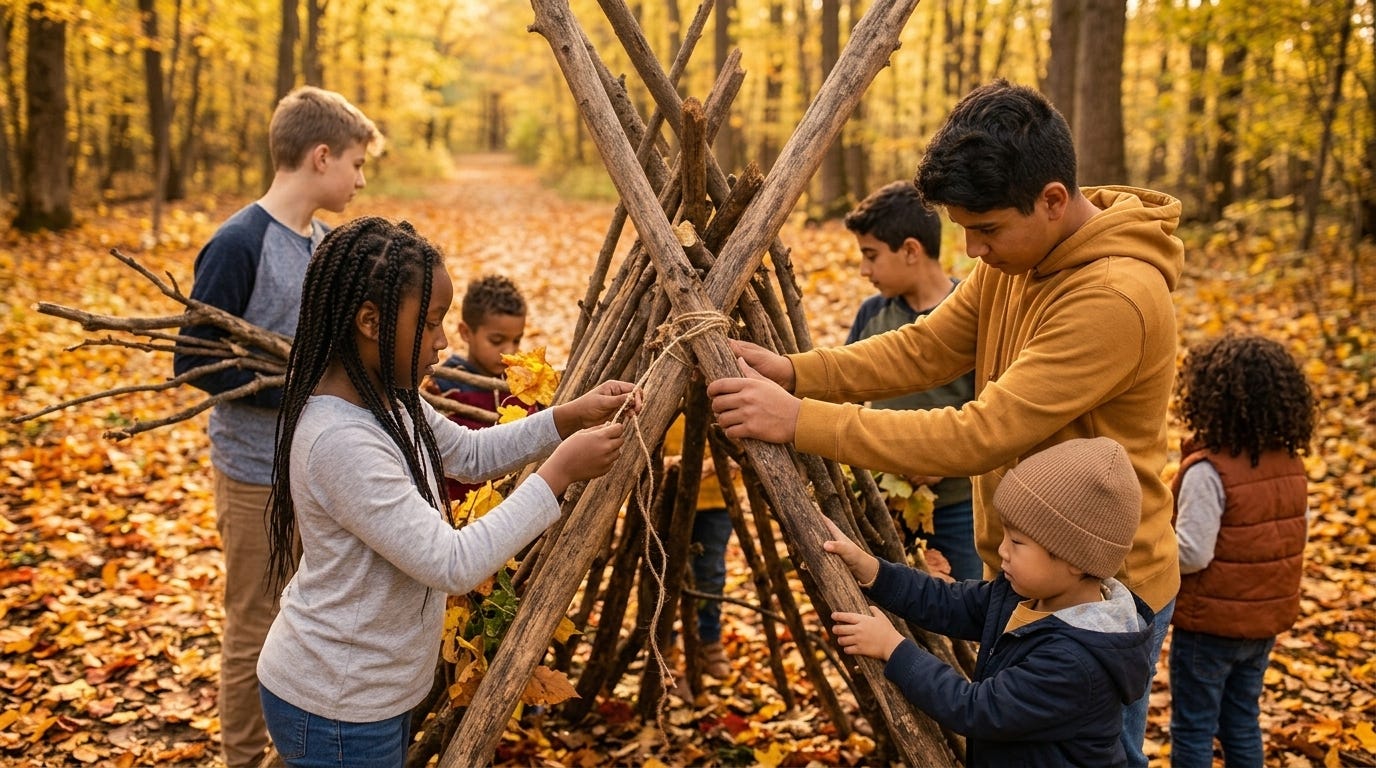
There are no grades at the Co-op. There is no honor roll, no reading level chart, no spelling bee. Children of different ages spend their days together outdoors, year round, in all weather, choosing what to pursue and how to pursue it. What emerges is what most parents already recognize from a good family dinner or a well-run job site: people of different ages and skill levels getting things done together, each contributing what they actually have to offer, with no one keeping a running scoreboard of who is “winning.” Older children mentor younger ones because that is what naturally happens when nobody is competing for the same narrow form of approval.
Democratic and sociocratic schools share this same founding commitment, even where their decision-making processes differ. A democratic school resolves community decisions by majority vote. A sociocratic school, like the Co-op, resolves them by consent, meaning a decision moves forward when no member has a reasoned objection, rather than when the largest group simply outvotes the rest. Both models start from the same premise: a child is a full person now, not a smaller, less finished version of an adult who has to earn full personhood through performance.
If children treated this way organize themselves around fairness, and if removing rank produces more cooperation rather than less, then competition in schools was never a necessary ingredient for learning. It was a choice made by the people running the institutions, and it served them well. A ranked, sortable student body is easier to manage than thirty individuals with thirty different needs. A child taught to chase approval from an authority figure is easier to control than a child who already trusts their own judgment. Ranking children was never really about helping them learn. It was about making a crowded room of children easier to run.
Today: Catch the comparison before it lands.
For 24 hours, do not compare your child or your students to anyone else: not a sibling, not a classmate, not a number on a chart. Every time the urge to compare rises, pause and notice what you would say instead if ranking were not available to you. The goal is not to become a kinder narrator of the same ranking system. The goal is to discover how much of your own language was built around a scarcity you never actually chose.
This week: Spend real time somewhere with no ranking at all.
Find one mixed-age setting where children of different ages spend time together with no test, no grade, and no leaderboard: a homeschool co-op, a park day, or a visit to a community like the Spokane Learning Co-op. Watch closely who ends up teaching whom, and notice how rarely it has anything to do with age. This is what cooperative learning looks like when nobody engineered a winner into the gathering.
This week, bigger: Remove one ranking system completely.
Most fixes to a competitive structure leave the structure standing. A friendlier grading system is still a grading system. Choose one place where ranking currently happens in your home or classroom, a reading group sorted by level, a chore chart with prizes for “best,” a sport with constant standings, and remove it for two weeks without replacing it with anything new. Watch what children do once the structure that was constantly telling them where they stand simply disappears.
Competition in schools feels permanent because it is everywhere, but it is a man-made structure, not a law of nature. For most of human history, children learned cooperatively, in mixed-age groups, with no ranking attached to the process at all.
The research on childhood play and the lived example of communities built without ranked grades point to the same conclusion. Remove the manufactured scarcity, and cooperation is what children default to, because sharing was never actually in competition with their own success in the first place.
The Spokane Learning Co-op, run as a consent-based, sociocratic community, shows what becomes possible when a school is built on the simple premise that children deserve to be treated as full people. Children do not need to be ranked to learn. They need adults willing to trust that cooperation, not competition, was the original design.
Where did you first learn that someone else’s success meant less for you? Tell us in the comments.
Gray, Peter. Free to Learn: Why Unleashing the Instinct to Play Will Make Our Children Happier, More Self-Reliant, and Better Students for Life. New York: Basic Books, 2013.
Comments
Nothing yet. Say the first thing.
Sign in to join the conversation.