
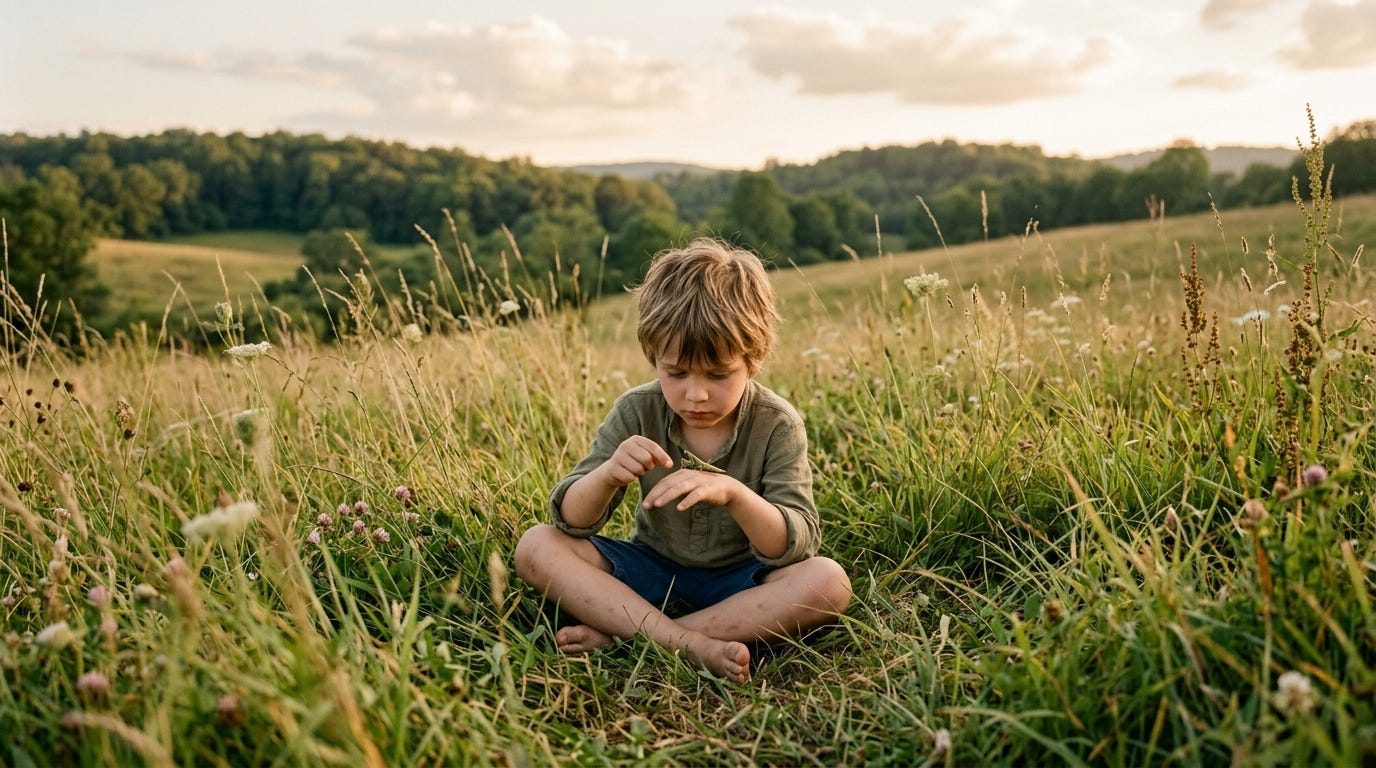
A child is in the middle of building something. It isn’t finished. The bell rings. The child has to stop, leave it exactly where it is, and move to the next room, whether or not anything got resolved, whether or not the thought was complete. This happens many times a day, every day, from day one of kindergarten through the last day of high school.
Unstructured time for kids, the kind where a child gets to follow one thought or one project all the way through, has been quietly engineered out of childhood. The bell is only the most visible piece of the machinery. The deeper lesson is harder to see, and much harder to undo: your hours belong to someone else.
Most of us absorbed that lesson so completely we stopped noticing it. We feel guilty about taking time off. We apologize for needing rest. We schedule every available hour and call it productivity, then wonder why we always feel behind. We never quite have enough time for the things that actually matter to us, the friendships we keep meaning to invest in, the projects we’ve been putting off for years, the long unhurried afternoons that make a life feel worth living. We were trained out of believing we were allowed to have those things, starting the first day someone rang a bell and told us it was time to stop.
The question worth sitting with is this: if your child is in school right now, what are they learning about who their time belongs to?
John Taylor Gatto taught in New York City public schools for twenty-six years and won the New York City Teacher of the Year award three consecutive times before resigning in 1991. He identified seven lessons that all schools actually teach, regardless of what teachers intend. One of them was indifference. The constant ringing of bells, he wrote, teaches students not to care too deeply about any one thing. The bell doesn’t only end class. It delivers a lesson about attention itself: that nothing you are doing is important enough to finish, that depth is beside the point, and that someone else will always decide when you are done.
The schedule structured around fifty-minute periods cannot teach children that sustained attention has value, because the structure itself contradicts that lesson at every turn. Children who spend thirteen years inside that structure do not emerge with the skills or the permission to direct their own attention. They emerge waiting for the next bell.
There is a phrase that circulates quietly among parents of young children. You only get eighteen summers. It moves through parenting communities with the weight of something people know is true but cannot quite bear to hold in focus. One mother, describing the day her daughter left for college, wrote that she found herself frozen on her driveway, waving goodbye, and that it felt dark and cold even though it was a hot bright Texas morning. Another described the experience as standing at the end of a book, not a chapter, a book, that had been her whole life for eighteen years.
Eighteen summers. That’s it.
A child who attends conventional school from kindergarten through twelfth grade spends approximately 1,200 hours per year in school, plus commute time, plus homework. By middle school, homework alone can add two to three hours to a school day. That is an enormous portion of a childhood allocated to a system designed by people who are not the child’s parents, toward outcomes that are not necessarily the child’s own.
All the family gets are the leftovers: a few hours on weeknights, already compressed by exhaustion, weekends, and eighteen summers, if you count them as whole seasons, which most parents who’ve had a child leave home will tell you is an illusion. Summer fills up too.
Parents who have lived past that moment almost universally report the same thing: they wish they had done things differently sooner. The most repeated phrase across every platform where parents discuss homeschooling and alternative education is not about academics. It is: I wish we had done it sooner.
Pediatric occupational therapist Angela Hanscom has spent her career studying what children’s bodies and brains actually need in order to develop well. Her research, explored at length in her book Balanced and Barefoot and in conversations with the 1000 Hours Outside podcast, converges on a number that may surprise parents who have never encountered it: children need a minimum of three hours of outdoor free play every day. Not organized sports. Not structured activities with adult supervision and defined outcomes. Free outdoor time, where the child moves through uneven terrain, makes decisions about their own body, and takes in the sensory environment that the natural world provides and manufactured environments simply cannot replicate.
The reason this matters goes deeper than fresh air. Outdoor movement builds what are called the vestibular and proprioceptive systems, the systems that govern balance, coordination, spatial awareness, and the regulation of attention and emotional state. When children spin, climb, dig, run on uneven ground, and move through natural spaces without being told what to do next, they are not wasting time. They are building the neurological architecture that makes focused learning possible in the first place. Hanscom found that elementary-age children who were not getting adequate movement and outdoor time were showing measurable declines in core strength, balance, and the ability to self-regulate, and that one in six children was being referred for occupational or physical therapy as a result.
The National Wildlife Federation has reported that the average American child now gets four to seven minutes of outdoor free play per day. Four to seven minutes. Children in this same population average four to seven hours of sedentary indoor time daily.
A typical school day runs six to seven hours. Some students say that “SCHOOL” stands for “Seven Cruel Hours Of Our Lives.” Add the commute, add homework, add dinner and the routines that follow, and the math is clear. Three hours outside every day is impossible within a conventional school schedule for most families. It is not a matter of parental intention or effort. The schedule itself prevents it.
At the Spokane Learning Co-op, a consent-based, sociocratic Self-Directed Education community on ten acres in Spokane, Washington, three hours outside is not a goal families work toward. It is the ordinary default of a normal day.
“It is hard to pay attention when you are not allowed to move for extended periods of time.” — Angela J. Hanscom, Balanced and Barefoot, 2016
Research on what psychologists now call “time poverty” has produced a finding that should give every parent pause. More than half of full-time American workers report feeling chronically time-starved, according to surveys conducted by the Bureau of Labor Statistics. Studies published in the Journal of Health and Social Behavior have linked this persistent sense of time scarcity to elevated rates of depression, anxiety, and burnout. One recent analysis of time poverty research found something even more striking: the damage is not primarily about how many hours a person actually has. It is about whether they experience their time as their own.
People who feel their time belongs to someone else, to employers, to obligations, to an ever-present sense of what they should be doing, suffer the same psychological effects as people who are genuinely stretched beyond capacity, even when the clock says otherwise. The feeling of time poverty depends more on perceived control than on actual hours available. Constant interruptions, long lists of obligations, and a lack of authority over one’s own schedule all produce the same result: the chronic, grinding sense that there is never enough time to do what matters.
Children who spend thirteen years being interrupted by bells, who complete their evenings doing homework assigned by someone else, and who are given no meaningful practice in directing their own attention, are developing a relationship with time that they will carry for the rest of their lives. Adults who feel perpetually behind, who cannot rest without guilt, who cannot invest deeply in community or relationships because the time required feels prohibitive, are not people with a “productivity problem”. They are people who were schooled.
Self-Directed Education is not unstructured in the sense of being “random” or without intention. At the Spokane Learning Co-op, children of all ages, from toddlers to teenagers, participate in a community that is organized through sociocratic governance, meaning decisions affecting the group are made by the group, with every voice carrying real weight. Children choose what they pursue, how long they pursue it, and when they are done. They work alongside people of different ages. They are outside, at length, every day. They experience time as something that belongs to them.
Peter Gray’s research on children in self-directed educational settings, documented in his book Free to Learn, shows what happens when children are trusted with their own time over years. They develop the capacity for sustained, self-initiated attention that schools claim to value but structurally undermine. They pursue deep knowledge in areas of genuine interest. They learn to manage disagreement, to negotiate, to collaborate without compulsion, skills that emerge naturally when children have enough uninterrupted time and sufficient autonomy to practice them.
The children who grow up in environments like the Spokane Learning Co-op learn something that cannot be taught by direct instruction: that their hours belong to them, that their attention is worth directing, and that the projects and relationships worth caring about are worth the time required to actually care about them. It is, arguably, the most important preparation for adult life that education could possibly offer.
Today: Count the summers you have left. If your child is eight, you have ten summers. If they are twelve, you have six. Sit with that number. Then ask what the schedule filling those summers is actually for, who designed it, and whether it reflects what you want your child’s childhood to have been. Ask yourself if it’s time to make different choices.
This week: Run the outdoor time numbers. Track how much time your child actually spends outside each day, not in organized sports, but genuine free outdoor time. Angela Hanscom’s research identifies three hours as the daily minimum for healthy brain and body development. If the number you find is significantly lower, that gap is information worth taking seriously.
This week, bigger: Give an entire afternoon back, without conditions. Choose one afternoon and hand it to your child without an agenda, without substitutions, and without announcing how much time is left. If they seem restless, let them be restless. The restlessness is often the first thing that shows up before genuine self-direction takes over. Children who have never experienced time ending on their own terms often don’t know what that feels like, and it shows in how they approach everything else.
Time is our only non-renewable resource, which makes what children learn about it one of the most consequential lessons of childhood. Conventional school, organized around bells, timed transitions, and hours allocated by someone else, teaches children that their attention belongs to other people. That lesson compounds over a lifetime into guilt about rest, chronic busyness, and the persistent inability to invest deeply in anything that genuinely matters.
Every study on time poverty is, at bottom, a study of adults who were trained as children to treat their own hours as borrowed. They feel behind before the day begins, cannot fathom taking three hours outside, and have lost the thread of what they actually care about. Children who grow up owning their time become something different: adults who know how to use it, for deep work, for genuine community, for the kind of relationships and projects that give a life its texture and meaning.
The Spokane Learning Co-op exists as evidence that a different approach is possible: a consent-based, sociocratic Self-Directed Education community where children direct the shape of their own days, spend hours outside as a matter of course, and learn, through daily practice, that their hours belong to them. What they take into adulthood is not simply knowledge. It is a relationship with time that most of the adults around them were never given the chance to develop.
If you have never stopped to consider what the school bell is actually teaching, there is more where this came from. Subscribe to The Joy of Learning for more on what conventional schooling does to attention, autonomy, and the hours that make up a childhood, and what it looks like when children are trusted to direct their own.
Share this with a parent who seems to be watching their child’s days fill up faster than they can keep track of. It may be the next step in a more intentional life.
When was the last time you had a stretch of hours with nothing scheduled and nobody checking on you? What happened? Tell us in the comments.
Gatto, J. T. (2017). Dumbing us down: The hidden curriculum of compulsory schooling (25th anniversary ed.). New Society Publishers. (Original work published 1992)
Gray, P. (2013). Free to learn: Why unleashing the instinct to play will make our children happier, more self-reliant, and better students for life. Basic Books.
Hanscom, A. J. (2016). Balanced and barefoot: How unrestricted outdoor play makes for strong, confident, and capable children. New Harbinger Publications.
National Wildlife Federation. (n.d.). Be out there: The whole child. https://www.nwf.org/~/media/PDFs/Be Out There/BeOutThere_WholeChild_V2.ashx
Sansone, G. (Host). (2021, November 8). Play is the main occupation of children [Interview with Angela Hanscom]. 1000 Hours Outside Podcast. https://www.1000hoursoutside.com/blog/play-is-the-main-occupation-of-children-interview-with-angela-hanscom
Lachman, M. E., & Weaver, S. L. (1998). The sense of control as a moderator of social class differences in health and well-being. Journal of Personality and Social Psychology, 74(3), 763–773.
Bureau of Labor Statistics, U.S. Department of Labor. (2023). American time use survey. U.S. Government Publishing Office.
Comments
Nothing yet. Say the first thing.
Sign in to join the conversation.