
To celebrate the upcoming publication of my fifteenth book, The Secret Society of Librarians, I’m sharing some of the remarkable stories I uncovered in my research.
When you delve into the past, you never know what treasures you will unearth, what surprising initiatives, pioneers and trailblazers are waiting for you in dusty folders or sitting rooms. All the stories I share in the novel are inspired by real people and places. From a magical library in the heart of London, founded after the Great Fire of London (which you can visit) to a fearless group of librarians fighting back against censorship. I’ll be sharing these stories and more over the coming weeks. This book is for anyone who believes that reading is resistance. This week…
The underground Blitz newspaper…
Just occasionally, you meet someone from the past who you fall a tiny bit in love with. Let me introduce you to Dore Silverman.
Jewish journalist, Dore, was the founder and editor of Britain’s only underground Tube station newspaper, The Swiss Cottager. I found him and his paper (not literally) in the sound archives at the Imperial War Museum, and fell for him when he said, in that unique way that wartime Londoners spoke, ‘You were never introduced to a stranger in wartime.’
But imagine living and sleeping underground with thousands of them? This was the strange new reality for Londoners who took to the Underground stations to shelter from Nazi bombs.
At the outset of ‘Black Saturday’ September 7, 1940, the start of the Blitz, it quickly became obvious there was a lack of deep level shelter in the capital. Authorities were underprepared for the scale and ferocity of the nightly bombardment.
Exhausted Londoners squeezed themselves into cold brick shelters, dusty cupboards under the stairs, drafty church crypts, Andersons, railway arches and trenches. Or simply took their chances in their own beds.
What they needed most, however, were safe, dry, clean, deep shelters. What they got from the Government, aside from Anderson shelters, were brick street shelters. Tube stations were an obvious solution, but Churchill had declared these to be for transport only, not sheltering, worried they might create a nation of troglodytes.
The day after the first heavy bombing of London, a huge group attempted to gain access to Liverpool Street Station. The station entrance was being guarded by police, but the crowds simply roared past. Three nights later, on 11 September, 2,000 people rushed down the stairs at Holborn Station before going to sleep on platforms and in corridors. Others simply bought a ticket to travel, then bedded down for the night.
On September 14th, one week after the Blitz broke out, Phil Piratin, a 33-year-old Communist councillor for Spitalfields East led a party of 77 from Stepney and invaded the plush Savoy Hotel, which had transformed its underground banqueting hall into a shelter (complete with Blitz butlers) and refused to leave until the all-clear had sounded. Piratin chose the Savoy on account of the American journalists who were staying there, who wouldn’t be subject to the same censorship that British journalists were.
The police soon arrived, and Piratin pointed to a mother from Stepney with four children whose husband was in the army. ‘What would you do,’ he asked the police inspector, ‘if your wife were put in the position of that woman over there?’ Piratin says that the inspector expressed sympathy – although he proceeded to take the name and address of every Stepney intruder. When the all-clear eventually sounded, the occupation ended. ‘Everyone left elated,’ says Piratin, ‘and there was publicity in the Sunday papers.’
It was this publicity perhaps, and growing public pressure, which forced Churchill into a U-turn on Government policy. On September 25th, 18 days after the Blitz began, the Government conceded defeat and declared: ‘The use of Tube stations as shelters has now been officially recognized.’ The people had won.
‘There was no adequate shelter in the East End, so civilians took over the Tubes, what choice did we have?’ a lady called Gladys told me. ‘It was happening night after night. Most of the houses in Bethnal Green were so old, it was only the wall paper holding ’em up. Not having a safe place to shelter was soul-destroying. No one was trying to break the law, it was simply a case of do or die, self-preservation really.’
From then on, thousands of Londoners called the Underground home. Each underground shelter had its own distinct personality.
‘As the Blitz raged on, we tried all the stations, from Liverpool Street Station right up to Oxford Circus,’ Gladys recalled. ‘I must have slept on every platform on the Central Line! Bethnal Green was the best though.’
Bethnal Green was a lively affair. Triple bunks sleeping up to five thousand people were erected up the east bound tunnels and shelterers were treated to an underground theatre with nightly concerts, a library, cafe, creche, doctor’s quarters and even it’s own underground hairdressers.
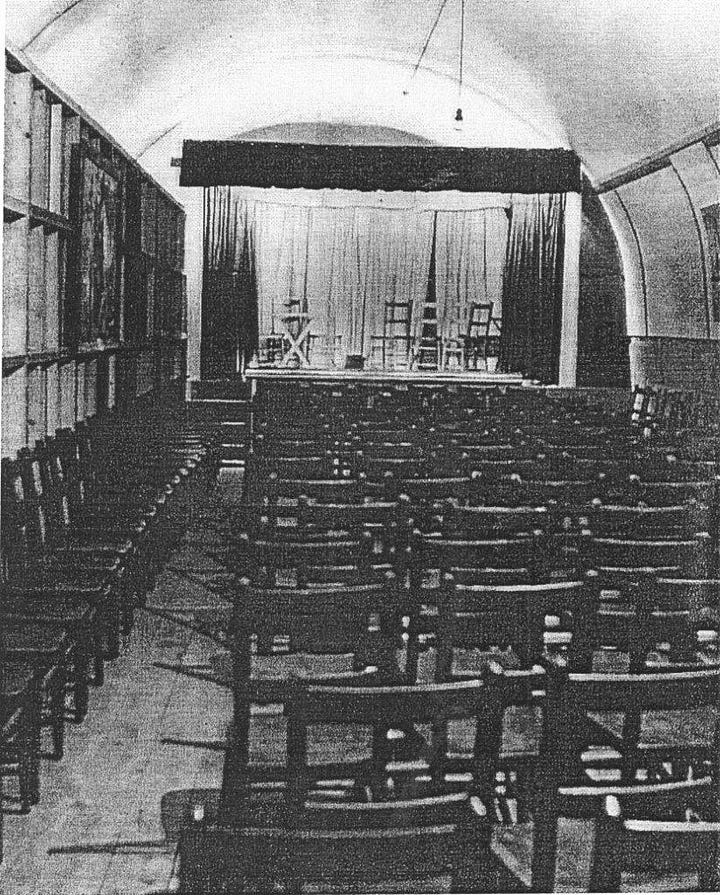
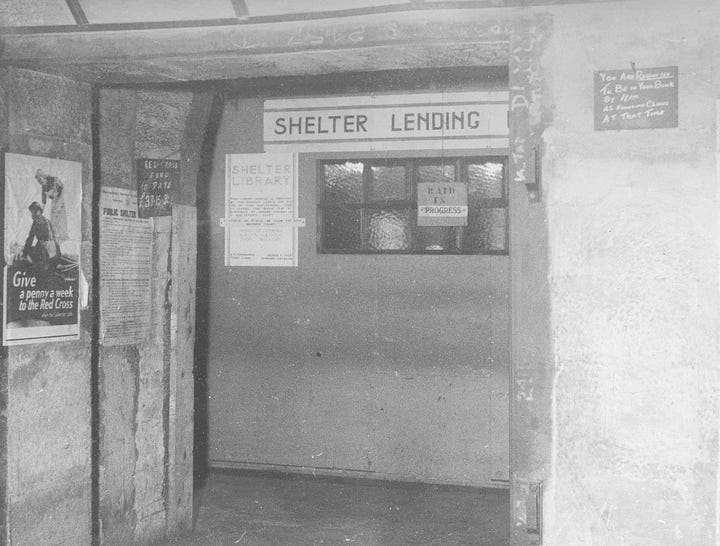
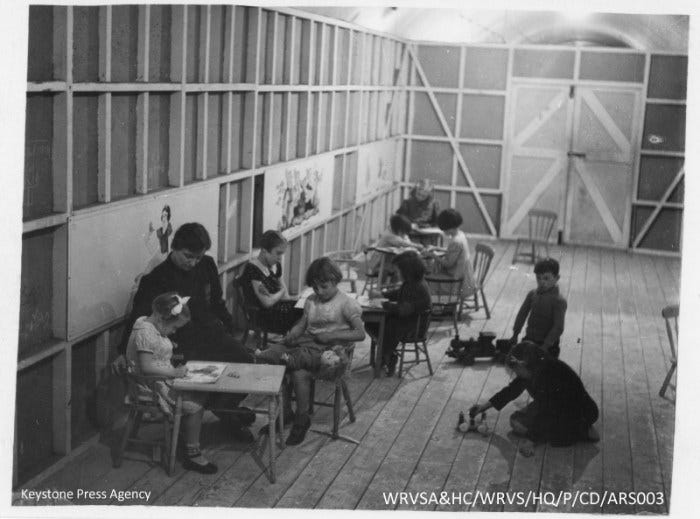
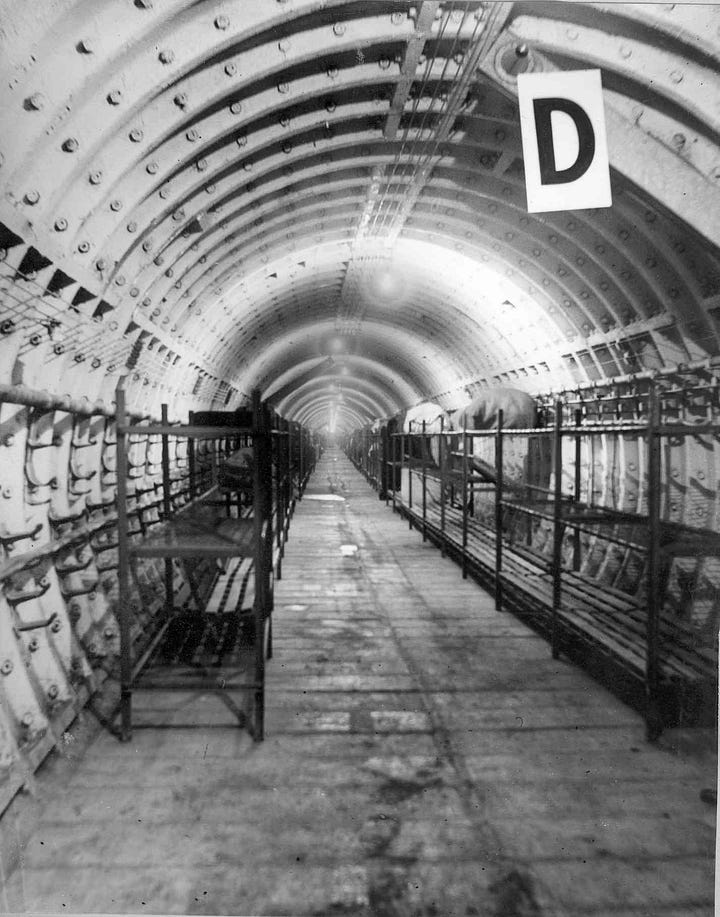
A self-contained subterranean town. Top left, Bethnal Green’s underground theatre, top right, the shelter library, bottom left, the WVS-run creche and bottom right, the triple bunks.
Further north on the Bakerloo line was smaller, but no less lively, Swiss Cottage Underground, which is where, during the Blitz you would find Dore Silverman. By day, Dore worked for the Daily Express, but by night he was to be found underground, hunched over his typewriter, fingers clacking over the keys.
Dore produced five editions of The Swiss Cottager and I tracked them down to Camden Local Studies and Archives Centre where I spent a happy afternoon reading them.
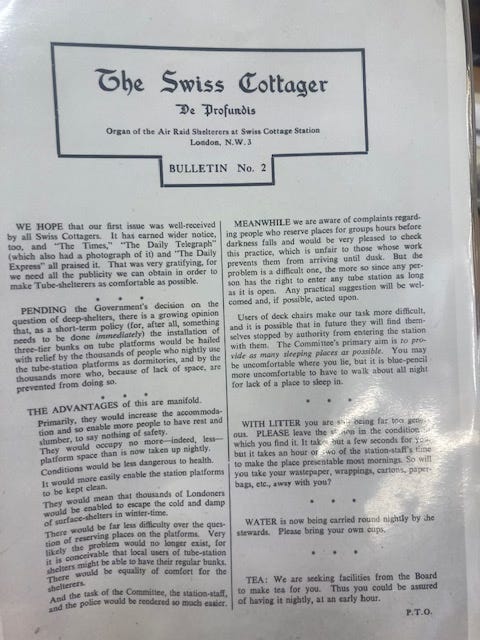
As a journalist, I felt a connection to Dore and what he was trying to achieve in fostering a sense of belonging and community in the underground shelter at Swiss Cottage Tube.
‘Greetings to you our nightly companions, somnambulists, snorers, chatterers, moles and all who inhabit our underground world,’ was how he opened his first editorial.
Dore also used the newspaper to gently remind shelterers to look after their temporary home. ‘With litter you are being far too generous. Please leave the station in the condition which you find it.’
And not so gently remind them that Swiss Cottage was a shelter for all who needed it.
‘Here we have English, Austrians, Czechs, Poles, Germans, Hungarians, French, Dutch, Swiss and even one or two Spaniards. We have all sorts of religions represented, and there is no reason why, since we all come down here for one purpose, we should not gather together in friendship.’
He went on: ‘One truculent gentleman interrupted the deliberations of the Committee to enquire how many Jews were members. He thought there were too many on the Committee. He was told that membership of this or that faith was not a ticket of entry into the Committee. If it served the best interests of Swiss Cottagers, the Committee would consist entirely of Jews, or Baptists, or Methodists, or even vegetarians! To quote from the new Charlie Chaplin film “We want to live by each other’s happiness and not by each other’s misery”.’
Dore even included a lonely hearts column, with this heartfelt plea from a shelterer, ‘to the beautiful woman who sleeps under the clock on the westbound platform, my heart is yours.’
Dore was justifiably proud of his underground newspaper.
‘Being in Fleet Street, I wasn’t in it for vanity or publicity, but to get the project known and the next morning, The Times quoted it from first to last word.
‘The Library of Congress in Washington and Toronto Library got in touch and asked would I let them know what the subscription fee was as they would like to subscribe.
‘An American correspondent sent a flattering letter and a cheque for ten pounds for our amenities fund. One dear lady in Scotland sent us a five shilling postal order and wrote, “what else can I do when I’m sitting in safety?”.’
What a great connector that little underground newspaper was.
As the war went on, Dore began working for the Ministry of Information, where he was frank about his role. ‘On the home front, we slanted the news; ie, night fighter pilots eat a lot of carrots because it helps them see in the dark. We sold that to the public. It was nonsense of course, but it did no harm. It was nutritious food and we didn’t have to import it so that was part of the ploy.’
Dore also took turns fire spotting on the station roof and worked for Swiss Cottage Shelter Welfare Committee (did he never sleep?) Over the course of the war, shelterers underground at Swiss Cottage had access to free medicines, milk for babies, bunkbeds, concerts, talks, arts and crafts, drama, singing and film shows.
To add to the list of wartime curios, alongside the underground newspaper, my favourite story of all, is the ‘refreshments special’ tube train which pulled into the station at 9pm every evening serving Bovril, cocoa and meat pies to shelterers, while the Luftwaffe bombed the streets above. How quickly civilians adapted.
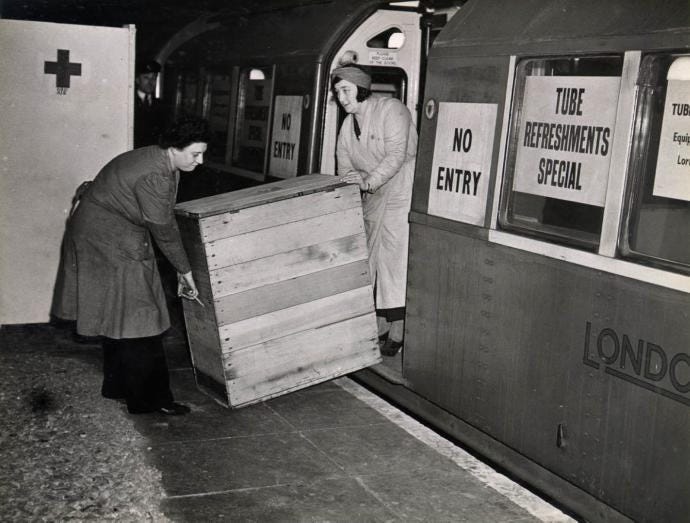
Loading up the Tube Refreshments special. Image, London Transport Museum.
Meat pies and cocoa delivered direct to your bunk? Little wonder Swiss Cottage regular Lilley Richardson vowed never to leave.
‘I’ve been sheltering here every night since the shelter opened,’ she said proudly. ‘I for one am coming here to sleep after the war in my same old place and no one is going to stop me.
‘I like my bunk bed. It’s better than my old bed at home. No laundry, no housework and lots of other women to natter to. It’s beautiful down here.’
Take a walk along Swiss Cottage Underground platform today and I’m afraid you won’t find Tube trains serving free hot chocolate and pies, Dore hunched over his typewriter, or Lilley and her pals having a gossip in their bunkbeds.
But you will find them in the pages of my upcoming novel, The Secret Society of Librarians, out in hardback and Kindle March 12, and paperback in August. Available to preorder now, click here.

No posts
Comments
Nothing yet. Say the first thing.
Sign in to join the conversation.