
I’ve always been fascinated by rock pools.
As a child growing up in the Forest of Dean, Gloucestershire, England, that probably sounds unlikely. There wasn’t a coastline to explore, only woodland, streams and old quarries. Nature was something to walk through rather than paddle in.
It wasn’t until I moved to the Sussex coast when I was five that I discovered the quiet joy of searching the shoreline after the tide had retreated.
Most people walk along a beach looking out towards the sea. I spend most of my time looking down.
Rock pools have always felt like tiny windows into another world. Small enough to overlook, yet impossibly rich if you stop for a moment. Every one is different. Every tide rearranges them. The creatures change, the seaweed shifts, shells appear where there were none before, and sunlight transforms everything beneath the surface.
Perhaps that’s why they’ve never become boring.
Even if you return to exactly the same place, you’re never really seeing the same rock pool twice.
On Sørvær, I found myself drawn back to one in particular.
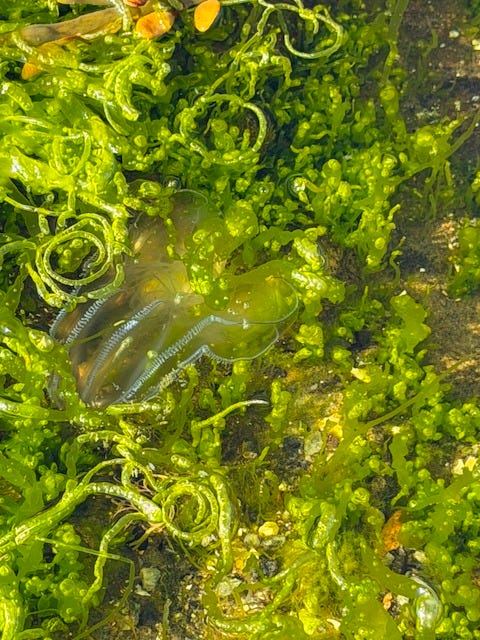
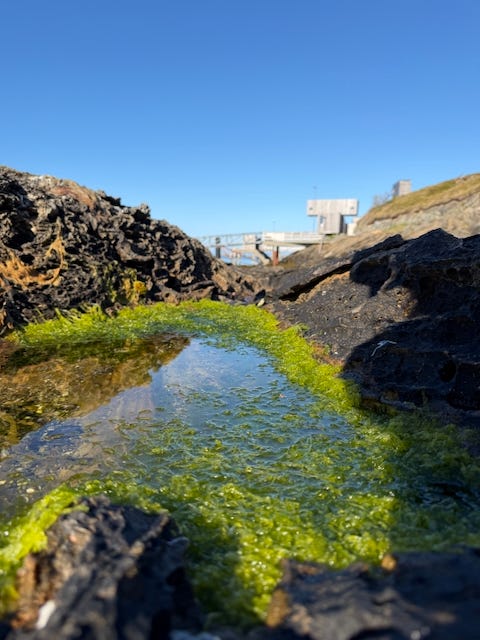
It wasn't the largest or most dramatic rock pool on the island, but it had its own quiet treasures. A delicate comb jelly pulsated like a tiny living prism, while vivid green seaweed glowed beneath the surface. Someone else might have walked straight past it, but I found myself returning again and again.
But something about it kept calling me back.
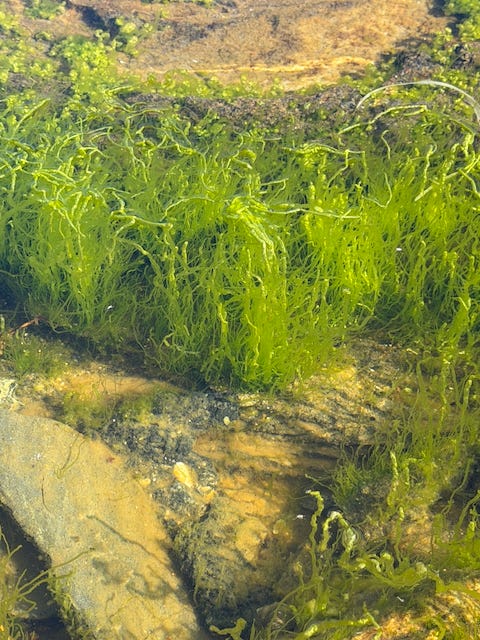
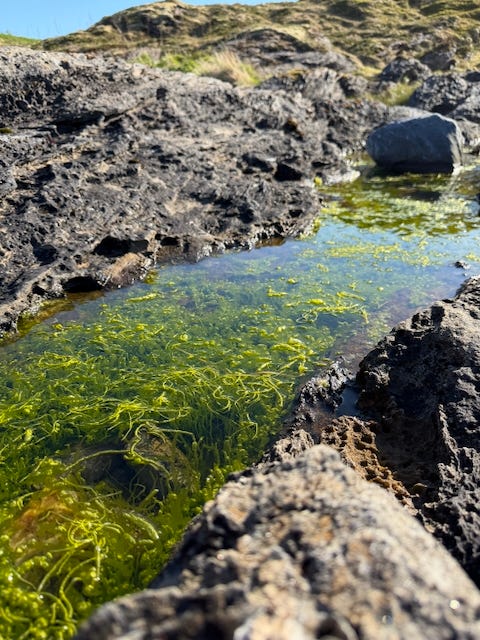
The seaweed was unlike anything I had seen before. A vivid, almost luminescent green that glowed beneath the surface when the sun caught it. Around it, ribbons of brown kelp swayed gently with the movement of the water, turning even the smallest ripple into a slow underwater dance.
The surrounding rocks fascinated me just as much.
Some were striped with layers of sediment, recording stories written over millions of years. Others glittered with tiny crystals of quartz. Every surface seemed to hold another texture, another pattern, another excuse to crouch down for just a few more minutes.
I realised I was beginning every walk in exactly the same way. I’d tell myself I was going exploring. Then somehow I’d end up back at the same little rock pool.
It became my starting point. Sometimes I’d photograph it. Sometimes I’d sketch. Sometimes I’d simply sit beside it and watch the seaweed move beneath the water.
As an artist, it’s easy to feel pressure to constantly seek new inspiration. New places. New compositions. New ideas.
Yet here I was, voluntarily returning to the same few square metres of shoreline over and over again.
It made me wonder whether creativity isn’t always about finding something new.
Perhaps it’s about looking more closely.
There is a tendency, particularly when we travel, to try and see everything. We tick viewpoints off a list, search for the famous photograph, hurry to the next destination before we’ve really absorbed the last one.
The island quietly resisted that way of thinking. There wasn’t an endless itinerary.
There was simply time. Time to notice that the seaweed looked greener beneath an overcast sky than it did in full sunshine.
Time to see how the tide completely transformed the shoreline every few hours.
Time to realise that a rock I had ignored yesterday was covered in sparkling crystals today because the light had changed.
The more I returned, the more I noticed. And perhaps that’s the real gift of slowing down.
By the end of my stay, that little rock pool no longer felt like something I had discovered. It felt familiar. Almost like an old friend.
When I left Sørvær, I took home sketches, photographs and a few pebbles. But I also carried something less tangible.
A reminder that the most interesting places aren’t always the biggest or the most dramatic.
Sometimes they’re small enough to step over. You just have to stop long enough to see them.
No posts
Comments
Nothing yet. Say the first thing.
Sign in to join the conversation.