
As the boat approached Sørvær, I could make out a small gathering of people waiting on the dock.
Some were there to meet us. Others were waiting for returning islanders. In a place where boats are the roads, arrivals and departures matter.
When I stepped off the boat, the welcome was immediate. One of the caretakers appeared beside me almost instantly and relieved me of my largest suitcase before I had a chance to protest. After days of travelling and hauling an unreasonable amount of luggage across airports and ferry terminals, the gesture was deeply appreciated.
We climbed from the dock towards the cabins.
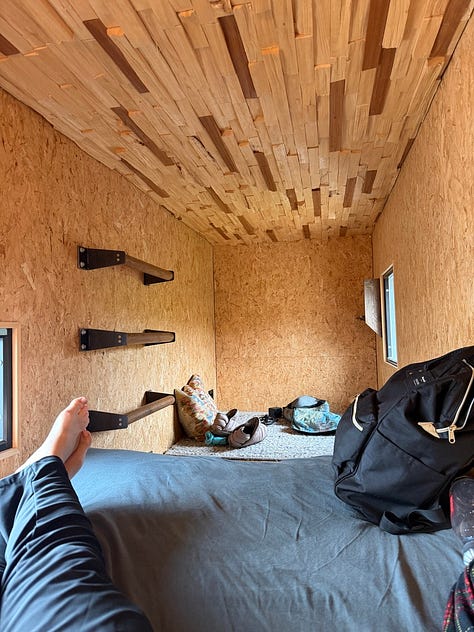
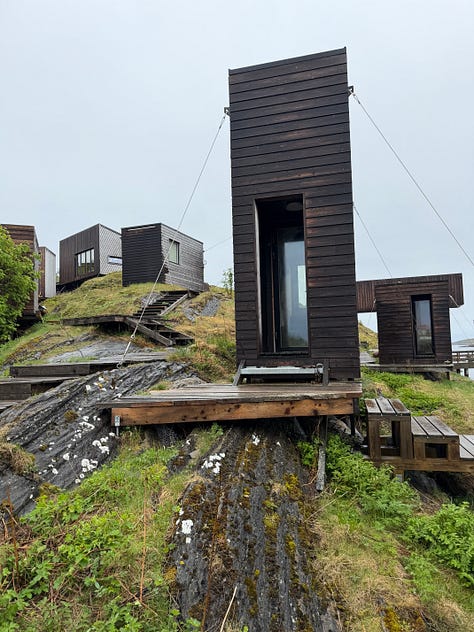
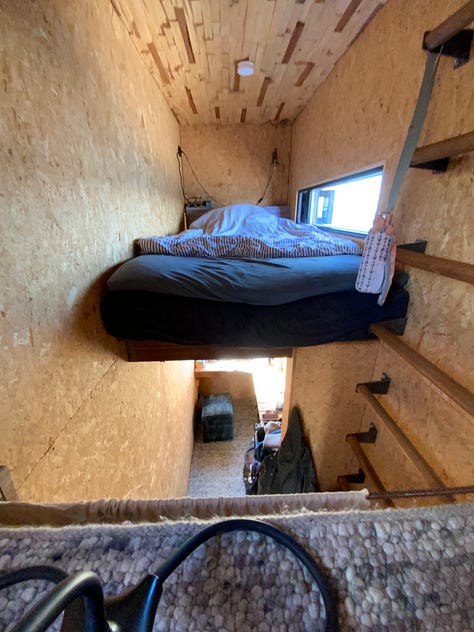
My room was one of the famous skinny cabins that form part of the Arctic Hideaway. Small but beautifully designed, it was simple, comfortable and thoughtfully arranged. Once my belongings were safely stowed away, we gathered in the communal kitchen where coffee, biscuits and introductions awaited.
Around the table, the caretakers explained the rhythms of island life.
Everything that arrives on the island must eventually leave. Waste cannot simply disappear into a collection lorry. Resources are finite. Composting matters. Water matters. Seawater is desalinated and stored in tanks.
It was my first glimpse into a different way of thinking.
Back home, much of our infrastructure is invisible. Water appears when we turn on a tap. Waste vanishes when we flush it away. Here, the connection between actions and consequences felt impossible to ignore.
After coffee, I headed out to explore.
A short walk up the hill overlooking the cabins brought me face to face with the infamous Norwegian wind. It whipped around my face and quickly persuaded my camera-holding fingers into gloves. The views stretched across the islands and out towards the open sea.
Up there, I met a woman staying with her father. Her small dog was enthusiastically yapping around my feet.
“Is he friendly?” I asked.
“Oh no,” she replied without hesitation. “He’s vicious.”
I laughed.
Talking to Norwegians often feels like talking to Brits. The humour is dry, understated and delivered with such a straight face that you almost miss it. Given that I work with Americans, it took me a little off guard.
The afternoon unfolded without any particular plan.
I retreated briefly to my cabin for a cup of tea before wandering back down towards the shoreline. Lunch was a casual help-yourself affair centred around the most incredible homemade bread.
The rest of the day drifted by in photography, beachcombing and slow exploration.
I became fascinated by the luminous green seaweed in the rock pools. Throughout my stay, I found myself returning to it, trying to understand and memorise the colour so I could somehow recreate it in my work. It seemed to glow beneath the water, impossibly vivid against the muted greys and browns of the surrounding rocks.
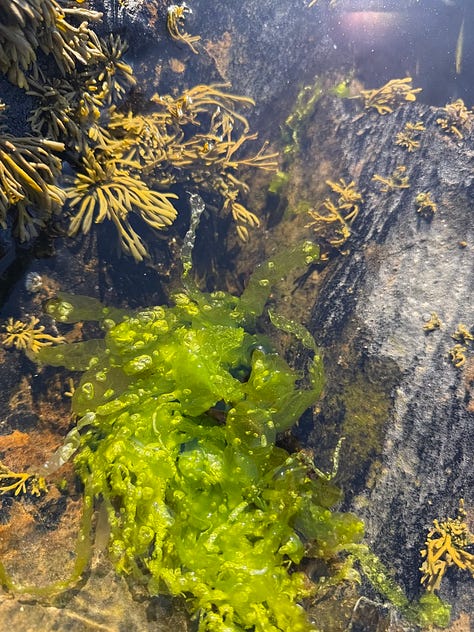
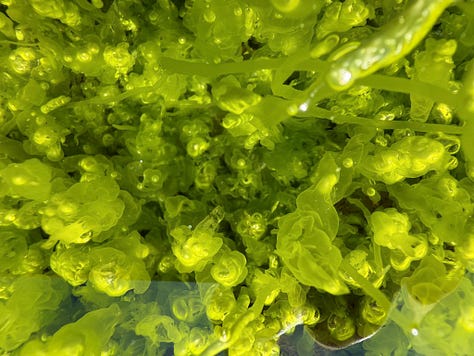
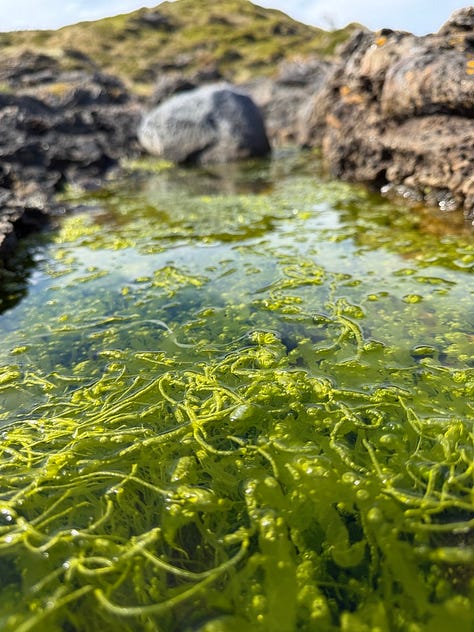
Elsewhere, layers of sediment striped the stone in delicate bands, pebbles glittered with quartz. I found myself bending down repeatedly to pick things up: a smooth stone, an unusual shell fragment, a piece of seaweed with an interesting shape.
There was nothing to achieve.
I wasn’t gathering material for a project or searching for the perfect photograph. I was simply looking.
So much of modern life rewards speed. We skim rather than read. We photograph experiences before we’ve fully had them. We move constantly to the next thing, convinced that productivity and worth are somehow connected.
On the island, there was nowhere else to be.
Later, I sat with my sketchbook and tried to draw what I’d seen: the curves of seaweed, the contours of stones, the textures that photographs often flatten and simplify.
The drawings themselves weren’t remarkable. No masterpieces emerged from those pages. But drawing demanded a different kind of attention.
You cannot draw something properly without really seeing it.
One of the things I came to appreciate most about the Arctic Hideaway was the balance between community and solitude. People spent their days however they wished. A sculptor hammered away at metalwork. Others worked quietly online, drew, wrote or wandered the islands. There was always space to focus and always somewhere to retreat.
That evening, we gathered for our first communal meal.
Shared meals are central to life at the Arctic Hideaway. Residents take turns cooking dinner, with volunteers inevitably appearing as vegetables are chopped and pans begin to simmer. On this first evening, the caretakers led the effort with help from a couple of guests, producing a meal that far exceeded anything I expected.
As we sat around the long table, passing dishes between us, I began to understand why so many people speak fondly of their time here.
Everyone spent the day differently, yet morning and evening drew us back together around the table.
Conversation unfolded slowly. Nobody seemed in a hurry to be elsewhere. Phones stayed largely forgotten, apart from the occasional scramble to photograph an extraordinary sunset, or indeed anything that happened on the water.
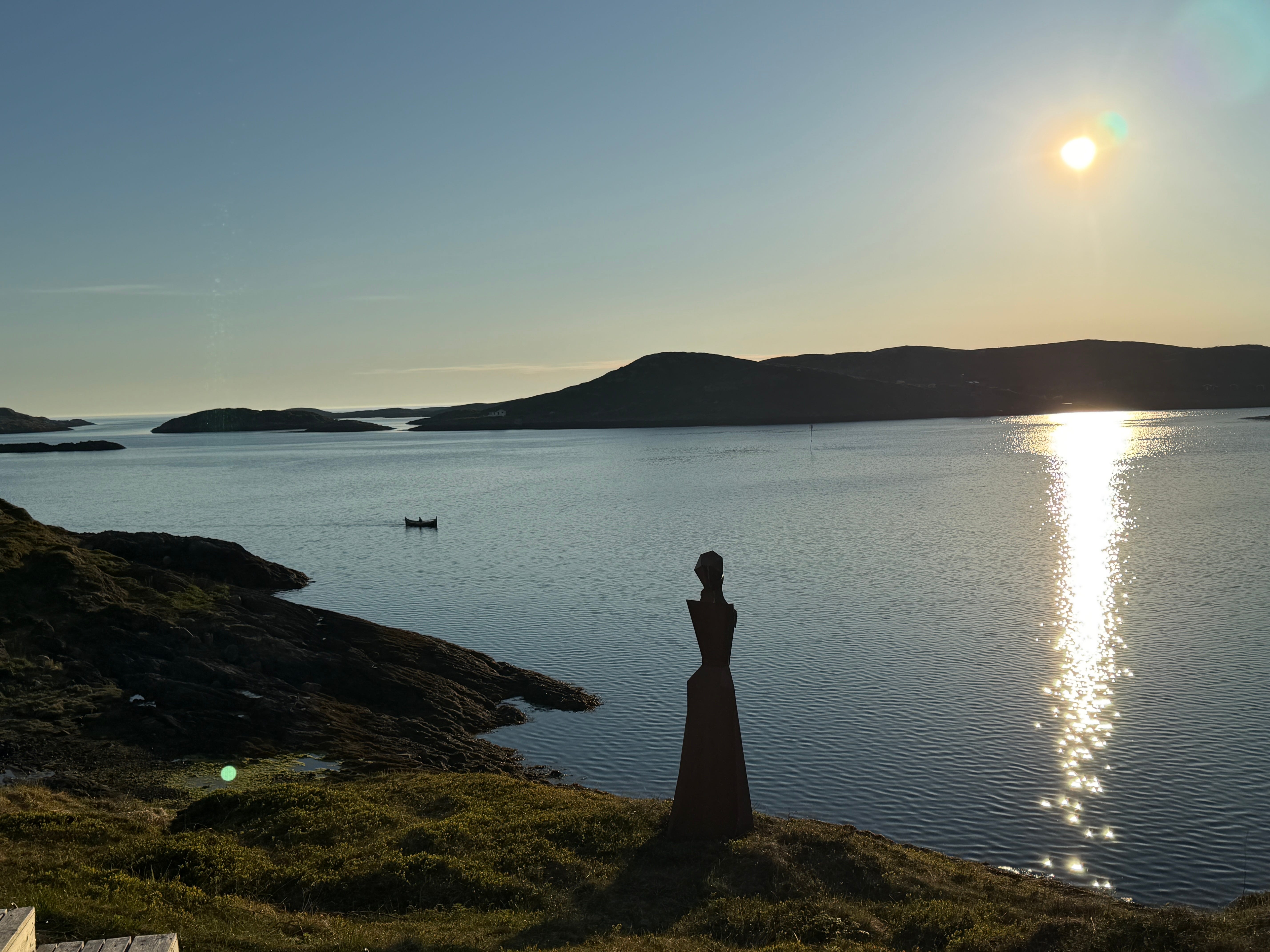
The discussions wandered from art and travel to philosophy and everyday life. Around the table were visual artists, musicians, performers and people who would never call themselves artists at all. Each brought their own experiences and perspectives.
I found myself listening as much as talking.
Something was comforting about the rhythm of it all: breakfast together each morning, dinner together each evening, and long conversations in between. It reminded me why stepping outside your comfort zone is often where the most meaningful experiences begin.
Perhaps it was the creative company. Perhaps it was the openness of the people I met. Whatever the reason, there was an immediate sense of belonging.
The island was remote, windswept and unfamiliar. Yet somehow, by the end of that first day, it already felt a little like home.
No posts
Comments
Nothing yet. Say the first thing.
Sign in to join the conversation.