
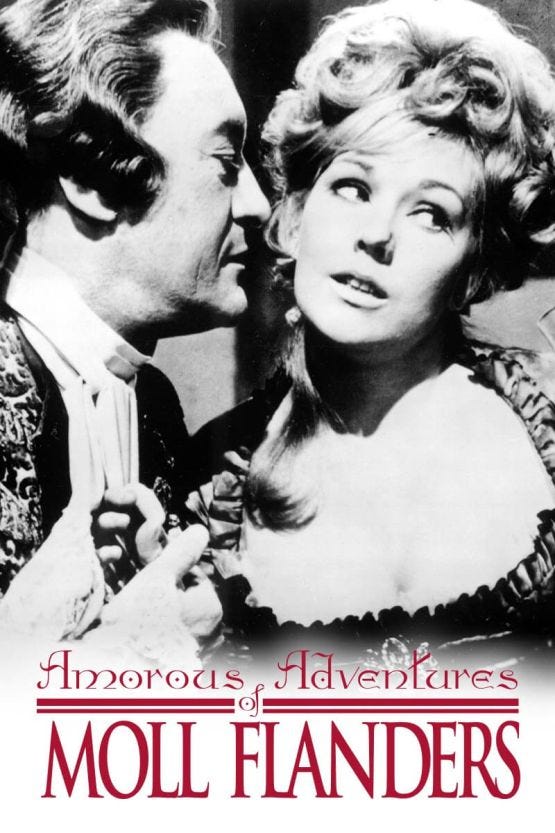
Moll’s character grows increasingly complex in this week’s reading.
As we encounter events in the story that may stretch credulity, it’s helpful to keep a few things in mind.
There are some cultural differences between today and 1722 that we need to consider.
For example, Moll’s affair with the Gentleman at Bath includes some details that historical context helps to make more sense of. It seems weird that he would promise Moll that they could sleep in the same bed and he would not try to carry it further. This is odd for a couple of reasons, but I’m talking here about the actual sleeping.
One point of history is that bedsharing—with strangers in taverns, with family members and friends at home—was very common, given the limited accommodations and furnishings to be had for most people. It was not unusual for strangers to share a room or even the same bed while staying at an inn. This doesn’t mean the situation of Moll and the gentleman was common (indeed, the owner of an inn where they stay draws a curtain between the two beds they share in one room while mentioning he doesn’t need to know their relationship, so we know their usual arrangement was frowned upon. Still, the fact that many people shared a bed in various circumstances sheds some light on why this whole situation would come up to begin with—although obviously, there are other reasons!
When reading works from so long ago, we encounter lots of things that are assumed to be normal and common in that time that aren’t in ours. Thus, it’s helpful to read with an eye for unexamined assumptions—those of the earlier times and those of our own—and see where those assumptions have changed. When something that seems strange to us isn’t explained in a historical text, we can usually surmise that something was different enough then that no explanation was needed.
The more important thing to keep in mind, however, is that Defoe, as stated in the preface, is writing a moral tale more than a realistic one. The realism comes as a bonus, or perhaps more as a lure to draw readers sideways into the moral lesson.1
Thus, the lesson Moll draws from this bed-sharing practice and how it turned out is something she reflects on a couple of times. For example, after they cross the line, she admits, there is no going back:
In the morning we were both at our penitentials; I cried very heartily, he expressed himself very sorry; but that was all either of us could do at that time, and the way being thus cleared, and the bars of virtue and conscience thus removed, we had the less difficult afterwards to struggle with.
This is a moral truth about all kinds of transgressions: once done, it is easier to do again.
Recall, too, that in the preface, Defoe (or rather the alleged “editor” of these memoranda) also comments on this incident:
The repentance of her lover at the Bath, and how brought by the just alarm of his fit of sickness to abandon her; the just caution given there against even the lawful intimacies of the dearest friends, and how unable they are to preserve the most solemn resolutions of virtue without divine assistance; these are parts which, to a just discernment, will appear to have more real beauty in them, than all the amorous chain of story which introduces it.
But at this point, Moll is no longer merely an innocent victim. She is shrewd and calculating. She knows her part and she is playing it to the hilt. She confesses that she lacked the scruples her gentleman showed: “I own I was much wickeder than he,” she says, admitting that she is the one who released him from his vow of chastity.
Yet, Moll does take her cues from those of her acquaintance who are more experienced in these ways of the world. She understands in looking back that upon arriving in Bath, she surrounded herself with “some unhappy acquaintance” who encouraged her “follies.” In the situation with the Gentleman at Bath, her landlady takes the lead in setting Moll up to be his mistress by dropping hints about Moll’s financial needs, hints Moll then pretends to be reluctant to expand on. When the Gentleman at Bath insists on buying Moll fine clothes, she pretends not to be concerned about such but tells us she “loved nothing in the world better than fine clothes.”
Of course, the gentleman is no saint—he is married but says his wife is “distempered in her head.” (Remind you of a certain Mr. Rochester from Jane Eyre, anyone?)
Moll is more than content to be a well-kept mistress for six years, giving birth to three children by this man, only one of which survives. Again, this is a part of the narrative that many readers struggle with in terms of how detached Moll seems from her children and how realistic (or unrealistic) that is. (I’m curious, readers, what you think of the gentleman’s repentance, as well as the restitution he attempts to make to Moll and their son. Thoughts?)
Yet, Moll struggles with her conscience the whole time. She is in a push-and-pull between her moral conviction and her material (and emotional) needs:
On the other hand, though I was not without secret reproaches of my own conscience for the life I led, and that even in the greatest height of the satisfaction I ever took, yet I had the terrible prospect of poverty and starving, which lay on me as a frightful spectre, so that there was no looking behind me. But as poverty brought me into it, so fear of poverty kept me in it, and I frequently resolved to leave it quite off, if I could but come to lay up money enough to maintain me. But these were thoughts of no weight, and whenever he came to me they vanished; for his company was so delightful, that there was no being melancholy when he was there; the reflections were all the subject of those hours when I was alone.
I think this is the element of realism Defoe gets most right, the psychological/spiritual one: sin, sin nature, the workings of the conscience, and the real human needs that need to be fulfilled. In fact, this is among Defoe’s greatest contributions to the novel, something George Starr argues in his classic text, Daniel Defoe and Spiritual Autobiography.
Defoe (a Presbyterian Dissenter) came from a Puritan family background, and Puritans emphasized the discipline of keeping a spiritual inventory through journals in order to measure growth and stem temptation and sin. Moll Flanders is, in many ways, a fictional spiritual autobiography.
And it’s a rousing tale of adventure.
While the Gentleman at Bath experiences a sickbed repentance, Moll is not quite there yet.
As this chapter of her life ends, she takes stock of everything she has (in a literal way—she counts her money and her goods, a practice she will engage in over and over) and sets out at age 42 for her next adventure.
She admits her experiences have not made her look better for her age. She sets herself to advantage in terms of appearance but, pridefully, resists “painting” (make-up), thinking she need not resort to that.
She is still playing the game—the game of gaining a reputation for wealth that will attract better suitors—but she does so because she—like all such women—is extremely vulnerable. One of the most moving lines in this part is when Moll makes this observation:
… when a woman is thus left desolate and void of counsel, she is just like a bag of money or a jewel dropped on the highway, which is a prey to the next comer; if a man of virtue and upright principles happens to find it, he will have it cried, and the owner may come to hear of it again; but how many times shall such a thing fall into hands that will make no scruple of seizing it for their own, to once that it shall come into good hands?
A woman so vulnerable as Moll is simply prey for the predators. Some things don’t change.
She refuses to be foolish enough to marry a married banker. (Again, Jane Eyre comes to mind. Bigamy was very easy to accomplish in a world that lacked the sort of connections and communications we are accustomed to.) It’s not Moll’s moral scruples that stand in the way here—it’s her shrewdness:
I played with this lover as an angler does with a trout. I found I had him fast on the hook, so I jested with his new proposal, and put him off. I told him he knew little of me, and bade him inquire about me; I let him also go home with me to my lodging, though I would not ask him to go in, for I told him it was not decent.
In short, I ventured to avoid signing a contract of marriage, and the reason why I did it was because the lady that had invited me so earnestly to go with her into Lancashire insisted so positively upon it, and promised me such great fortunes, and such fine things there, that I was tempted to go and try. “Perhaps,” said I, “I may mend myself very much”; and then I made no scruple in my thoughts of quitting my honest citizen, whom I was not so much in love with as not to leave him for a richer.
Next, we shall discover what adventures Moll finds in Lancashire.
Reading schedule for what’s ahead: Note that there are no chapter or other breaks in the text, so I’m giving the page numbers in the Dover edition along with the last sentence or phrase in each reading:
July 21: pp. 100-136, through the line, “… grew poor apace.”
July 28: pp. 136-189, through the line, “…contrived to appear in new shapes every time I went abroad.”
Aug. 4: pp. 189-end
BOOK GIVEAWAY
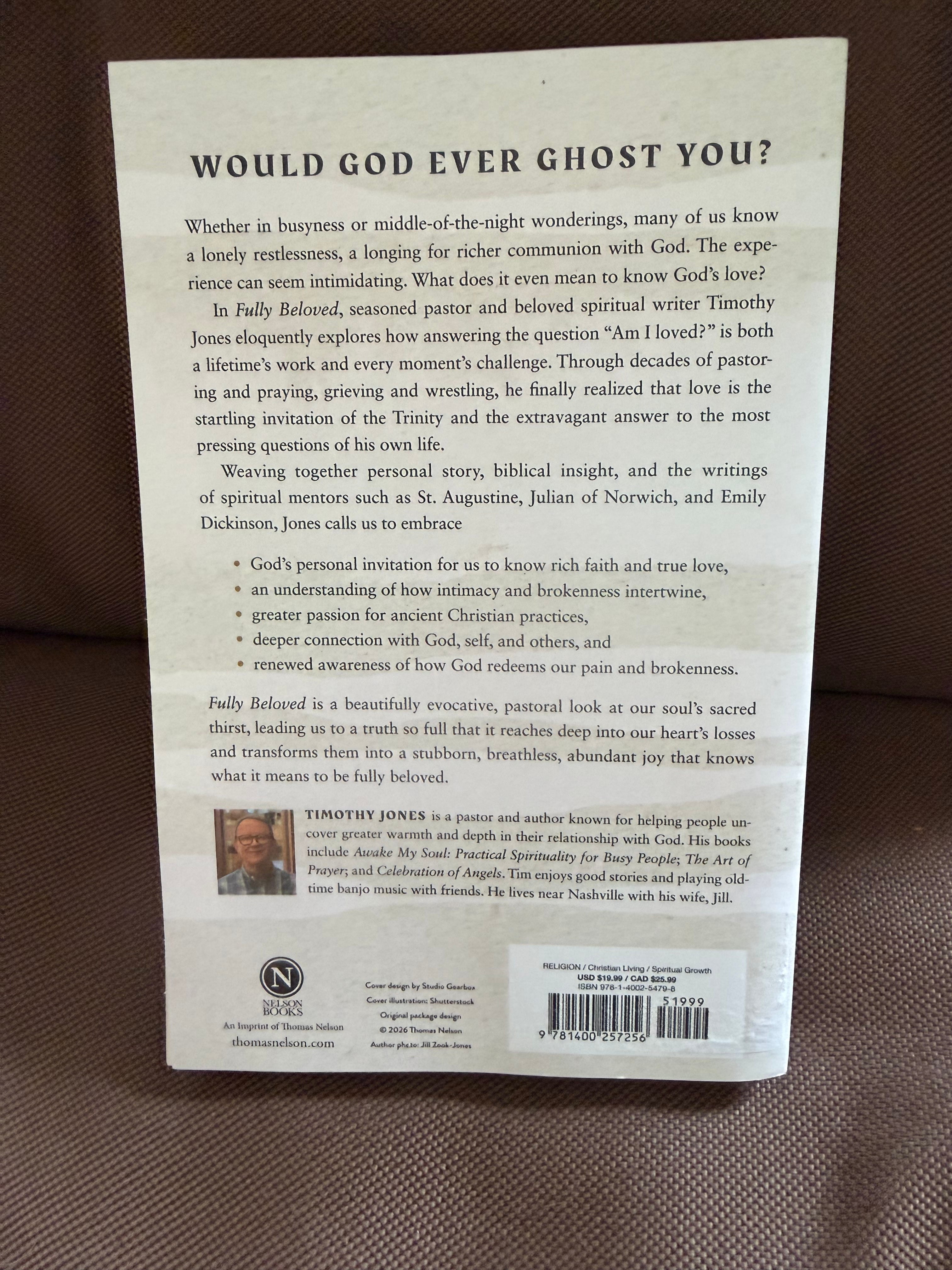
This week’s book giveaway to a paid subscriber is Fully Beloved: Meeting God in Our Heartaches and Our Hopes by Timothy Jones. Jones’ writing is beautiful, personal, and inviting.

[Note: As an Amazon Affiliate, I may receive a small commission for qualifying purchases made through links here.]
THIS WEEK’S PODCAST:
I’m back with the Two Cities Podcast crew to talk about all things calling—and You Have a Calling! Listen here.
“Absolutely unmixed attention is prayer.” – Simone Weil2
When I was in Junior High, or thereabouts, a rock group came to play during the school day at my public school. The lead singer was kind of a Peter Frampton knock-off, and we loved them. At the end of the school performance, they invited us to a full evening concert at another venue. My friends and I went, and that is where the group offered the big reveal that they were Christians and they were there to evangelize in addition to perform. We were tricked! Kind of like what Defoe is doing—except he says up front what his purpose is.
Simone Weil, Gravity and Grace, trans. By Emma Crawford and Mario von der Ruhr (London: Routledge, 2002), 117.
Comments
Nothing yet. Say the first thing.
Sign in to join the conversation.