
One of the things we’ve been discussing a great deal during our reading of Moll Flanders is her characterization, particularly the believability of her character as the story develops it.
I’ve pointed out that the roughness of her character (including where Moll is either not believable and/or not consistent) reflects where this work sits in the development of the novel as a literary form. The novel as we know it hadn’t proclaimed itself yet, and Moll Flanders is a pre-novel, a work building toward what we now call the novel.
Because of our discussions thus far, it occurs to me that another important aspect of both the novel as a genre and the modern age in which it appeared, an aspect I haven’t brought into the discussion yet, is the phenomenon of “inwardness” or the character of the inner life, that is particularly Western and particularly modern.
Moll seems “strange” to us in many ways. (Her lack of expression of affection for her children is one example that keeps coming up.) The way she tells her story—both in terms of the outward events and people as well as her inward experience of these—does not always accord with the way we would understand the connection between what happens to us externally and how we process it internally.
This is because the time in which this work was written was undergoing a dramatic shift in the way in which one narrated one’s own story.
Moll Flanders was written in the very years in which the notion of identity and the idea of the “self” were beginning to become modern. And that is, not coincidentally, also the moment when this transition was about to be expressed literarily within the novel, an expression that would take another century to find its fullness. I’ve written previously that I think that expression finds its footing most notably in Jane Eyre: here in The Atlantic and at The Gospel Coalition.
Moll’s character is one who is living and writing just as these specifically modern ways of forging self-identity and the sense of self were emerging—this is more than a century before Jane Eyre. Certainly, Moll demonstrates deep reflectiveness—at times—especially writing as her older self who is looking back on her younger self. Other times, she is oddly detached (especially regarding her children). She seems more interested in simply narrating the facts of her life without much introspection at these times. This mixture reflects powerfully the transition taking place during this age between a sense of self based on one’s social station and place in a family or other communities and a more recent sense of self based more on one’s inner life, something philosophers refer to as the modern turn to the subject.
To explain further what I mean, I’m going to draw on philosopher Charles Taylor’s Sources of the Self: The Making of the Modern Identity. Taylor cites the eighteenth-century English novel (and Defoe specifically) as contributing to the modern development of the quality that he calls “inwardness” or the interior life. Of course, all human beings in all ages have had an inner life and a sense of self, but modernity has altered that sense in profound ways that are hard to see when we are ourselves immersed in these ways and know nothing different.
Here’s a good and concise summary of Sources of the Self from Prof. Lincoln Mullen that I will quote before explaining how it helps us better understand Moll Flanders:
The bulk of the book is spent on a sweeping exposition of the changes in the self, running from Plato to Augustine to Descartes to Locke to Montaigne to Protestant Christianity to the Victorians to the present. In brief, the transition [that] Taylor describes is from an external sense of the self to an interior sense of the self. It is also a transition from finding meaning in extraordinary deeds to one that finds meaning in everyday actions.
Among the insights Taylor makes that we can see embodied in the text of Moll Flanders are those when, as he says, he looks “outside philosophy to certain broad movements of the culture of the seventeenth and eighteenth centuries: to the new valuation of commerce, to the rise of the novel, to the changing understanding of marriage and the family, and to the new importance of sentiment.”1
As we read Moll’s account, we can see the absence, presence, and in-betweenness of all these phenomena that were developing during this period. We see the emphasis on commerce (with Moll’s relationships with tradesmen and with her own treatment of marriage as a kind of commercial bargain). We see along with the treatment of marriage as a business transaction, Moll’s delight in marriage as companionship (another development Taylor attributes specifically to the Protestant Reformers’ understanding of marriage). We see not much, if any, emphasis on sentiment—that was to come a little later in the century and to be emphasized much more in the Romantic period. Moll’s love for Jemy, and his love for her in return, is remarkable for combining so many features of this very transitional time. Another connection to Jane Eyre is that mysterious calling that takes place in both stories: here when Moll calls Jemy back and he hears her from miles away; in Jane Eyre, when Jane hears Rochester calling out for her from even farther away. And, of course, we see the early seeds of the novel, as we’ve already discussed.
Taylor links “the rise of the modern novel” with the manifestation of a “new consciousness,” one we see in Moll, to be sure, but one that will become a central feature of novels of the later eighteenth century and beyond. In fact, a central point of Taylor’s book is the way in which “life has to be lived as a story.”2 The change that occurs in modernity, Taylor shows, is that the nature of that story shifts from “ready-made … canonical models and archetypes” to stories “drawn from the particular events and circumstances of this life.” Voilà! Moll Flanders.
It is right at this time that, as Taylor argues, a sense of self developed from turning inward rather than being based as it had always been more on one’s place within society and within political and social structures.
What we get in Moll Flanders is an odd mixture of these two ways of being. Moll emphasizes her own and others’ roles and positions in society and identifies them and herself accordingly. At the same time, she is listening to her conscience, expressing her feelings and convictions, and desiring to live according to them.
Sources of the Self explains exactly why Moll both exhibits and lacks the depth of an interior life we take for granted today in both literature and life. But I also realize that this is an understanding that can be developed simply by reading these works of fiction chronologically as the novel form develops. To do so is to see not only history and culture change, but also to see the sense of self evolve into a modern self-consciousness.
Having spent most of this week’s installment on this philosophical and phenomenological background, there is one other point from this week’s reading I want to remark on.
When Moll finds herself in the difficult circumstances of being pregnant and not with her husband, she is treated like an unmarried woman. She is presented in not-so-subtle ways with the opportunity to induce a miscarriage—in other words, to procure an abortion. And while she admits she would have been happy to have a miscarriage due to the course of nature, this is something she won’t do herself.
I think this is one of the most interesting and complicated parts of the work, revealing Moll’s character, the difficulty of her social and economic circumstances, and, once again, her formation by the dictates of natural law (reflecting Defoe’s own religious and ethical system): natural law permits for a natural miscarriage, but not for willful taking of innocent life. At the same time, all of the complexities Moll faces in a period of time three hundred years ago illustrate how few of such complexities have changed, don’t they?
A related point of natural law is Moll’s abhorrence at self-murder or suicide. This is the fate of the banker’s wife. (There is some very hard reading in this story, isn’t there?) At various other times (for example, back in Virginia, in regards to her brother-husband), Moll addresses the temptation to “sink under the weight” of whatever difficult circumstances one finds oneself in. This is something presented as both understandable but also something to be resisted.
As dark and full of vice as this book is, I think we can already see that it is, in many ways, life-affirming.
***
Reading schedule for what’s ahead: Note that there are no chapter or other breaks in the text, so I’m giving the page numbers in the Dover edition along with the last sentence or phrase in each reading:
July 28: pp. 136-189, through the line, “…contrived to appear in new shapes every time I went abroad.”
Aug. 4: pp. 189-end
BOOK GIVEAWAY
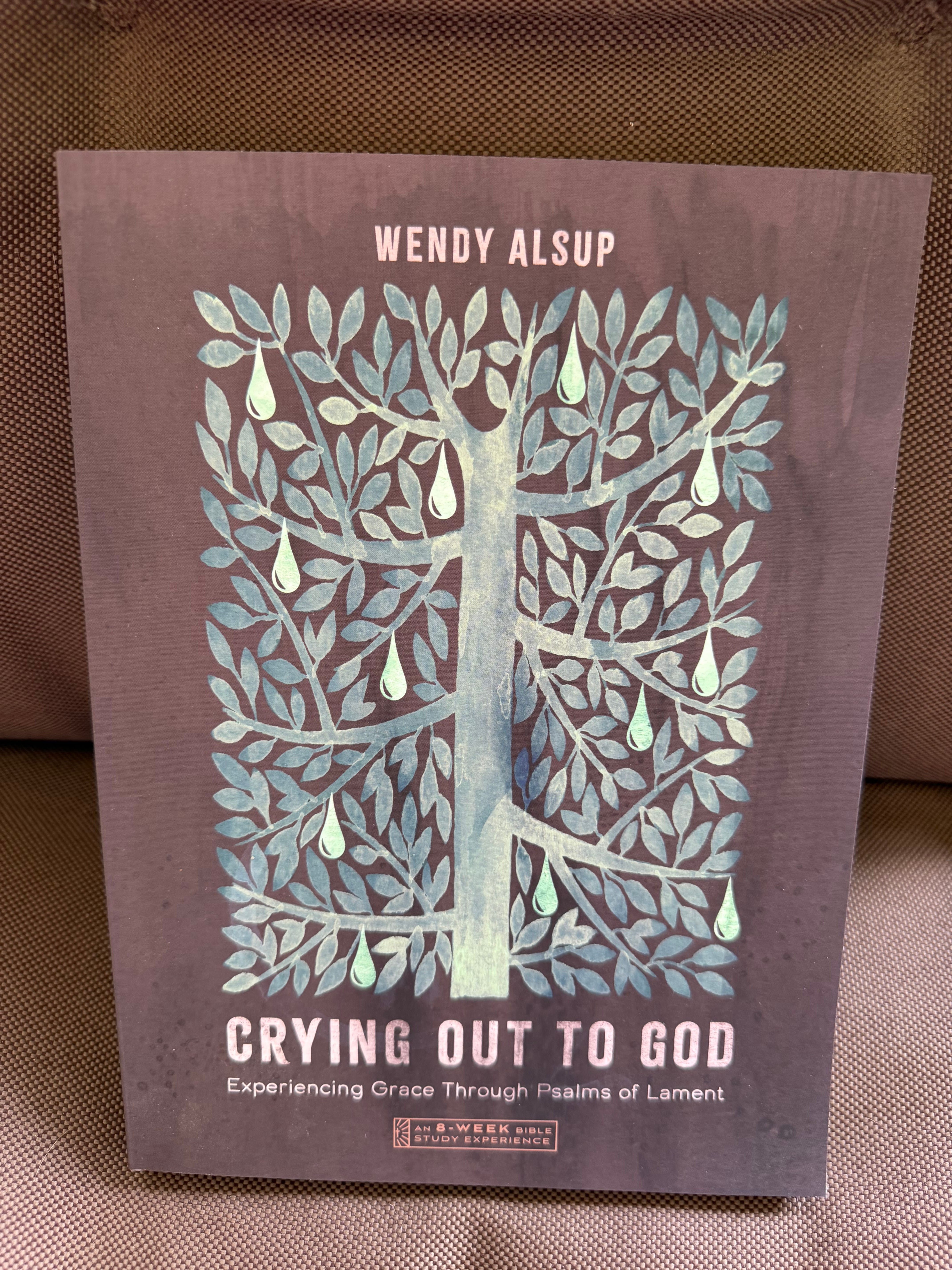
I’m giving away the latest work by my dear friend Wendy Alsup to one paid subscriber. This is an 8-week Bible study, Crying Out to God: Experiencing God through Psalms of Lament. Comment CRYING OUT and I will pick one winner at week’s end.
“Absolutely unmixed attention is prayer.” – Simone Weil3
[Note: As an Amazon Affiliate, I may receive a small commission for qualifying purchases made through links here.]
Charles Taylor, Sources of the Self: The Making of the Modern Identity. (Harvard University Press, 1989), 285.
Simone Weil, Gravity and Grace, trans. By Emma Crawford and Mario von der Ruhr (London: Routledge, 2002), 117.
Comments
Nothing yet. Say the first thing.
Sign in to join the conversation.