
TL;DR: The workplace keeps you second-guessing yourself—your competence, your judgment, your worth. Your work bestie keeps it real. Research shows having a best friend at work makes you 43% more likely to receive recognition and 37% more likely to feel encouraged. But only 17% of workers have one. Here’s why that friendship matters more than you think.
Hello there 👋
I’ve never been without a work bestie—honestly, I kind of think the purpose of a job is to provide access to a new work bestie. My work besties have changed from job to job, of course. I’ve held onto some after moving on, but not all. Sometimes a work bestie relationship gets forged in the smallest, most ridiculous moment.
Once, I had a boss proclaim that Rhode Island had the best Italian food in the US. I happened to meet the eye of someone else in that meeting. Afterwards, we laughed about Rhode Island’s Italian food for literally the next four years. It wasn’t even funny. And yet...
Here’s the thing about making friends as an adult: it’s wildly hard. We don’t have the built-in social structures we had in college or our twenties. But work? Work immediately gives us something in common—shared frustrations, inside jokes, the same absurd meeting we just survived. Now that I work remotely, my work bestie is all Slack and WhatsApp and side-texting. We chat about our workouts, our messy kitchens, our whiny kids, our late hours, the book we’re reading, the Netflix show we’re watching, what we’re cooking.
Here’s why it matters: There are always those painful moments at work—the screwups, the poor reviews, the sexist comment, the feeling of being overlooked. Without the work bestie, we’d believe it was just all us. Our work besties help us see the bigger picture, release the stress, and laugh at the dumb stuff. Side-texting our way through the chaos? That’s how adult friendships happen now.
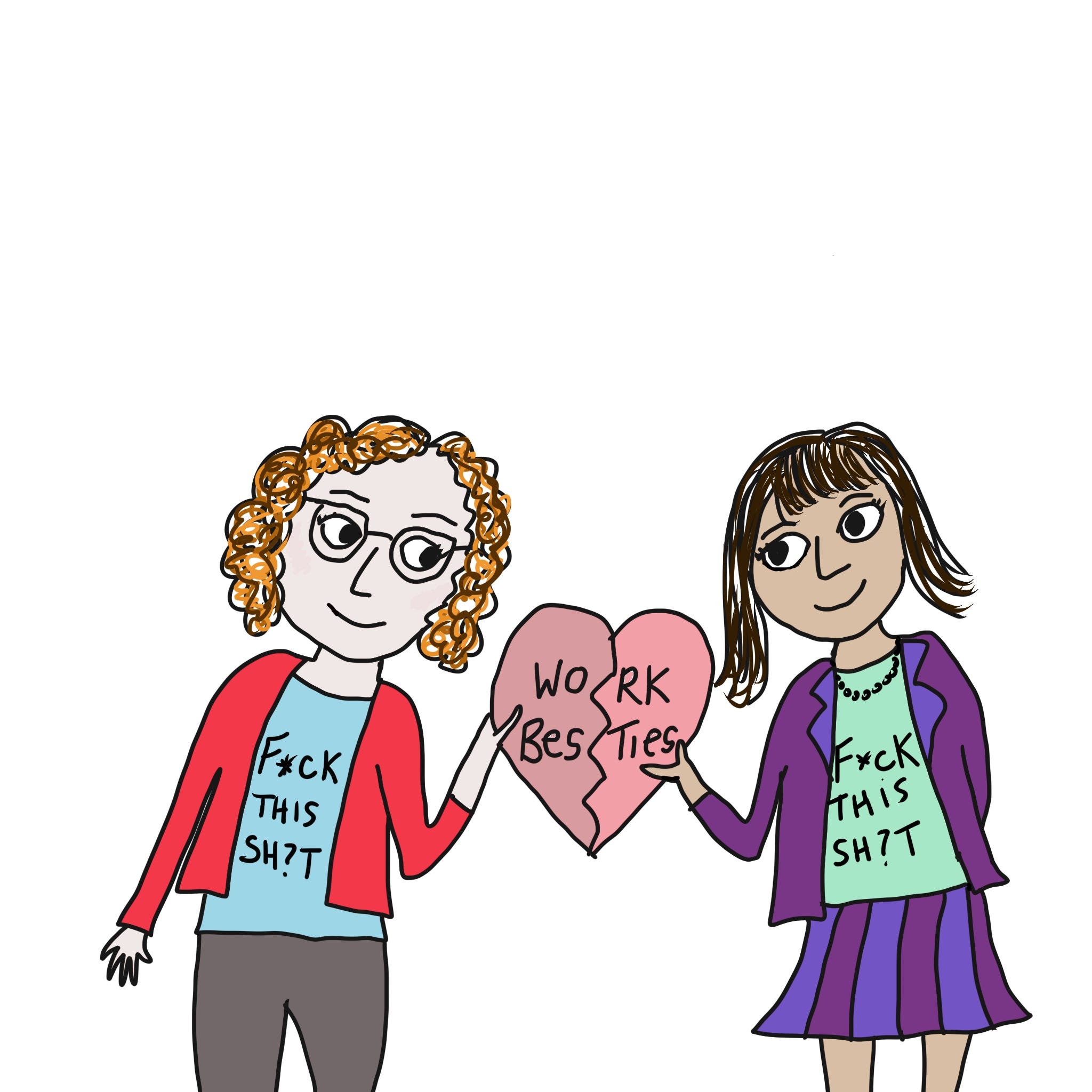
Here’s what happens when you don’t have someone in your corner at work: you absorb every setback as personal failure. You internalize every microaggression. You believe the narrative that maybe you’re not quite good enough, not quite strategic enough, not quite leadership material.
The workplace is designed to make women doubt themselves. Your judgment gets questioned in your area of expertise. You get interrupted more than your male colleagues. Your contributions get attributed to someone else. And when you’re navigating this alone, it’s incredibly easy to think it’s just you.
Research from the American Enterprise Institute found that only 17% of workers have a best friend at work. That means 83% of people are going through their workdays without someone who truly has their back (😱). And for women specifically, this isolation compounds the existing challenges we face. When you’re the only woman in leadership meetings or one of few women in your department, not having an ally means you’re constantly questioning whether what you’re experiencing is real or if you’re being “too sensitive.”
Your work bestie does something the system never will: confirms your reality. She witnessed that meeting where your idea was ignored until a man repeated it. She saw your boss take credit for your project. She knows the double standard isn’t in your head.
The standard career advice completely misses the point about workplace friendships:
“Keep it professional.” This approach treats work relationships as transactional networking opportunities rather than genuine human connections. You’re told to be strategic about who you connect with, to always be “on,” to maintain appropriate boundaries. The result? You spend 40+ hours a week with people you never really know, managing your image instead of building actual support systems. As one blogger noted, we’ve been conditioned to believe we must be stoic to be professional. That vulnerability at work is weakness.
“Focus on your work, not socializing.” This advice ignores how workplace friendships actually function. The assumption is that chatting with coworkers is a distraction from productivity when research shows the opposite. Studies indicate having a best friend at work increases productivity and reduces sick days. But the “head down, work hard” mentality means you end up isolated, stressed, and more likely to burn out.
“Build your network strategically.” Career coaches love to talk about networking, but they’re usually talking about LinkedIn connections and coffee meetings with senior leaders. They’re not talking about the person you text when you’re about to lose it in a meeting or who confirms that yes, that comment was wildly inappropriate. Strategic networking doesn’t give you someone to laugh with about Rhode Island’s Italian food for four years. It doesn’t give you the person who knows when you’re about to cry and suggests a walk.
The fundamental problem with all this advice? It positions workplace friendship as either unprofessional or purely instrumental. It completely misses that women need workplace allies not just to advance our careers, but to survive them intact. When you’re navigating bias, microaggressions, and constant competence questioning without a witness, you start believing the gaslighting.
Here’s what actually works: intentionally cultivating one genuine workplace friendship and recognize it as career infrastructure, not social indulgence.
A Gallup poll found that employees with a best friend at work were 43% more likely to receive praise for their work, 37% more likely to report encouragement, and 27% more likely to feel their work is important. College-educated women are particularly good at building these connections and it’s paying off in ways traditional networking never could.
All this to say, your work bestie isn’t a nice-to-have. She’s your reality check, your pattern spotter, your burnout prevention plan.
Here’s how to approach this differently:
Instead of: Keeping all work relationships surface-level to “stay professional”
Try: “I need one person here I can be real with. That’s not unprofessional. It’s essential.”
Instead of: Waiting for friendship to happen organically
Try: Making small moments of connection intentional. Share something personal. Follow up on that comment about their weekend. Make eye contact when someone says something absurd in a meeting. These micro-moments build trust.
Instead of: Thinking you don’t have time for workplace friendships
Try: “The 10 minutes I spend venting with her saves me 3 hours of ruminating alone.” In other words, the minutes that workplace friendships take away from doing your actual work is what’s making your job emotionally sustainable.
Instead of: Only connecting with people who can “help your career”
Try: Connecting with someone who sees what you see. The person who notices the same patterns, who gets why that comment was problematic, who understands the specific challenges you’re navigating. That shared reality is worth more than any networking contact.
The mindset shift required: Stop viewing workplace friendship as frivolous and start seeing it as survival strategy. In a system designed to isolate and undermine you, having one person who confirms your reality is about preserving your sanity.
Identify one potential work bestie and make one genuine connection this week.
Think about who at work seems to “get it”—who shares knowing looks in meetings, who’s navigating similar challenges, who you’d actually want to talk to. Then do one of these:
Send a message referencing something that happened: “That meeting was something, huh?”
Invite them for a quick walk or coffee
Share something real (not just work-related) in your next conversation
The metric: Did you have one conversation this week where you dropped the professional facade, even briefly?
Only 17% of workers have a best friend at work—but those who do are 43% more likely to receive recognition
Women excel at workplace friendships—and it’s making them better at their jobs, not worse
Your work bestie confirms your reality when the system is designed to make you doubt yourself
With you all the way,
- Kara
P.S. Next week: The guilt spiral that keeps women stuck. Spoiler: the system wants you feeling guilty 🤦♀️
Comments
Nothing yet. Say the first thing.
Sign in to join the conversation.